


From free markets to closed networks: with the entry of global central banks, can the stablecoin cake be preserved?
Author: Thejaswini M A
Compiled by Chopper, Foresight News
Original title: When the world's top eight central banks enter the market, do they have to share the stablecoin cake?
Thousands of years ago, Agorá in ancient Greece was a public market square in Athens. Anyone could attend, trade freely, had no entry threshold, and was not bound by geographical jurisdiction. “No permission required” is the original meaning of this term.
The Bank for International Settlements (BIS) named the project Agorá, which is intriguing. However, the actual design of the Agorá project, led by BIS and launched by 7 central banks and more than 40 private institutions, is the exact opposite of the meaning of “free market.”
In this system, funds are marked with the country they belong to before they are transferred; smart contracts automatically complete anti-money laundering screening and sanctions list checks at the token level; central banks completely control their own reserves, and cross-border capital flows must go through a compliance check layer embedded in the token.
Simply put, it's a programmable fiat currency system that requires approval before everything is approved.
The seven major central banks participating in the Agorá project are the Federal Reserve of New York, the Bank of England, the Bank of Japan, the Bank of Korea, the Bank of Mexico, the Bank of Switzerland, and the Bank of France representing the Eurozone; the Bank of Canada was added to the list four days ago. Financial giants such as J.P. Morgan Chase, HSBC, Deutsche Bank, UBS, Mastercard, Visa, and the Global Banking Financial Telecommunication Association (SWIFT) participated in research and development with more than 40 institutions.
One project brought together such huge institutional strength, so I decided to thoroughly dismantle this system.
The project structure uses a two-tier separation design: one layer is fully controlled by central banks and is responsible for the underlying base currency reserves; the other layer is operated by commercial banks to handle the daily transactions of end users. Tokenized commercial bank deposits are uniformly collected on a shared platform, and multiple private institutions collaborate to handle multi-currency clearing; while central bank reserves are stored independently in the country's exclusive ledgers, the sovereignty is always firmly held in the hands of each sovereign central bank.
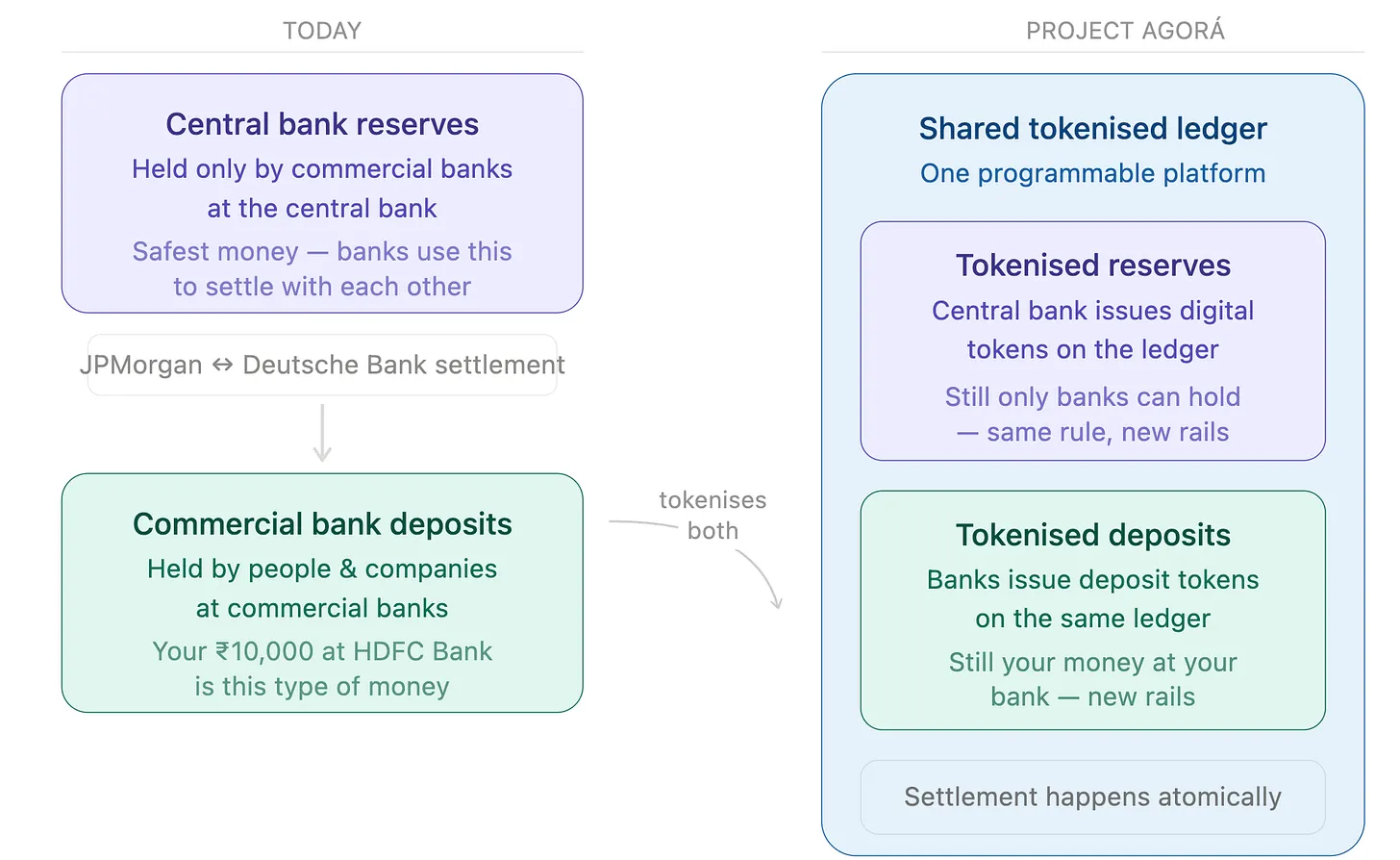
BIS is trying to establish a closed-loop payment system controlled by the country by integrating commercial bank accounts and anchoring each country's sovereign reserves. The agency is speeding up the implementation of the compliance framework, with the intention of completing the layout just before decentralized stablecoins such as Tether completely split global commerce and traditional banking systems.
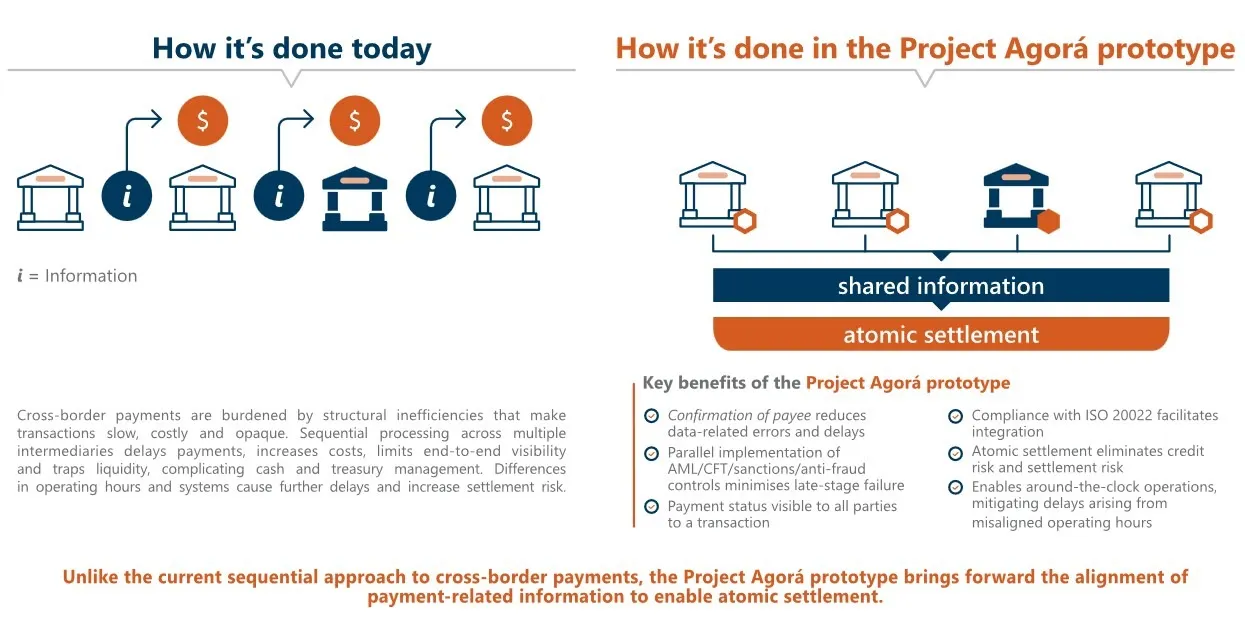
Currently, cross-border payments are like a relay race: message transmission, manual compliance verification, and ledger settlement are divided into different institutional systems, which can easily take days. The Agorá project condenses lengthy multi-link collaboration into an instant operation on a single chain. The prototype came to an end on May 27, 2026, and the Bank of Canada immediately announced the partnership.
The organizers emphasized that the current stage is still an infrastructure test, and there is no official commercial implementation schedule yet, but the next stage will be a pilot project in a real funding scenario.
Unlike the central bank in the past, which only published research reports, it took two years for the seven major mainstream monetary authorities to complete the development and actual testing of this real-time cross-border clearing system, and the underlying code has already been completed. The existing difficulties in the project are no longer technical issues, but rather how many governments supervise the implementation of shared networks and divide powers and responsibilities, and administrative coordination are extremely resistant.
The established cross-border messaging giant SWIFT is simultaneously advancing the bottom layer transformation, and the layout level is exactly at the commercial bank level. On March 30, 2026, SWIFT's blockchain-based shared ledger finalized the design plan, began minimum viable product (MVP) development, and plans to launch real-time transactions within the year. The ledger is built on Hyperledger Besu, which is compatible with the Ethereum Virtual Machine (EVM), and the final settlement of funds is still completed off-chain using the traditional real-time full payment system.
However, SWIFT and Agorá are not in competition: SWIFT ledgers focus on tokenized deposit reconciliation between commercial banks, and Agorá undertakes the final large liquidation of central banks' reserves. At the beginning of the design, BIS realized standard interoperability between the two systems. The traditional cross-border clearing system is being transformed into a programmable digital network in two steps in an orderly manner.
Looking closely at the list of participants, it is easy to see that there is a high degree of overlap: Deutsche Bank is a core member of Agorá, and formed an alliance with nine banks including Goldman Sachs, Bank of America, Barclays, and Santander to explore the issuance of 1:1 reservation-supported tokens on the public chain; UBS and Citibank also entered the market; J.P. Morgan participated in Agorá and operated its own JPM Coin, and recently launched a cross-border clearing pilot project on Ripple's ledger.
This kind of two-tier investment is very abnormal in the financial industry: the usual practice of institutions is to concentrate technical resources and bet on a technical route. The leading team simultaneously developed two sets of competing solutions, which reflected the division of opinions within the bank management. Giants with massive amounts of data and huge sums of money can't predict which framework will eventually win in the future. The technology path is clear, but the policy direction is full of variables.
Ripple has been deeply involved for ten years and has always argued that “atomic liquidation” is the best solution for cross-border payments (atomic liquidation means that the transaction is either completed in full or completely abandoned). Today, the BIS Agorá project has implemented this liquidation logic, only using central bank reserve tokens to replace XRP as a settlement medium, directly weakening the need for XRP as a bridge asset across borders.
However, Ripple's ledger continues to infiltrate traditional finance. On May 6, J.P. Morgan Chase's Kinexys, Mastercard, Ripple, and Ondo Finance completed the first cross-border redemption of tokenized US bonds at Ripple. The entire settlement process took less than 5 seconds. The market value of Ripple's US dollar stablecoin RLUSD exceeded 1.4 billion US dollars; in January 2026, the total amount of tokenized assets on Ripple exceeded 2 billion US dollars; Société Générale issued a euro stablecoin in Ripple in February; in December 2025, Ripple obtained a limited trust banking license from the US Monetary Authority (OCC).
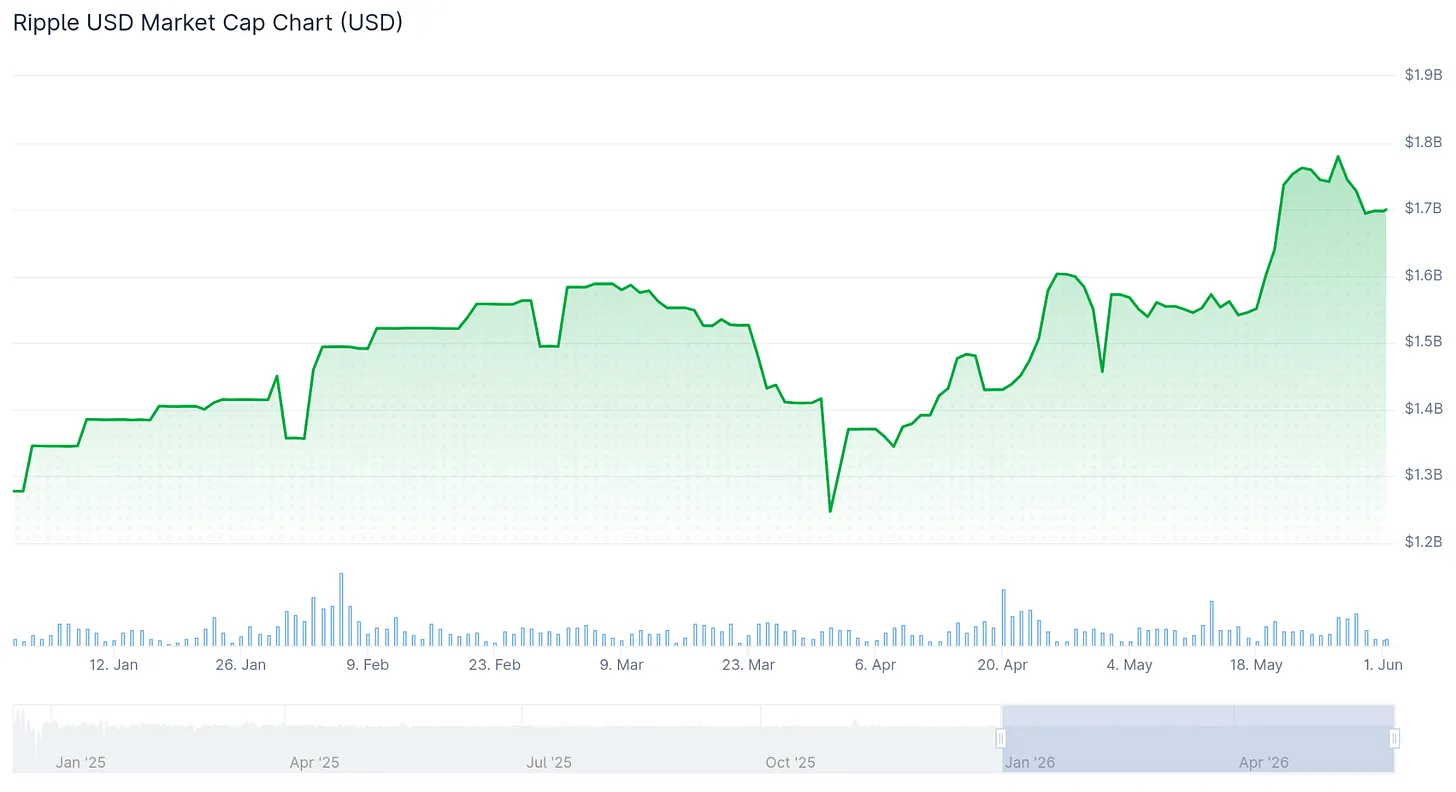
Ripple's architectural logic was verified, but the assertion that “XRP is indispensable” failed to come to fruition. Even so, Ripple continues to be connected to the institutional clearing system. The significance of this matter for long-term value far outweighs the dispute between Ripple and the central bank over the advantages and disadvantages of reserve tokens.
Commercial propaganda aside, on Ripple, transaction fees are very low, and are permanently exempt, and will not go to node operators. Increased institutional transaction volume will not generate revenue for verification nodes and coin holders like Ethereum gas fees; it will only slightly destroy existing XRP stocks. When transferring tokenized assets on the chain, institutions such as J.P. Morgan Chase use their own capital pools and do not need to rely on XRP circulating in the market as liquidity support; the network only provides high-speed transfers and cryptographic security guarantees.
The core value of this model is ecological binding. Once financial institutions trust this network to host fiat and stablecoin assets, the technology will be embedded in global financial infrastructure, forcing bank-level node facilities to be implemented, and the ledger will become a fixed component of the global financial system. In the long run, technology is deeply tied to the global banking industry and is far more important than the rise and fall of a single token.
All of the above variables ultimately end up on the stablecoin circuit. Tether's daily daily transaction volume is stable in the 40 billion to 50 billion US dollars range, and the total size of stablecoins in the entire market has reached 320 billion US dollars. Agorá is still in the pilot phase and is far from being implemented, but SpaceX has already used stablecoins to manage cross-border corporate capital, and Western Union has also launched a remittance business on the Solana public chain, so market competition is already one step ahead.
Agorá focuses on wholesale cross-border clearing of large institutions. If successfully implemented, it will divert the cross-border capital requirements of enterprises originally carried out by stablecoins. But this market is only one part of stablecoin applications: the Central Bank of Brazil introduced Act No. 561, which prohibits local financial institutions from using stablecoins to make cross-border payments, but it cannot prevent Brazilians from holding US dollar stablecoins; Turkish retail investors buy USDT to avoid lira inflation; this kind of scattered demand is not within the scope of Agorá's services.
In the short term, stablecoins and Agorá complement each other more than competition, and there is almost no overlap in application scenarios: Agorá is a closed institutional network, and access is limited to central banks or licensed banks authorized by central banks; ordinary people hoard dollars for safe haven, and small and medium-sized payment companies rely on public chains for cross-border remittance, and none of them can reach this system. The official closed-loop system is unable to achieve the speed of inclusive access to the public chain, and public chain stablecoins cannot meet the final clearing effect required by the central bank.
The medium term landscape is more complicated. Currently, corporate finance teams use USDC and USDT for cross-border settlement. The root cause is the long cycle and high processing fees of traditional agents. If Agorá succeeds in the future and has sufficient liquidity, some corporate capital may be transferred. On the premise that liquidation efficiency remains flat, the Corporate Finance Supervisory Committee gives priority to choosing official channels that are subject to sovereign supervision and have no credit risk from third parties.
However, unifying the governance rules of the seven major sovereign central banks itself is a world-class problem, and many cross-border projects in the past have come to a standstill. At the same time, major enterprises have already completed the USDC system connection and established mature risk control processes, and will not completely overthrow existing businesses simply because of a new theoretically higher quality system.
The final market is likely to be stratified: Agorá has a monopoly on cross-border channels for large institutions, and public chain stablecoins maintain scattered retail businesses. Seemingly dividing the market equally, the sovereignty system has actually locked the boundaries of public chains, limiting decentralized networks to areas where traditional intermediaries cannot shake their roots — remittance, residents' savings, and micropayments in emerging markets. These markets are sizeable, yet they are not the core gathering places for global financial leverage.
This market stratification theory is about to be tested: the EU Pontes framework will open up all types of distributed ledgers and the European core clearing system TARGET in September 2026, and there are only three months left until implementation. Once the connection is successful, European institutional tokenized payments can directly reach the central bank, and the positive game between the official system and the open public chain officially begins.
The reason for the demise of the ancient Agorá market in Athens is that people no longer come to trade. This is the ultimate yardstick for all financial networks.
Twitter:https://twitter.com/BitpushNewsCN
Compare the TG exchange group:https://t.me/BitPushCommunity
Compare TG subscriptions:https://t.me/bitpush
