


From stablecoins to tokenized deposits: deposits will eventually flow to freely convertible winners
Author: Prathik Desai
Compiled by Chopper, Foresight News
Original title: Banks Face Stablecoins, Where Will Deposits Go?
In the long development of the banking industry, depositors have always been in a vulnerable position. People deposit funds in banks, and banks then lend these funds to the outside world, and the benefits earned are several times greater than the interest given to depositors. Savers are embracing this model because they have no better choice: the value of cash in their hands only shrinks over time.
Currently, the average interest rate for ordinary savings accounts in the US is only 0.6%, but when investing in US Treasury bonds and money market funds, the yield can reach at least 4%. The core reason this traditional model works for a long time is that savers have always lacked convenient alternatives. But every few decades, new choices always appear in the market.
Stablecoins rely on blockchain to circulate around the clock. Transactions arrive in seconds, and the transfer cost is less than a cent. Although relevant laws prohibit stablecoin issuers from directly paying interest to holders, the combinable nature of decentralized finance allows users to transfer stablecoins to loan agreements and obtain 5% to 8% annualized income. This provides savers with a new location for their funds without compromising on ease of use.
In this article, we will analyze the various steps banks have taken to stop loss of deposits and how this transformation will reshape the global banking industry and capital flow patterns.
Saver behavior
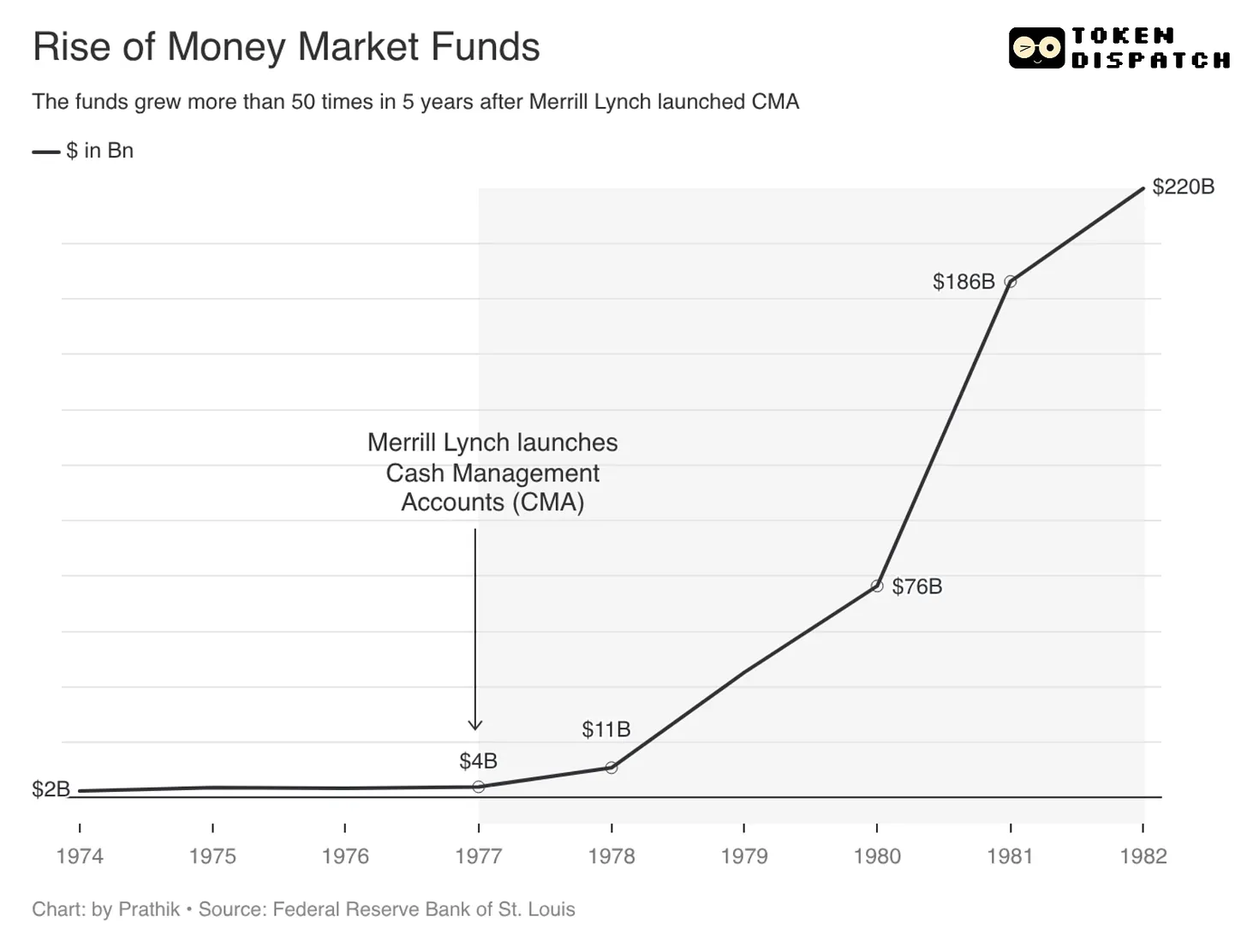
In 1977, wealth management and investment agency Merrill Lynch Securities launched a cash management account (CMA). At the time, the US “Q Regulations” stipulated that the upper limit of interest rates on bank deposits should not exceed 5.25%, while the yield on US Treasury bonds exceeded 7% during the same period. Merrill Lynch discovered a regulatory loophole and used the cash management account function to automatically transfer idle funds from clients' securities accounts to money market funds on a daily basis. At the same time, Lin also provides checking account and debit card services to customers.
By combining multiple functions, customers can not only enjoy high market-level returns, but also withdraw funds at any time, just like using a current account. Affected by this, the size of money market funds ushered in explosive growth, soaring from about US$4 billion in 1977 to US$220 billion in 1982, an increase of 55 times, and behind the increase was a massive loss of bank deposits.
The banking industry immediately protested collectively. Eventually, the US Congress abolished the upper interest rate requirement of the “Q Regulations”, and major banks followed the trend and introduced money market deposit accounts to re-absorb deposits with higher yields. From the introduction of cash management accounts to the lifting of deposit interest rate restrictions, the entire process took nine years.
Today, technological innovations have shortened fund transfers to minutes or even less, and savers are no longer willing to wait long.
During the Silicon Valley bank storm on March 8, 2023, depositors initiated withdrawal requests totaling $42 billion in less than eight hours, with an average withdrawal amount of around $1.5 million per second. More than 85% of the bank's deposits are not covered by deposit insurance, which is the core reason why savers are concentrated in crowding out.
Prudent savers will always move their funds to a safer place where they can at least preserve their value, or possibly increase in value.
Two digital dollars
In response to this problem, the market has given birth to two competing digital dollar forms. The two trends are quite different: one will keep funds out of the banking system, and the other will remain within the banking system, only changing the form of existence.
Type 1: Stablecoins
Take USDC issued by Circle as an example. After users exchange US dollars for USDC, the corresponding fiat currency funds will be used to buy US Treasury bonds, and this money leaves the bank's balance sheet. As a result, the principal amount that banks can use to lend and earn interest spreads is reduced. At the same time, such funds are no longer covered by the US Federal Deposit Insurance Company. Once a stablecoin issuer ceases operations, it is difficult for holders to recover their principal.
The “GENIUS Act”, which officially came into effect in July 2025, establishes regulatory rules specifically for the issuance and use of stablecoins. The law clearly prohibits stablecoin issuers from paying interest to users. This control idea is the same as the “Q Regulations” of that year, which restricted interest rates on deposits. However, just as Merrill Lynch Securities circumvented the “Q Regulations” and used money market funds to achieve high returns, now stablecoin issuers also provide income in disguise by issuing rewards. Currently, related disputes are still ongoing in the “CLARITY Act” legislative discussions. In addition to this, users can also deposit stablecoins into various loan agreements on their own to obtain benefits.
For the banking industry, this is certainly an existential threat. After the bankruptcy of the Bank of Silicon Valley occurred, huge deposits flowed out of the banking system within just a few hours. Standard Chartered Bank predicts that by 2028, bank deposits of 500 billion US dollars may gradually be converted to stablecoins. Regional banks in the US will be hit the hardest. The revenue of such banks is highly dependent on net interest margin business.
Even though these predictions may not be entirely true, the trend of deposit outflows is clear. Precisely because of this, the four largest US banks joined forces for the first time in decades to explore a new response plan.
Type 2: Tokenized Deposits
The core advantages of stablecoins are low transfer costs and sub-second settlement. In response to this pain point, the banking industry introduced tokenized deposits.
Banks can convert users' deposits into on-chain tokens, which can circulate in blockchain networks at low cost and with high efficiency. At the same time, the original US dollar deposit remains on the bank's balance sheet, banks can still carry out normal lending operations and earn interest, and tokenized deposits are still covered by the US Federal Deposit Insurance Company.
At present, two major bank alliances have been formed in the market to jointly promote the implementation of tokenized deposits.
The first is a clearing house network. More than 10 institutions, including J.P. Morgan Chase, Citibank, Bank of America, and Wells Fargo, are working together to build a unified tokenized deposit platform, which is scheduled to be officially launched in the first half of 2027. The platform is mainly aimed at institutional customers and will enable functions such as round-the-clock settlement, programmable fund clearing, and cross-border payments to compete head-on from stablecoins.
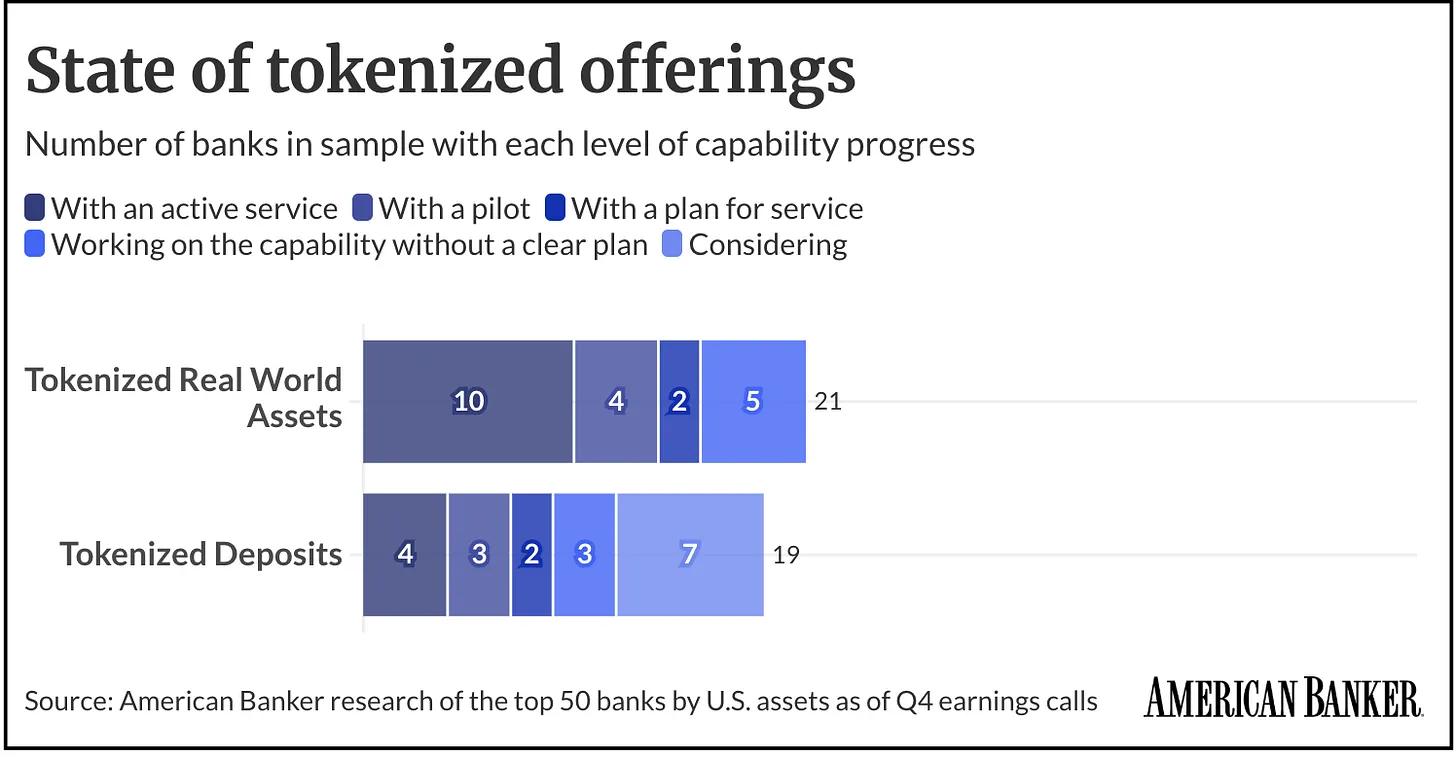
The second is Cari Network, which consists of five regional banks including Heng Huntington, M&T, KeyCorp, First Horizon, and Old National. The alliance manages a total assets of about $780 billion. The network relies on the Prividium technology stack of the zero-knowledge proof public chain zkSync to create a tokenized deposit platform for retail users, and is expected to launch in the fourth quarter of 2026. Regional banks have taken the lead, which also reflects how serious the risk of deposit loss caused by stablecoins is. The survival of such banks is highly dependent on net interest income.
So which products do savers ultimately prefer?
Judging from past experience, when choosing a product, savers often don't simply judge the advantages and disadvantages of the product itself, but prefer the option that can most easily get rid of the current pain points of using funds.
In the late 70s of the last century, the core appeal of savers was to increase profits. Restricted by the Q Regulations, although bank deposits are safe, earnings lose competitiveness when market interest rates rise. The innovation of Merrill Lynch Securities is that it breaks down bank accounts into two core requirements: yield that matches the market level, and the convenience of flexible daily withdrawals. After regulations liberalize interest rate restrictions, major banks have also introduced money market deposit accounts, integrating similar functions.
Today, stablecoins have similar advantages to Merrill Lynch products back then: they are independent of traditional deposit systems, support global circulation, can connect with various cryptographic platforms, and allow idle funds to be used programmatically. But it also has the same shortcomings as money market funds back then: they are not insured bank liabilities, and asset safety depends entirely on issuers, reserve asset structures, payment channels, and the overall regulatory environment.
Tokenized deposits, on the other hand, replicate the advantages of traditional banks in the 80s of the last century: funds are kept in a regulated banking system, which guarantees the bank's loan profit model, and at the same time continues the well-known deposit insurance mechanism. However, due to the regulatory rules of the banking system, tokenized deposits are not as open, liquid, and combinable as stablecoins. Bank deposits can be accelerated and made programmable, but once they completely have the open nature of stablecoins, banks lose core control over deposits.
It can be seen from this that the core of competition between the two sides gradually evolved into a battle for authority to transfer funds.
In this context, a third development path came into being, which also gave us a glimpse into the prototype of the future banking industry and monetary pattern.
A bridge of integration
On May 27 this year, SoFi Bank officially launched SoFiUSD, which is also the first stablecoin issued by a US national bank. The token has been launched on the Ethereum and Solana public chains, and 15 million users of the platform can exchange and use it through mobile apps. SofiUSD has all the characteristics of a stablecoin: round-the-clock circulation, instant cross-border transfers, and a single transfer fee of only a few cents.
At the same time, users can also convert SofiUSD into tokenized deposits within the same app. This type of deposit can generate interest and is covered by federal deposit insurance. Users can switch forms flexibly: when they want to transfer funds easily, they use stablecoins; when they want to earn interest and get security, they switch to tokenized deposits. If you are not satisfied with the yield given by the bank, you can also transfer back to stablecoins and deposit various loan agreements to obtain higher profits.
SoFi may never be more decentralized than Circle, and its overall size is difficult to surpass J.P. Morgan Chase, but it has created a unique advantage: it integrates the three functions of bank accounts, stablecoin wallets, and tokenized deposits in the same application interface.
This model is closer to the innovative ideas of Merrill Lynch Securities back then, and is different from pure stablecoin issuers or traditional banking alliances. SoFi is trying to eliminate the two-choice dilemma of users without having to make trade-offs between the convenience of blockchain technology and the profitability of bank deposits.
The evolutionary trajectory of various products confirms a truth: in the scenario of fund storage and circulation, the shape of the product itself is not the key; the ability to freely transform between forms is the core.
Faced with the impact of stablecoins, the banking industry's initial response was to lobby regulators to ban stablecoins from distributing earnings and rewards. However, it is difficult to win this competition by simply relying on regulatory pressure. The only way to break the game in the banking industry is active evolution, the ability to target and even surpass cryptographic products: on the basis of having second-level transfers and programmable features, interest income and deposit insurance are combined. Interestingly, the vehicle for this upgrade is blockchain technology.
This is the appeal of the market; it will force traditional industries to continue to evolve until the entire ecosystem maximizes the service participants. Back then, Merrill Lynch's cash management accounts forced the US to abolish the “Q Regulations” and pushed banks to introduce money market deposit accounts; now, the rise of stablecoins is also driving banks to develop tokenized deposits and establish a round-the-clock settlement system. In both changes, traditional industries were not completely eliminated; instead, they drew on the advantages of innovative products and completed self-iteration to maintain their position in the industry.
The impact of this round of changes on regional banks was the most severe. These banks are more dependent on net interest spreads, and have far less room to withstand loss of deposits than large banks. If you only optimize traditional bank accounts, you will lose users seeking high liquidity; if you simply target the transfer speed of cryptographic products, you will also lose the core advantages of deposit insurance and loan profits. Cari Network is a self-help attempt by regional banks, and the Clearing House Alliance represents the defensive strategy of large banks, while SoFi chose a more aggressive route: actively build integrated service bridges to avoid being taken advantage of by external institutions.
Looking back at past financial development rules, emerging business formats often rely on exploiting inefficient links in traditional systems to achieve breakthroughs; however, after related pain points become impossible to ignore, traditional giants absorb new functions to complete upgrades and stabilize their market position. Back then, Merrill Lynch Securities pointed out the problem that the upper limit of deposit interest rates was out of sync with market returns, and banks then made up for the shortcomings through money market deposit accounts; now stablecoins have revealed the shortcomings of traditional banks that only process settlement on weekdays and are restricted in capital flow, and banks are also beginning to use tokenized deposits and round-the-clock settlement functions to make up for the shortcomings.
The ownership of industry advantages is also gradually shifting from innovative products that initially discovered problems to organizations that can integrate functions, operate in compliance, and implement solutions on a large scale.
We've been discussing an idea recently: the crypto industry, or more accurately, blockchain technology, is becoming the underlying infrastructure for fintech.
This judgment also holds true in this transformation. Blockchain is not meant to completely replace bank deposits, but rather forces the industry to split the value dimensions of various services: revenue is a layer of value, settlement efficiency is a layer of value, deposit insurance is a layer of value, and free transformation between forms is probably the most valuable part of it.
Regardless of the direction of the industry, bank deposits will not completely disappear; they will only be dismantled and restructured. The ultimate winners must be institutions that can switch funds without friction between safety, yield, and high liquidity.
Twitter:https://twitter.com/BitpushNewsCN
Compare the TG exchange group:https://t.me/BitPushCommunity
Compare TG subscriptions:https://t.me/bitpush
