


With 100 million dollars of capital leveraging trillion in market capitalization, how did AI stocks play tricks in the coin industry?

Author: Ga Roku
Original title: 100 million dollars speculated out a market value of several trillion dollars. This year's AI stock market is beginning to be popular in a new way
Low circulation, big narrative, and high market capitalization are becoming common features of this round of financial market speculation.
It's been less than half a year since Smart Spectrum rang the bell on the Hong Kong Stock Exchange, and at one point its stock price rose 25 times. However, if you look at its share structure, you'll find a more critical, yet easily overlooked figure: in the early days of listing, only about 17.35 million shares were actually freely traded on the market, accounting for less than 4% of the total share capital. A company with a market capitalization of HKD trillion, the daily trading chip pool is actually only in the amount of HK$340 billion.
This is a typical but not unique case, and can even be said to be the epitome of this round of market gameplay.
SpaceX went public ten days ago, with a valuation of 1.77 trillion US dollars and only 4.3% of publicly traded shares. In order to coincide with its listing, NASDAQ directly abolished the 10% minimum public shareholding threshold implemented for decades. SPCX's market capitalization exceeded 2 trillion US dollars, but the daily trading volume was only about 100 million US dollars.
Cerebras, an American AI chip company, sold only about 15% of its issued shares at the time of its May IPO, rising to more than double the issue price on the first day. Figma, the sum of the issuance and sale of old shares was less than 10% of the total share capital, up 250% on the first day.
Low circulation, big story, high market value. The crypto market played with the structure for several years and is now being completely replicated by the traditional stock market. US stocks, Hong Kong stocks, and A shares have a similar structure at the same time, and the narrative extends from AI, chips, and big models to stablecoins.
The era of looking at financial reports and pricing is over
In February 2000, a hand puppet dog made of socks appeared in a Super Bowl commercial. It was a 30-second ad that PETS.com bought for $1.2 million. At the time, it earned less than $6 million a year and lost more than $60 million. Nine months later, the company liquidated, and the sock hand puppet became the most classic tombstone of the Internet bubble.
The market lessons of that generation were written into almost every investment textbook: valuations without income support are bubbles, and narratives cannot replace financial reports.
Over the next twenty years, this lesson dominated the market. DCF, PE, PEG, free cash flow discounts, and pricing methods based on financial data have become orthodox. Buffett was re-enshrined after the 2008 financial crisis. “Buy without looking at financial reports” has become synonymous with speculation.
But if we look at the new tech circuit from 2025 to 2026 today, we'll find a fact: the most sought-after companies in these industries are actually losing money.
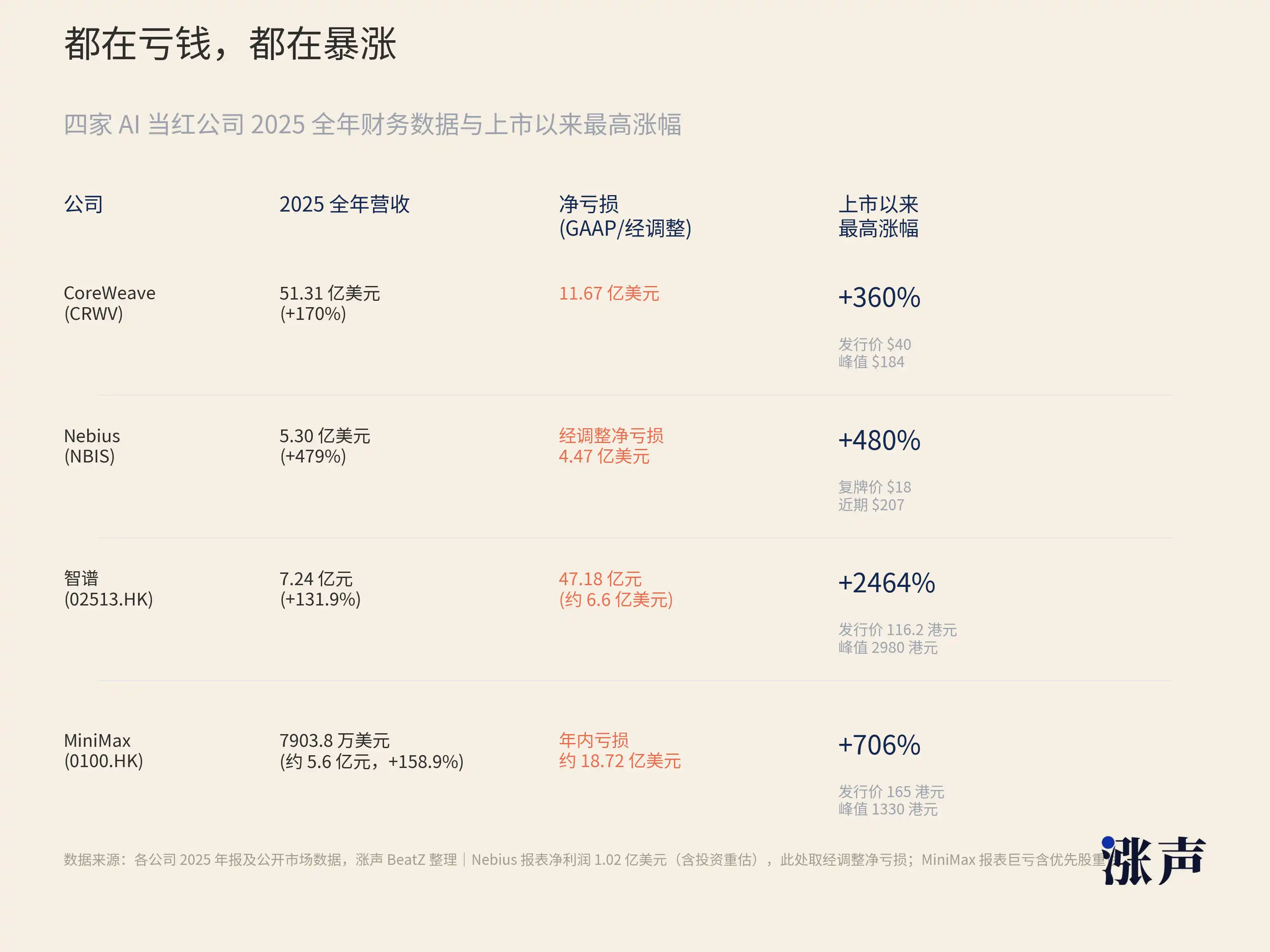
For example, CoreWeave, an AI computing power infrastructure company invested by Nvidia, with revenue of $16 million in 2022 and $5.1 billion in 2025, a 300-fold increase in three years. Revenue grew at an impressive rate, but net loss also widened from $31 million to $1.2 billion. In the first quarter of 2026, the company had revenue of $2.1 billion, net loss of $740 million, and a debt-to-equity ratio of 10.7 billion dollars. According to traditional banks' credit standards, such balance sheets are not healthy. However, once it went public, its stock price rose 190%.
The situation with Nebius is similar. The company, formerly known as Russia's Yandex, split and switched to AI cloud services. Revenue for the first quarter of 2026 was $399 million, up 684% year over year, but adjusted net loss was still $100 million. Over the past 12 months, its share price has risen by more than 510%.
Turn your gaze back to the Chinese market.
Smart Spectrum's revenue for the full year of 2025 was 724 million yuan, about 100 million US dollars, but the net loss was 3.182 billion yuan, 4.4 times the revenue. In other words, for every dollar it earns, it spends far more than $1 on computing power and R&D. The AI Hong Kong stock MiniMax, which was listed in the same batch, rose 109% on the first day, and surged more than 700% at one point. Annual revenue of $790.38 million, or about 550 million yuan, is less than Smart Spectrum.
Similarly, the Hong Kong-stock GPU company Bizao Technology, A-share domestic GPU Mu Xi shares, and the Science and Technology Innovation Board MoorThread rose 120%, 693%, and 425% respectively on the first day of listing. These new stocks, which had astonishing gains, were also in a state of serious losses or no profit.
If you look at these companies using PE, many of them don't even have calculation prerequisites because profits are negative. On PS, the intelligence spectrum is over 1200 times, and SpaceX is about 95 times higher. Looking at DCF, once the discount rate and terminal growth rate change slightly, the conclusion may change from 100 billion to 10 billion, and the model is so sensitive that it loses its guiding significance. Damodaran, the author of the DCF textbook, himself valued SpaceX at $1.2 trillion, which is 30% lower than the IPO price. He himself admits that when dealing with this generation of IPOs, fine-tuning parameters will cause results to fluctuate drastically.
Some people will say that the internet didn't look at PE in the early days; Amazon lost 20 years to make a profit. This is nothing new. Yes, but there is a key difference between this round and the internet age: the market is now not even using alternative indicators of PE to set prices, but is trading pure narratives.
Although investors in the Internet age don't look at PE, they look at user growth, GMV, and page visits. Essentially, they still use a set of quantifiable intermediate indicators to anchor valuations. Today's AI companies also have metrics such as ARR, but ARR doesn't explain the 1,200x market sales ratio of intelligence. The explosion of the supply chain has long since lost its gravitational pull from the fundamentals of financial reporting, and all expectations for the next three to five years have been priced into the present.
The old pricing framework began to fail in the face of a new class of assets. Financial markets and investors' investment logic around the world have also changed dramatically.
Model weight, algorithm power, developer ecology, and computing power scheduling capabilities are the real core assets of AI companies, but none of them can be recorded on the balance sheet. The programming ability of GLM-5.2 made CEO Vercel say “almost impossible,” and this statement will not be reflected in the intelligent profit and loss statement. CoreWeave sits on a $100 billion order backlog, but that doesn't change the fact that it had a net loss for the quarter. Nvidia's GPUs are called the oil of the AI era, and the pricing of oil has never depended not only on seasonal production, but also on reserves, demand curves, and geopolitics.
The core assumption of traditional pricing methods is that future cash flows can be extrapolated from historical financial data. This hypothesis is very useful in industries such as consumer goods, finance, and real estate.
But AI companies' revenue curves aren't linearly extrapolated. It depends on changes in model capabilities, network effects in the open source ecosystem, and abrupt changes in policies and industrial cycles. After the release of GLM-5.2, the narrative status of Smart Spectrum could change overnight; Llama's open source allowed Meta's AI influence to expand rapidly; US chip restrictions on China turned Bizong and Mu Xi from marginal companies into “domestic replacement leaders.” These variables are difficult to pre-write in any financial model.
At the same time, the market's tolerance for narrative-driven narratives is also rising, as people who have written narratives have actually made money in the past few years.
People who bought Nvidia without looking at earnings reports at the beginning of 2023 earned ten times more. At the beginning of 2026, people who didn't read financial reports and bought SmartSpectrum earned 24 times as much. When a “wrong” approach continues to produce “correct” results, the market revises its methodology rather than the results.
The money that supports the high market value is actually not much
Nasdaq's own research goes back to data from 1980 to 2020: in the 1980s, the average circulation of US IPOs was about 30% of total share capital. By 2020, that number had dropped to around 20%.
In the June 2026 report, J.P. Morgan gave an even bigger figure: new shares issued through IPOs, plus the share of early investors allowed to sell after the ban was lifted, only account for about 1% of the total market value of the entire market.
The circulation market for IPOs is getting smaller. It's a trend that's been going on for almost three decades.
Nasdaq also found a clear inverse relationship between the circulation market and the first-day increase. In the few years when the circulation market became smaller, the increase on the first day became larger.
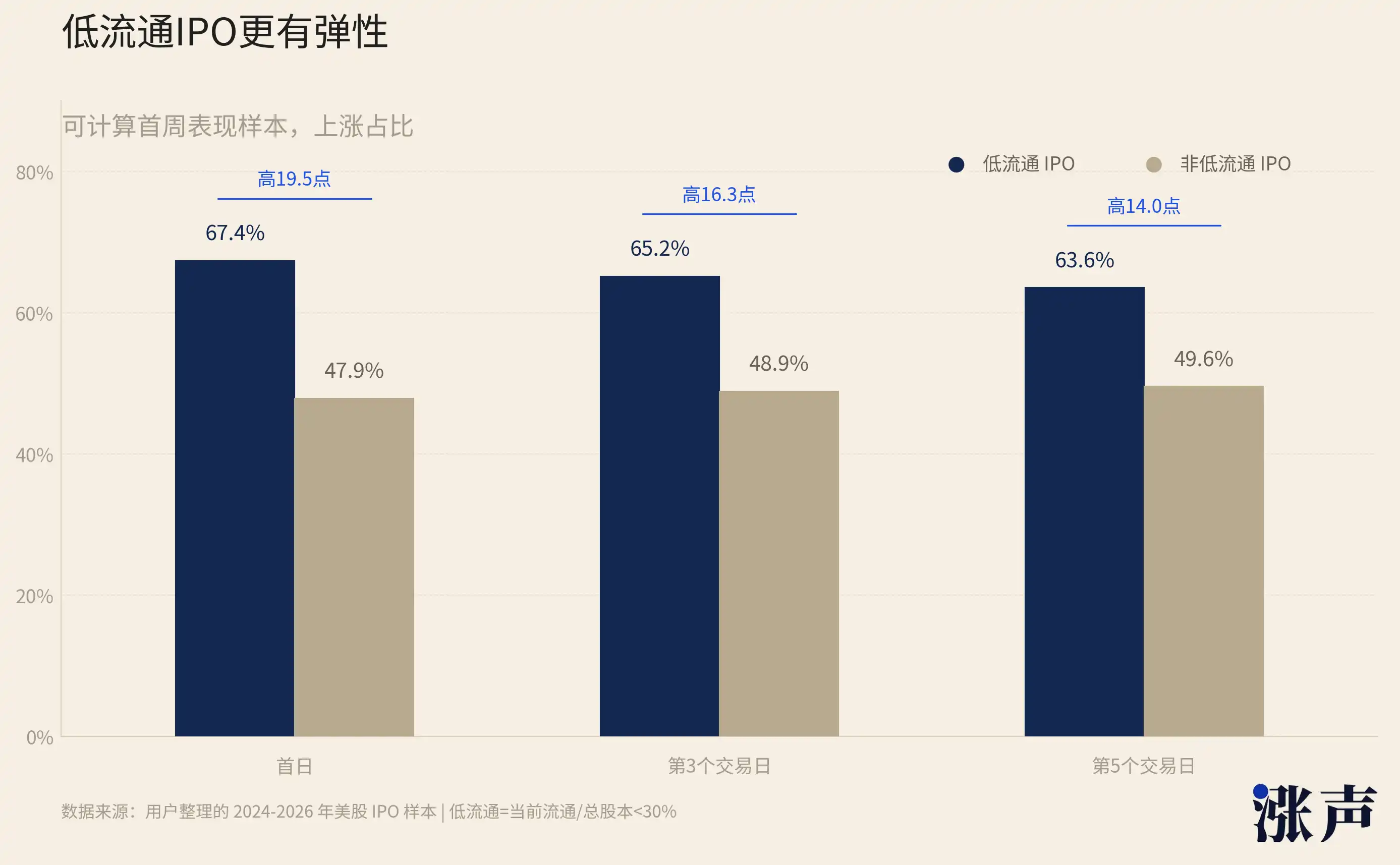
The same characteristics can also be seen in our 2024-2026 US stock IPO sample that we have compiled ourselves. Low circulation is defined by “current circulation/total share capital less than 30%”. In the sample that can calculate the first week's performance, low-circulation IPOs rose 67.4% on the first day, 65.2% on the 3rd trading day, and 63.6% on the 5th trading day.
The corresponding proportion of non-low-circulation IPOs was only 47.9%, 48.9%, and 49.6%.
Fewer chips can be bought, and the same buying momentum is greater, and price flexibility is stronger.
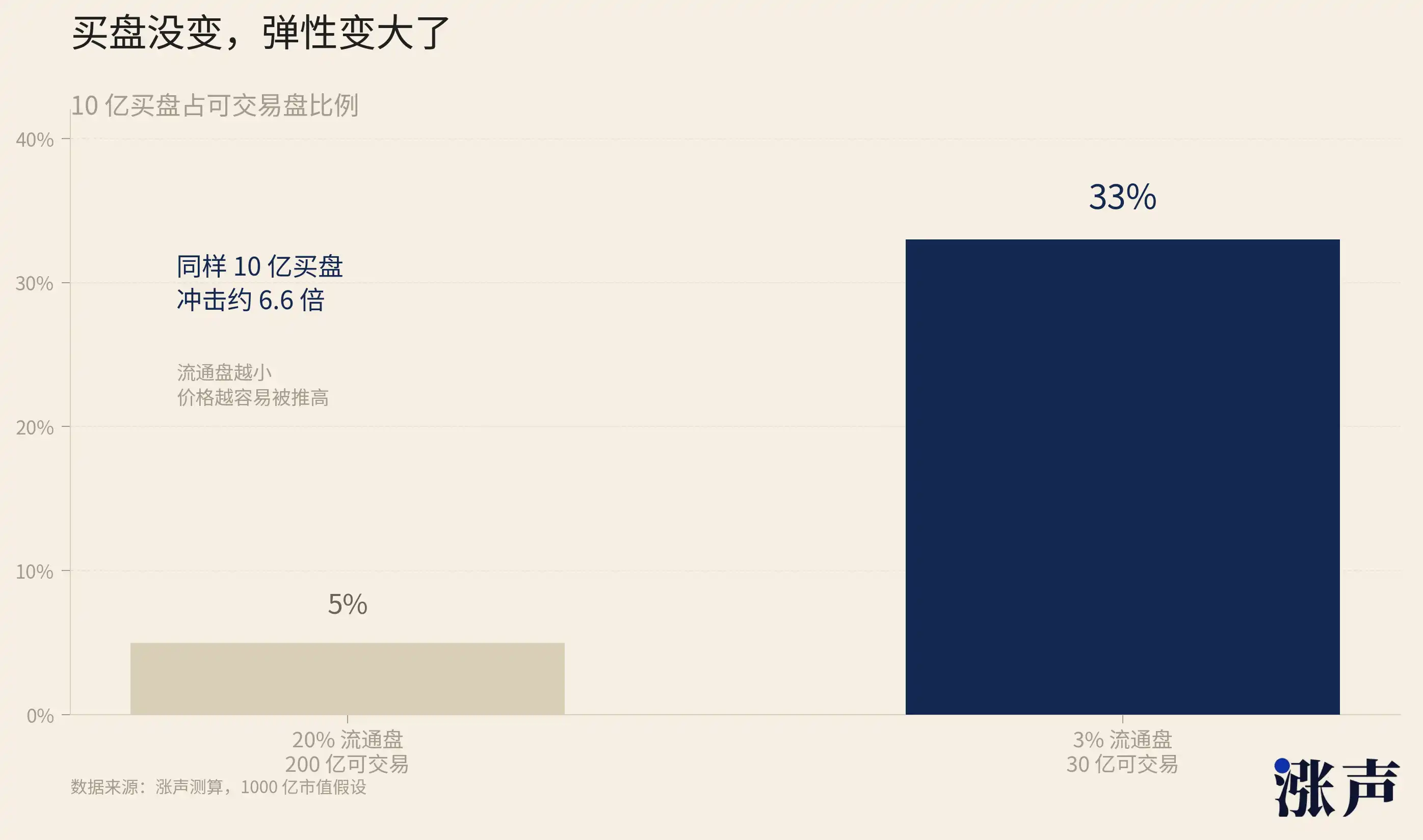
The reason is simple. Similarly, buying 1 billion dollars is a wave in the circulation market of 20 billion dollars, and in the circulation market of 3 billion dollars, it is a tsunami. The contraction of the circulation market from 20% to 3% is not a linear change; it is a qualitative change in price elasticity.
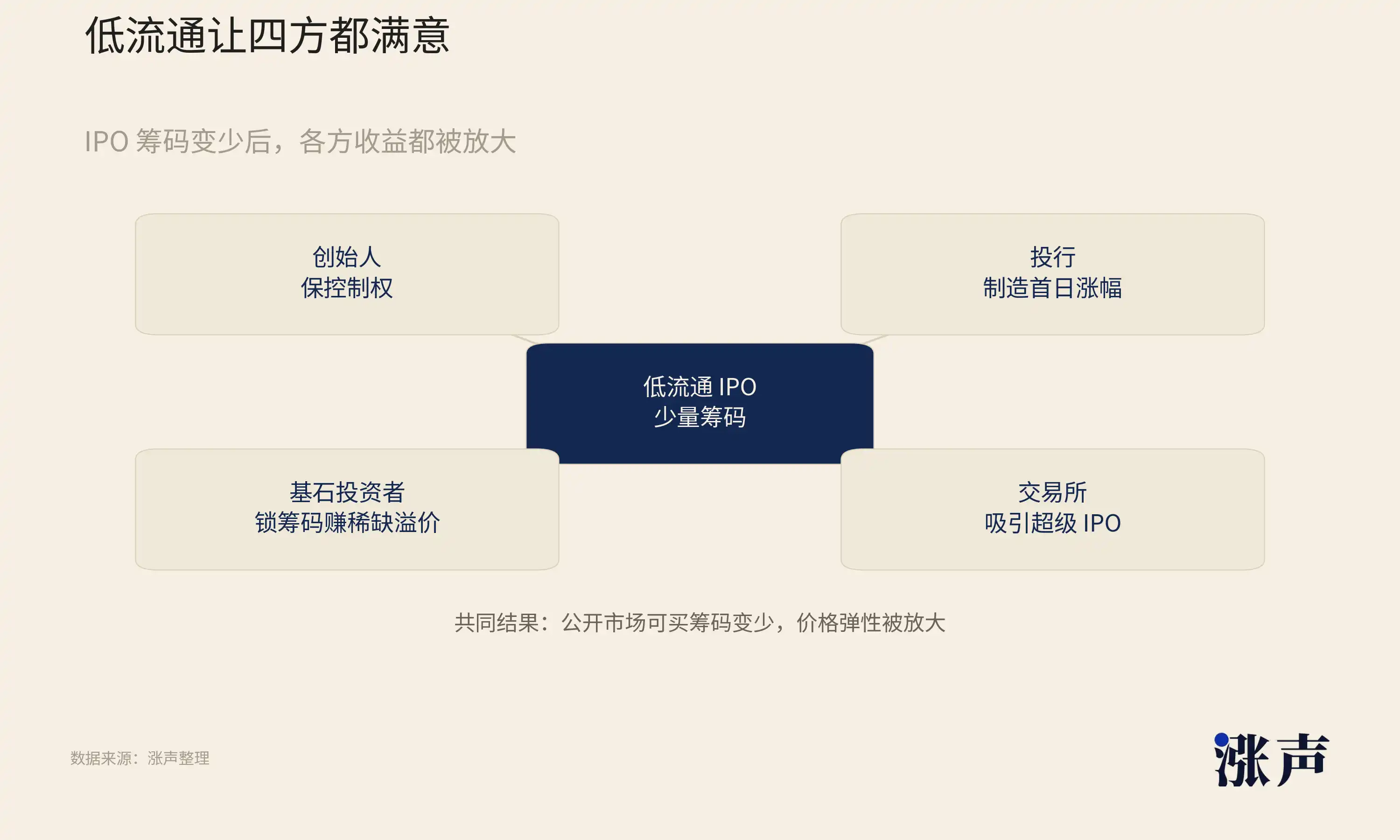
Newly listed companies are increasingly inclined to have low circulation, as this is a result of maximizing the interests of all parties.
Let's look at the founders first. The smaller the circulation market, the more stable control. SpaceX's Musk controls about 85% of voting power through Class B shares, and 4.3% of the open market circulation market means that external investors have almost no governance influence. He can simultaneously serve as CEO, CTO, and Chairman of the Board. He can merge xAI into SpaceX without shareholder approval, and fully control the company's strategic direction. The smaller the circulation market, the weaker the voices of external shareholders, and the more freedom the founders have.
Scarcity has also directly boosted market capitalization figures. The market value of a company is not determined by the total number of shares, but is calculated by multiplying the price of the last transaction by the total share capital. If only 3% of the chips are being traded, and this 3% is being chased to a ridiculous price, the market value of the entire company will be calculated at this price.
The book value of the 97% untraded shares in the hands of the founders and early shareholders all expanded. This inflated market value can be used for financing, as a currency for mergers and acquisitions, and attracting talents. SpaceX went public at a valuation of 1.77 trillion US dollars. This figure will appear in all recruitment information and will appear on the desktop of all cooperation negotiations.
This phenomenon doesn't just happen with small-cap stocks.
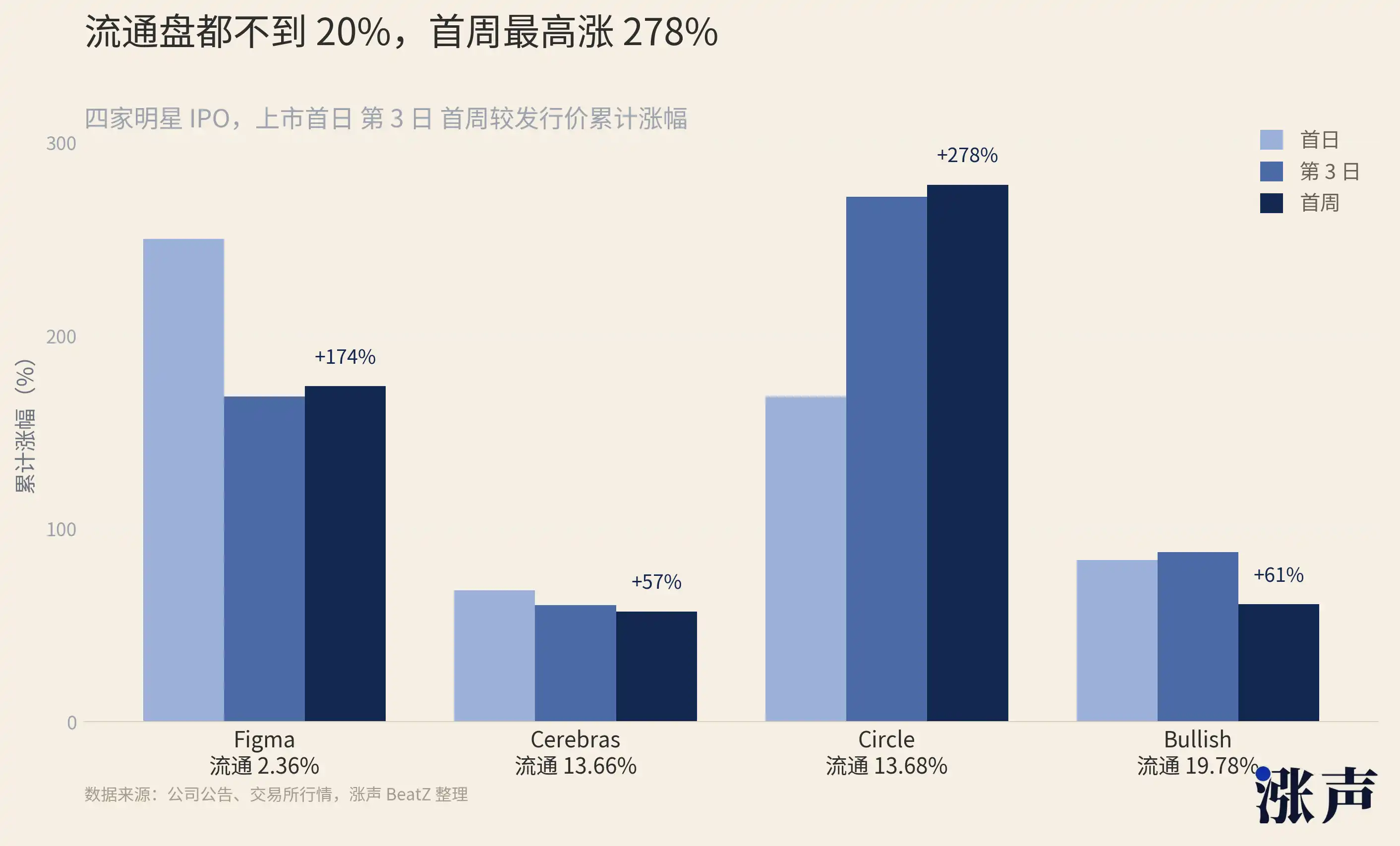
Figma (FIG) is a collaborative design software platform. The number of chips in circulation was only 2.36%, up 250% on the first day, 168.48% on the 3rd day, and 173.7% in one week.
Circle (CRCL) is the stablecoin and blockchain financial infrastructure company behind USDC. It listed 13.68% of the chips in circulation, up 168.48% on the first day, 271.77% on the 3rd day, and 278.06% in one week.
Bullish (BLSH) is a digital asset trading platform and market infrastructure company. It listed 19.78% of the chips in circulation, up 83.78% on the first day, 87.95% on the 3rd day, and 60.84% in one week.
Cerebras (CBRS) is an AI computing power infrastructure company. It listed 13.66% of the chips in circulation, up 68.15% on the first day, 60.35% on the 3rd day, and 57.13% in the week.
Let's look at investment banks again. The “first-day increase” of an IPO is a core measure of underwriting success. Media headlines, customer reviews, and the reputation of investment banks are all linked to this figure. The smaller the circulation market, the easier it is to increase on the first day. Goldman Sachs helped SpaceX design 4.3% of the circulation market, which rose 19% on the first day. Everyone said it was a great IPO. If the circulation market is 20%, and purchases of the same size are spread over five times the chips, they may only increase by 4%. The media headline is completely different.
The incentive structure of investment banks is naturally biased towards low circulation — the smaller the circulation market, the better the increase on the first day, and the greater the reputation of the investment bank.
Then there are cornerstone investors. The cornerstone system of Hong Kong stocks is essentially a transaction: “I'll help you lock in chips, you guarantee distribution.” The benefit of cornerstone investors is to get a fixed share of the IPO (no need to worry about being scaled down or drawn) at the cost of not being able to sell for 6 months. But that cost often becomes a reward — because the cornerstone locks in most of the circulation market, and there are very few chips left to trade, the stock price can easily be pushed up.
When the ban is lifted six months later, if the stock price has increased several times due to low circulation, the return on the cornerstone far exceeds the normal IPO. The cornerstone system binds “helping the company lock chips” and “making more money yourself”, and the interests of both parties are completely consistent.
Intelligent Spectrum's 11 cornerstones (Gao Yi Asset, Taikang Life Insurance, Guangfa Fund, etc.) took 70% of what was already a small number of tradable shares, resulting in less than 4% of the final circulating share. All locked down for 6 months. While they are helping Smart Spectrum lock in circulation, they are also helping to create scarcity premiums for themselves.
As a result, we can even see that from an institutional turning point on the NASDAQ trading platform, the 10% minimum public shareholding threshold was abolished.
This rule existed for decades. A listed company must have at least 10% of its shares in public hands to ensure sufficient market liquidity and protect the interests of public investors. The S&P 500 is more strict, requiring that the public shareholding ratio of constituent stocks be at least a certain level. The MSCI requirement is 15%. The Russell series requires 5%.
This precedent has far-reaching effects. If Nasdaq can abolish the 10% threshold for SpaceX, what hurdles are there for the next company that wants to go public with a 3% circulation market? If America's largest trading platform thinks low circulation is acceptable, will other trading platforms follow suit? The cornerstone system of the Hong Kong Stock Exchange has allowed most of the IPO chips to be locked in. If NASDAQ also liberalizes, will there be a kind of global competition: who is more friendly to low circulation, so as to attract the best IPO targets?
Level 1 investment, level 2 hedging, and the stock market began to replicate the old routine of the coin industry
In the 1990s, after the options market slowly matured, a zero-cost collar (zero-cost collar) became the standard for the wealthy. You own a stock, buy a put option to protect the downside (it costs money), and sell a call option to get the cost back (collect money). By countervailing both sides, they locked in a price range without spending money. Michael Dell used a variable prepaid forward contract (variable prepaid forward) in the late 1990s to cash out part of Dell's shares without triggering taxes or reducing the number of positions, but he received cash early.
However, in the past, it was used by a few super-rich people and founders. Now, after SpaceX went public, wealth management companies are publicly promoting this plan for several thousand employees, and the scale is completely different. Wealth managers such as Bernstein and Mercer are now directly sending out guides to teach SpaceX employees how to make collars. This level of popularity has never been seen before.
Bernstein's report contains a very dispassionate set of data. They looked back at all US stock IPOs that raised more than $50 million in the past ten years and found that six months after the lockdown period ended, the median report fell by about 10%. One-tenth of IPOs fell by at least 62% within half a year after the ban was lifted. The conclusion is straightforward: if you're a SpaceX employee with locked shares in your hands, statistically speaking, the price is likely to be lower than it is now by the time you can sell it. So you should lock in profits with derivatives before the ban is lifted.
Michael Burry, who made hundreds of millions of dollars by shorting the US subprime mortgage market in 2008, publicly stated after SpaceX went public that he had studied put options and wanted to go short, but found that they were too expensive to bear, and ultimately neither went long or short. Even “big shorts” think that shorting is too expensive, which indicates that too many people are already trying the same trade, raising the price of options to an absurd position.
In addition to the above methods, whether it's collar, matchmaking, or unbanning arbitrage, they all have a common premise: the company has already gone public. The stock already has an open market price, the options chain has come out, and a shorting mechanism has been established.
But if you're someone who's been in the crypto market for a few years, you'll find that these changes aren't new at all.
In 2024, Binance Research, the largest trading platform in the crypto market, published a report titled “Low Float & High FDV: How Did We Get Here?” The report lists a group of tokens that were just launched at the time. The lowest circulation was only 6% of the total supply, and the highest was no more than 20%.

The ratio of market capitalization to fully diluted valuation of newly issued tokens in 2024 is the lowest in the past three years. When it went online, only a few chips were put in, and the valuation soared to the sky. At the beginning of their launch, these projects used very few tradable chips to inflate prices, and it appears that the market capitalization has rivaled those Layer-1 and DeFi blue chips that have been running for several years. Once unlocked, the price went all the way down.
This is the lesson that the crypto market taught everyone in two years: low circulation can push prices up, but it can't be maintained. Because locked positions will eventually be unlocked; unlocking means supply. If supply does not catch up with corresponding demand, the price falls. Binance Research has calculated that from 2024 to 2030, $155 billion worth of tokens are expected to be unlocked one after another. For these tokens to maintain their current prices, the market would need to inject an additional $80 billion in buyer liquidity.
According to Memento Research statistics, the current price of 118 major token issuance events (TGE) in 2025, of which 100, or 84.7%, is lower than the fully diluted valuation at the time of launch. The median decline was 71%.
CryptoRank put it bluntly in its 2025 year-end summary: “The low circulation and high FDV token issuance model continues to hinder the arrival of the copycat season, as most of the upside was taken away early by private equity and early investors, leaving very limited opportunities for the open market.”
Low-circulation tokens in the crypto market and low-circulation IPOs in traditional finance have almost exactly the same price formation mechanism in the early stages of listing/listing: a small number of chips, a large number of narratives, purchases far exceeded tradable supply, and prices were pushed far beyond fundamentals.
So will the decline in crypto altcoins be repeated in the stock market?
Actually, not necessarily. After all, there are exponential passive funds in the stock market that provide continuous buying, have deeper institutional participation, and more diversified sources of funding. These are structural supports that the crypto market doesn't have. With low liquidity in the stock market, IPOs can also rise for several months.
Of course, the stock market still can't escape the day the ban will finally be lifted.
Twitter:https://twitter.com/BitpushNewsCN
Compare the TG exchange group:https://t.me/BitPushCommunity
Compare TG subscriptions:https://t.me/bitpush
