


When the regulatory gap is filled, how much competitive advantage does Binance have?
By Chloe, ChainCatcher
Original title: What do you think of Binance's competitive advantage?
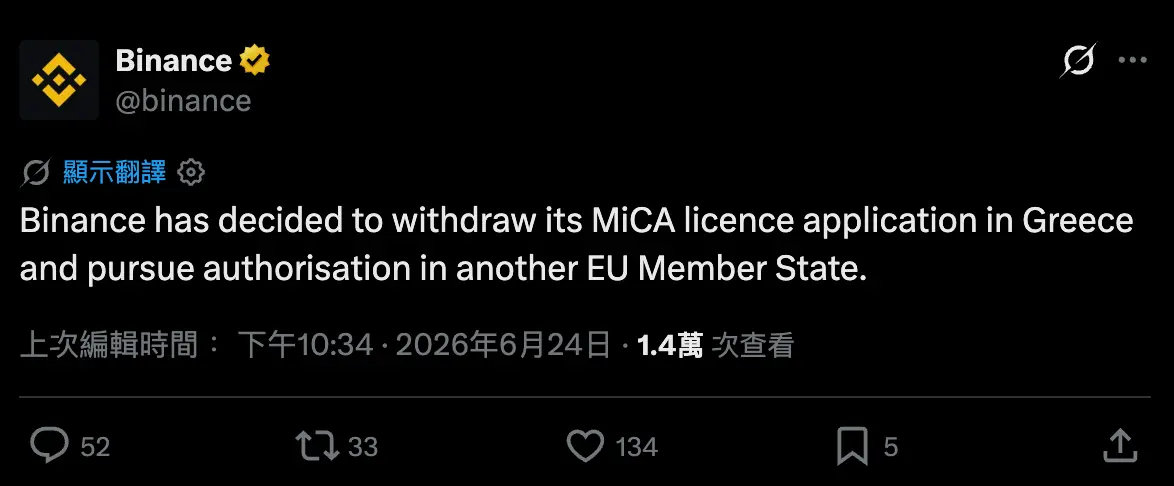
On June 16, 2026, Reuters quoted two people familiar with the matter as reporting that the Greek Capital Markets Commission (HCMC) was preparing to reject Binance's MiCA license application; two days after the news broke, OKX founder Star (Xu Xingxing) published a long article on X to dismantle Binance's competitive advantage in regulatory blind spots. As regulatory pressure continued to heat up, a few days later, on June 24, Binance officially announced that it had decided to withdraw its MiCA license application in Greece and would turn to other EU member states to seek authorization.
As we examine the four strengths that Binance has been accused of: regulatory arbitrage, speculative narrative cycle, social media control, and paper compliance, and then compare the MiCA dead line currently unfolding in the EU to examine how many of the moats Binance has accumulated over the past ten years when the rules are gradually completed and all exchanges stand on the same starting line, how much of the moat that Binance has accumulated over the past ten years is actually a real product or technology, and how many are just the dividends of lack of rules?
Dismantling Binance's competitive advantage
In the article, Xu Mingxing split Binance's competitive advantage into four pieces. If you look at them side by side, you'll find one thing in common: each is not “Binance has made a product that others can't do,” but “Binance is not bound where others are bound.”
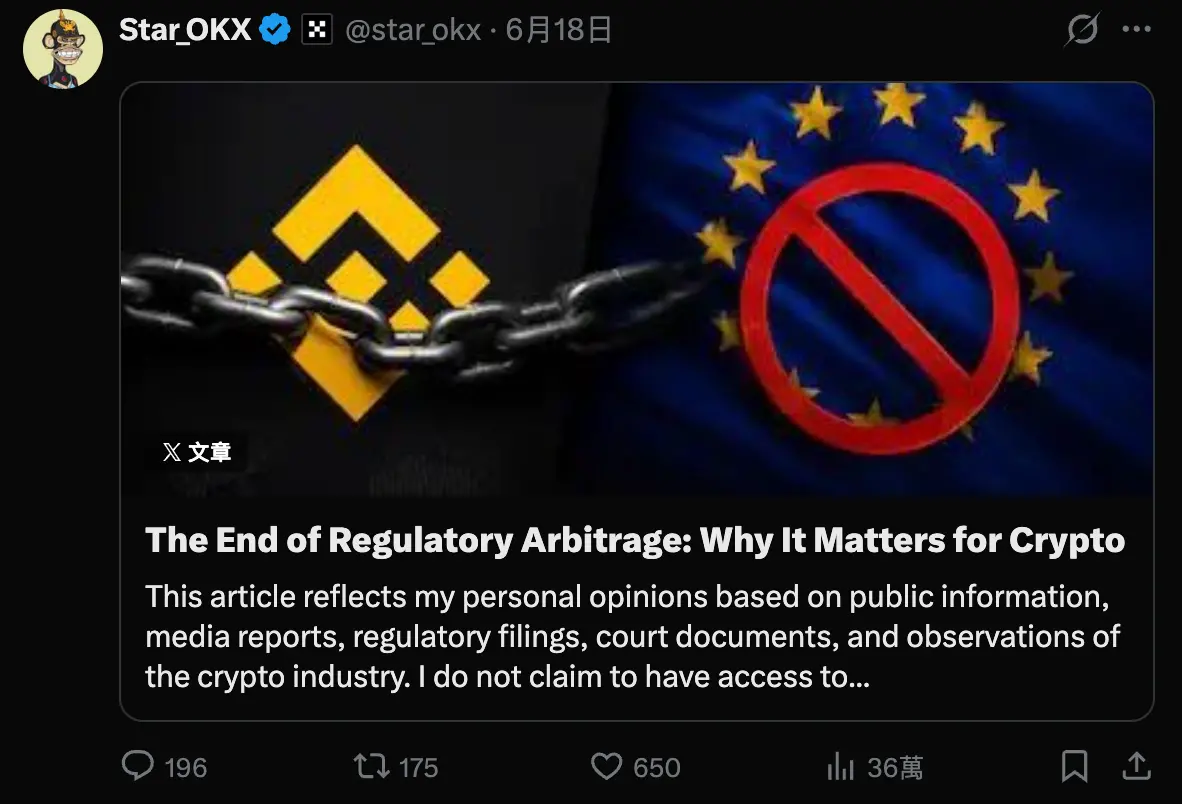
Regulatory arbitrage: operating where rules are minimal
The central argument is that over the past decade, cryptocurrency competition has long been affected by regulatory arbitrage: companies operating under less regulatory constraints often enjoy more advantages than those that invest heavily in licensing, compliance, governance, and regulatory participation.
In other words, when an exchange can serve global users without establishing an entity, applying for a license, or cooperating with regulation, its cost structure is inherently lighter than a serious compliant competitor. This gap is not due to the product, but to the lack of rules themselves.
Speculative narrative cycle: there is always the next chance to get rich
He described Binance's business model as “a continuous cycle of speculative asset promotion”: when one asset narrative loses momentum, the other quickly makes up; users lose money in one cycle, and their attention is quickly directed to the next token, next trend, and next opportunity.
He also pointed out that over the years, Binance has built a huge ecosystem composed of founders, former employees, venture capital funds, incubation projects, and affiliate market participants. Many projects received listing and exposure, but prices fell more than 95% from their peak after launch. Critics believe that the real profits are related insiders and early participants, while much larger retail investors have borne most of the losses.
Social media machines: the ability to shape cognition
The third advantage is social media control. Xu Mingxing pointed out that over the years, Binance has invested heavily in establishing links with KOLs, media agencies, promotion partners, and the community to develop one of the strongest communication networks in the industry; whenever negative news appears, it is often seen that a group of influential accounts immediately post positive content, while criticism is often questioned, refuted, or attacked.
Supporters see it as strong community building and marketing, while critics see it as narrative management. Whichever claim is true, almost no one denies that Binance has built one of the most efficient social media machines in the history of the crypto industry, but this is also not a product power, but rather the distribution of influence in the public opinion arena.
Paper Compliance: The 1500 Compliance Officer Paradox
The fourth item is compliance. Binance often emphasizes that it employs more than 1500 compliance professionals and is one of the most compliant crypto companies in the world. Xu Mingxing's objection is that for any financial institution, compliance is never determined by the number of employees, but depends on whether the organization actually values compliance from a conceptual point of view and establishes control measures to manage real risk exposures.
Citing reports from the “Wall Street Journal” and other media, he questioned Binance's “heavy form and light substance” in sanctions risk exposure, market monitoring, and suspicious account handling, and using Binance's sale of business to ComMex after leaving Russia, and the close relationship with Aster as an example to raise a fundamental question: if a business model is so risky that Binance is unwilling to directly operate, then is it acceptable to do it through an “independent” entity that is still closely linked to its ecosystem?
These are all one-sided accusations by Xu Mingxing, and Binance does not necessarily agree with them. But what I want to say is actually the same sentence: this is not a company that wins by its products; it is a company that wins by a regulatory gap.
MiCA Deadline: The First Frontal Collapse of Regulatory Arbitrage Advantages
The EU's Crypto Asset Market Regulation (MiCA) came into full effect at the end of 2024, and the transition period will end on June 30, 2026; from July 1, only authorized crypto asset service providers (CASP) can legally serve EU customers. A MiCA license can be “passed” in 27 member states, which is why the decision of a single Greek regulator affects the entire European Union.
As of mid-2026, only about 210 to 223 institutions in the EU have obtained full MiCA authorization, while more than 3,000 institutions have registered to operate under the old system. In other words, out of every four existing institutions, approximately three will lose their eligibility to operate after the transition period is over.
However, rivals such as Coinbase, Kraken, and Bitstamp have all obtained MiCA licenses, but Binance may fail. It did not submit an application through a Greek holding subsidiary until January 2026, and Greece had zero MiCA licenses at the time. Compared to Germany, which had already issued more than 45 cards and the Netherlands had 22. This part echoes what Xu Mingxing mentioned in the article that Binance is good at laying out in countries with regulatory gaps. If it is a country where Germany or the Netherlands have licensing experience, there is no such thing as a regulatory gap that can be laid out if the rules and systems have already been shaped.
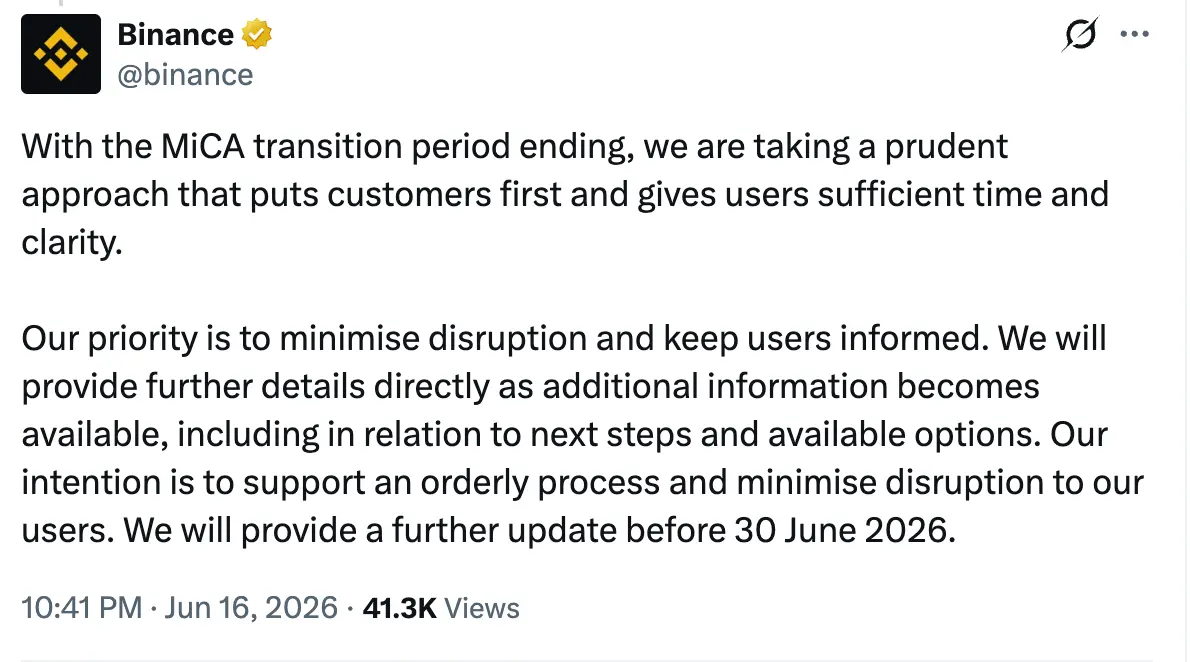
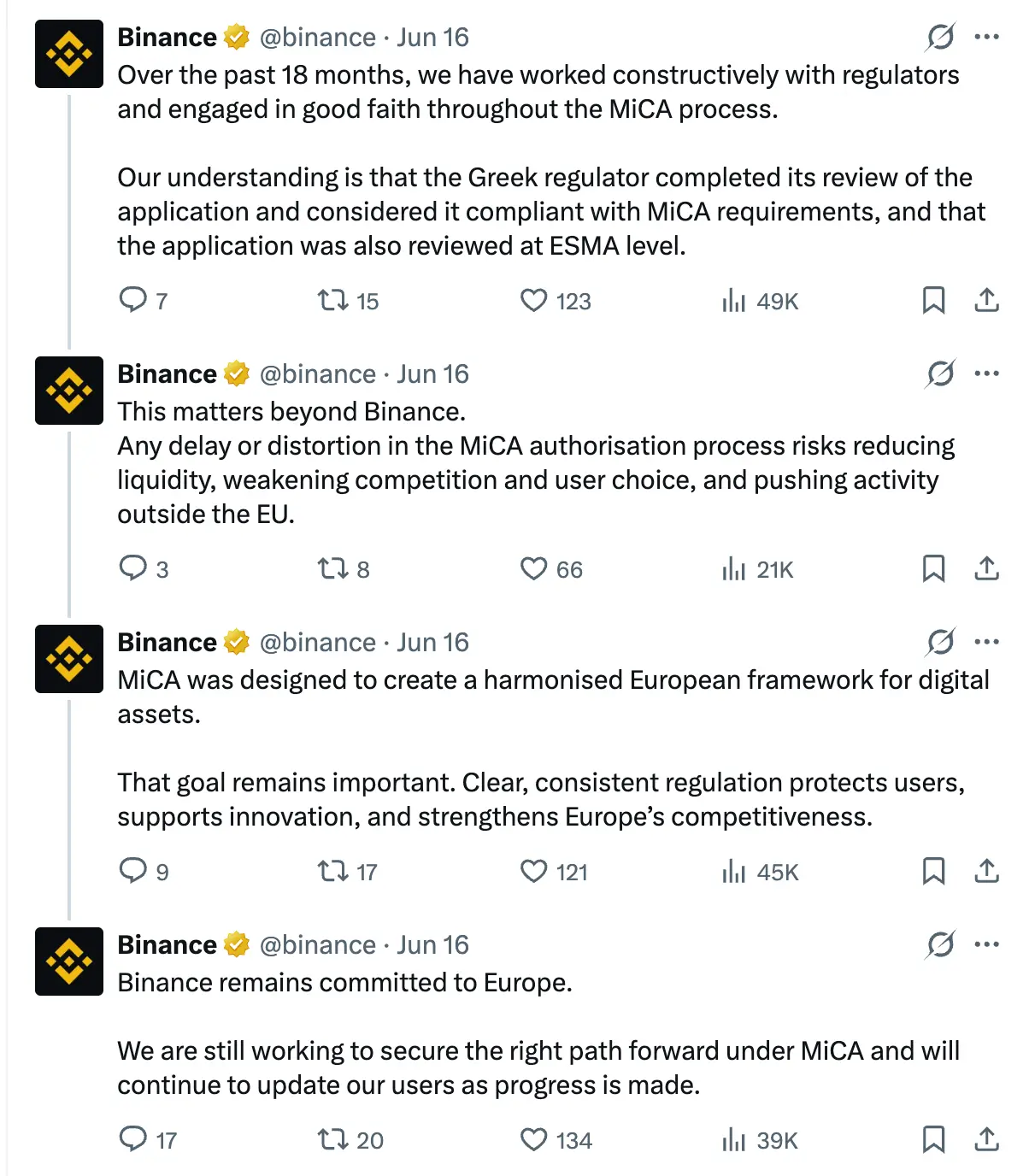
In addition, Binance also raised objections to the Reuters report, stressing that it has been in constructive communication with regulators for over 18 months, and believes that HCMC has completed the review and considered its application to meet MiCA requirements, and was planning to approve it at the recent board meeting. Binance also promised to provide users with further updates by June 30, stressing that it will use an “orderly process” to minimize the impact on users.
Greece was blocked, and France became the last entry point to the European Union
According to Binance's official tweet on the 24th, it has decided to withdraw its MiCA license application submitted in Greece and will seek authorization in another EU member state. On the other hand, The Big Whale reports that Binance is in negotiations with the French Financial Markets Authority (AMF), but no formal application has been submitted so far.
France is originally one of Binance's main operating bases in Europe, and it also issued digital asset service registrations earlier in the past; under dead pressure on June 30, France was viewed by the outside world as the only jurisdiction that could complete the review within a time limit and allow Binance to regain the EU's “regulatory passport.” However, it is important to note that in the past, Binance's national registration in countries such as France was not equivalent to a MiCA license, nor was it accompanied by a right of passage across 27 countries. There are still variables as to whether this alternative route can be converted into official authorization in a timely manner.
Regardless of the final outcome, the symbolic significance of this incident is already clear: in a market where regulations are truly complete, Binance's “largest in the world” did not receive an exemption; instead, it became the highest-profile test subject of this new set of rules. This is exactly what Xu Mingxing said: when supervision levels the moat, the scale itself is no longer a moat.
The competition only really began after the moat was leveled
If the four advantages of regulatory arbitrage, narrative cycles, social media, and paper compliance are all essentially based on the “others are bound, I'm not bound” gap, then what happens when this gap is bridged by regulation?
Xu Mingxing's answer is: the focus of competition will shift to products, technology, execution, customer service, governance, and trust. This is also the real purpose of his article: to change the standard of competition from “who can operate under the fewest rules” to “who can build the best products, serve users responsibly, manage risk effectively, and win trust over the long term.”
Seen from this perspective, the MiCA dead line is good for Binance's opponents. CCN and Spaziocrypto all point out that licensed Coinbase and Kraken are expected to absorb EU users looking for compliance due to Binance's withdrawal. For exchanges such as OKX that obtained MiCA licenses as early as 2025, the cost of investing in compliance over many years is being converted into actual market share at this point in time.
Bringing competition back to “product and trust” is beneficial to all rivals who have already complied. Of course, this also includes Xu Mingxing's own OKX.
Binance doesn't have to lose, but the rules have changed
MiCA's loss did not equal the collapse of Binance. Binance Global still has more than 300 million registered users, making it the most liquid and most traded exchange in the world. Even if it is blocked from the EU, it still has a huge footprint in Asia, the Middle East, and Latin America; Greece's decision has not yet been officially announced, Binance is still fighting for it, and the results until June 30 are still variable.
Binance is also not without progress in compliance. As early as 2023, it reached a settlement of about $4.3 billion with the US Department of Justice and Treasury. Former CEO Changpeng Zhao (CZ) pleaded guilty and stepped down, and Richard Teng took over. The company's strategy has since shifted from publicly boycotting regulation to active licensing, which simply describes Binance as “only arbitrage rules”, which is unfair.
However, Xu Mingxing's core proposition is Binance's strongest competitive advantage over the past ten years. Indeed, a large part of it comes from regulatory gaps, and this gap is being filled by one jurisdiction after another. MiCA is only the first floodgate to actually start; I'm afraid there will only be more similar cases later.
So back to the original question: What do you think of Binance's competitive advantage? The more pragmatic view is that there is no need to be deified or underestimated. What is really worth tracking is not whether Binance can get the Greek license this time, but whether it can develop product power, governance, and trust commensurate with its scale after the dividends of rule arbitrage are gradually reduced to zero.
Twitter:https://twitter.com/BitpushNewsCN
Compare the TG exchange group:https://t.me/BitPushCommunity
Compare TG subscriptions:https://t.me/bitpush
