


There is no room for the AI community to understand blockchain

Source: Tiger Research
Authors: Ekko An, Ryan Yoon
Compiled and organized by: bitPushNews
The artificial intelligence industry continues to advance rapidly, and there is no sign of cooling down. However, in the field of “blockchain AI,” the situation is quite different. Why hasn't it garnered much attention?
Core points
In the AI boom, the blockchain industry needs to be examined from a demand-side perspective: what problems can't be solved by existing systems, and what unique capabilities does it bring?
Decentralized computing and storage does have reasonable logic in terms of data sovereignty and cost competitiveness. The obstacle is that neither of these currently shows sufficient technical advantages to make customers already tied to existing cloud infrastructure willing to take the risk of migration.
The issues addressed by model verification and privacy technology have not yet reached the level of urgency that makes companies willing to take initiatives. This type of demand is more likely to follow regulatory requirements rather than pre-empt regulation. The EU Artificial Intelligence Act is a typical model: standards first, then the market follows.
In the Agent framework category, the bottleneck is not technology. Mainstream companies are still focusing on automating internal workflows, and blockchain projects are already building the infrastructure layer for the next phase. It takes time for demand to catch up with technology.
Smart payments are the only field where blockchain is on the same line as traditional financial stations. Both have yet to resolve this issue, making it the only category where both face the same challenges at the same time.
Overall, the reason why the blockchain AI industry is struggling is not because the combination of the two is unreasonable, but because there is a mismatch: each of the four categories faces different reasons why demand has yet to take shape, and among them, only smart payments currently have the conditions to compete on the same platform.
1. Blockchain projects forgotten by the AI boom
The AI industry is experiencing unprecedented investment in capital and infrastructure. The big language model ecosystem, led by large technology companies, has become a standard feature of everyday life and industrial operations. Amid this rapid expansion, the cryptocurrency industry is also rapidly evolving, seeking technical integration points with AI.
Early efforts focused on complementing or replicating aspects of the traditional AI value chain: decentralized GPU provisioning, data ownership restoration, and cryptographic verification. Recently, the focus has turned to filling gaps that are difficult to solve in centralized architectures, including autonomous on-chain activities for AI agents and real-time machine-to-machine (M2M) settlement.
Describing this field in broad terms as “AI plus blockchain” masks its complexity. We need a rigorous demand-side analysis: What issues does each segment address? Does the blockchain native solution provide a truly differentiated solution?
2. Features in each category
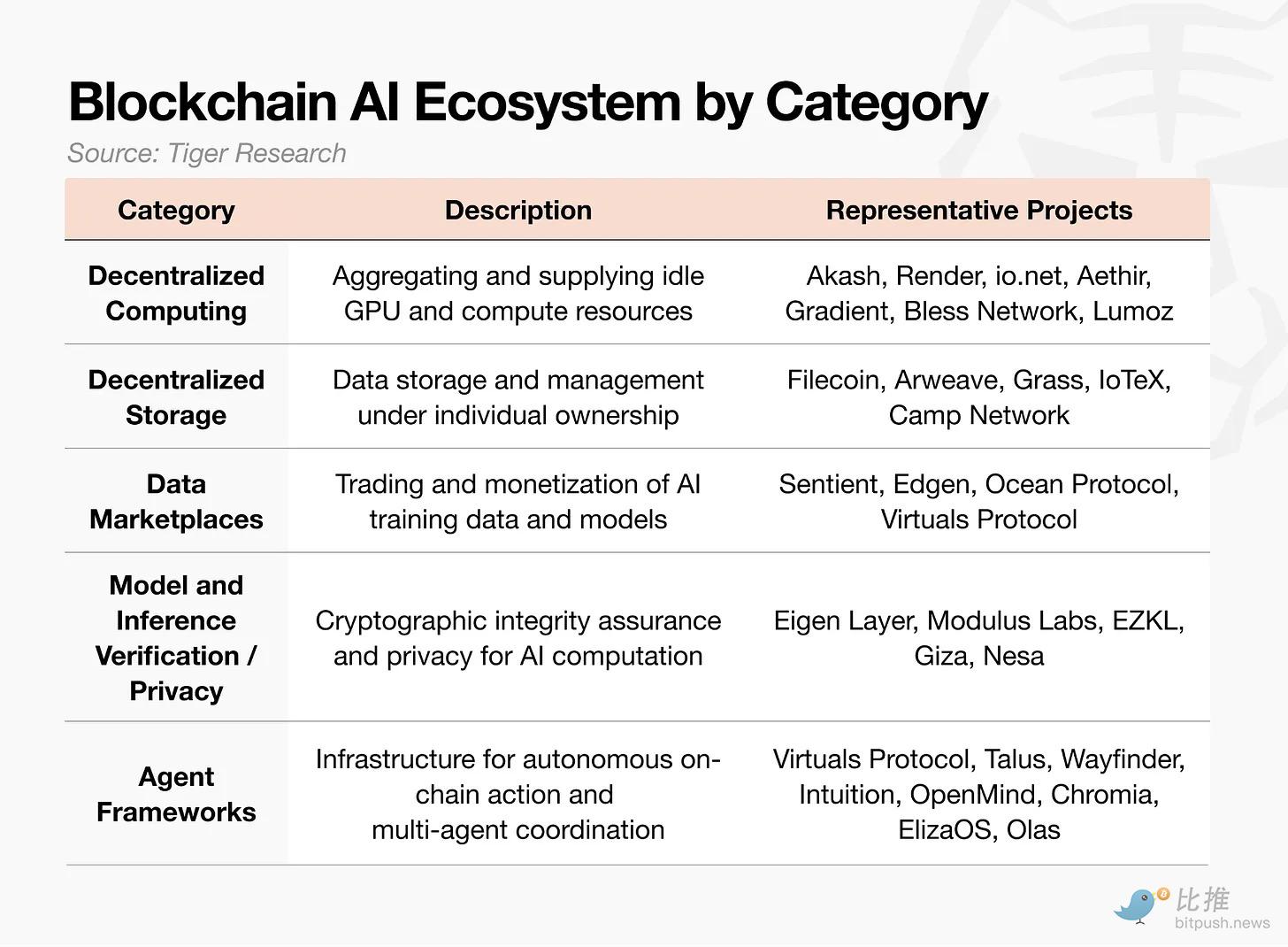
2.1. Decentralized computing
Today's cloud computing market is structurally dependent on a few large technology companies that control computing resources. High-performance GPUs are difficult to obtain and expensive, creating a steep barrier to entry for AI startups and research teams that don't have access to large-scale infrastructure.
Centralized systems focus resources on the biggest buyers, and there are no neutral channels in the market that can reallocate large amounts of idle GPU capacity.
Decentralized computing addresses this centralization and inefficiency problem in two ways:
Sharing economy model: The project aggregates idle GPU resources held by individuals and small data centers into a unified network, thereby creating a more flexible supply chain outside of established technology monopolies.
Distributed computing model: Users can rent computing resources globally without relying on any single vendor's infrastructure, thereby improving hardware utilization and lowering the entry threshold for high-performance computing.
2.2. Decentralized storage
Current data storage architectures rely almost entirely on centralized cloud infrastructure operated by companies such as Google and Meta. When users uploaded data to these platforms, ownership was actually transferred to the platforms, thereby solidifying their monopoly control over AI training data. Centralized infrastructure also introduces operational risks: policy changes, service interruptions, or platform failures may cut off data access or result in data loss.
Decentralized storage addresses these structural problems in two ways:
Sharing economy model: Using Filecoin and Arweave as an example, participants pool their idle storage space into a network, which can replace existing centralized cloud services.
Permanent storage model: Data is distributed and replicated across nodes to ensure data durability without being affected by the operating status of any single server and reducing dependency on any single platform.
2.3. data marketplace
AI developers need training data, but the current operating model of the data distribution market is closed, and large platforms such as Hugging Face and cloud service providers have taken over economic benefits and controlled pricing. Data creators are rarely compensated, and there is a lack of transparency in reward mechanisms for data collection and contributions.
The on-chain marketplace has eliminated intermediaries and established transparent terms of trade through smart contracts:
Direct transaction model: such as Ocean Protocol, data owners and AI developers directly trade through smart contracts, and rewards are distributed transparently.
Contribution reward models: such as Grass, where individuals connect idle bandwidth for AI data collection and receive rewards proportional to the value of their contributions.
2.4. Model and inference verification/privacy
Traditional AI systems operate like a “black box,” with no external means to verify that the model is working correctly or that sensitive user data has been handled safely.
Zero-knowledge machine learning (ZKML) introduces a cryptographic verification layer for AI inference, enabling privacy protection and auditability. In this architecture, the model runs off-chain in the traditional way, but the computation process generates a cryptographic proof that the process is correctly executed according to established rules.
It is this “proof” that is recorded on the chain, not the underlying data. For example, in an automated health insurance claims service, hospitals only need to submit proof that an AI model is working properly without sharing full medical records. Insurers can verify the legality of a claim without access to the original data.
2.5. AI agent framework
As AI agents become the main core of traffic and value creation, they are evolving from tools to autonomous economic players. The current financial system is designed around the human consumption model and is structurally incompatible with the machine-centered payment environment.
The agency economy requires micropayments, high-frequency settlements, and millisecond cross-border payments, and the existing financial infrastructure cannot adapt to these demands.
The on-chain proxy infrastructure addresses this issue through two mechanisms:
Autonomous execution and control mechanism: AI agents are assigned unique wallets and identities, enabling them to directly sign transactions, set spending limits, and protections against unexpected behavior.
Protocol-based settlement mechanism: Use stablecoin payment protocols such as x402 to settle microtransactions and high-frequency payments in real time, and skip currency conversion and approval processes.
3. Why blockchain AI is deviating from the AI value chain
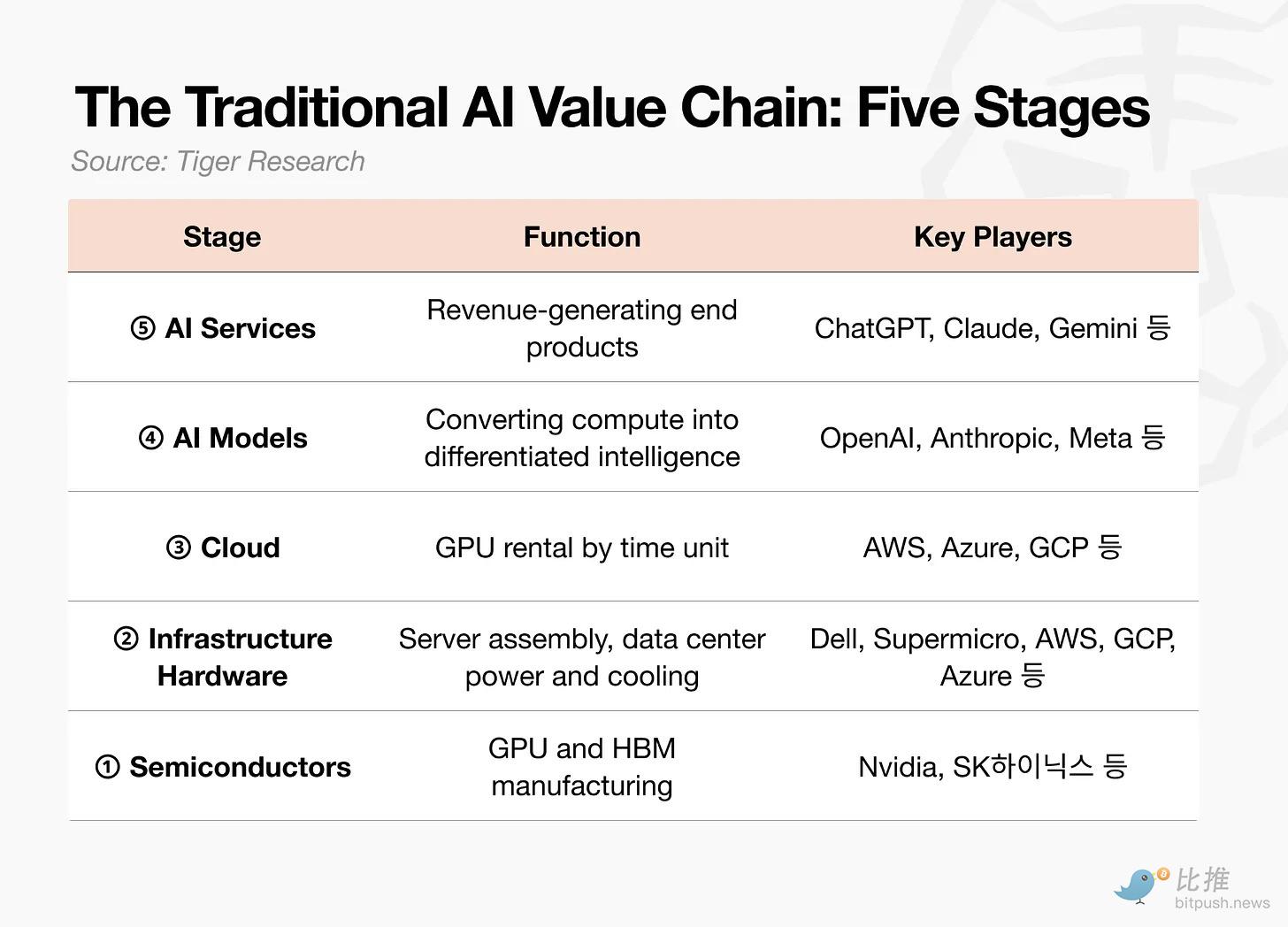
The AI value chain revolves around “eliminating bottlenecks sequentially.” As demand for AI grows, memory shortages have arisen, and power and data transmission capabilities have also been limited. Companies that can quickly solve these problems (such as HBM manufacturers and power infrastructure providers) have attracted significant capital and market appreciation. The market clearly gave value to solutions that remove barriers to growth.
Although blockchain AI projects have identified real problems, they haven't received the same level of market attention. If these issues were as urgent as they claim, they should have driven a significant shift in the market.
The reason blockchain AI projects fail to attract mainstream capital while promoting legitimate goals such as “reducing GPU centralization” and “restoring data sovereignty” is because there is a huge gap between the priorities of technology vendors and those of buyers who control capital allocation.
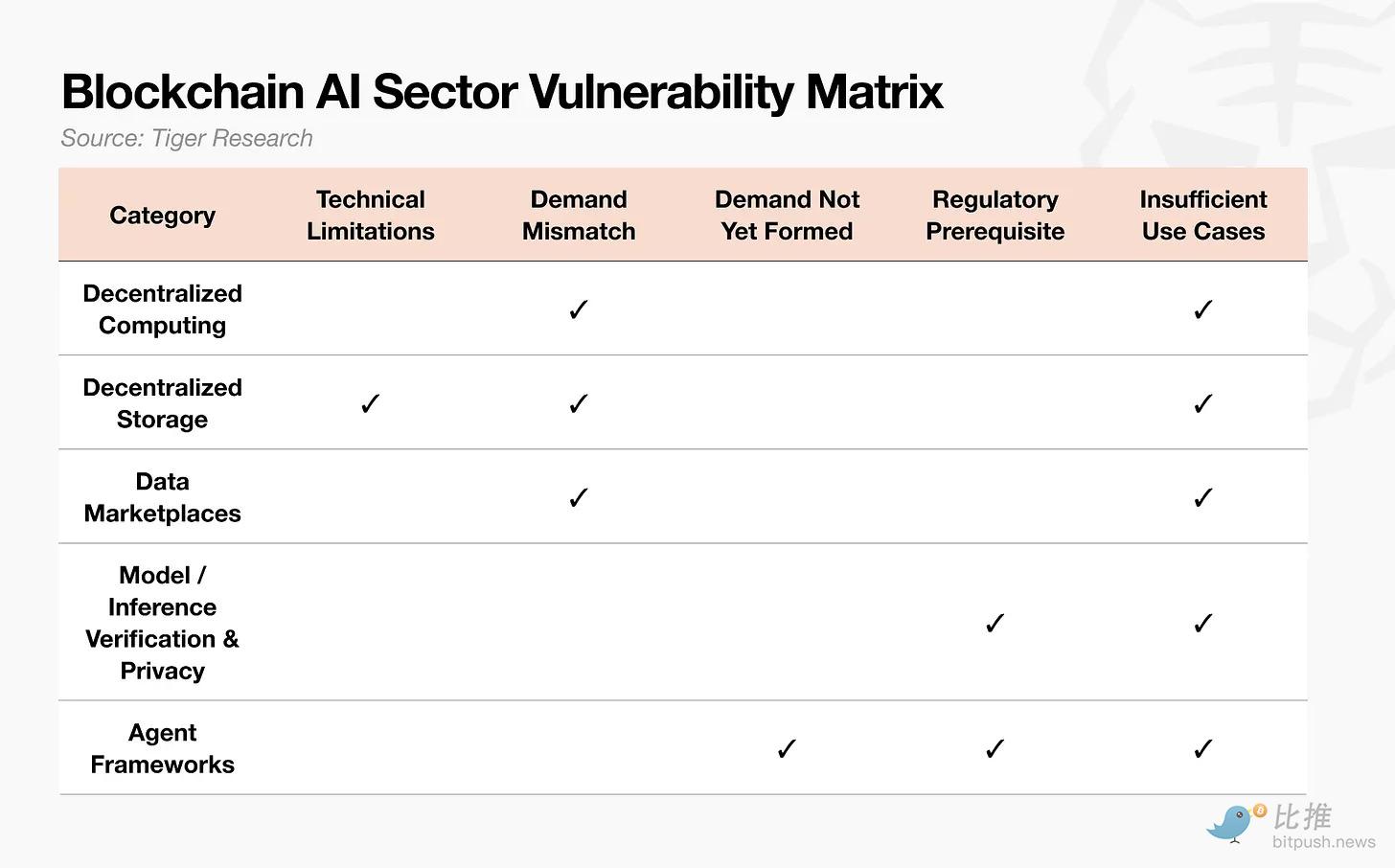
The AI industry operates on a competitive timeline, and buyers (mostly big tech companies and enterprise customers) invest massively in technology that can resolve their immediate operational bottlenecks as quickly as possible. They don't spend time evaluating unproven infrastructure. Their priorities are computational performance, infrastructure reliability, and a proven return on investment.
For example, when data transmission speed became a bottleneck in model training, large amounts of capital went to optical fiber infrastructure to replace copper cables; when memory bandwidth became a major constraint, SK Hynix and Samsung Electronics solved this critical problem through high-bandwidth memory (HBM), thereby gaining global recognition. The pattern is consistent: capital follows those who have removed the constraints to progress.
The fundamental problem with blockchain AI is “positioning.” Buyers with large capital budgets only focus on recent performance improvements and cost reductions. Blockchain AI, by contrast, focuses on issues that buyers consider “secondary” or “future states.” Technical ambitions on the supply side are at odds with immediate operational requirements on the demand side.
3.1. Technical limitations
Some projects used benchmarking to demonstrate the potential and design ideas of decentralized infrastructure. But the more fundamental problem is that this work has yet to produce a decisive technological leap sufficient to replace established giants in mainstream markets.
For a new technology, if it wants to take a share from centralized cloud service providers that already have huge capital and infrastructure, such as AWS or GCP, it must provide huge performance advantages, so much so that the gap with existing giants is no longer significant.
When Apple switched from Intel chips to M1 chips (and took the huge risk of disrupting software compatibility), the move was justified by a threefold increase in energy efficiency — a gap that was enough to make the switch worthwhile.
Blockchain AI has yet to provide a clear enough case for business buyers that require petabyte-level data sync and ultra-low latency as a benchmark for them to accept the risk of conversion.
3.2. Demand misalignment
In the field of decentralized computing, some projects have introduced “service level agreements” (SLAs) as a risk mitigation mechanism, but corporate buyers are still unconvinced. The reason is structural, not contractual. Large cloud service providers provide controlled, dedicated data centers. Blockchain networks, on the other hand, rely on scattered, anonymous node participation.
If a node goes offline and interrupts model training tasks worth hundreds of millions of won, no token compensation or financial compensation can recover the opportunity cost and loss of time. For business buyers operating on competitive timelines, system stability is not a negotiable parameter. Even with hedging mechanisms, most buyers are unmotivated to take the remaining risk of uncertainty.
3.3. Demand has not yet been formed
Blockchain proxy frameworks are designed for complex ecosystems (that is, multiple AI agents collaborate autonomously), but there is a maturity gap between this vision and the current state of the mainstream market.
Enterprise adoption of AI agents is accelerating, led by companies such as Microsoft and Salesforce, but the focus is now firmly on “workflow automation” running within controlled internal networks. The infrastructure the blockchain project is building targets the next phase: independent AI agents that operate autonomously on an external network outside of any organizational boundary. Most businesses are still focused on building the stability and return on investment of their deployed AI systems. Multi-agent collaboration across external networks has yet to be a priority in the enterprise infrastructure roadmap.
The limited demand at this stage reflects “timing” rather than “technical failure.” This should be understood more as a long-term infrastructure investment targeting the future of the proxy economy rather than an immediate revenue opportunity.
3.4. Regulatory prerequisites
Zero-knowledge proof and privacy-preserving technology are core solutions for building AI trust, yet in the early stages of AI adoption, businesses had limited actual need for privacy infrastructure. Spontaneous adoption by enterprises is unlikely to drive meaningful adoption; the more likely path is for regulatory standards to create demand and then technology will follow suit.
The increasing specificity of the global regulatory framework (including the EU Artificial Intelligence Act) is a positive development in this regard. As legal requirements for data sources and security become specific, blockchain's advanced verification capabilities are expected to become a compliance requirement rather than an optional feature in enterprise deployment.
Regulatory developments in this field are best understood as a catalyst for market formation rather than as a constraint. Clear regulatory standards reduce market uncertainty and thereby create a stable path, enabling blockchain AI to establish mainstream demand within an institutional framework.
3.5. Lack of sufficient use cases
The combination of these structural factors has created an even more fundamental problem: lacking a “defining success story” that can prove its value on a large scale, the traditional AI industry has established its current position through Flywheel adoption triggered by ChatGPT, using a specific and widely visible product to attract the capital and talent needed to sustain further growth.
Blockchain AI projects have yet to produce the same product-market fit (Product-Market Fit) evidence in terms of scale. Other than early community enthusiasm, no project can prove that it has reached a level of adoption sufficient to attract serious attention from mainstream capital in business operations or consumers' everyday lives. The lack of convincing reference cases remains the biggest obstacle to attracting conservative institutional investment that can accelerate wider adoption.
4. Is the combination of the two valuable?
Blockchain AI has yet to find a foothold in the mainstream AI value chain. But does that mean the combination of the two is meaningless?
That's not the case.
The fundamental reason why blockchain AI projects are currently being overlooked is not because of the conflicting logic of the two, but because there is a misalignment between the requirements of the existing industry and the direction provided by the technology in every segment.
The traditional AI industry's priorities are clear: near-term performance, cost optimization, and stringent infrastructure reliability. Many current blockchain AI proposals focus on data ownership, computational transparency, and decentralization.
These issues are not what established industry players see as “immediate bottlenecks,” and pursuing these goals often requires the acceptance of performance losses, which are too expensive compared to the benefits.
Before the AI boom, power infrastructure companies were broadly classified as mature, low-growth businesses. This was changed by the surge in power demand driven by data centers, and since then they have attracted significant market attention. The current indifference to blockchain AI may reflect a similar lag — a transition period before a new paradigm creates conditions that reflect its value.
In this transition period, the key is how the industry responds to the real needs of the market.
The path ahead is divided into two directions: one is to actively adapt to existing AI value chain standards and close the immediate performance gap as soon as possible; the other is to adhere to existing capabilities while continuing to build the infrastructure needed for future generations of AI deployments.
The end result will depend on which choice is more in line with the next direction of demand.
Twitter:https://twitter.com/BitpushNewsCN
Compare the TG exchange group:https://t.me/BitPushCommunity
Compare TG subscriptions:https://t.me/bitpush
