


Predicting a market turnover of 3.3 billion US dollars, why is half of the capital betting on unpopularity?
By Oluwapelumi Adejumo
Compiled by Luffy, Foresight News
Original title: World Cup prediction market frenzy: total transaction of 3.3 billion US dollars, half of the capital went viral
TL; DR:
The total contract volume of the Polymarket World Cup tournament exceeded 3.3 billion US dollars, far exceeding the predicted market volume of this year's Super Bowl;
France and Argentina lead the championship and the final seat market, and traders are betting that the two teams will repeat the 2022 finals match;
The market has $1.6 billion in trading capital betting on underdog teams with less than 1% win rate.
The World Cup brought one of the largest sports traffic in history to the forecasting market, but behind high transaction amounts, industry data showed an abnormal market structure.
The total number of World Cup-related contracts on the Polymarket platform has exceeded 3.3 billion US dollars, significantly ahead of the predicted market volume of 1.4 billion US dollars for this year's Super Bowl. This gap intuitively reflects the rapid penetration of the event trading circuit into mainstream sporting events: soccer covers the global market, the tournament cycle is longer, and the trading window obtained by the platform is much longer than that of a single final match.
Polymarket not only ushered in a market explosion, but Kalshi and other predictive trading platforms also saw a sharp rise in football-related contract trading volume, such as winning or losing matches and winning the World Cup.
However, the funds were not concentrated on the team with the highest chance of winning the championship. As the tournament enters the round of 32, the forecast market is polarized: top popular teams compete fiercely, while there is still plenty of money betting on underdog teams with extremely low win rates.
France and Argentina lead the market, and the market is betting on a repeat of the previous finals
France became the top pick to win the 2026 World Cup, followed by Argentina. According to Polymarket data, France has an implied probability of winning the championship 23%, Argentina 21%, and the two 2022 Qatar World Cup final teams are in the top two; Spain is third with 11%, England is fourth with 10%, and Brazil is fifth with 6%.
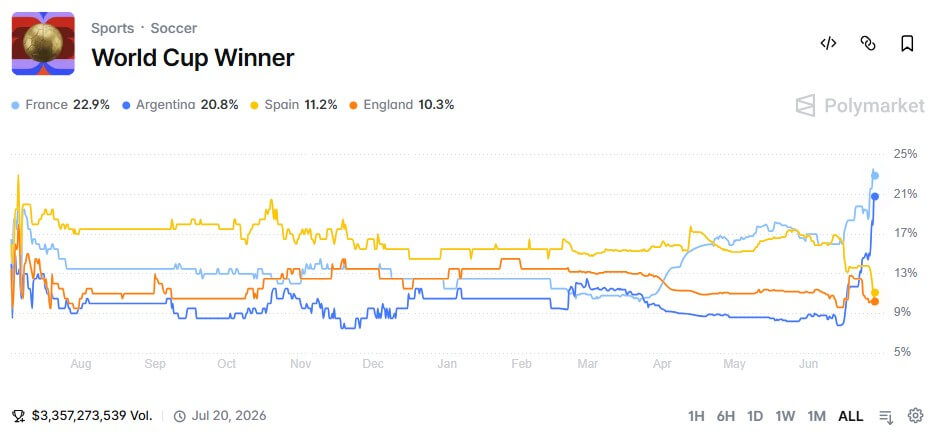
The contract trend for a place in the finals is highly similar. France ranked first with an implied probability of advancing to the finals with a 39% chance, followed by Argentina with 38%, and Spain ranked third with 23%. Market pricing reflects the predictions of many traders, and the final story where Messi led Argentina to the championship four years ago may be played out again.
The volume of trading capital of popular teams intuitively reflects market attention: Argentina won the championship contract of US$81 million, France US$77 million, Portugal US$76 million, Spain US$68 million, and England US$61 million. The data is sufficient to prove that there is strong demand for transactions with popular targets, but this does not explain the market's unbalanced funding structure.
$1.6 billion pours into underdog teams
Approximately $1.6 billion in trading capital is placed on teams with a probability of winning the championship of only 1% or less. This capital accounts for two-thirds of the total volume of contracts to win the championship, even though these teams have little chance of winning the championship in theory.
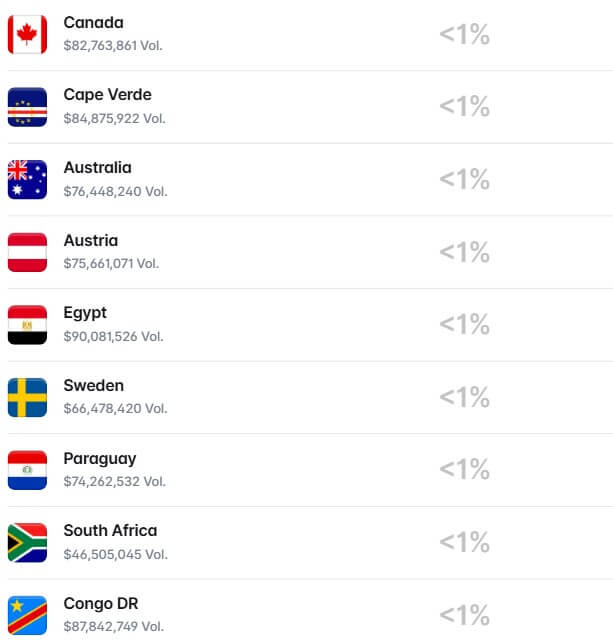
Many underdog teams have remained high in historical transactions, with Côte d'Ivoire trading at US$101 million, Mexico at US$97 million, Egypt at US$90 million, Cape Verde at US$87 million, and Morocco at US$82 million.
There is a serious disconnect between trading volume and probability of winning, revealing the unique characteristics of the prediction market. The popularity of a contract does not mean that current traders are generally optimistic about this result; it only indicates that a large number of transactions occurred when the odds did not change drastically in the early stages of the tournament.
In addition to this, some holdings stem from simple unpopular speculation, fans' emotional purchases, hedging arbitrage, collusion orders, or historical positions that users have not closed for a long time. As a result, some targets appear to be actively traded, but in fact, they are completely out of touch with current market expectations.
Traditional sports betting resets odds according to market conditions, and predicts that market contracts will continue to trade until settlement or user closes positions, and capital will be stored for a long time in unpopular team positions that are no longer favored by the market. This characteristic is particularly prominent in this World Cup market.
Market differentiation can be seen more clearly compared to the top hits. Buying a combination of five popular teams from France, Argentina, Spain, England, and Portugal now costs only $0.72. As long as any team wins the championship, you can redeem $1. The deal reflects a high concentration of market confidence, yet billions of dollars are still scattered over other unpopular targets.
From this perspective, the World Cup trading list is not only a ranking of the probability of winning, but also a complete record of traders' operations throughout the cycle: timing of entry, positions that have been put on hold for a long time, and liquidity that has not been fully settled.
Predict that the overall market will usher in full prosperity
The World Cup sports market is driving the entire prediction track to accelerate the institutionalization and large-scale expansion of users. Wall Street investment bank Bernstein predicts that before the World Cup comes to an end on July 19, the total amount of game-related bets on all platforms may exceed $10 billion.
The popularity of sports tracks is also spilling over into non-sports contracts. According to the latest data from venture capital agency a16z, the total transaction volume of non-sports contracts such as geopolitics, macro-data, and general elections on the Kalshi and Polymarket platforms reached 3.6 billion US dollars.
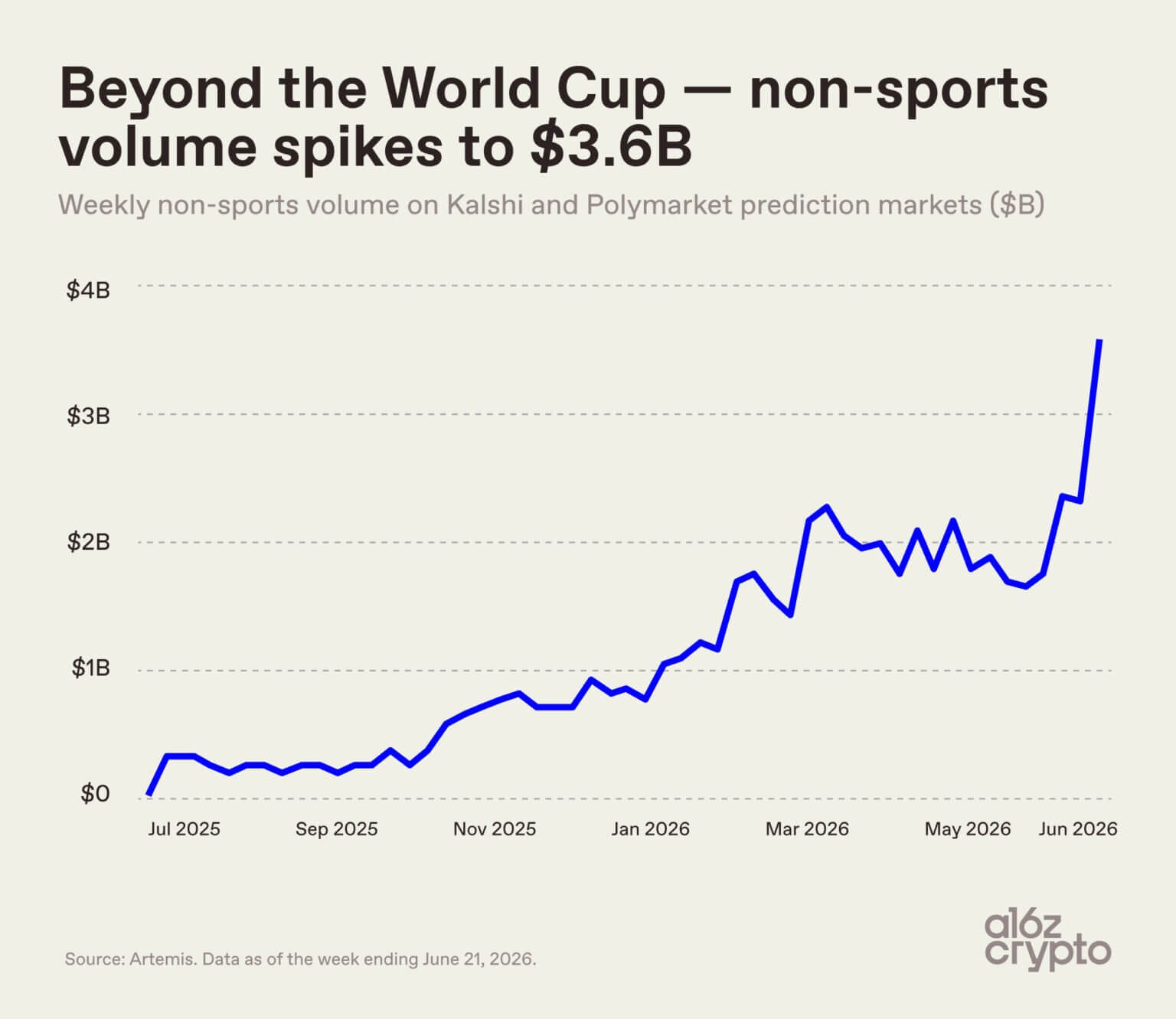
a16z said that in addition to the current trading volume on sports tracks alone, it has already exceeded the total market volume predicted by the entire industry a year ago. In July 2025, weekly non-sports track sales were only $200 million, an 18-fold increase in 12 months.
According to a16z statistics, the weekly trading volume of the full forecast market hit a record high of 14.5 billion US dollars last week, and the position size maintained a record of 1.6 billion US dollars for three consecutive weeks.
Regulatory scrutiny continues to be tightened
At the same time as the commercial scale of the World Cup trading market reached a new high, the industry ushered in a new round of legal regulatory scrutiny. According to the Wall Street Journal, the US Commodity Futures Trading Commission (CFTC) has launched an investigation into Polymarket.
Consumer protection agencies and multi-state regulators in the US continue to call for strengthened supervision of prediction platforms. Polymarket and Kalshi businesses are expanding rapidly, and users can bet on various events such as sporting events, general elections, cryptocurrency quotes, and financial market trends on the platform.
The survey brought significant uncertainty to Polymarket. The platform banned US users after being punished by regulations in 2022, and only resumed business in the US region on a limited basis last year.
The timing of the tightening of regulations is very delicate. It is predicted that market transaction volume will set new records one after another, while regulators are also carefully reviewing the platform's operating model and consumer protection mechanisms to clearly differentiate the regulatory boundaries between compliance event contracts and illegal gambling.
Twitter:https://twitter.com/BitpushNewsCN
Compare the TG exchange group:https://t.me/BitPushCommunity
Compare TG subscriptions:https://t.me/bitpush
