


On the eve of going to the US, Hynix fell like a native dog

Author: Azuma (@azuma_eth)
Original title: On the eve of going to the US, Hynix fell like a native dog
SK Hynix's US listing process has reached its final stage, but just before the South Korean storage giant is about to land on the NASDAQ, the AI and semiconductor industry narrative has taken a sharp turn in sentiment in a very short period of time.
On the evening of July 1, the news that “Meta may release excess computing power” sparked speculation that major manufacturers might reduce capital expenditure, which in turn caused sharp market fluctuations. As the narrative of “absolute scarcity” of AI computing power began to loosen up, the semiconductor memory chip sector was directly impacted, and related concept stocks collectively experienced a huge correction in the secondary market — SK Hynix Korean stocks closed down 14.57%, dropping hundreds of billions of dollars in market value in a single day.
Countdown for SK Hynix to the US
On June 30, SK Hynix submitted an F-1 prospectus to the US Securities and Exchange Commission (SEC) to list on NASDAQ through the issuance of an “American Depositary Receipt” (ADR). It plans to raise about 45.45 trillion won (approximately US$29.4 billion), and is expected to become one of the largest ADR issuances in history. All of the capital raised will be used to expand production capacity in Korea, including the Yongin Fab, Cheongju Advanced Packaging Production Line, and investment in EUV and related equipment.
Odaily Note: The so-called ADR is essentially a trading vehicle for non-US companies in the US stock market. ADR is not a US stock directly issued by a company, but an “alternative security” issued by a custodian bank in the US. The underlying level corresponds to the common stock assets of overseas companies. Through ADR, investors can directly trade overseas company shares in US dollars in the US stock market without opening a cross-border account or handling foreign exchange and settlement processes.
The transaction is jointly underwritten by Bank of America, Citibank, Goldman Sachs and J.P. Morgan Chase. A total of 17.79 million new shares (2.5% of its total issued share capital) will be issued under the stock code SKHY. In terms of schedule, ADR is expected to be traded on NASDAQ on July 10.
The reason why SK Hynix chose to actively promote its listing in the US during the current cycle is essentially the result of the resonance of the three factors of the industrial cycle, capital window, and competitive structure.
First, SK Hynix is currently in a historic boom cycle. Driven by AI server demand, high-bandwidth memory (HBM) has become the core supply bottleneck. The company's market share in this field has exceeded 50%, while driving the overall DRAM business into a high-profit stage. This also enabled its performance to enter the upward channel at the same time as its stock price, forming a typical “cyclical high-level financing window” — large-scale production expansion financing at the stage where fundamentals are strongest.
Second, judging from the capital market structure, the US market is still the main pricing center for global AI assets. Whether it's Nvidia, AMD, or memory chip companies such as Micron, US stocks as a whole give the AI industry chain a significantly higher valuation center and liquidity premium. In contrast, there has been a so-called “Korean discount” in the Korean market for a long time, and the valuation of similar semiconductor assets is generally lower than that of US stocks. Therefore, one of the core meanings of SK Hynix going to the US to issue ADR is to hope to include the company in a higher valuation system for repricing.
Finally, storage giants are in fierce competition to expand production, and the expansion of production capacity is highly dependent on continuous huge capital investment. SK Hynix's financing of close to 30 billion US dollars will be used to expand production of fabs, advanced packaging and equipment. Essentially, it is also seeking to transform capital advantages into production capacity advantages.
If it turns out like this, can I still buy Hynix?
Originally, SK Hynix's visit to the US can be seen as a historic moment for the storage industry, but this round of sharp correction, which began last night, temporarily injected great uncertainty into its future market. Should we take the opportunity to break the bottom and wait for US stocks to take off after listing? Or is it time to reduce positions decisively to avoid potential bubble bursting?
I would like to state in advance that the next part is solely my opinion and does not constitute investment advice.
In my personal opinion, this round of SK Hynix's sharp decline, including a sharp correction in the sector, is closer to a liquidity stampede driven by heightened sentiment rather than a substantial reversal of industry trends.
First, let's focus on the trigger in the news — “Meta may release excess computing power.” The news itself is overinterpreted.
Bloomberg first published this news with the headline “Meta Is Building a Cloud Business to Sell Excess AI Compute” (Meta Is Building a Cloud Business to Sell Excess AI Compute), but then changed to “Meta Is Planning a Cloud Business and Selling AI Computing Power” (Meta Is Planning a Cloud Business Sell AI Computing) Power), but other media, including Reuters, have retweeted the story using the first headline.
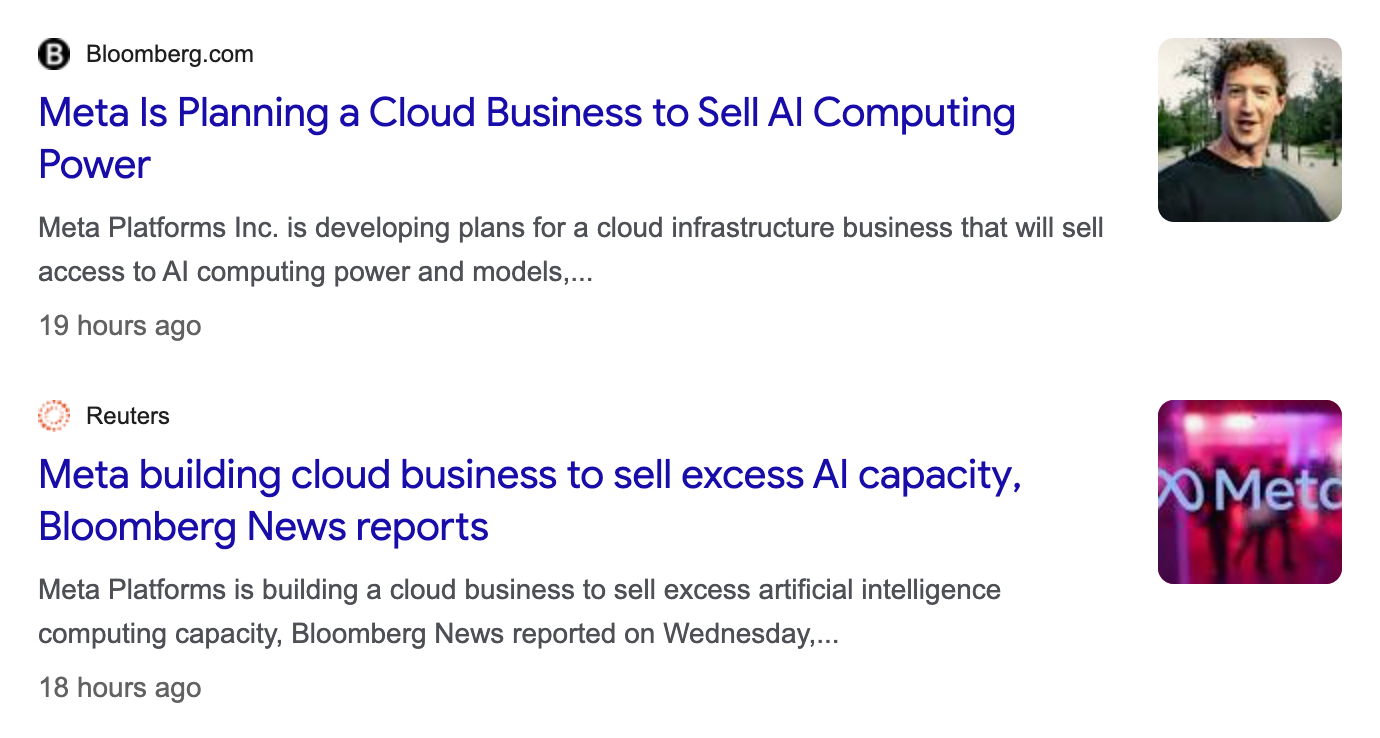
There are two key changes in the two headings. One is that “under construction” was changed to “plan construction,” which directly weakened the certainty and timeliness of the report; the second was that the expression “excess” was removed, but this initial statement was easily interpreted by the market as “excessive computing power”, which in turn formed a chain of deductions from “excess computing power → capital expenditure peaking → AI demand weakening”, which ultimately caused market panic.
Taking a step back of ten thousand steps, even if it is confirmed that Meta is about to sell computing power, it is actually difficult to form a sufficient reason to determine that the “AI capital expenditure cycle” is over. Judging from industrial logic, Meta itself is relatively backward in the AI competition. The pressure on its basic model and computing power efficiency objectively determines Meta's need for computing power scheduling and asset optimization to a certain extent. In this context, the externalization or commercialization of some computing power resources is closer to an asset utilization optimization act rather than a systematic contraction on the demand side.
This kind of “redistribution of computing power” is not uncommon in the AI industry chain. Two months ago, SpaceX also commercialized some computing power resources (such as leasing to Anthropic). Essentially, this was only due to a rebalancing of costs and resource efficiency, not a denial of AI demand itself. As a result, the computing power scheduling behavior of a single enterprise where the scale is still uncertain is directly extrapolated to “industry surplus,” and there is a clear logical leap forward.
As to why this news is so lethal, another key reason is the market structure. Prior to this round of decline, the semiconductor memory chip sector itself was already at a relatively high level, and the concentration of trend capital and leveraged ETFs was high. Under this structure, the market's sensitivity to marginal information has increased markedly. Once a narrative shock occurs, it is easy to trigger amplified deleveraging and passive position reduction, thereby amplifying fluctuations that were originally at the “expected adjustment level” to a “price stomping level” retreat.
Therefore, this pullback is more like the result of a typical combination of “emotional panic + structural deleveraging”, and I personally tend to take the opportunity to fill up positions in this round of decline.
After all, SK Hynix itself is in the critical window of going public in the US, raising close to 30 billion US dollars. Whether it is an underwriter or institutional capital participating in the subscription, they probably don't want the stock price to go too bad after listing.
Twitter:https://twitter.com/BitpushNewsCN
Compare the TG exchange group:https://t.me/BitPushCommunity
Compare TG subscriptions:https://t.me/bitpush
