


Strategy's accounting trick: the upper limit of coin sales is far more than $1.25 billion

Author: Bankless
Compiled by Azuma
Original title: Strategy's Accounting Trick: The upper limit of coin sales is far more than $1.25 billion
Strategy revealed on July 7 that the company had sold 3,588 BTC worth approximately $216 million between June 29 and July 5.
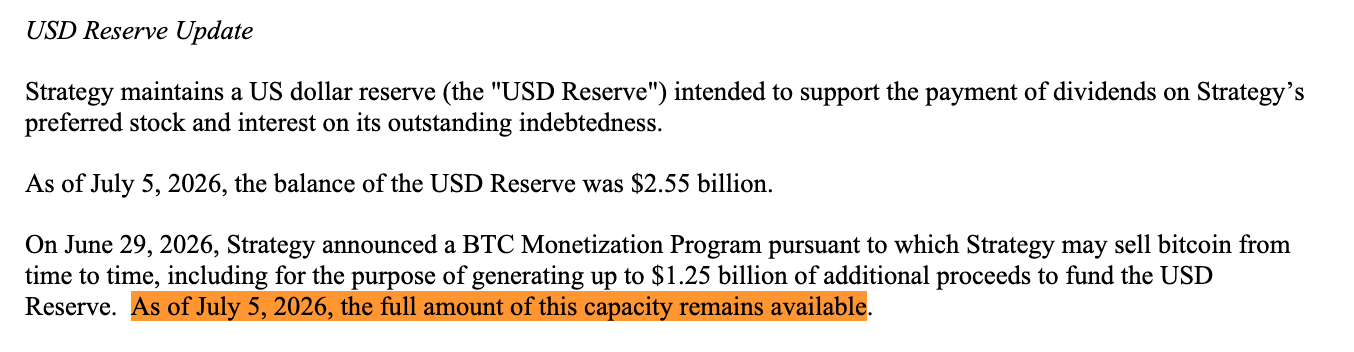
The funds were used to pay STRC's dividends and supplement the USD Reserve (USD Reserve) previously used to pay dividends. Despite completing this sale, Strategy said its full $1.25 billion reserve-building capacity (reserve-building capacity) is still in effect.
Daily note: In the “Self-Rescue Plan” announced last week, Strategy stated that it has authorized the company to sell BTC and build up a reserve of up to $1.25 billion.
In other words, the $216 million BTC sold by Strategy to replenish reserves did not count against previously disclosed reserve construction amounts.
Strictly speaking, there is a technical difference between the two: one is “replenishing reserves” (replenishing reserves) and the other is “building” (building). However, in reality, both types of sales will eventually flow into the same reserve pool for the same purpose, but are classified as different uses.
Looking at it another way, the “BTC Monetization Program” (BTC Monetization Program) previously disclosed by BTC never limited Strategy to sell a total of $1.25 billion in Bitcoin; it limited only one pool of funds — that is, “building” dollar reserves by selling BTC.
The plan also allows Strategy to sell BTC for other purposes, and this is exactly what we're seeing right now.
Three funding pools
On June 29, after weeks of pressure on MSTR and STRC, Strategy launched the aforementioned BTC “monetization plan” as part of its larger “Digital Credit Capital Framework” (Digital Credit Capital Framework).
The plan allows Strategy to sell Bitcoin and actually mentions three main uses:
The first is to build the reserve (Build the Reserve), which can sell up to $1.25 billion in BTC to establish a USD Reserve (USD Reserve);
The second is to pay the cost of preferred stock and debt (Cover the preferreds), that is, selling BTC to pay Strategy's fixed dividends and interest obligations on its preferred shares and debts. If management believes “selling BTC is more profitable than issuing common shares,” it can also supplement reserves previously used to pay for these obligations by selling BTC.
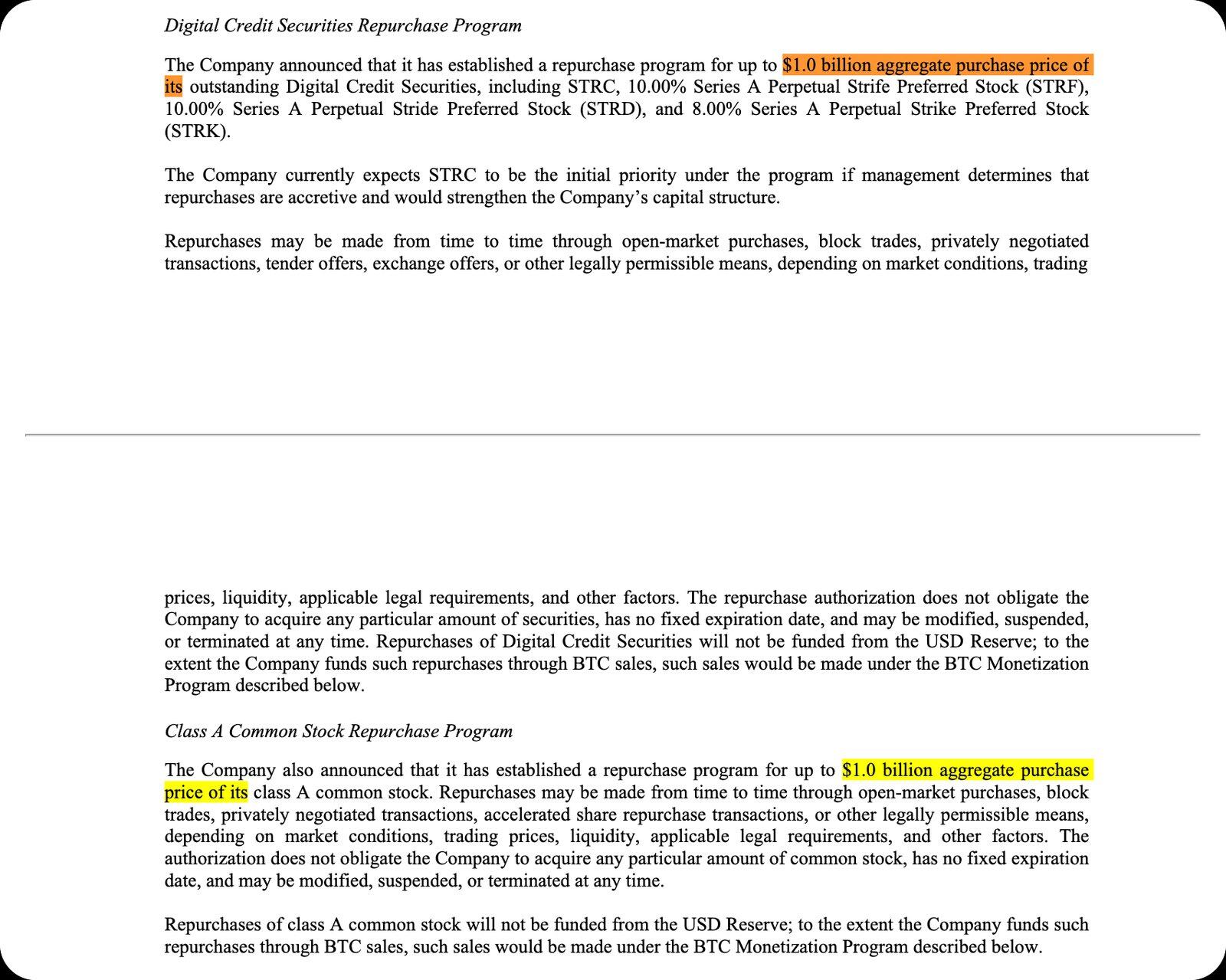
The third is fund buybacks (fund buybacks), that is, selling BTC to buy back up to $1 billion of preferred shares (preferred shares) and up to $1 billion of MSTR common stock (common stock). Additionally, the proceeds from the sale of BTC may also be used to cover related taxes, processing fees, and other charges.
At the time, discussions across the market focused on the first pool of funds of $1.25 billion, but that was far from the case.
Looking at the third pool alone, the sales amount was actually increased by an additional 2 billion US dollars. Therefore, when calculating only the portion with a clear upper limit, the BTC coin sales scale currently designed by Strategy has exceeded 3 billion US dollars, and this does not include the pool used to pay dividends, interest, and supplementary reserves — this section does not currently disclose any clear upper limit.
Building (Building) and Replenishing (Replenishing)
Here's where the real subtlety lies.
The purpose of the USD Reserve (USD Reserve) is to pay dividends and debt interest obligations on these preferred shares. Under the current policy framework, it cannot be used for share repurchases.
As of June 28, Strategy's dollar reserves were US$2.55 billion, which is sufficient to cover the company's annual debt and preferred share payment obligations of approximately US$1.76 billion, which is equivalent to a 17-month guarantee period. The Strategy Board has set a minimum requirement to maintain a 12-month level of coverage, unless the Board approves a reduction in this standard.
This is why the line between “building up reserves” and “replenishing reserves” is worth paying attention to.
Selling BTC and adding cash to reserves before dividends are paid: this is defined as “building” (building).
Use reserves to pay dividends, then sell BTC to refill reserves: this is defined as “replenishing” (replenishing).
The plan sees the two as different categories, but they actually do the same thing — converting BTC into cash to cover preferential share dividends and interest expenses.
These details have actually already been disclosed in the documents, but this round of sales a few days ago made this classification difference even more obvious. Strategy sold $216 million worth of BTC to pay dividends and replenish reserves, while still announcing that its $1.25 billion reserve establishment amount remains complete.
Now, the market needs to start understanding Strategy's “specific language”: “build” and “add” are essentially just accounting classifications, but they determine whether Strategy's BTC sale will take up the “public quota” the market sees.
From coin hoarding to active capital management
In an announcement on June 29, Michael Saylor stated that the framework reflects Strategy's need for “liquidity, discipline, and active capital management” (liquidity, discipline, and active capital management).
Strategy CEO Phong Le stated more directly: “Strategy is shifting from a one-way capital issuance model to an active capital management model.”
Like Castle Island's Matt Walsh and Jeff Dorman last weekpodcastsAs explained in, Strategy has actually gradually become an actively managed hedge fund (actively managed hedge fund).
The strategy narrative in the past was very simple: selling MSTR shares → buying Bitcoin → providing investors with leveraged BTC exposure, but now the logic is different.
Today, Strategy is trading different components of its capital structure to manage the stressful relationship between common stocks (MSTR), preferred shares (preferred shares), dollar reserves (reserves), and Bitcoin assets (BTC).
This dynamic also brought about new conflicts of interest, and Walsh and Dorman stated:
Selling common shares can support preferred stock dividends, but it will reduce MSTR's premium relative to the value of its BTC holdings;
Selling Bitcoin can extend the duration of cash flow, but it will further weaken the “never sell” core narrative;
Supporting the preferred stock system can maintain market confidence, but it will consume cash reserves;
Cutting preferred stock dividends can protect liquidity, but may cause the price of preferred shares to collapse.
The so-called “reserve gap” is a reflection of this transformation. Today, Bitcoin is no longer just an asset that Strategy uses to continuously accumulate; it is becoming a balance sheet lever (balance-sheet lever) to maintain the operation of the preferred stock system.
What will we see in the end
Today, investors must assess Saylor's ability to operate such a “machine” — every time a lever is adjusted in the capital structure, it helps one part while potentially threatening the other.
This was the most interesting conclusion after the July 6 documents were revealed. Strategy isn't without options. It probably has more room to operate than what is seen on the surface of the market.
Don't make the mistake of thinking that the $1.25 billion limit represents the total limit for Strategy's Bitcoin sales.
Today, Strategy is an institution in need of a new understanding of the market. Now every specific phrase is even more important:
build (build);
supplement (replenish);
issue (issue);
repurchase (repurchase);
defend (defend);
Just as Fed observers carefully analyze every punctuation in every policy statement, the market must deconstruct every term Strategy uses to determine what it means for future BTC sales.
By launching this plan, Strategy has gained more flexibility for itself, but underlying contradictions still exist. This is no longer a simple “leveraged Bitcoin transaction,” but now it's a bet on active capital management capabilities.
Can Strategy continue to “sell BTC,” “replenish reserves,” “issue securities,” “buy back shares,” and “maintain the capital structure” while ensuring that no one part of this process disrupts the others?
I personally wouldn't want to bet on that.
Twitter:https://twitter.com/BitpushNewsCN
Compare the TG exchange group:https://t.me/BitPushCommunity
Compare TG subscriptions:https://t.me/bitpush
