


a16z latest long article: The most underrated type of token, not for speculation
Source: A16z Crypto
By Tim Roughgarden, Eddy Lazzarin, Miles Jennings, Scott Duke Kominers
Compiled and organized by: bitPushNews
In our article on token classification, we covered seven types of tokens, including web tokens, collectible tokens, and meme coins.
Among them, the least explored and underappreciated is Arcade Token: a token with a relatively stable value within a specific software or product ecosystem, usually managed by an issuer (such as a company).
Basically, Arcade Tokens are the blockchain equivalent of assets people are already familiar with in the real world: air miles, credit card points, in-game coins, etc. What all of these assets have in common is that they are all internally circulated currency to support the operation of a market economy: for example, frequent flyer miles and reward points can encourage brand loyalty and are used to buy tickets and upgrades; in-game coins can be used to buy and sell items in video games.
Although companies have been using these assets for decades, almost all previous instances have run on centralized databases, limiting ownership, portability, and user choice. Public chain-basedArcade TokenInstead, they are open, interoperable, and composable, which provides a new set of market design advantages.
This article aims to answer the most common questions we receive about arcade tokens: what they are, what they do, why are they valuable, how builders use them, the design trade-offs they involve, and the opportunities they present.
WhatsArcade Token (arcade tokens)?
At the technical level, an arcade token is a digital currency designed for consumption within its associated application ecosystem — its supply and demand are managed flexibly to maintain price stability. Please first think of them as currencies in the digital economy.
So where did the term “arcade token” come from? Whether you've been to an arcade hall or not, you're probably familiar with this concept:You walk into an arcade hall; exchange cash for coins, usually physical; then use those tokens to play a few rounds of “Big Bee,” “Crocodile Panic,” or other games of your choice.These tokens allow you to participate in the arcade's economic activities.
The arcade hall analogy clearly illustrates how these tokens work: arcade tokens have a relatively stable value within the economic system to which they belong — whether within a single service or between multiple services. The relative stability of the value of arcade tokens distinguishes them from other types of tokens, such as tokens that derive value from the operation of an underlying asset (such as asset-backed or collectible tokens), the operation of a decentralized network market (such as a network token), or speculative investments in a specific entity (such as company-backed or securities tokens).
As funny as the name sounds, arcade tokens are a powerful, programmable economic primitive — they're the key to unlocking a new field of crypto design.
What is not an arcade token?
Once again, the most substantial difference between arcade tokens and other types of tokens is that arcade tokens are not meant for investment or speculation. Unlike network tokens or securities tokens that people usually earn in anticipation of a return on investment, arcade tokens are used for spending.
People sometimes refer to arcade tokens as “functional tokens” because they are designed to provide, um, functionality. We avoid using this label because it suggests that other types of tokens lack functionality, which is by no means true. (See our “Defining Tokens” article for more information.) Alternative names for arcade tokens can include “points” (although in common parlance, this usually means that relevant records are kept on a private ledger rather than on a public chain) and “loyalty tokens” (which only describe a specific application).
This doesn't mean that the value of an arcade token will never change—as described below, the price of an arcade token may fluctuate slightly over time. However, arcade tokens usually provide an unlimited supply at current prices, and do not provide, promise, or imply financial returns. This means they are generally unsuitable as investment products and are therefore generally not subject to US securities laws.
What are the benefits of arcade tokens? Why should builders consider using them?
Arcade tokens enable builders to create and distribute value in the digital economy. Crucially, this ability to create and distribute value can motivate user behavior, drive early growth, and create network effects — without relying on external capital or speculative demand.
This intuition is simple, and once again fits the arcade analogy: if you run an arcade, you probably want to control the supply of tokens to keep circulation in line with customer demand. For example, on a day when the number of customers doubles, it might be helpful to roughly double the number of tokens in circulation, so all visitors can play the games they want (unless there are any capacity limits). Since you can mint enough tokens to meet demand, why shut people out?
You might also want to be able to adjust the price: if you make major improvements to the arcade itself — such as doubling the number of games, introducing better full-featured machines, or offering more attractive prizes — you might increase the price per token. Simply put, you need flexible control over your economic system to better manage the trade-off between supply and demand (in addition, to signal the value of your arcade to customers).
In addition to streamlining day-to-day operations, this financial control also helps build lasting relationships with your most loyal customers. For example, you can give out reward tokens to your most loyal players. Importantly, when people get home at the end of the day and have a few tokens left in their pockets, they have an incentive to go back to your arcade room, because that's the only place you can use those tokens.
More formally, the arcade token supports:
Dynamic pricing and promotions: Arcade token issuers can adjust the token price, adjust the token-denominated purchase price, or both. This allows them to discount goods or services during periods of low demand, or to reward spending spikes during peak times.
Network effect: Similar to frequent flyer miles and credit card credit categories, users who receive or hold tokens are more likely to remain attached to the brand. And the value of this established user base will drive increased participation and cooperation among merchants, developers, and other service providers, which in turn increases the value of users — a classic platform network effect
Incentives and loyalty rewards: Arcade token issuers can provide rewards and other benefits to users who perform desired actions. They can also use their issuance rights to reward network participants who accept or exchange tokens. All of this reinforces the network effects just described.
Economic control: Arcade token issuers can destroy tokens during exchange, track liabilities on-chain, and implement monetary policies similar to central banks — while keeping supply and price within a predictable range.
How do arcade tokens work?
Analysis of economic dynamics
The economic dynamics of arcade tokens differentiate them from other types of tokens. Arcade tokens do not grant the holder ownership of the underlying ecosystem, but rather give the holder the right to access or use certain apps or services; crucially, their market value is designed to be programmatically bounded. This doesn't require arcade tokens to be tied to the price of fiat currencies like stablecoins; it simply means that issuers can use some mechanism to achieve lower price limits and (often more important) price caps.
Arcade tokens are usually freely acquired at a pre-set price. Imagine again the token vending machine in the seaside promenade arcade: you walk up, put in a dollar, and the machine gives you, say, four tokens, 25 cents each. This token dispenser, commonly known as a “faucet,” actually sets a price cap that the market value should not exceed. As a result, arcade tokens are not investable: they are used for consumption, not speculation.
The value of the token can then be assessed based on the item to which the token is redeemable through any “sink” (that is, a mechanism for removing tokens from circulation). In the example of an arcade hall, the sink is the game's “coin slot” — you can play by inserting tokens. If playing a game costs one token, then it must be worth 25 cents. Alternatively, as an addition, the arcade can redeem the tokens at a repurchase price slightly below the price of the faucet, so the issuer can guarantee to always buy back those 25 cent tokens for, say, 20 cents. This sets a lower limit that the price should not fall below.
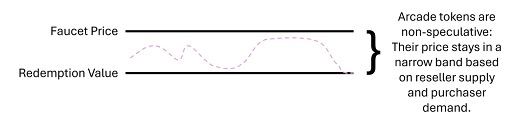
Consider the impact of these parameters on the market: when you could always buy the same token for a quarter of the price from a faucet (or vending machine), would you spend a dollar to buy a 25 cent token from a speculator? Never possible—that makes no sense! (Or rather, there are no “cents” at all!) A person moving to another town might stand in front of an arcade hall and try to sell their excess 25 cent tokens for 22 cents, but it's not profitable for anyone to buy them for more than 25 cents. So while some might choose to sell their arcade tokens at a discount (for example, if they leave this ecosystem forever), the price should remain relatively stable at any given point in time.
All of these non-speculative factors make arcade tokens particularly suitable as a foundation for a controlled market economy. Note that this doesn't depend on whether arcade tokens are only used on a small or medium scale in a single app or service, or more broadly — they're simply the result of an arcade token faucet/redemption design. (Continuing with the arcade hall analogy: even if the local grocery store owner is a huge game fan and chooses to accept local arcade tokens instead of cash payments, if you can always buy them for 25 cents by walking to the arcade, there's still no reason for someone to pay more than 25 cents per token.)
Why not just accept stablecoins as a form of payment?
There is some conceptual overlap between arcade tokens and stablecoins — both are designed to facilitate economic transactions while maintaining a relatively stable value. But arcade tokens can provide builders with more flexibility. Issuers can mint arcade tokens as needed (although issuers must still track the “shadow” value of these tokens on their balance sheets — that is, consider what happens when they are redeemed). The issuer can then use these tokens to provide grants and subsidies to users, developers, and other network participants.
Furthermore, these tokens encourage participants to stay within a given economic system rather than spend money elsewhere. (There's a reason why airlines issue “miles” that must be used on future flights rather than simply giving frequent flyers cash rebates.)
Arcade tokens can also provide builders with more profitable options. Issuers can sell tokens directly to users (at a fixed or dynamic price), bundle them into subscription packages, or distribute them through promotions. When partner networks agree to accept some kind of arcade token, it enables them to establish cross-promotion and affiliate models — strategies that can expand each partner's reach without the need for external capital.
Crucially, arcade tokens also allow issuers to exercise fine control over the flow of value within their economy by:
limit portability (for example, only within an app or between whitelisted addresses),
Set depreciation or expiration dates (encourage timely use and reduce stockpiling), and
Bundle redemptions with specific goods or services (aligning utility with economic intent).
These features help reinforce the value of tokens as a medium of exchange — not a speculative asset — and can be programmatically coded on-chain. In short: Arcade tokens can help drive growth, encourage participation, and manage the operation of the internal economy, while providing a degree of control to their maintainers.
The power of interoperability
As we've described, arcade tokens issued on a public chain are similar to loyalty points or air miles — but they have one major difference: they're on-chain, which means they can be open, interoperable, and composable.
Unlike traditional loyalty systems that trap value in a closed ecosystem, blockchain-based arcade tokens can be shared, accepted, and exchanged by multiple participants without permission — even between competitors in principle. Portability is a benefit: in this model, users can carry loyalty between different services, and status can be easily transferred (unlike today's complicated aviation “elite status matching” process). This portability encourages market participants to compete for product and service quality — rather than a pure lock-up effect — and may turn fragmented loyalty programs into public goods.
An example of the best on-chain arcade token is $FLY issued by BlackBird. This token creates a loyalty program for restaurants, similar to Starbucks stars or McDonald's rewards. This might sound familiar, but there's one change: the same token can be used in many different restaurants. Customers earn tokens when they spend at restaurants within the Blackbird network and can redeem discounts and other benefits at any participating restaurant. Because the underlying protocol is built on the blockchain, all of this can happen without those restaurants having to interact with each other. Just as an individual restaurant's rewards program strengthens customer loyalty, here $FLY can simultaneously strengthen the loyalty of the entire restaurant network.
Consumers benefit from broader utility; businesses benefit from shared network effects.
The result is competition (not competition in the classic sense): for example, your local coffee shop and Starbucks may benefit from accepting the same type of token. While it might seem at first glance that the two coffee businesses don't want this to happen, a shared loyalty program mediated by arcade tokens might actually benefit both parties. Arcade tokens can complement the Starbucks and local coffee shop experiences, so going to any of them can generate benefits that enhance the value of both parties. For example, if one of them redeems arcade tokens for free mocha, then this increases the value customers get when they buy coffee at any store. Such deals can strengthen customer loyalty to the network and encourage them to spend a larger share of their coffee budget overall.
This competition causes the network to generate more total surpluses, which can be distributed among all providers in proportion to the sales generated. In other words, instead of competing for a share of the existing cake, it's better to make the whole cake bigger.
Design trade-offs (and opportunities)
Arcade tokens are not available for all projects. They don't make sense in situations where speculative assets may be needed. For example, a first-tier blockchain network with its own network token usually doesn't require arcade tokens to run.
But for many projects — particularly those with a consumption-centered economy or a real-world combination — arcade tokens can be a good choice. They provide:
Price stability: Through a price cap and floor mechanism and controlled issuance.
Usability: Intuitive and consistent value helps users understand what they're spending.
Measurement clarity: Their cost on your balance sheet is the opportunity cost of their convertible items—no more, no less.
Control: Issuers can be managed in a manner similar to a central bank.
We are also seeing arcade tokens playing an emerging role as a complement or forerunner to network tokens. For example, a decentralized computing network may use network tokens to guarantee security and incentives among computing providers, while using arcade tokens to establish network effects among customer groups. Alternatively, a marketplace might use arcade tokens to guide participation and then introduce network tokens when its operating protocol is decentralized. In these cases, arcade tokens can act as an entry point to catalyze early demand and help establish initial traction before the network moves to a more decentralized system in the long term.
Regulatory outlook
An early example of an arcade token was the Quarters token from the blockchain-based gaming platform Pocketful of Quarters. Players can use Quarters tokens to access features and rewards for participating in the game. Regarding the opinion that arcade tokens are not investable assets, Pocketful of Quarters received a letter of inaction from the US Securities and Exchange Commission in July 2019, in which the agency acknowledged that people only use Quarters to participate in games, not speculation or investment.
Despite this positive precedent, the Quarters' no-action letter and many states' regulatory systems are flawed. For example, they are skeptical about interoperability and see it as a flaw rather than a feature. Their reasoning stemmed from the mistaken view that where interoperability exists, assets may become easier to trade and thus have the characteristics of financial instruments. This view overlooks that trading demand still depends on whether the asset has speculative upside — which, as we've explained, is generally not the case with arcade tokens. Meanwhile, interoperability is one of the most exciting prospects for on-chain arcade tokens, providing consumers with huge benefits, including less friction and more choices.
Smart design can ease regulatory concerns. Arcade tokens don't need to be confined to a closed network. Mechanisms such as price caps, faucet and sink models, and use-related redemptions allow issuers to programmatically curb speculative activity. Consumers also benefit from interoperability because it enhances usability, boosts competition, and creates a broader network effect — ultimately fostering innovation and bringing greater value to users without relying on financial speculation.
Although arcade tokens aren't suitable for all use cases, they represent a key building block in the evolution of crypto networks. Just as stablecoins unlock new forms of commerce and network tokens enable decentralized value sharing and governance, arcade tokens can power a large-scale digital economy.
As regulations become more clear, we expect more builders and users to recognize the benefits of arcade tokens, as more and more projects — including those not native to crypto — are exploring their usefulness.
Twitter:https://twitter.com/BitpushNewsCN
Compare the TG exchange group:https://t.me/BitPushCommunity
Compare TG subscriptions:https://t.me/bitpush
