


Morgan Stanley: The AI network market is rushing to $70 billion, and the first to reap the dividends is the copper cable sector
Author: Groove BlockBeats
Original title: Morgan Stanley's interpretation: The AI network market is rushing to 70 billion US dollars. Why is it copper cable that takes the dividends first?
TL; DR
· Morgan Stanley estimates AI large-scale networking opportunities of around $70 billion in 2030, more than four times larger than last year's estimate.
· Large-scale networks will still be dominated by copper cables in 2026-2027, and CPO will not reach 20%-30% penetration until 2029-2030.
· Keysight, Astera, Broadcom, and Semtech benefit first, while Corning, Lumentum, and Coherent Elasticity fall behind.
In its latest report, Morgan Stanley estimated the market opportunity for large-scale AI networks to about $70 billion in 2030 and put the life cycle of copper cables in AI clusters back in front of the stage.
This isn't a “CPO breaks out right away” story. AI clusters are moving from a single rack to multiple racks. GPUs require more intensive and faster connections, and the overall back-end network is being expanded. However, until power consumption, distance, and bandwidth density actually approach the upper limit, short-distance connections still have strong copper inertia.
The timeline given in this report is restrained: in 2026-2027, the CPO penetration rate in large-scale networks is close to zero; minor introduction will begin in 2028; it will only be possible to reach a meaningful level of 20%-30% until 2029-2030. Market opportunities have been drastically raised, but optics will actually eat up the majority of large-scale networks, and we will have to wait for a larger GPU domain and a more mature supply chain to be in place at the same time.
The $70 billion opportunity comes from multiple racks; it wasn't the optical module that amplified first
The core of this upgrade is that after the AI cluster was expanded, the demand for connectivity within the server and between the racks increased markedly.
In the traditional single-rack scenario, the distance between GPUs is short, and copper cables still have advantages in terms of cost, latency, and power consumption. For short distance connections, especially within 7-9 meters, copper cabling is still the most direct solution. Over the past few years, stronger technologies such as SerDes, retimer, and PAM4/PAM6 have continuously extended the life span of copper cables, and delayed the timing of optical replacement several times.
The change occurred after the cluster continued to grow larger. The training and inference cluster expands from one rack to multiple racks. GPUs need to communicate across racks, and signal speeds are also advancing from 100G to 200G and 400G. As the distance becomes longer and the speed increases, the difficulty of managing electrical loss, insertion loss, and noise will all increase, and copper cables will begin to approach the performance boundary.
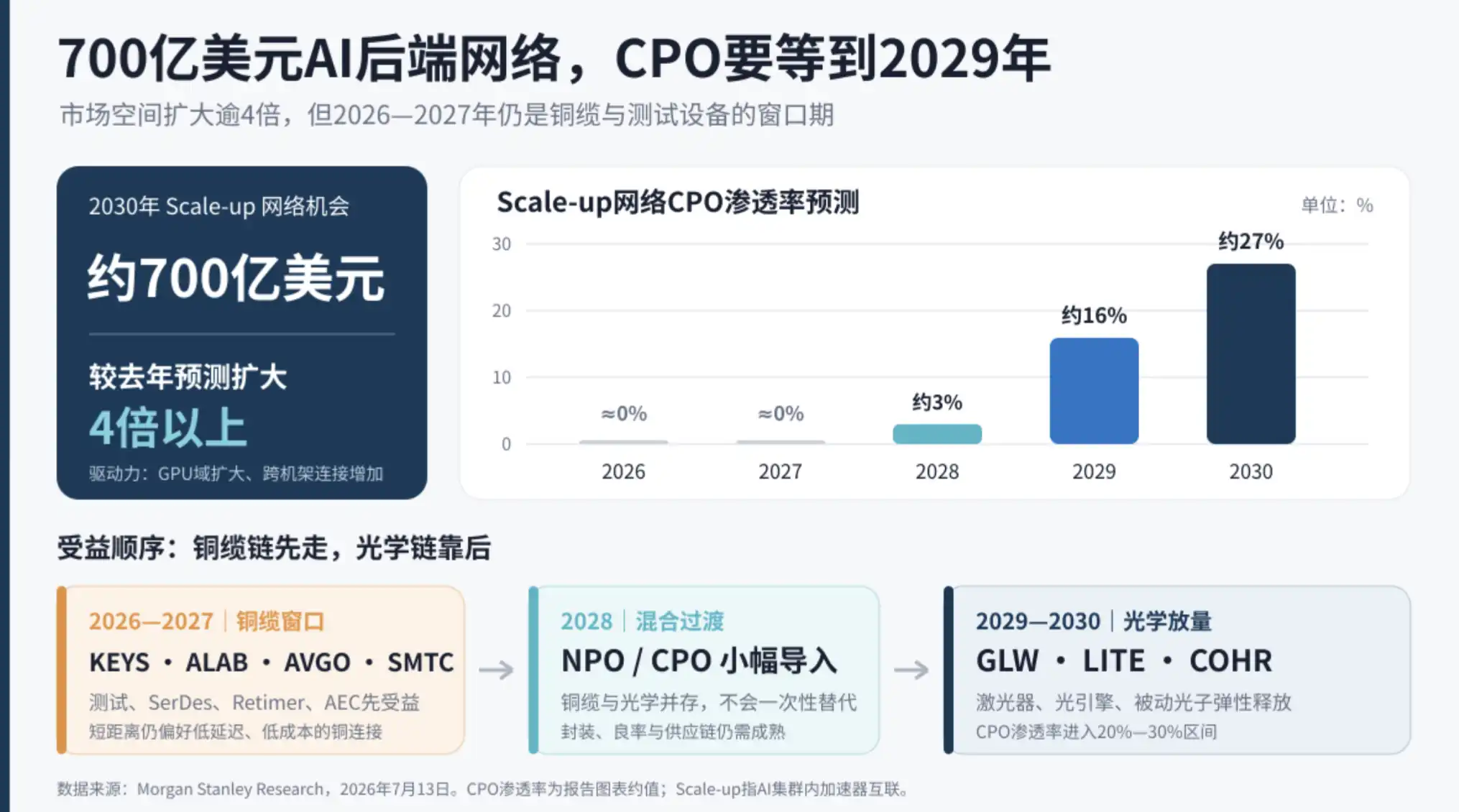
Back-end network revenue forecast 2024-2030; large-scale network revenue is rising rapidly, with market opportunities of around $70 billion in 2030.
For investors, this determines the order of benefits. The first beneficiaries are not necessarily CPO suppliers, but chip and module companies that enable copper cables to continue to run faster and farther; until multi-rack clusters become more popular, the elasticity of optical engines, passive photons, lasers, and test equipment will become more obvious.
2026-2027 is still a copper window, and CPO won't break out until 2029
The appeal of CPO is to bring optical devices closer to switching chips or computing chips to reduce the transmission distance of high-speed electrical signals on the board, thereby improving power consumption and bandwidth density. The challenge is that this isn't just a line replacement; it's changing the division of packaging, manufacturing, testing, maintenance, and supply chain responsibilities.
That's why CPO won't fully explode in 2026. CPO penetration in large-scale networks was close to zero in 2026-2027, introduced slightly in 2028, and real meaningful adoption is expected until 2029-2030. At that time, if the multi-rack GPU domain expansion progresses according to plan, the penetration rate of CPO in large-scale networks is likely to reach 20%-30%.
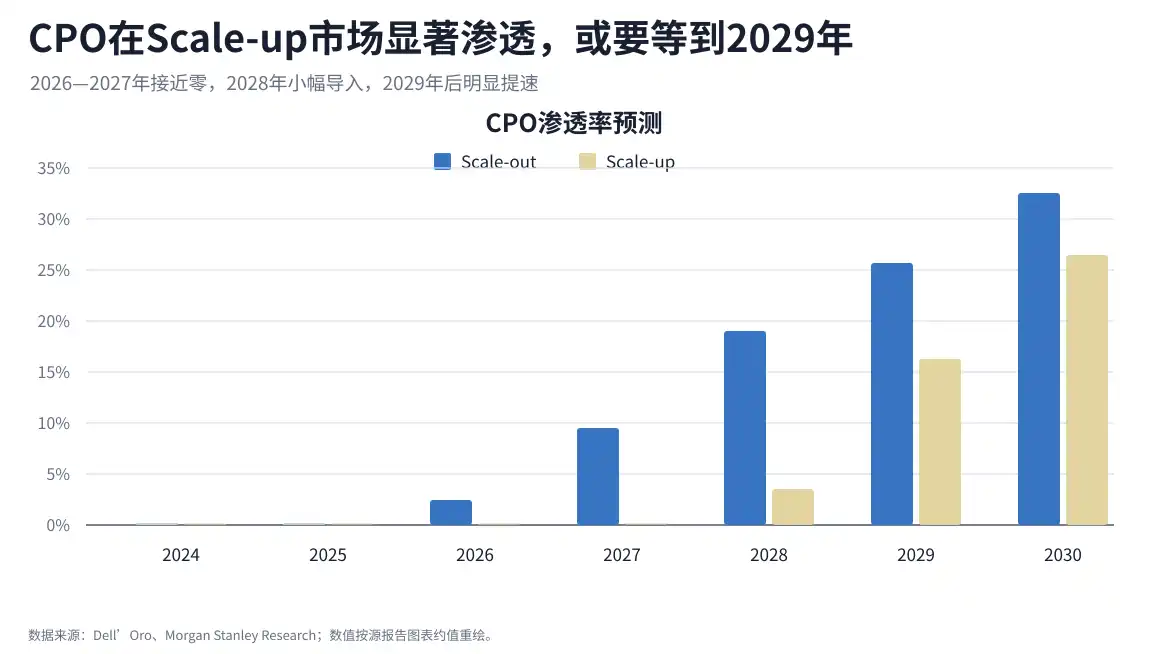
CPO penetration rate is projected on a scale/scale scale; large-scale CPO will only rise to 20%-30% in 2029-2030.
This left a window for at least two years for copper chains. Astera Labs' Scorpio X-Series has entered initial mass production and shipment, Broadcom has connectivity opportunities in the AMD Mi400/Helios and custom ASIC ecosystem, and Semtech is participating in the transition phase through CopperEdge's low-power copper and linear optics solutions.
More importantly, copper cabling and optics are not simply an alternative relationship. Large cloud vendors will use a mix of DAC, ACC, AEC, AOC, NPO, and CPO based on distance, power consumption, cost, maintainability, and reliability. Short-distance, in-rack, and near-rack connections may still retain large amounts of copper cabling, and CPO is more likely to take on high-density, long-distance, and high-power pressure links.
Nvidia's roadmap pushes up demand for optics, but the pace also depends on platform landing
The CPO has really become important and is directly linked to Nvidia's next-generation AI platform roadmap.
According to Nvidia's official technical blog, the Vera Rubin Ultra NVL576 will form 8 72-GPU racks into the 576-GPU NVLink domain and use copper cables and direct optical connections; the Feynman-era Kyber NVL1152 is aimed at larger interconnects and uses a similar direct optical solution.
As the GPU domain expands, the demand for optical engines will not just increase linearly. According to the report's estimates, the number of optical engines per GPU is likely to increase from about 2 to 35 to 70. In other words, once the architecture switch occurs, the amount of optical content will increase significantly.
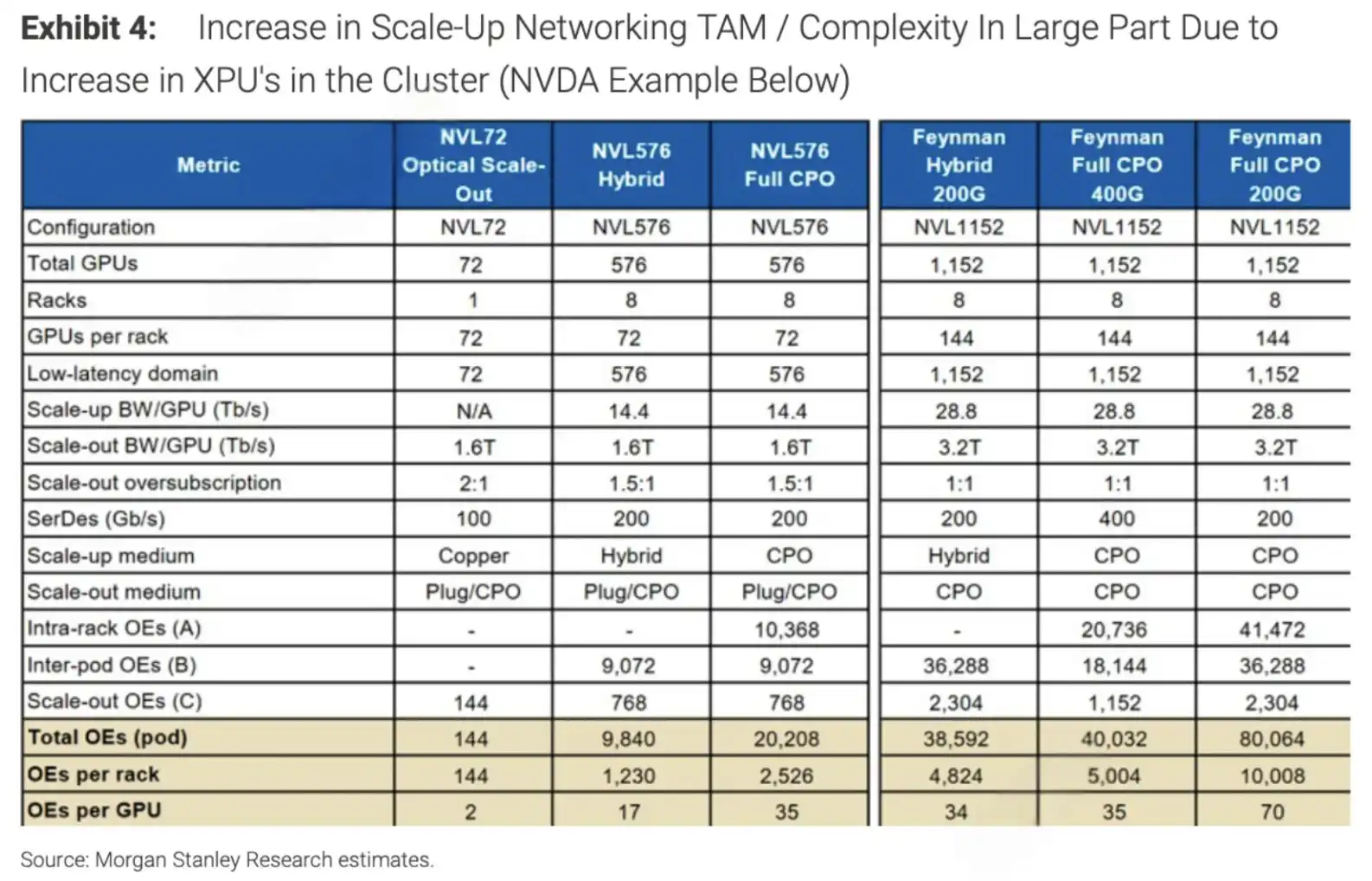
XPU cluster size compared to OE demand; GPU domain expanded from 72 to 576/1152, and the number of OEs per GPU increased from 2 to 17-70.
This is why Corning (GLW), Lumentum (LITE), and Coherent (COHR) were put into this main line. Corning benefits from passive photonics and glass-related content, while Lumentum and Coherent are more relevant to lasers, light engines, and optics. After Damo included large-scale CPO adoption rates in the model, the profit elasticity of related companies depended more on the pace of adoption.
But this is still an “if adoption happens” elasticity rather than revenue that has already been realized. Nvidia's roadmap itself also has market differences. Some industry analysts say some Kyber or Rubin Ultra configurations may be delayed, while Nvidia responded that the roadmap remains unchanged. For optical chains, the key is not the name of a single product generation, but whether the big GPU domain enters mass production as planned, and whether the non-Nvidia XPU ecosystem follows a similar connection path.
Shide Technology is more like a “shovel seller”. There is no need to bet on a single route for testing equipment
In this main line, the logic of KEYS is different from that of optical module companies. It doesn't have to bet on copper or CPO who will win, because the more AI network architectures, the higher the need for testing and verification.
Currently, there is no uniform standard for AI back-end networks. Nvidia has NVLink and subsequent expansion routes, while non-Nvidia teams have UALink, SUE, PCIe, and self-developed interconnection solutions from different cloud vendors. Every architecture requires testing for signal integrity, bit error rate, interoperability, power consumption, and reliability.
According to Investing.com, Morgan Stanley has raised German Tech's rating from Equalweight to Equalweight and the target price from $350 to $400 for reasons including AI investment, diversification of network architectures, and increased demand for 800G, 1.6T, and 3.2T tests. Shide Technology's AI-related revenue accounts for about ten percent of total revenue.
In contrast, the flexibility of optical device companies is more focused on CPO adoption rates and specific platform rhythms. If Nvidia's roadmap progresses smoothly, Corning, Lumentum, and Coherent will benefit more directly; if copper cables continue to prolong their lifespan in 2026-2027, Astera, Broadcom, and Semtech will have higher short-term certainty.
CPO will eventually enter the core position, but cloud vendors aren't ready to take the first step
The counterintuitive aspect of this report is that it also acknowledges that CPO will be at the core in the long term, and emphasizes that copper cables cannot be underestimated in the short term.
CPOs face no small hurdles. Large cloud vendors are concerned about vendor lock-up. Once optical devices are deeply integrated into an exchange or computational package, subsequent replacement, maintenance, and multi-vendor procurement will be more complicated. Manufacturing yield, thermal management, maintainability, and quality risks will also affect the pace of introduction. If the cost premium is not offset by power savings and increased bandwidth density, adoption will also be delayed.
There are also architectural differences. Nvidia's roadmap may drive a higher proportion of optical connectivity, but self-developed architectures such as Google's TPU use different topologies, which may reduce reliance on traditional CPO solutions. Although the non-Nvidia XPU ecosystem creates opportunities for companies such as Broadcom and Astera, the standards are not uniform, which also means that it is difficult for the supply chain to quickly scale up according to one plan.
Therefore, the $70 billion market adjustment is more like the overall AI back-end network market being amplified, rather than a single technology route already locking in victory. In 2026-2027, copper cabling will still dominate in-rack and short-range scenarios; after 2028, optics will begin to take a more central position; until 2029-2030, CPO will have a real meaningful penetration in large-scale networks. The easiest place in the market to be misunderstood is to directly equate “CPO will eventually arrive” with “CPO will break out soon.”
Twitter:https://twitter.com/BitpushNewsCN
Compare the TG exchange group:https://t.me/BitPushCommunity
Compare TG subscriptions:https://t.me/bitpush
