


25 times increase in half a year: Smart Spectrum AI's trillion-dollar market capitalization is betting on scarcity rather than profit statements
Author: Robonaissance
Compiled by Deep Wave TechFlow
Original title: Intelligent AI in the eyes of a foreigner: models are free, huge losses, why did the market capitalization once surpass Meituan?
Guide to Shenchao: Zhi Spectrum AI's Hong Kong stock market rose 25 times in half a year, and its market capitalization once surpassed Meituan, but it had revenue of 724 million yuan in 2025 and a loss of 4.72 billion yuan. The strongest model, GLM-5.2, or the MIT open source agreement, is free to download. It's not that the market is crazy; it's pricing scarcity, sovereignty, and circulation markets that are small enough to be promoted. Tsinghua ancestry, state-owned endorsements, and 73.7% of revenue comes from privatization deployments of state-owned enterprises — this is what Zhipu is actually selling.
On July 2, 2026, the stock price of the world's first publicly listed AI lab plummeted by nearly 17% in a single day. Six days later, in early trading on July 8, the lockdown period expired, and the HK$46 billion frozen stock ban was lifted. Instead, the stock price rose 13%. Within 24 hours, the company took advantage of the rally to issue $4 billion in new shares.
Smart Spectrum AI, known as “Knowledge Map Technology” in Hong Kong stocks, was rated by Bloomberg as the most volatile stock in Asia. But fluctuation is not a side effect; fluctuation itself is a mechanism.
The underlying business is more magical than a K-line chart. In 2025, Zhi Spectrum's revenue was 724 million yuan, or about 105 million US dollars. The loss was RMB 4.72 billion, or approximately US$650 million. The R&D investment was RMB 3.18 billion, which is 4.4 times the annual revenue. The flagship model, GLM-5.2, uses the MIT open source protocol. Anyone can download weights, run their own reasoning, fine-tune, and make commercial products without paying a penny for Smart Spectrum.
At the end of June, the market valued the company at HK$1 trillion, or about US$128 billion. More expensive than Meituan — Meituan delivers takeout to hundreds of millions of people and really makes money.
The simple explanation is that the market is crazy. A more useful interpretation is that the market is pricing something real, and that thing isn't on the profit sheet. It's pricing scarcity, sovereignty, and a circulation market small enough to be pushed around. This is a story about these three, and when the world finally set an open price for a cutting-edge AI lab, it was discovered that this price hardly reflected the lab itself.
Tsinghua ancestry
Smart Spectrum didn't start as a startup; it started with a university research group. This difference explains much of the company's later shape.
The Tsinghua University Knowledge Engineering Group, known internationally as THUDM, has been studying knowledge maps and language models for many years when they were not popular. In 2019, two professors Tang Jie and Li Juanzi split these jobs and set up a company. The architecture they brought out is called GLM, the Common Language Model, which is both the technical identity of the company and the origin of its name.
This origin brought two things, but only the same one is often written.
The first is technology. In March 2023, when most Chinese AI companies had not released anything that developers could use, Smart Spectrum released ChatGLM-6b, an open source conversation model small enough to run reasoning on a single consumer-grade video card. It became one of the most downloaded models that year, and the first widely available Chinese command fine-tuning large language model. Enthusiasts fine-tune it on a notebook, university laboratories use it as a course, and companies disassemble it to study the principles. The habit of posting models for free has been around since the beginning, and the reason isn't romantic at all: free posting is how academic spin-out gets noticed.
The second thing is trust, which later became the business itself. Zhipu became one of the “Six Little Dragons,” or the group of big Chinese model startups that emerged from the generative AI wave. Before going public, it formed an unusually broad list of investors: Ali, Tencent, Ant, Meituan, Xiaomi, Gao Wei, Qiming Ventures, China Local Government Funds, and Saudi Aramco's Prosperity7 Ventures, totaling about $1.5 billion. A Tsinghua spin-out company with state-owned assets on the shareholder list, China's state-owned banks can buy with confidence, and no one in the procurement chain needs to defend this decision. This admission is not a soft advantage. As can be seen from the revenue structure, it is the entire business engine.
There are less than 900 intellectuals, and about three-quarters are researchers. The CEO is Zhang Peng, Tang Jie is the core scientist, and the chairman is Liu Debing. For a company whose market valuation once surpassed Meituan, this is a very small building, all of which are academics.
What does Smart Spectrum actually sell
In 2025, out of Smart Spectrum's 724 million revenue, 534 million came from privatization deployments, accounting for 73.7%.
This one number has reshaped the entire company.
Private deployment means that intelligent engineers go to the customer building and install the GLM model kit into the customer's own server and intranet, and the data never leaves the local area. They use customer data to fine-tune the model and integrate it with the customer's existing system until it can be used. Then go to the next customer and try again.
Customers are Chinese state-owned enterprises, banks, and government agencies: these institutions can't put sensitive data on someone else's cloud, and they won't buy foreign models at any price. For them, the model of Tsinghua ancestry, state-owned investment, and domestic deployment is not one of several options, but the only one. This is what the Tsinghua lineage got in exchange and turned into an invoice.
The remaining 190 million yuan, accounting for 26.3%, comes from the cloud business: APIs, developer platforms, and parts that work like software. This area is growing rapidly. The revenue share has risen from 15.5% in 2024, and gross margin has climbed from 3.3% to 18.9%, as inference optimization and scale have reduced the marginal cost of a single token.
But the shape of the company is determined by that 73.7%, and there is a problem with that shape. Overall gross margin fell from 56.3% in 2024 to 41.0% in 2025. The gross margin of privatization and deployment fell from 66.0% to 48.8%. As the business grew, gross margins were shrinking, because growing up meant hiring more engineers to sit in more buildings. There is no version of the private deployment that makes the tenth customer a cheaper service than the first. There is no cost curve for manpower, only the number of people.
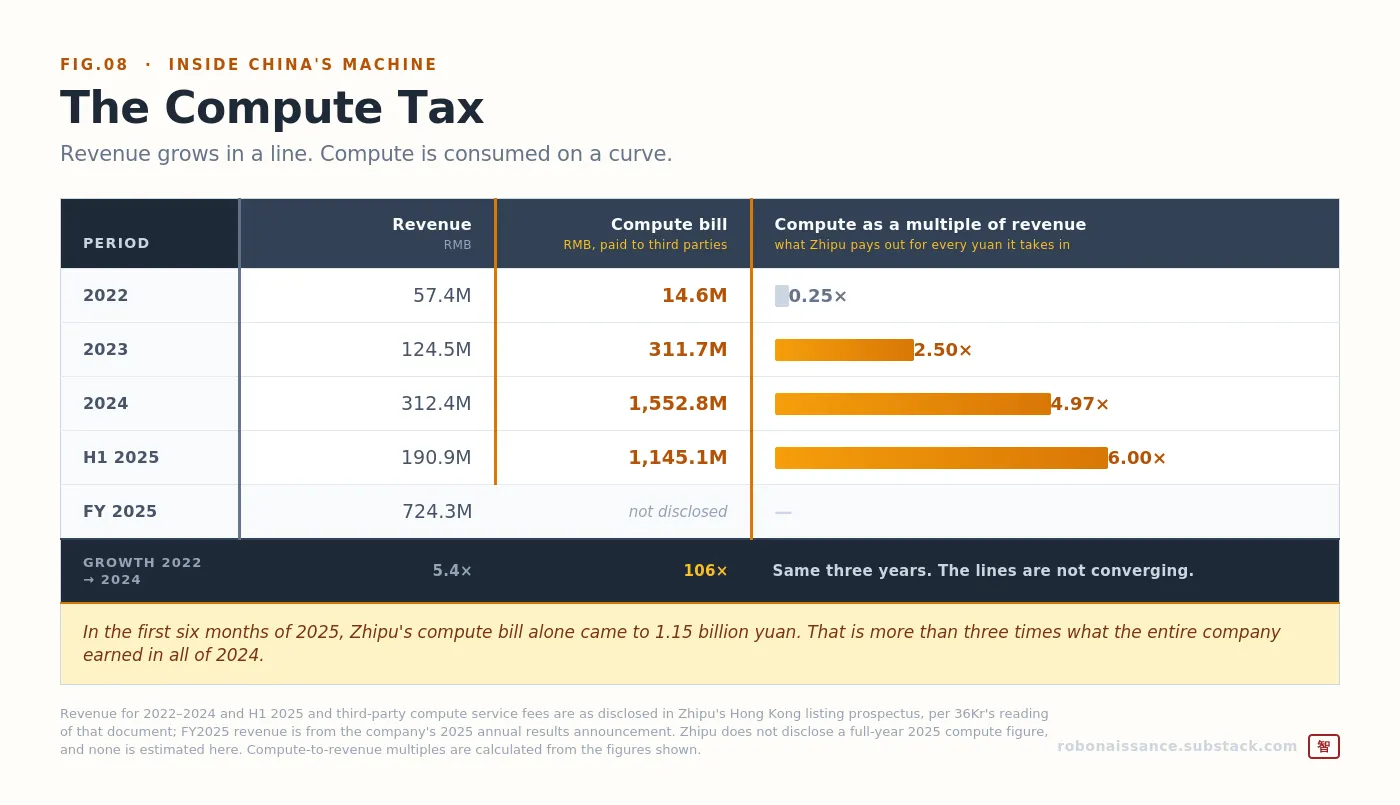
Growth is unquestionable. Smart Spectrum's revenue was 57.4 million in 2022, $124.5 million in 2023, $312.4 million in 2024, and $724 million in 2025. This is a company that is basically doubling every year. In terms of revenue, Zhipu is the largest independent large-scale model developer in China. The trajectory is exactly what believers want to see.
The problem was the bill below, which decided everything. SmartSpectrum's computing power costs to third parties were 14.6 million in 2022, 3117 million in 2023, and 1.55 billion in 2024. In the first half of 2025 alone, according to prospectus figures, it was 1.15 billion.
Look at these two lines together. Between 2022 and 2024, Zhi Spectrum's revenue increased roughly fivefold. In the same three years, computing power bills have increased more than 100 times. However, in the first six months of 2025, computing power alone was spent more than the full year of 2024.
The two lines aren't converging.
There is no cost to write traditional software and copy it once, so software companies are the most profitable companies in history. The big model broke this. It's written once, but every time someone uses it, they have to pay again. Revenue is growing linearly, computing power consumption is a curve, and as the context window lengthens and the inference chain runs longer, the curve continues to get steeper. For every dollar that Smart Spectrum earns in 2025, it will have to give chip manufacturers far more than 1 yuan for cloud service deals.
The open source paradox
The most powerful model of Intellect Spectrum is free.
GLM-5.2, released in mid-June 2026, supports a context window of up to 1 million tokens and uses the MIT open source protocol. Download the weight, run it on your own hardware, change it, make a product, and sell it, and you'll never have to give Zhipu a penny. This is not a castrated community edition; this is the flagship. The company ranked it with the leading American model.
The obvious question is how can this possibly turn into a business.
The answer is that open source is a distribution strategy that Smart Spectrum can afford, precisely because its revenue is not selling access to the self-selling model. Revenue comes from selling deployments, integrations, and services. Open source authority is marketing; privatization contracts are products. The free delivery model doesn't eat away at revenue, because those paying customers don't plan to rent the model via an API in the first place. They had planned to pay someone to install one in the building.
What you get for free is coverage. According to the company, more than 4 million registered enterprises and developer users in 218 countries and regions have integrated nine of the top ten Internet companies in China. In exchange for developer habits, this is the raw material for API revenue. It also comes in exchange for a specific kind of credit: a model that has been checked by the world's weight, and the bank risk committee can approve it without believing anyone's words.
The proof that a strategy works isn't the number of downloads — they're easy to buy and can't be monetized. The proof is the price. At a time when their Chinese peers were cutting prices to grab shares, Zhi Specu raised the API price by 83%, and demand still exceeded supply. The ARR of the open platform reached 1.7 billion yuan, or about 240 million US dollars, an increase of 60 times over the previous year. This is the figure Zhang Peng gave during the company's first earnings call as a listed company.
A company's ability to raise prices in a price war indicates that it has things that cannot be touched by price wars.
It's the agent that changes the demand curve. The GLM-5 series targets long-term software engineering tuning. The model can continue to work for hundreds of iterations without stopping by answering a single question. The programming packages sold by Smart Spectrum can be inserted into the tools developers are already using. When a code agent runs on its own for an hour, it consumes not the amount of tokens for a single query; it is several thousand times higher. Chairman Liu Debing's argument is that the resulting increase in usage and price is long-lasting rather than a peak, because it is driven by stronger models and users making them do more work.
This is a one-sentence version of the multi-story case: agents are a melting pot of tokens, and smart spectra sells tokens.
Distribution plate machine
However, none of this explains the increase of a stock from HK$116.20 in January to a high of HK$2,980 in the June 22 market, a 25-fold increase in less than half a year. To explain this, it depends on the pipe.
On January 8, 2026, Zhipu was listed at an issue price of HK$116.20, including over allotted sales of approximately 43 million shares, accounting for approximately 9.65% of the share capital. Among them, 11 Cornerstone investors took approximately HK$2.98 billion, which is close to 70% of the shares offered. Cornerstone investors are large institutions brought in by Hong Kong issuers before listing: they promised to buy large chunks and guarantee a quota, in exchange they agreed not to sell for 6 months. Retail investors oversubscribed the remaining portion by more than a thousand times.
Do a subtraction. About 17.35 million shares can actually be traded on the first day. Less than 4% of the company.
A 4% tradable stock doesn't have the same price as a normal stock. It only has a level of settlement between a very small number of people willing to sell and any demand that arises, and the demand that emerged in the first half of 2026 was for every investor on the planet who wanted exposure to China's cutting-edge AI and did not go public until January. It's not a deep search; it's private. It's not Dark Side of the Moon; it's private. It's not Huawei, and it doesn't go public or sell models. As far as Smart Spectrum is concerned, there is also MiniMax, which went on sale one day later; that's the full menu.
UBS put it bluntly: the valuation reflects a scarcity premium and a limited number of tradable shares. Bloomberg later observed that Smart Spectrum stocks were the most volatile in Asia, largely because there were too few tradable shares.
This machine has been running for 6 months. Then July arrived, and the crowd ran it all over again.
On July 2, the cornerstone lockdown period was approaching, and stocks fell by nearly 17% in a single day. Nothing happened, just the supply was expected to arrive. The market closed at HK$1,754, and the market capitalization fell below $800 billion. Trading is too crowded, and the circulation market is too thin. The ban on 25.68 million shares alone is about to be lifted, accounting for 5.8% of the company, and about one-sixth of the market value will be erased in one day.
The lockdown period then expired on July 7, and Cornerstone investors didn't sell. Nearly 70% of them have committed to continuing to hold. The stock rose 13.35% on July 8, increasing its market value by more than HK$100 billion in a single day, because not selling was interpreted as a vote of confidence.
Within 24 hours, Zhipu added shares to this wave of gains. It placed about 19.8 million new shares at HK$1,588 per share and raised about HK$31.4 billion, slightly over US$4 billion. It is one of the biggest placements in Hong Kong this year, more than six times the size of Zhipu's own IPO. CICC CCB International is the bookkeeper. Stock pricing is discounted by about 13% compared to the previous closing. This is the discount needed for institutions to take over at that level.
After the release of the lockdown period and after the placement, only about 13.5% of the shares already issued by Zhipu can be freely traded.
The company did not repair the circulation; it monetized the circulation market.
The controlled experiment ran on the second day. MiniMax, another Chinese model developer that was listed on the Hong Kong stock market in January, ushered in the end of its lockdown period on July 9. The founders extended the lockdown period, and strategic shareholders promised not to sell. It's still down more than 20% in the intraday period.
The difference isn't the underlying architecture—the architecture is largely the same. The difference is that MiniMax tried to raise the price of its M3 model, but was rejected by the market and had to cut the price. Smart Spectrum, on the other hand, raised its price by 83%, and the market took it in full. A thin circulation market will amplify any existing market belief, but it won't create belief out of thin air. When faith exists, a thin circulation market can turn a good quarter into a 25-fold increase. When there is no belief, the same thin circulation market will turn the lifting of the ban into failure.
Does not rely on Nvidia training
For anyone tracking China's AI tech stack, one of the most important statements is Intellect's unpretentious statement.
According to reports, the GLM-5, the open source flagship model released in February 2026, was trained and deployed on Chinese accelerators rather than Nvidia hardware: Huawei's Ascend, as well as chips from Cambrian, Mohr Threads, and Kunlun Core. During the earnings call, Zhang Peng said that since February, Smart Spectrum has been speeding up the use of domestic chips to meet the sharp rise in computing power demand. The R&D budget includes joint design work for adapting domestic chips. The company built its own asynchronous reinforcement learning framework, Slime, in part to allow the training pipeline to run on the hardware it was actually allowed to buy.
When Intellect chose this path, it was not so much about making active choices as being chosen. In January 2025, the US Department of Commerce added Beijing Zhipu Huazhang Technology and its subsidiaries to the list of entities, citing concerns that the company will help advance China's military modernization through AI. Zhi Spectrum objected to this reason and stated that it did not rely on American big model technology. No matter how you look at this determination, its actual effect is to limit access to American technology and turn domestic chips from a preference to a necessity.
The final product closes a cycle throughout this series. A cutting-edge open source model that is competitive in international programming benchmarks and has been trained on Chinese chips.
Cambrian needed a client with a large enough inference workload to make the domestic accelerator business a reality. Smart Spectrum requires a chip that is allowed to be purchased. The chip requires a model. The model requires a chip. Both require export controls to create a closed market where each other's best options are available. A technology stack fork is no longer a prediction; it's a delivered product with a benchmark score.
Sovereign transactions
In mid-June 2026, Anthropic suspended access to its newest models, Fable and Mythos, to comply with the US Department of Commerce's export control regulations. Visits resumed on July 1.
In this window, Smart Spectrum released GLM-5.2 and a piece of information. The company said on social media that cutting-edge intelligence should not only belong to a few people, nor should it be withdrawn at any moment due to a few rules.
This statement is not entirely accurate. These models were suspended to comply with regulatory orders, not withdrawn due to a whim by the company, and resumed within three weeks.
But this inaccuracy isn't commercially important; understanding this is key. Buyers who choose to build a business on will not evaluate why the model may not be available. Buyers evaluate this possibility itself. Intellectual Spectrum has never argued that the American model is worse. GLM-5.2 ranked second on the Code Arena front-end leaderboard, behind Anthropic's Claude Fable 5, and Smart Spectrum didn't pretend otherwise. This argument is narrower and harder to refute: the American model can be shut down by someone other than you, and a set of open source weights placed on your own server won't.
This is Cambrian logic, moving one level up the tech stack.
Cambrian chips aren't the best chips. They are chips that Chinese buyers can actually get. In a sanctioned market, accessibility is a form of performance. The intelligent spectrum model isn't the best model. They are models that buyers can download, audit, deploy, and keep, and perpetuity is a form of performance in a market where frontiers may be shut down by foreign regulators.
In the field of chips, good enough and obtainable is better than the best, but not available. In the field of weights, the models you can keep are better than the better models you might lose. The same transaction occurred twice at two different heights of the same technology stack.
Anthropic or Palantir
This leaves the valuation problem, which boils down to a classification problem.
The market's pricing method for smart spectrum is like a cutting-edge pricing platform: a company that sets a paradigm, has an ecosystem premium and operating leverage that will eventually explode. Today's loss is an entry fee with tomorrow's standards. This is the reason for the trillion-dollar market capitalization, and the reason Zhang Peng gave when he said that Zhipu will continue to follow the path of becoming China's Anthropic.
Smart Spectrum's profit statement describes a different company. Nearly three-quarters of revenue comes from project-based deliveries to corporate and national customers, on-site engineers, custom fine-tuning, and margins that thin as the scale of work expands. Chinese analysts have made the comparison bluntly: the valuation is Anthropic, and the business model is Palantir. Deep customer engagement, eligibility thresholds, and delivery teams, not platform economics.
Both descriptions are partly true, and the distance between them is where all the risks lie.
If there is a solution, it's visible in the revenue structure. The platform business is 26.3%, which is a part of compound growth: the share of cloud service revenue has risen, the gross margin of the cloud business has risen from 3.3% to 18.9%, and the platform's recurring revenue has increased 60 times, increasing prices in the price war. The service business is 73.7%, which is part of today's bill payments, while also limiting the company's future ceiling. Zhang Peng has said that the company is moving from local deployment to the cloud. This is the right direction and an acknowledgement of what the current structure means.
The HKD trillion valuation is betting that 26.3% will become the main body of the company, while 73.7% will become a legacy business line. This transformation is possible. However, it is not yet apparent in the audit results for a single full year.
This distance is measured in multiples. At a market capitalization of HK$trillion, Zhipu's market-sales ratio is over a thousand times; some estimates suggest that it is close to 1,280 times. In rough comparison, OpenAI's valuation of about $730 billion is worth about $13 billion in revenue, and the market-sales ratio is close to 56 times. Even when calculating the 2026 RMB 4.6 billion revenue (an increase of more than 500%) of J.P. Massage Root's aggressive forecast, the forward multiplier is still more than 200 times. J.P. Morgan expects to be profitable in 2028. The growth modeled by Dongwu Securities is slower, and the numbers are smaller.
As Smart Spectrum grew to match the price, the competition did not stop. DeepSeek has reportedly completed a new round of financing of over $7 billion. The Dark Side of the Moon is financing its listing. MiniMax went public in Hong Kong one day after Smart Spectrum, cut the price of the M3 model in half, then saw about half of the market value disappear. In a market where model capabilities converge and prices have become a battleground, pricing power is the only factor that distinguishes platforms from products, and pricing power is exactly what SmartSpectrum has managed to maintain until now.
The company is also seeking more capital. On June 1, the company announced plans to go public on the Shanghai Science and Technology Innovation Board with a target financing of about 15 billion yuan, or about 2.2 billion US dollars. The application passed the acceptance phase on June 17. If completed, Smart Spectrum will become the first AI company to complete a full dual listing in the mainland after listing in Hong Kong, facing domestic investors who have witnessed Nvidia's soaring rise from the outside and want to have a local title.
Computing power tax
This series now has three versions with the same problem.
The Cambrian era proved its ability; it hasn't proven to be captured: a good enough chip that runs on a real scale and is priced by the market as if its share has been won. Stardom Era has captured, but has yet to prove, its ability: four internet giants and a $2.8 billion valuation, connected to a model that only passed 4 of its own benchmarks out of 17 missions.
The Intellectual Spectrum is the third variant and the most inspiring because it has both.
The ability is real. GLM-5.2 ranked second in a serious international programming ranking, behind one American model and ahead of all other open source models. The weights are public, the benchmarks are independent, and the models are trained on Chinese chips. The capture is real too. Nine of China's top ten internet companies have integrated their models. 4 million registered developers. Recurring platform revenue grew 60 times a year. It raised its price by 83% in the price war, but demand increased.
But it still lost about six yuan for every dollar it earned.
What the intelligence spectrum lacks is neither ability nor capture, but rather unit economic benefits. The great trick of the software is that you write it once, the first ten million copies are made at zero cost. The big model broke that trick. There is a cost for each copy. There is a cost for every inquiry. Every new customer comes with a bill for computing power, and the bill grows as the context window, length of reasoning, and the entire industry is racing to lengthen the smart cycle. Zhi Spectrum's R&D expenditure last year was 4.4 times its revenue, not because of recklessness, but because it is the cost of being at the cutting edge.
The world now has an open price for a cutting-edge AI lab. This price is set when 4% of the circulation market collides with unlimited demand. It talks about scarcity, sovereignty, and the value of options that have become China's default option. What it hasn't explained yet is: this business works.
This is the experiment that Smart Spectrum is currently conducting on the open market, on a stock code, with a filing calendar and quarterly disclosure obligations. It has proven that a company can build cutting-edge models on sanctioned chips, release weights for free, and still let the world pay. It hasn't proven that a company can do all of this and make money.
No one has proven it. Smart Spectrum is just the first one that must show how it works.
Models and Benchmarks: AI Wiki; The AI Implications; BigGO Finance; Asia Tech Review. Information on GLM-4.7 (December 22, 2025; SWE-bench Verified score 73.8%, LiveCodeBench score 84.9%), GLM-5 (February 2026), GLM-5.1 (April 2026), and GLM-5.2 (mid-June 2026; context length up to 1 million tokens; using an MIT license) was published by the companies reported in these media. As to the exact release date of GLM-5.2 in mid-June, different sources have mixed opinions, so no specific dates are given here. GLM-5.2 ranked second on the Code Arena front-end leaderboard, behind Anthropic's Claude Fable 5. This information comes from Code Arena results reported by Asia Tech Review and Startup Fortune. The benchmark data published by Zhipu itself is self-reported by the manufacturer and is treated separately from the independent ranking results.
Domestic chips: Reprinted by Reuters AOL, summarized by The AI Reports; CNBC (Earnings Conference Call). The report on GLM-5 using Chinese accelerators (Huawei Ascend, Cambrian, Moore Thread, Kunlun Chip) instead of Nvidia hardware for training and service is presented here as the content of the report rather than information disclosed by the company. Zhang Peng's statement that the company is speeding up the use of domestic chips comes from CNBC's report on the earnings call. Investment in research and development of the Slime asynchronous reinforcement learning framework and “collaborative design adapted to domestic chips” comes from the annual report comments reprinted by Dongwu Securities through Futu.
Entity list: SCMP reprinted by The AI Newspapers. The inclusion of Beijing Zhipu Huazhang Technology and its subsidiaries in the list of US entities in January 2025, the reasons cited for military modernization, and Zhiguo's objections to this reason were all reported based on these sources.
Anthropic model suspension: Anthropic suspended Fable and Mythos model visits on June 12, 2026 to comply with US Department of Commerce export controls, and resumed visits on July 1, 2026 after those controls were lifted (Anthropic statement: https://www.anthropic.com/news/fable-mythos-access). Zhi Spectrum's public response characterized cutting-edge intelligence as something that should not be withdrawn, as reported by Asia Tech Review on Zhi Spectrum social media. This article explains the regulatory reason for the suspension because the difference between compliance-driven suspension and voluntary withdrawal is critical to the argument, and intellectual-spectral statements avoid this.
Valuation, Forecasts, and Competitors: Caixin Global; South China Morning Post; Startup Fortune; BigGo Finance; KuCoin; Asia Tech Review. The market sales ratio (over 1000 times tracking revenue at peak, some estimates are close to 1,280 times; according to J.P. Morgan's 2026 forecast, the long-term market sales rate is over 200 times) is an estimate by analysts and media, and changes with the stock price; it is presented here as a reference rather than an accurate value. J.P. Morgan Chase's revenue forecasts (RMB 4.6 billion in 2026, RMB 11.4 billion in 2027, RMB 30.9 billion in 2028, expected to be profitable in 2028) are from Caixin Global and SCMP. The lower forecast for Dongwu Securities comes from Futu. The comparison with OpenAI (valued at around $730 billion versus approximately $13 billion in revenue, as reported by the Financial Times) is used only as a rough scale reference. DeepSeek received more than $7 billion in financing, Dark Side of the Moon in pre-listing financing, MiniMax price cuts, and stock price drops, as reported by Asia Tech Review, Caixin Global, and BigGo Finance. Anthropic's classification framework compared to Palantir is an analyst comparison reported by BigGO Finance. It cites Chinese market reviews, and is not the original opinion of this magazine.
Listed on the Science and Technology Innovation Board: Startup Fortune cites Caixin Global. The A-share listing plan was announced on June 1. The target was to raise about RMB 15 billion (approximately US$2.2 billion), share capital accounting for 2% to 8% after issuance, Cathay Pacific Haitong Securities acted as a mentoring agency, and passed the acceptance phase on June 17, all from these sources.
Classification description
The financial results, shareholding structure, IPO terms, lock-up mechanism, and July placement information are all confirmed information from company disclosures and multiple media reports. Stock prices and market values are point-in-time data, and all are dated when quoted. Domestic chip training, competitor financing rounds, and analysts' predictions are reported information, and the source has been indicated. The valuation multiplier is an estimated value that changes with the stock price. Zhipu's own benchmark data is self-reported by the manufacturer; only rankings from independent rankings are quoted here as results.
Twitter:https://twitter.com/BitpushNewsCN
Compare the TG exchange group:https://t.me/BitPushCommunity
Compare TG subscriptions:https://t.me/bitpush
