


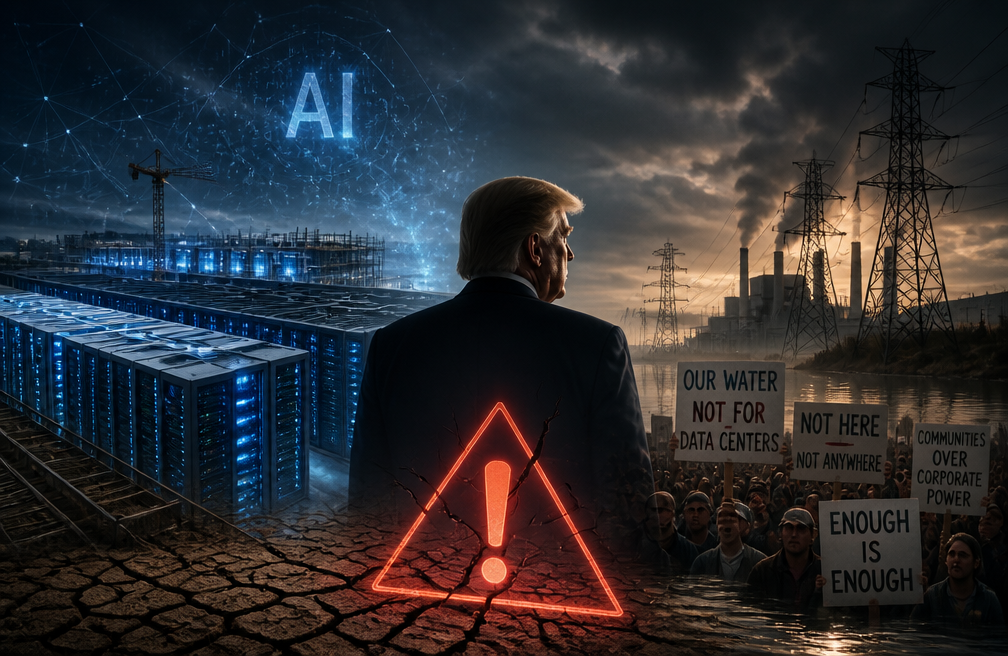
Trump pushes for data centers, and opposition is raised in many places: electricity and water sources have become new bottlenecks for AI
Author: Fire
Original title: If Trump wants to expand data centers and many places oppose it, will it be a new bottleneck for AI?
TL; DR
· New York State suspends state-level environmental permits for the construction of some large-scale data centers for a maximum period of one year.
· The focus of controversy shifts to the pace of delivery of electricity, water resources, community costs, and AI infrastructure.
· Related targets: ORCL, MSFT, GOOG, AMZN, Blackstone, and power, nuclear power, gas, liquid cooling and data center developers.
New York Governor Kathy Hochul signed an executive order on July 14 to suspend state-level environmental permits for the construction of large-scale data centers for a maximum period of one year. This applies to large-scale projects that meet or exceed 50 MW of electricity requirements. Trump later criticized that such restrictions would weaken America's advantage in AI and data center competition.
For investors, the focus is not on New York, which will not block all projects, and the restrictions on AI infrastructure have changed. In the past, the market mainly looked at GPUs and capital expenditure budgets, but now it also depends on electricity, water resources, land, and local permits.
Hyperscale data centers can be understood as giant power-hungry factories for AI. The project load may range from tens of megawatts to several gigawatts, and will also affect cooling water, transmission access, noise, and land use. The stronger the demand for computing power, the harder it is to keep these costs in the company's ledger.
Hochul's logic is that New York cannot continue to release mega-projects in the absence of uniform rules. Contrary to Trump's logic, supporters believe that data centers represent investment, employment, and computing power advantages, and that suspending the project will push the project to other states. This set of conflicts summarizes the conflicts in the next stage of AI infrastructure.
New York escalates community backlash into approval variables
The New York moratorium is important not because it will permanently block data centers, but rather elevates the friction that was scattered in residents' hearings, town councils, and environmental lawsuits to the level of statewide approval.
According to the governor's official website, the executive order requires New York to promote general environmental impact assessments and establish review standards around energy, water resources, and community impacts. To switch to the project language, press the pause button and then set rules on how the giant data center uses electricity, water, compensates the community, and bears external costs.
The market can no longer simply use “demand is strong, so we can definitely build” to extrapolate AI infrastructure. Demand is still there, but the construction path is narrowing. Whether the project can be implemented depends on whether electricity prices are being pushed up, who pays for power grid upgrades, whether regions with scarce water resources can afford it, and whether tax incentives can be exchanged for residents' support.
For tech companies, this friction won't necessarily change the direction of long-term expansion, but it will change the pace of delivery. The more sensitive variables in the valuation model are not just a state suspending it for one year, but whether similar rules will spread, and whether approval cycles and power supply packages will systematically raise costs.
Michigan says the project will slow down
New York is an iconic event, but it is not an exception. Michigan's Saline Township project shows that local resistance will not necessarily drive the project out of the game, but will change the way it is progressed.
OpenAI says the local Stargate campus is 1GW. Blackstone and Related Digital previously announced that they will provide $16 billion in funding support for the Oracle data center project in Saline Township, with participants including OpenAI and Walbridge. The project was opposed by residents. The town council rejected it for a while, and the developers then pushed the project forward through lawsuits and settlements.
This case gave a direct signal to the market. As long as the strategic value is high enough and the capital is deep enough, the enterprise may still push the project forward through legal procedures, compensation arrangements, and design adjustments. The cost is that it takes longer, and political and legal costs go into the calculation of project returns.
AI data centers are no longer just a capital expenditure competition between cloud vendors and developers. It also has to be filtered by local governance. What residents see is an exchange between electricity, water, noise, roads, and tax revenue; what companies see is order delivery, computing power online, and customer promises.
New Mexico Exposes Hard Constraints on Energy Supply
New Mexico's Project Jupiter is closer to energy bottlenecks. The local state land commissioner denied an application for the Energy Transfer pipeline to cross state trust land in March, and denied its request for review in July. The pipeline was intended to serve Oracle-related data center projects, and the reasons for refusal involved greenhouse gas emissions and water pressure.
This detail is harsher than residents' objections. Data centers don't just run when servers arrive; they need stable power, transmission access, and cooling systems. Any licensing process stuck will turn AI capital expenditure from a financial plan to a queuing project.
Oracle said on July 1 that the project's electricity plan has been adjusted to Bloom Energy fuel cells. This indicates that large data centers will continue to look for alternative energy configurations, but the alternatives themselves also mean that costs, technology, and delivery times will need to be re-evaluated.
This type of case affects investors' judgment on the quality of AI infrastructure companies. Being able to obtain servers and chips is only the first step. Connecting the equipment to a stable, compliant, and locally acceptable energy system will determine whether the project can turn from announcements into revenue.
Electricity and site selection capacity are being repriced
The meaning of this round of market changes is not the end of AI expansion, but rather that the criteria for winners are changing. Chip supply is the first threshold, and electricity, site selection, and licensing power are becoming second-tier moats.
According to public statistics, about $156 billion of US data center projects in 2025 were affected by local opposition, lawsuits, or suspensions. An additional $130 billion worth of projects were blocked or delayed in the first quarter of 2026. These figures are not equivalent to the cancellation of all projects; a significant portion of them may only be postponed, relocated, or renegotiated, but it is sufficient to show that resource friction has affected the pace of capital deployment.
The pressure is on cloud vendors and developers to advance projects in regions where power grids are tight, regulations are strict, and water resources are sensitive. Infrastructure capital such as Oracle, Microsoft, Google, Amazon, and Blackstone will all need to re-evaluate the licensing certainty and power plan of the project site.
The direction of benefit is also more clear. In states with surplus electricity and friendly policies, stable power sources such as natural gas and nuclear power, dedicated power supply access, liquid cooling, and closed-loop cooling will all gain higher strategic weight. Electricity is becoming a precondition for capital expenditure to be met.
The speed of project migration determines valuation implementation
If New York develops an enforceable environmental assessment and community investment framework within a year, the moratorium would be more like a rule reset. Project costs are rising and construction times are getting longer, but the path to compliance will be clearer. If standards are too strict, or if other states follow stronger restrictions, short-term friction may become a national bottleneck.
Whether Trump pushes for federal-level energy and AI infrastructure support will also affect this tug-of-war. Even so, grid access, local water resources, and electricity prices for residents will not be directly erased by political statements.
AI data centers will continue to be built, but from now on, who can get electricity, licenses, and community acceptance faster is more likely to turn AI capital expenditure into real income.
Twitter:https://twitter.com/BitpushNewsCN
Compare the TG exchange group:https://t.me/BitPushCommunity
Compare TG subscriptions:https://t.me/bitpush
