


Kimi K3 released, Silicon Valley panics: the AI gap between China and the US has been reduced to 4 months
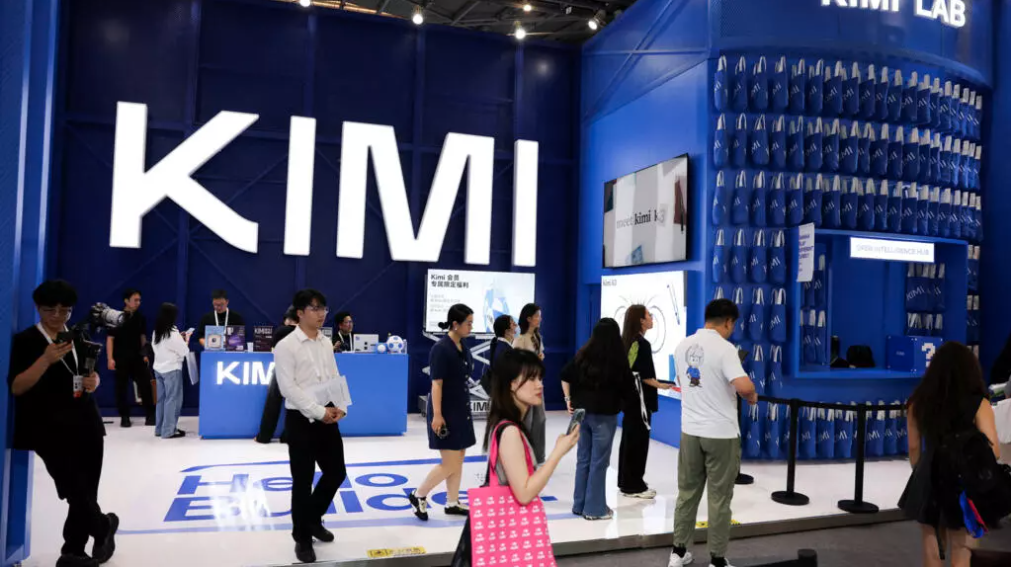
Source: RFI
Original title: What is the magic of China's release of Kimi K3? “It became the only source of negotiation in Silicon Valley”
“Echo” technology reporter Thomas Pontirolli reported on Monday (July 20) that by releasing the largest open source artificial intelligence model ever, Moonshot AI has shaken the entire artificial intelligence community.
Although the “DeepSeek Moment” has yet to be recreated, the startup has indeed narrowed the gap between China and the US in the AI field to an unprecedented extent.
According to estimates by the British AI Safety Research Institute, the gap between the Chinese model and the US has been reduced to 4 to 7 months, compared to 6 to 10 months last year.
The news shook America's AI lab over the weekend. On Thursday, on the eve of the Shanghai World Artificial Intelligence Conference, Chinese startup Moonshot AI unveiled its new flagship model: Kimi K3, an open source model with 2.8 trillion parameters, the largest in the category so far.
The Beijing startup is 36% owned by Alibaba. In May of this year, it raised $2 billion at a valuation of over $20 billion and is preparing to go public. Its founder, Yang Zhilin, collaborated with Yann LeCun and Yoshua Bengio to publish a paper. Previously, the K2 model was used by the US software company Cursor and the takeaway platform DoorDash. So it's not an unknown person, but the news still caught the industry by surprise.
“It's worrying”
The report notes that Box co-founder and CEO Aaron Levie told Bloomberg: “This was definitely a surprise to many. This has become the only source of discussion in Silicon Valley.” He sees this as a “major step forward” in the open source model. David Sacks, who was the head of AI in the White House in the Trump administration, called the matter “worrying.”
According to the only Chinese company data currently available, K3 is clearly ahead of Anthropic's benchmark model Claude Fable 5 in terms of long programming tasks (42 to 35) and online information retrieval (91.2 to 88), but it still lags behind in traditional software development (81.2 vs. 86.6).
The report notes that compared to OpenAI's latest top model, GPT-5.6 Sol, the results are closer: they are almost flat in terms of scientific reasoning (93.5 vs. 94.1). Moonshot AI also admits that there is still a “clear gap” with American AI in terms of user experience. Despite this, parts of Wall Street were volatile on Friday.
K3 effect
The report mentioned that during the intraday session on Friday 17th, Nvidia fell 3%, AMD once fell to 5%, Intel fell 4%, and Applied Materials and Fanlin Group both fell by more than 4%. The Philadelphia Semiconductor Index fell 5.7% at one point (then rebounded). The index has fallen by more than 20% since its high at the end of June, and the global semiconductor industry's market value has evaporated by $3.3 trillion since June 22.
The impact of K3 also affected the Chinese market itself. On the same day, the stock prices of the two companies listed in Hong Kong in January this year and directly competing with Moonshot AI fell sharply: two weeks ago, Smart Spectrum AI, which was still highly sought after due to the GLM-5.2 model, fell 28%, and MiniMax fell 16%.
Some people see Kimi K3 as a new “DeepSeek moment.” In January 2025, DeepSeek released the R1 model. Not only was the performance comparable to ChatGPT and Claude at the time, but it was also free, and the training cost was significantly lower. This move shook up the entire AI investment logic at the time — industry giants that invested billions of dollars were impacted; the biggest beneficiary, Nvidia, evaporated 590 billion US dollars in market value in a single day.
The market is “overreacting”
The report analyzed, however, that the situation may be different this time around. First, it's unclear under what conditions Kimi K3 will be open for use: Moonshot AI promised to open on July 27, but no license agreement has yet been announced. Furthermore, China may also impose export controls on the industry like in other fields.
Second, in the current context of increasingly sensitive computing costs and opposition to the construction of new data centers, this model seems too large. The internal deployment of the K3 requires at least 64 processors. And its price is three times higher than the previous generation. “This is the most expensive model ever commercialized by a Chinese AI lab,” notes developer Simon Willison. As companies increasingly focus on the profitability of AI projects, this could also be a hindrance.
The report also said that some analysts think the market is overreacting. Patrick Moorhead of Moor Insights believes this is similar to the initial panic about DeepSeek. Bernstein, on the other hand, believes that this is just a normal catch-up of China's technological strength. Just like DeepSeek, “not surprising” doesn't mean “not important.”
Trump's former “AI Tsar” speaks out
The report quoted Ion Stoica, co-founder of Databricks and founder of the AI model ranking platform Arena, to Bloomberg: “In the past, people thought that China's open source model was 6 to 9 months behind the most advanced model, but now this gap has narrowed to 2 to 3 months.” In the field of cybersecurity, the British AI Security Research Institute estimates that the gap between the Chinese model and the US has narrowed to 4 to 7 months, compared to 6 to 10 months last year.
In July of this year, OpenAI CEO Sam Altman stated on the US media CNBC: “China's open source model is getting stronger.” However, he still believes that the company can maintain its lead in the most advanced models, and Anthropic will continue to evaluate the lead for up to a year.
The report's final warning, but according to David Sacks, the catch-up is actually happening, and the timing is bad: after Anthropic restricts Claude Mythos 5 from being opened to non-US users, according to CNBC, the Trump administration will continue to decide which companies can access the latest models (although this claim has been denied). In the opinion of the former “AI Tsar”, this is an obstacle. He bluntly said, “This is how we lost the AI competition!”
Twitter:https://twitter.com/BitpushNewsCN
Compare the TG exchange group:https://t.me/BitPushCommunity
Compare TG subscriptions:https://t.me/bitpush
