


Stripe is struggling to change, and the time for agents in the payment industry is yet to arrive

Author: Zaoya Crooked Mountain
Original title: Eternal Fragments of Money: Three-party payments have no primacy
Four generations in the payment industry
The rain is about to fill the air, and Stripe is trying to buy PayPal again, and Feng Shui is taking turns. The last time was 30 years ago when Peter Thiel's PayPal merged with Musk's original X.com.
I don't understand why everyone is talking about PayPal's sluggish growth, as if this FinTech circuit is full of trouble and bad for us. Twenty years ago, Peter Thiel embarked on a payment journey and started his first business, and the PayPal gang came all together. Wherever Musk went, the public welcomed him wholeheartedly. It really can be described as when the sky was full of life, the state where everything flourished was still right in front of us. After just 20 years, did Payment change and become our burial place?
Growth is a miracle, stablecoins are not
The Stripe pandemic didn't go public; now it seems like a failure.
Stripe's various efforts are aimed at an unattainable dream of going public. In the context of the pandemic, Stripe touched a $100B valuation for the first time.
However, it did not follow the listing of Coinbase and the like, causing its valuation to fall over and over again, mistakenly treating the opportunities of the times as a personal effort, so in the midst of pain, Stripe embarked on the path of mergers and acquisitions.
Stripe started with a Dev-friendly model, with one-click API access, which is very tempting for developers. It's also the most unique way to play in the payment industry. It doesn't worry about rates and scenarios, but rather reaches out to the people actually working behind them.
Stripe hopes to reinvent the entire payment industry by reusing its experience, moving from the B-side to the billing system, from the C-side to stablecoins, and even laying out ACP/MPP agreements on the Agent side.
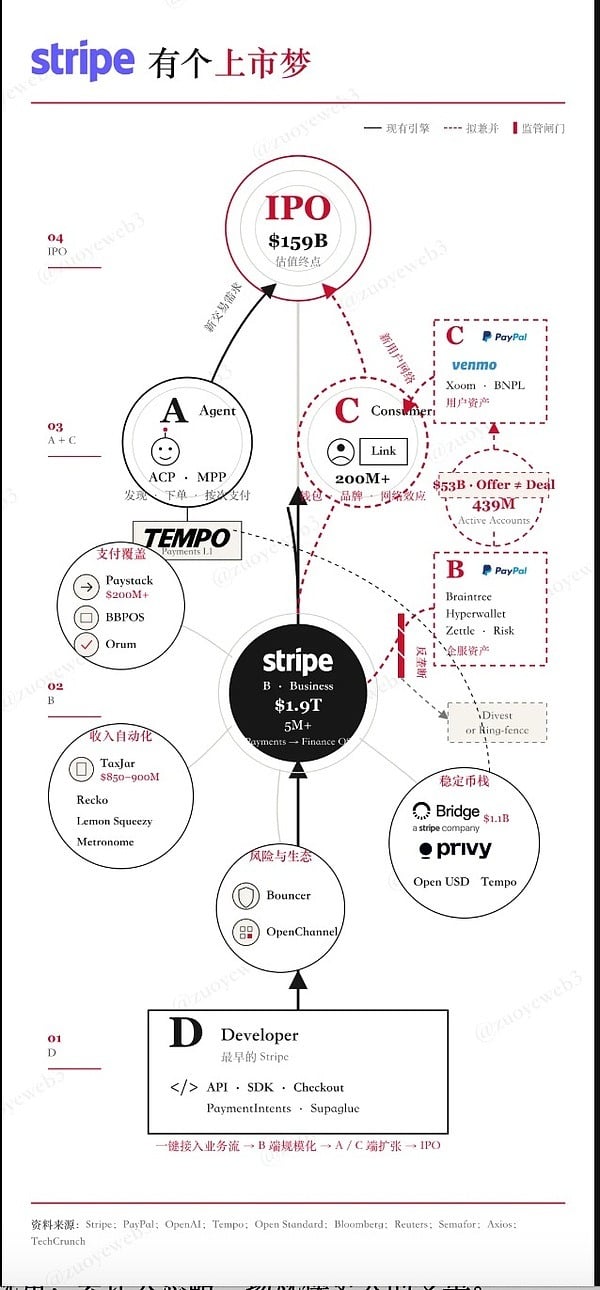
Photo Caption: Stripe's bumpy road to market
Photo credit: @zuoyeweb3
The payments industry has always had two characteristics that have hindered Stripe's continued progress:
The highly fragmented pattern of the payment industry has not changed. Defining a country, an industry, or even a few companies can continue to survive and cannot be directly eradicated by external forces;
Payments are an accessory to the banking industry. Developers and B/C-side companies are ultimately externalized bank processes, and stablecoins are eventually put into the bank's orbit.
In particular, the series of stablecoin acquisitions, from the issuance of Bridge, to Privy's wallet portal, and even Tempo and OpenUSD, can hardly repeat Stripe's past glory.
The proposed takeover of PayPal is actually a phased result of Stripe's attempt to open up the C-side failure with stablecoins, trying to make up for itself with PayPal's C-side business.
PayPal's problem isn't that it can't keep up with the times; nothing from Venmo to PYUSD has saved PayPal's downtrend.
In other words, PayPal is really old. The entire enterprise is structurally disabled, and it's no longer possible to start a new business to recover.
Stripe, which launched a little later, also wanted to add more narrative possibilities to itself before its IPO.
If the Stripe package backend dominates the developer market, then the stablecoin market package front-end - distribution network story is probably over. Tempo and OpenUSD will impact Circle's stock price, but they won't be able to touch Tether in the slightest.
If Stripe's upper limit is Coinbase or Circle, then the listing is bound to break the fate. Compared with Adyen's market capitalization and the valuation of Sky Cloud Exchange, Stripe's stablecoin narrative X Agent's narrative is useful.
Stablecoins are not an everyday part of the current payment system; they are a visible trend;
Agents still need to find an entrance for themselves to enter the current system.
On the front side of the news, Agent is already buying computing power and tokens with stablecoins, but apart from removing quantitative suspicions, Agent still hasn't entered the Web3 business, let alone more conservative companies or banking systems.

Photo Caption: Agent is currently mainly used for brush volume
Photo credit: @BarkerMoneyX
Side A (future), side B, side C, side D (startup), but it is difficult for Stripe's valuation to escape the reasonable value of the FinTech cap of 50 billion dollars. 100 billion contains too much active imagination.
If you can't reach the future for a short time, scaling up the scale and ecosystem is the only thing Stripe can do, and you can understand Stripe as an options product.
Agent will use OUSD stablecoins, run on Tempo, and Stripe should be the size of Visa;
Agent will use stablecoins, but OUSD fails, Tempo seizes part of the market, and Stripe should have a valuation of 100 billion dollars + Tempo's public chain valuation;
The Agent economy is hard to come true, and Agentic Payment is covered by a new concept, so at least Stripe has its own business.
Of course, losing an investment is a failure, but missing out will be a lifetime of regret. Starting from Stripe's challenges to the primary market, how the entire payments industry will evolve is also worth further thinking about.
Payment is only an entrance, value-added services are profitable
Agents are the future that can be seen with the naked eye, provided they live until that day.
Standing in the middle of 2026, it is a very delicate point. With a clear final window of time to pass the bill, stablecoin earnings may be settled once and for all.
Meanwhile, the long-term future of the Agent economy is now focused on alternative models for white-collar workers and blue-collar workers, as well as hardware fields such as new wearables and AIOS phones.
There is no social concern about Agent's transformation of payments. There is reason to believe that this is a hidden opportunity for stablecoins, a beta opportunity brought by the times.
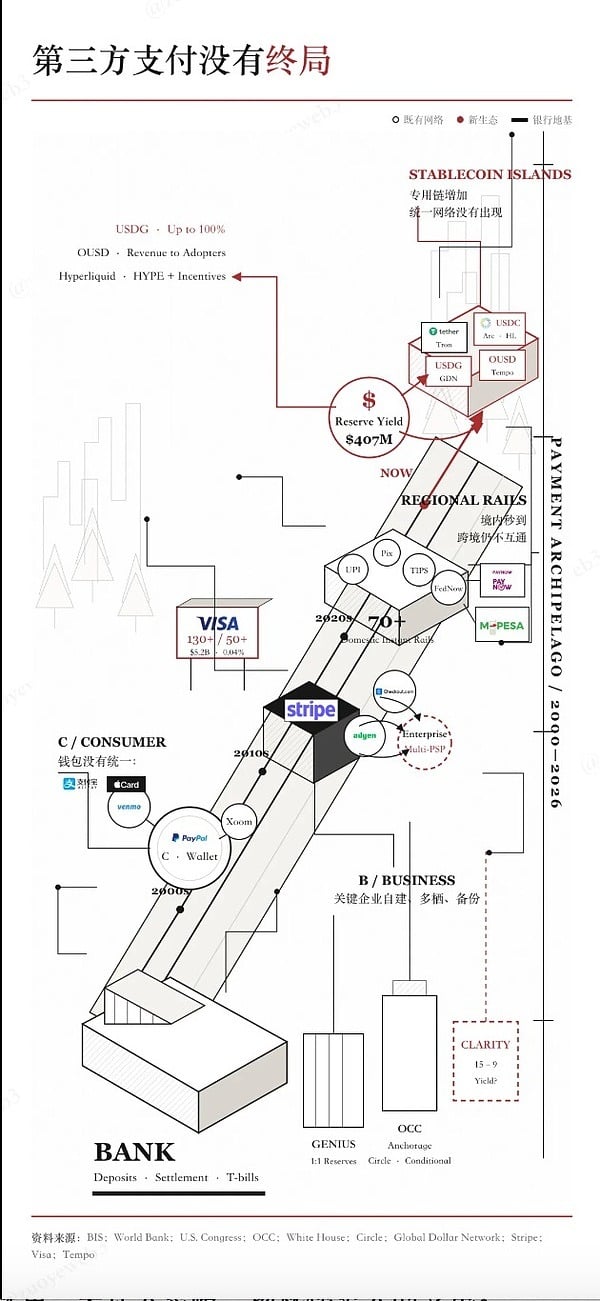
Photo Caption: Eternity Movement's Payments Industry
Photo credit: @zuoyeweb3
However, the payment industry's operating model, which used “license+localization” in the past, may continue to be impacted by the clearing network.
At the front-end, stablecoins still require entrances such as deposits, etc., as well as exports such as on-chain circulation, deposit and monetization. This is where the banking industry supports compliance.
The FinTech wave brought about by the internet over the past 30 years has ultimately increased the banking industry's grip on payments. Publishing, consumption, entertainment, catering, etc. have not been directly transformed or even disappeared.
Under the wave of technology, although banks are becoming more and more transparent, they always have access to terminals for cash and account opening outlets. In a sense, the fragmentation of the payment industry can be attributed to bank divisions and geographical divisions, and license and sovereignty boundaries are nothing more than recognition of reality.
However, in the actions of Stripe and Circle, there is another possibility of payment. Front-end stablecoins acquire customers and back-end liquidation for profit.
Stripe and Circle are actually very similar. They represent the future intersections of FinTech and Crypto, all operating as public chains (Tempo vs Arc), stablecoins (OUSD vs USDC), and clearing networks.
The reason why this is not revenue sharing from stablecoin issuance is because Circle has already begun to subsidize Hyperliquid channels, OUSD directly distributes profits to partners, and the two parties have already begun internal transactions, which is certainly not the future.
However, the clearing system, for the first time, allowed the two public chains without forcibly subsidizing partners, and relied solely on financial efficiency to earn benefits from the network effects of payments and stablecoins.
The clearing system is not complicated. Traditional fiat clearing relies on card organizations, SWIFT, central banks, and commercial banks, and is already overburdened.
Emerging stablecoin chains, on the other hand, have no historical burden and can focus on improving clearing efficiency. As Circle and Stripe obtain OCC chartered banking licenses (conditional approval), they will inevitably move towards liquidation after sharing stablecoin profits.
Clearing networks, on the other hand, may partially break away from the commercial banking system and keep profits in their own hands.
epilogue
Stripe missed the launch window of the pandemic and entered into a third-party payment trench war. This battle is an eternal Verdun model, and scale will never be able to overwhelm small players in the region and industries.
Twitter:https://twitter.com/BitpushNewsCN
Compare the TG exchange group:https://t.me/BitPushCommunity
Compare TG subscriptions:https://t.me/bitpush
