


After the White House makes concessions, can the Clarity Act successfully pass before adjourning?
Author: Azuma
Original title: The White House made concessions to clear ethical barriers, and the Clarity Act caught up with the last window of time before adjourning?
On July 21, Beijing time, a number of industry sources revealed thatThe Trump administration has agreed to add ethics provisions (ethics provisions) to the “Clarity Act” (Digital Asset Market Structure Act), and the relevant text has now been submitted to some Republican members of the Senate.Although the details of the specific provisions have not been fully disclosed, industry participants generally agree that this development may clear the way for updating the text of the bill (which is expected to be announced in the next few days) and subsequent Senate voting.
Negotiations around the “Clarity Act” have progressed slowly over the past year. After the parties gradually reached a compromise on early differences such as stablecoin earnings and DeFi regulation, the biggest remaining dispute was how to handle possible conflicts of interest between US government officials and the crypto industry. And as the White House expresses a willingness to compromise on ethical provisions, the last obstacle that has long prevented the bill from moving forward is likely to be resolved.
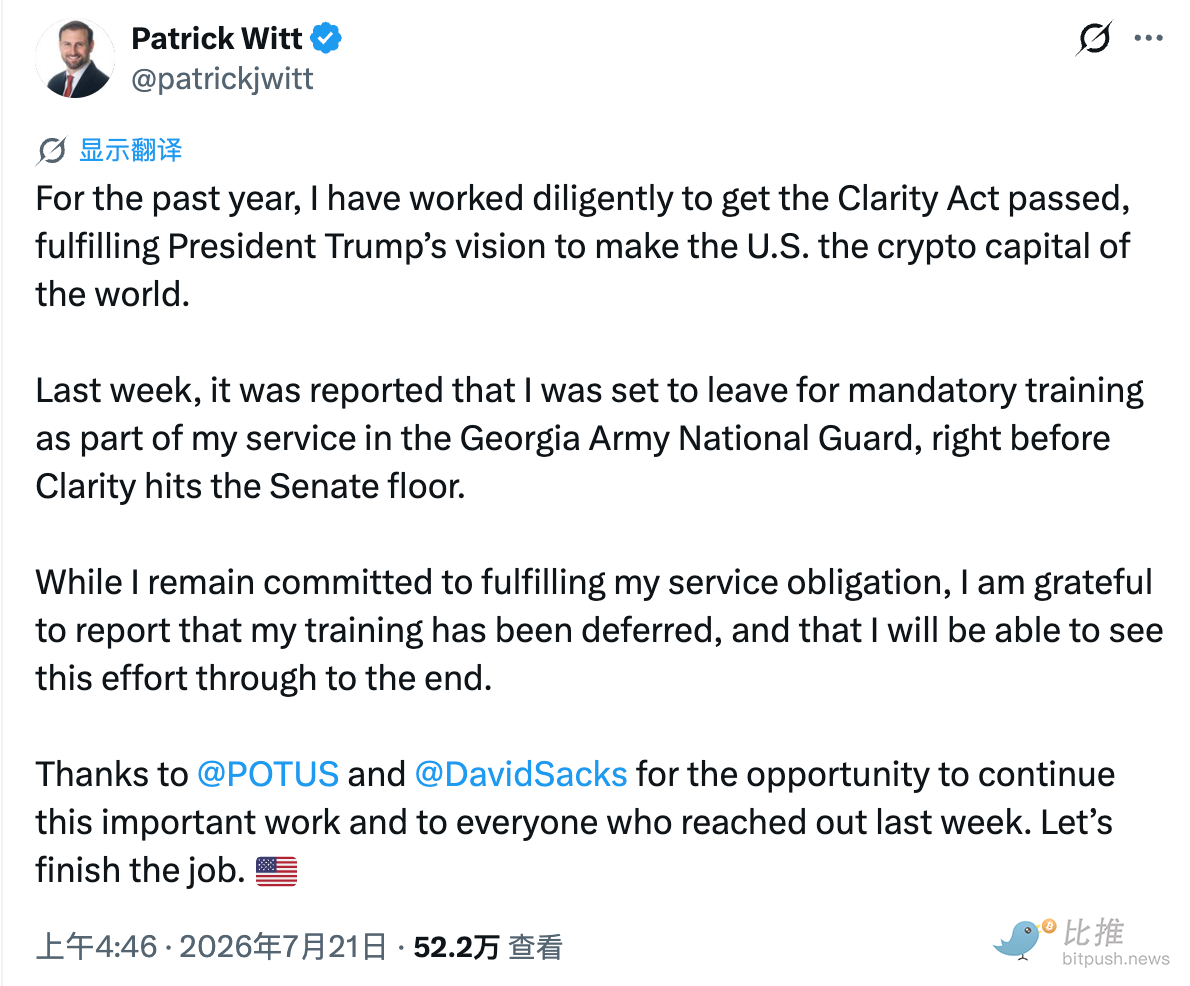
In addition to the progress of the ethics provisions, there was another positive sign this morning about the “Clarity Act” breaking through:Patrick Witt, executive director of the White House Digital Asset Advisory Committee, which is responsible for promoting the implementation of the bill, has confirmed that he will remain in office to help the bill complete its final sprint. Earlier, it was reported that Witt may leave his post before the “Clarity Act” enters a critical stage in the Senate due to the need to fulfill training obligations related to the US Army National Guard, which once raised concerns in the industry about the pace of the bill's progress. But now that Witt has confirmed that the training mission will be postponed, he will be able to continue participating in the process of breaking through this bill.
For the entire cryptocurrency industry, the latest trend may mean that the regulatory game, which has continued for almost a year, has finally reached the most critical turning point.
The content and meaning of the Clarity Act (familiarization can be skipped)
As one of the core legislations of the Trump administration to push the US to become a “global crypto center,” the full name of the “Clarity Act” is the “Digital Asset Market Clarity Act of 2025,” which aims to establish a unified federal regulatory framework for the US digital asset market.
The bill's core goal is to resolve the regulatory ambiguity that the US crypto industry has faced for a long time in the past few years —Clarify the legal attributes of different digital assets and redistribute regulatory responsibilities between the US Securities and Exchange Commission (SEC) and the Commodity Futures Trading Commission (CFTC).
Specifically, the Clarity Act aims to establish a digital asset classification system that distinguishes assets into digital commodities (digital commodities), investment contract assets (investment contract assets), and compliant payment stablecoins (compliant payment stablecoins). Among them, digital products with blockchain network functionality will be mainly regulated by the CFTC; investment contract assets involving financing will continue to be the responsibility of the SEC; stablecoin issuers will mainly be supervised by bank regulators.
The significance of this framework is to end the battle between the SEC and CFTC over digital asset supervision rights over many years and provide the industry with a more clear path to compliance. In the past, under former SEC Chairman Gary Gensler, the SEC preferred to recognize a large number of digital assets as securities based on Howey's tests and expand its scope of supervision through enforcement actions; while the CFTC believes that some digital assets with a high degree of decentralization are closer to commodities and should be supervised by them. The long-standing regulatory border conflict between the two sides has left US crypto companies, trading platforms, and developers in an uncertain environment.
If the Clarity Act is finally passed, the US crypto industry may usher in the first comprehensive regulatory framework for market structures. As far as the market is concerned, its short-term impact may be to boost market sentiment through improvements in policy expectations, but the longer-term significance is to reduce regulatory uncertainty and provide a more clear institutional foundation for traditional financial institutions and long-term capital to enter the digital asset sector.
The final disagreement, an ethical dispute
It wasn't easy for the Clarity Act to get to where it is today. On July 17 of last year, the Clarity Act passed the review by 294 to 134 in the US House of Representatives and received far more support than the simple majority requirement. However, unlike the GENIUS Act, which progressed smoothly during the same period and was eventually signed by Trump, the Clarity Act faced a more complicated political game after being handed over to the Senate.
Compared to the House of Representatives, although the Republican Party still has a majority in the Senate, the Clarity Act, as a major regulatory legislation affecting the entire digital asset market structure, still requires a certain degree of bipartisan support to complete the final vote.This means that the bill faces complex negotiations in the Senate around the direction of regulation, industry interests, and political claims.
Over the past year, the differences surrounding the Clarity Act have focused on three aspects — stablecoin yield rules, DeFi regulatory boundaries, and possible conflicts of interest between the Trump administration and the crypto industry. Today, the first two major differences have gradually cooled down as negotiations progress. Among them, the conflict was once the most acute issue of stablecoin earnings, and the parties have now reached a compromise solution that “prohibits earnings solely from holding stablecoins, but allows rewards based on actual activity.”
Today, the real question remains on the negotiation table; there is only one last disagreement:Ethical issues.In negotiations over the past year, members of Congress and the White House spent a great deal of time negotiating moral provisions aimed at limiting the benefits of digital assets during the presidency of the President, Vice President, Congressmen, and other federal officials (see “”Trump's “payroll” revealed: Cryptocurrency generated $1.4 billion in revenue and more than 22,000 stock transactions”), and with the latest developments coming out this morning, this means that a new breakthrough has occurred in the final political game surrounding the “Clarity Act.”
What is more urgent than disagreements over content is time
But compared to the controversy at the content level of the bill, another more pressing issue facing the “Clarity Act” today is time.The US Congress usually enters the summer recess (August recess) in mid-August, so there are only a dozen working days left for the two parties to complete text coordination and push for Senate review.
Kristin Smith, CEO of the US Blockchain Association (Blockchain Association), who played an important lobbying role in the “Clarity Act” bill process, said bluntly yesterday: “Now is the most critical moment.”

Smith said that the “Clarity Act” has gone through a long process. The current version has added stronger illegal financial regulations, improved consumer protection measures, and strengthened regulatory requirements for spot trading platforms. This is already one of the most comprehensive digital asset market structural frameworks it has ever seen.If the two sides can resolve ethics-related disputes within the next few weeks, the “Clarity Act” may have a chance to complete a key breakthrough before Congress adjourns; but if negotiations stall again, the crypto regulatory framework, which has been in the works for more than a year, may have to wait for a new political window.
A historic inflection point in crypto regulation?
Of course, there is still one last step before the “Clarity Act” is actually implemented. Even though the White House has decided to accept the ethics provisions, there is still uncertainty about the publication of subsequent texts, Senate review, and final coordination between the two parties, but judging from the signals released so far, this digital asset market structure bill, which has gone through more than a year of gaming, is getting closer to the end.
If the “Clarity Act” can complete its breakthrough before adjourning on August 10, it could become an important inflection point in the history of cryptocurrency regulation in the US and the world at large.One of the biggest challenges for the global crypto industry over the past few years was not a lack of demand in the market, but rather a lack of a sufficiently clear, stable, and predictable regulatory framework. There are huge differences in digital asset attributes, trading platform responsibilities, and issuance rules in different jurisdictions, and enterprises and capital will need to find development paths in an ever-changing regulatory environment for a long time.
The significance of the “Clarity Act” is to try to establish a more clear system of rules for digital assets through legislation. Once implemented, this framework may provide an important reference sample for the global market. For trading platforms, this means a clearer path to registration and operation; for developers, it means a more predictable environment for innovation; and for traditional financial institutions, it means having a more clear compliance foundation when entering the digital asset sector.
This is not only an upgrade of America's own regulatory system, but also represents that the global digital asset market will gradually move from an early stage of regulatory exploration to a more mature and institutionalized stage of development.
Twitter:https://twitter.com/BitpushNewsCN
Compare the TG exchange group:https://t.me/BitPushCommunity
Compare TG subscriptions:https://t.me/bitpush
