


KOSPI melted seven times during the year, and global stock markets are replicating the coin industry script
Author: Mamemaru Ryo
Original title: Welcome back to your native family, the global stock market is becoming a currency circle
Seoul, July 13, 2026.
Korea Composite Index KOSPI plummeted 8.95% in a single day, breaking for the 7th time in the year. SK Hynix, the “national transport stock” in the eyes of Koreans, fell sharply by 15.37% in a single day. We have not seen such a sharp decline in nearly 20 years. Samsung Electronics also dropped more than 10%.
More than 1.2 million leveraged accounts pop up deposit recovery notices, and the brokerage system automatically closes 320,000 to 460,000 accounts. What's even more worrisome is that 62% of those who have closed their positions are young people between the ages of 20 and 30. Some have lost their down payment on their wedding room, and others have taken out loans to trade stocks...
A young man in his 20s in Busan directly stabbed the blogger with a knife because he lost money after receiving recommendations from stock YouTubers.
In the past, these words were probably used to describe the scene after the coin industry plummeted; now, it is being repeated in the South Korean, American, and Japanese markets after the decline in technology stocks.
The sharp rise and fall is only an indication. What really changed was the pricing method. The narrative overweighed the valuation, the leverage amplified sentiment, and social media quickly pushed the consensus to the extreme.
The global stock market, especially technology stocks, is becoming more and more like a coin.
Return to the original family
“Welcome back to your native family.”
After the sharp decline, traders in the coin industry who switched to the stock market wrote short loss essays one after another. The above comments can be found everywhere in the comment area.

The so-called “native family” refers to cryptocurrencies. From the second half of 2025 to the beginning of 2026, a “run away from the native family” drama was staged in the coin industry.
A group of KOLs and veteran players who have been struggling in the cryptocurrency market for many years are beginning to lose confidence in the coin industry. Bitcoin fluctuated sideways, trading volume was weak, and meme coins were cut back and forth. Many people felt that “this circle is weak” and began to turn their attention to US stocks.
This seems like a reasonable choice.
Shares have revenue, profit, financial reports, and are regulated by the SEC. Compared to crypto projects that lack cash flow and rely entirely on consensus pricing, US stocks are at least a more mature and secure asset.
Not only did traders in the coin industry take away liquidity, but they also brought back the past in trading methods.
In the crypto market, they are used to chasing new narratives, finding highly flexible targets, using leverage, and quickly changing positions based on social media sentiment. Since entering the stock market, this method has hardly changed, except that trading partners have switched from tokens to AI, memory chips, and leveraged ETFs, and achieved great results over and over again.
Storage stocks soon became the new collective consensus.
The logic is not complicated: AI servers require more high-bandwidth memory, HBM is in short supply, and storage prices are rising. Naturally, Micron, Samsung Electronics, and SK Hynix have become the most direct “sellers”. Brother Sun's phrase “never lacking storage” is even more deeply rooted in the hearts of the people. Many crypto KOLs have changed and started talking about US stocks, storage cycles, and AI capital expenses. Doubling products such as SK Hynix is also used as a “more efficient” betting tool than ordinary stocks.
Until the market reversed in July.
Instead, Bitcoin has become a “low volatility asset”
How long will it take to fall in half from the top?
It took 268 days for Bitcoin and 169 days for silver to complete a similar retracement.
In contrast, it only took 36 days for SanDisk to drop about 55%, and it only took 34 days for SK Hynix to drop about 53%.
Also, it was a “backlog”. Bitcoin was used for almost nine months, and storage stocks only used for over a month.
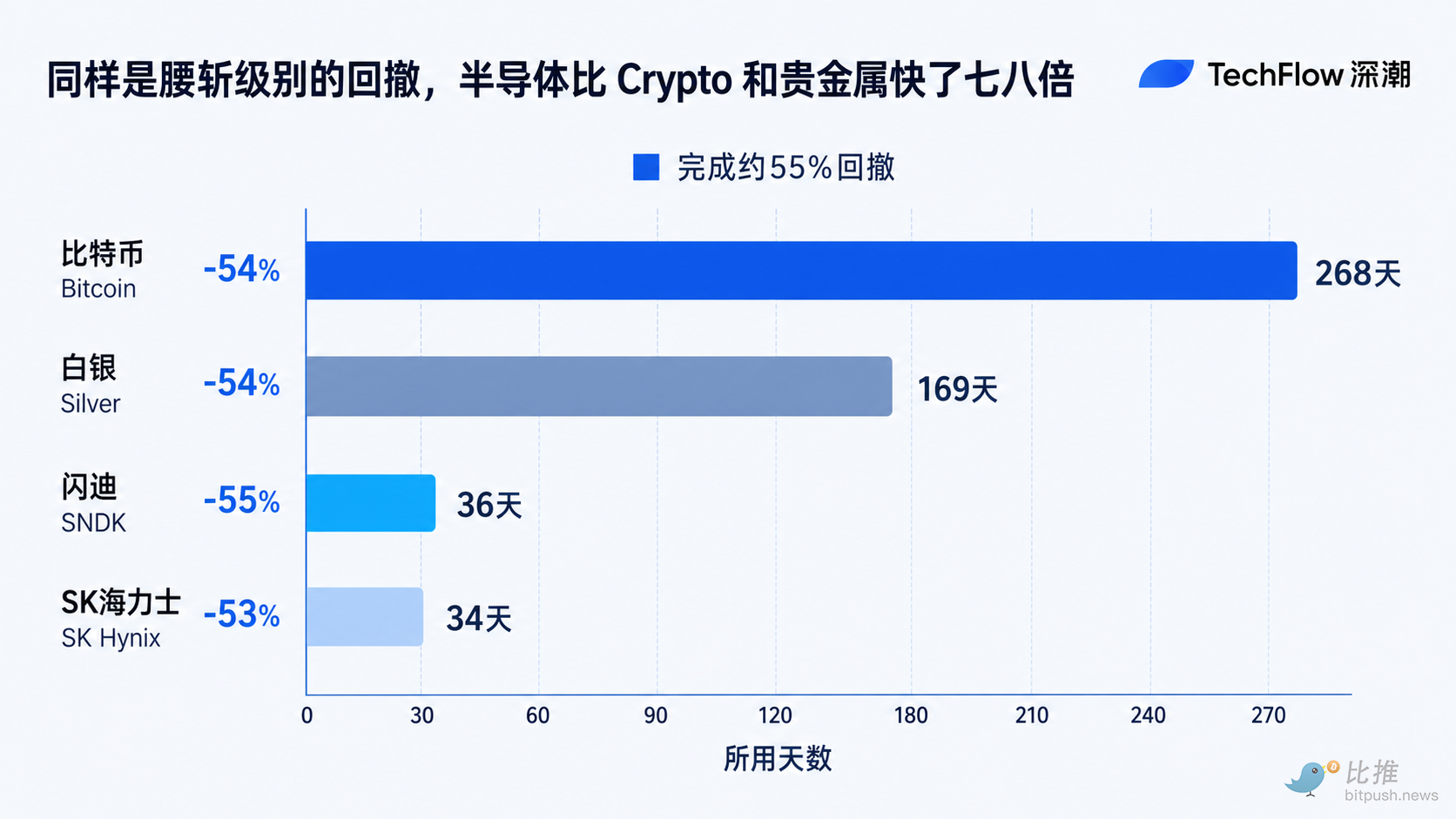
This is exactly what is strange about this round of the market: in the past, investors feared that Bitcoin would soar and fall within a few days, while stocks relied on profits and slow valuation adjustments; now, some tech stocks are completing a complete bubble burst in a shorter period of time than cryptocurrencies.
Very counterintuitive,Compared to some tech stocks, Bitcoin is becoming relatively stable.
According to Carson Wealth Management statistics, Bitcoin's historical volatility in 2025 was about 42%, with a maximum retracement of about 32%; during the same period, Tesla's volatility was about 63%, the maximum retracement was 48%, Nvidia's volatility was about 50%, and the maximum retracement was 37%.
Bitcoin is still a high-risk asset, but some big tech stocks are more volatile.
In its 2026 outlook, Bitwise even predicted that Bitcoin's overall volatility may continue to be lower than Nvidia.
So the current situation is quite absurd:Bitcoin is becoming more and more like technology stocks, but technology stocks are becoming more and more like Bitcoin.
When narrative becomes the anchor of valuation
There is an old saying in the coin industry that trading coins is speculating on narratives.
Global tech stocks in 2026 are turning this statement into reality.
AI is certainly not air. Nvidia, Microsoft, Google, and large cloud computing companies have real revenue and are also investing real money to build data centers.
But there is a long way to go from “AI does create value” to “any company involved with AI is worth buying at any price”.
At the peak of the market, this path was simply omitted by the market.
As long as AI servers, optical modules, memory chips, data centers, power equipment, and even nuclear energy companies can be released into the AI industry chain, stock prices may rise rapidly. The business is still being planned, and orders have not yet been placed, but the market will first set prices according to the best results in a few years.
Korea's story is “AI semiconductors are related to national transportation.” As KOSPI continues to reach new highs, more and more families are opening stock accounts for underage children, using popular stocks such as Samsung Electronics and SK Hynix as long-term gifts.
A shares also experienced a similar concentration. In the first half of 2026, the market value of the TMT sector reached 41.78 trillion yuan, accounting for about 31.45% of the total market value of A-shares; on some trading days, the turnover of the technology sector was once close to half of the total market.
The US market has long centered around a few big tech companies. When the index's growth depends more and more on several companies, and when funds, options, and retail investors all pour into the same batch of stocks, the seemingly fragmented investment portfolios are actually betting on the same AI story.
This is quite similar to the previous coin industry. Dogecoin skyrocketed in 2021 not because of technological breakthroughs, but because Musk tweeted. Tech stocks soared in 2026, not because all companies had an explosion of performance, but because ChatGPT convinced everyone that “AI will rewrite everything.”
The ability of narratives to dominate the market so quickly is also inseparable from changes in communication methods.
In the past, stock information mainly came from financial reports, research reports, and institutional roadshows. Today, more and more people are making investment decisions from YouTube, X, short videos, and paid communities.
The complex company study was condensed into a few words:Time will prove that computing power, optical modules, and AI will never be enough...
Social media algorithms also don't reward prudence; getting rich overnight is always the password for traffic: some people double their options overnight, some workers store stocks to achieve financial freedom, and some use leveraged ETFs to earn years of wages in a few months.
K-line is the best publicity. A large number of moms and aunts are starting to use their private money to enter the market, and some are even selling houses to trade stocks. Just like a group of students who dropped out of school a few years ago, all in Web3...
Leverage orgy
The scariest thing in the coin industry is not fluctuation; it is the deadly combination of leverage and fluctuation. The global stock market in 2026 is being completely replicated.
On May 27, 2026, the Korea Exchange approved the listing of 16 double leveraged ETFs with individual stocks. The linked targets are Samsung Electronics and SK Hynix.
Retail investors are crazy. From approval to mid-July, Korean retail investors made a cumulative net purchase of 14 trillion won (about 64 billion yuan) of single-share leveraged ETFs, while foreign investors only bought about 2 trillion won during the same period.
These ETFs have several fatal designs.
Positions for this type of product are readjusted every day. The more severe the shock, the more obvious the loss of net worth. Assuming a stock falls 10% and then rises 11.1%, the stock price can return to the original point; the corresponding 2-times leveraged product will first drop 20%, then rise 22.2%, and eventually still lose about 2.2%.
In times of rapid decline, the problem is even worse.
To maintain target leverage, products need to passively reduce risk exposure after a decline. Selling will further lower the price, and falling prices will trigger more position reduction, stop-loss, and margin pressure.
Goldman Sachs later pointed out that the “rapid deleveraging” of this batch of products was the main cause of KOSPI's abnormal intraday fluctuations, and 62% of institutional net sales came from ETF-related liquidations.
Two months later, South Korean regulators urgently stopped the listing of all new individual leveraged ETFs. The minimum deposit was drastically raised from 10 million won to 30 million won, and only cash was accepted.
But it was too late, and the wealth of hundreds of thousands of families was wiped out with a strong balance of 2.3 trillion won.
Even the deepest US stock market in the world is experiencing a backlash of leverage.
J.P. Morgan analysts recently pointed out that US stocks still have “room for deleveraging,” and it will take three months to return to pre-April levels.
The ratio of the size of a memory chip stock leveraged ETF to the underlying market capitalization is three times the average of all stock ETFs. Even if it is an overall leveraged stock index ETF, its ratio is high compared to its own history.
Primary degeneration
“Stock market currency circuitry” does not mean that stocks are no longer exactly like cryptocurrencies.
There are still companies, assets, revenue, and cash flows behind stocks, as well as financial disclosures, audits, and supervision. Even if market sentiment subsides, a company that actually makes money still has value that can be calculated.
What's really changing is the transaction layer.
In the past, people bought a company's future profits; now, more and more people are trading the popularity of a subject.
The currency circulation of the stock market is essentially a revolution of de-rationalization.
The traditional stock market looks at PE and cash flow, and the coin market looks at narrative and imagination; the volatility of the traditional stock market is 20% high, and it is normal for individual stocks in the coin market to fluctuate 10% to 15% in a single day.
Traditional stock market leverage is through financing and securities, and the coin market uses ETFs, derivatives, and quantitative strategies; traditional stock market information comes from research reports and financial reports, and cryptocurrency stock market information comes from Twitter, YouTubers, and communities; traditional stock market institutions set rational pricing, retail, and quantify increases and falls...
What's even more ridiculous is that now Bitcoin is striving to become like a stock. Through ETFs, institutionalization, and declining volatility, it is gradually being accepted by mainstream finance.
This is an absurd intersection.
People who moved from the coin industry to the stock market eventually discovered that they hadn't left their “native family”. It was a system that was repeated over and over again: big stories, crowded positions, easy leverage, and everyone believed they could leave the market before others.
The words written by Korean retail investors on the trading forum are worth everyone's memory:I want to go back to the days before stock trading and give me back my money.
But the marketplace never refunds.
Twitter:https://twitter.com/BitpushNewsCN
Compare the TG exchange group:https://t.me/BitPushCommunity
Compare TG subscriptions:https://t.me/bitpush
