

Multicoin goes long and understands Robinhood's “super money-making machine”
Author: Prathik Desai
Compiled and organized by: bitPushNews
Multicoin Capital general partner Shayon Sengupta recently revealed on the Hood House podcast that the agency is making every effort to expand Robinhood (HOOD), and HOOD has now become the agency's largest stock position in the open market.
I used to call Robinhood a “financial supermarket” because it satisfies every financial need of Americans under the same roof, because its newly launched blockchain itself doesn't require huge revenue, as long as it can connect more than a dozen of its businesses and cross-sell all kinds of products to its 28 million+ financial account users.
I still think this argument is in the right direction, but it is underestimated in terms of scale.
As I sat more than half of the planet watching Robinhood's second-quarter earnings call, it made me feel that the “financial supermarket” concept even underestimated the height the company could reach next. A supermarket's prosperity depended on attracting more people to its doors; Robinhood's second-quarter performance showed that its boom came from having the same group of people who originally opened the Robinhood app to buy product A, buy more A, buy A more often, and are increasingly interested in buying products B, C, and D on Robinhood.
Precisely because the company was able to do this, it has continued to thrive even though it hasn't recently attracted a large number of new users to get started for the first time.
This article will reveal to you the “machine” at the bottom of the Robinhood supermarket — how it turns every customer into a higher-density revenue node over time; and why the two lowest-margin projects the company launched (or about to launch) this year — blockchain and the built-in social Robinhood Social — are likely to be the most important core puzzle among them.
Assessment Criteria
In just 5 years since the public listing and 11 years since the app went live, Robinhood's annualized revenue has already broken the $5 billion mark. By contrast, brokerage giant Charles Schwab (Charles Schwab) took nearly 30 years to generate $5 billion in annual revenue since it opened in 1971. One of the biggest drivers of Robinhood's revenue is its vast distribution network with 30 million funding accounts. It has an extremely rich product line, from memecoin (memecoin) transactions to gold and retirement accounts, catering to all ages and classes. For most businesses, these metrics have long demonstrated strong distribution capabilities. However, the company doesn't intend to use these metrics to measure its progress.
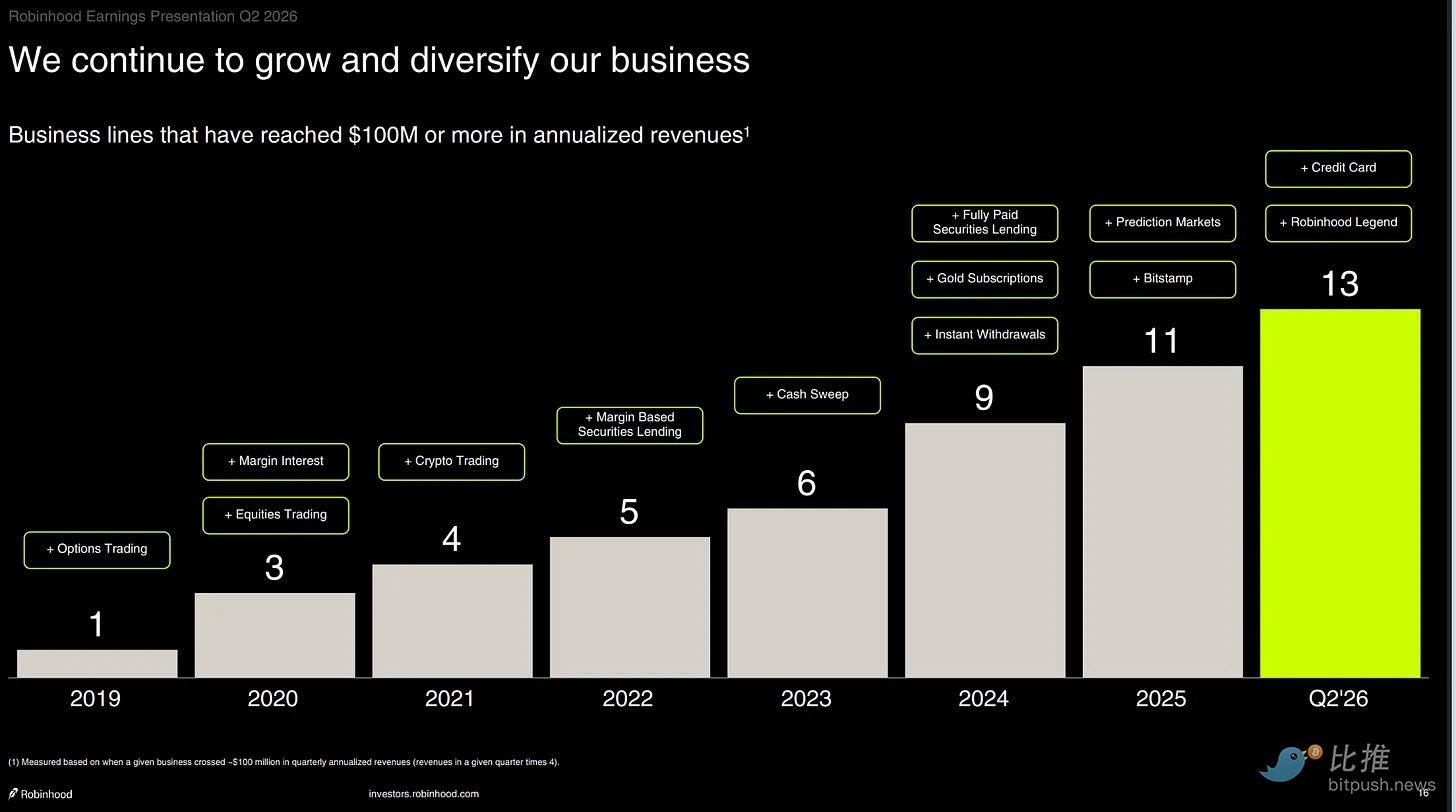
At the beginning of the earnings call, Robinhood Chief Financial Officer (CFO) Shiv Verma told investors that the company should be evaluated based on three metrics: net deposit amount, Rule of 40 (Rule of 40), and number of business lines with an annualized revenue operating rate (ARR) of at or above $100 million.
In the second quarter of 2026, Robinhood's desktop trading and analytics platform Legend and Credit Card (Credit Card) became the latest business lines to join the “$100 Million ARR Club.” Currently, the company has 13 business lines on this list. ,
@Q2Earnings
But let's put these macro indicators aside and take a look at some more microscopic data.
By the end of the second quarter of 2026, Robinhood's capital customers had increased 7% year over year, from 26.5 million to 28.4 million. Average revenue per user (ARPU) soared 24% from $151 to $187 over the same period.
Revenue from a single customer is growing more than three times faster than the customer base.
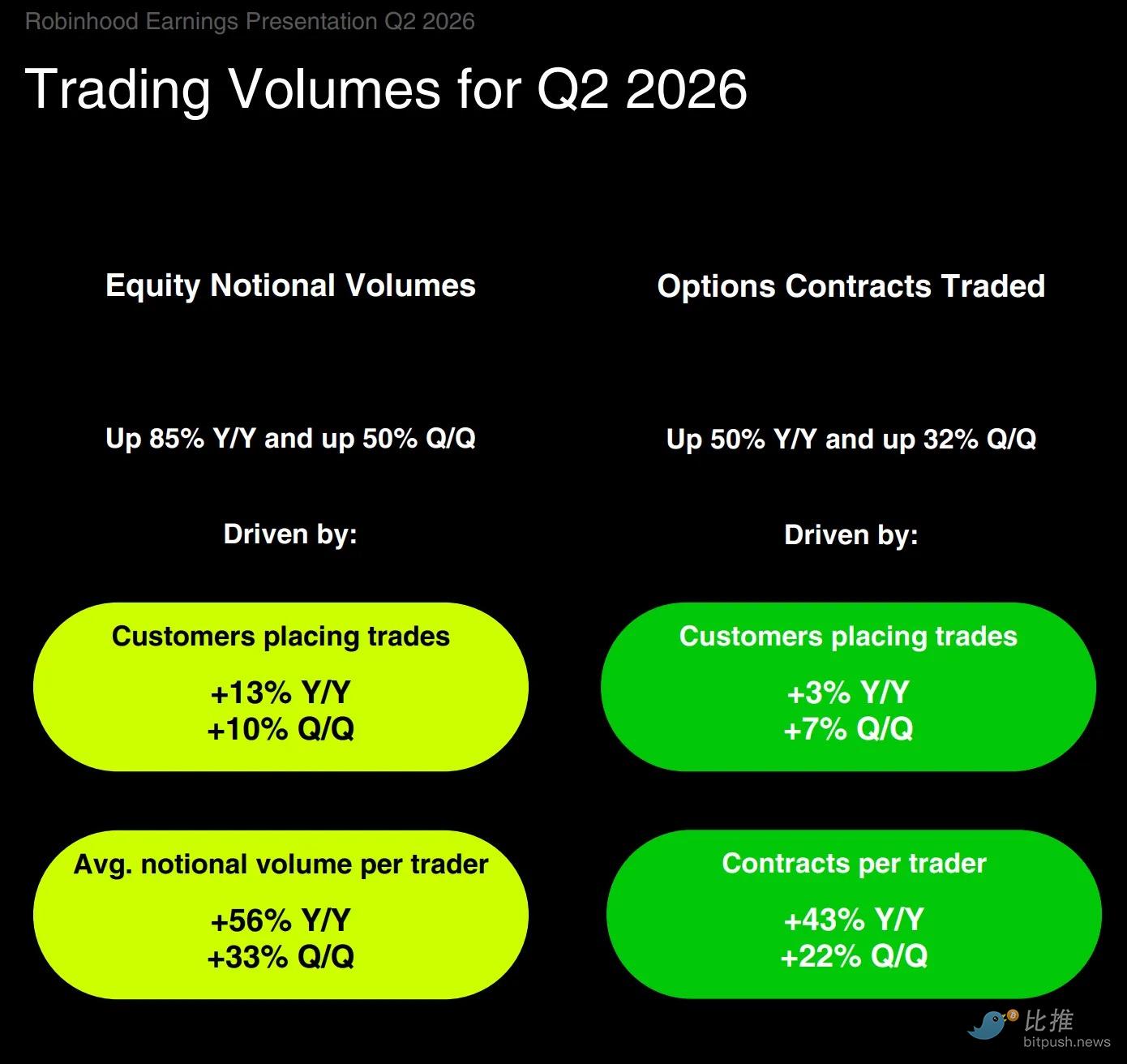
The transaction data also reflects this. Based on individual clients' trading volume in the second quarter, Robinhood showed that the nominal volume of shares per trader increased 56% year over year, while the number of options contracts per trader increased by 43%. However, the number of customers trading stocks only increased by 13%, and the number of customers trading options increased by only 3%.
@Q2Earnings
Robinhood's event contracts (event contracts) business didn't exist 15 months ago; today, it has generated $156 million in revenue, an increase of 50% over the previous year. And all of this doesn't require Robinhood to acquire a new group of users.
In May of this year, I wrote that Robinhood's ability to package stock, options, and perpetual contract transactions with event contracts enables it to provide a much better “information pricing platform” than its competitors.
All of this suggests that the accurate standard for evaluating a company like Robinhood is to look at how many things each basket its financial supermarket can sell. That's how its ARPU grew.
Gold tipping point
Although Robinhood has more than a dozen businesses, one of the most critical drivers in its engine is its Gold membership subscription. In just two years, the penetration rate of Robinhood Gold subscriptions has almost doubled, rising from 8.2% to 17% of the total funded customer base.
In the second quarter of 2026, the Gold subscription business generated $216 million in annualized subscription revenue. This accounts for only about 4% of total revenue. However, the potential benefits each Gold subscriber brings to the business as a whole are far greater. Compared to regular financial clients, a Gold member holds about 4.2 times more assets in custody and is about 3.1 times more likely to use retirement products.
CFO Verma stated during the earnings call that 40% to 50% of new Robinhood customers will sign up to buy Gold memberships regardless of what kind of product they are initially attracted to.
This shows Robinhood's cross-selling moat. Even if the customer initially came for commission-free stocks, World Cup prediction markets, or a credit card with 3% cash back, 1 in 2 customers will convert to a Gold membership. Once they purchased this $5 monthly subscription, they joined an exclusive community of 4.8 million members and enjoyed benefits such as cheaper options contracts, 3% IRA allocation from their employer, 3.5% bank annual return on cash (APY), credit cards, and more.
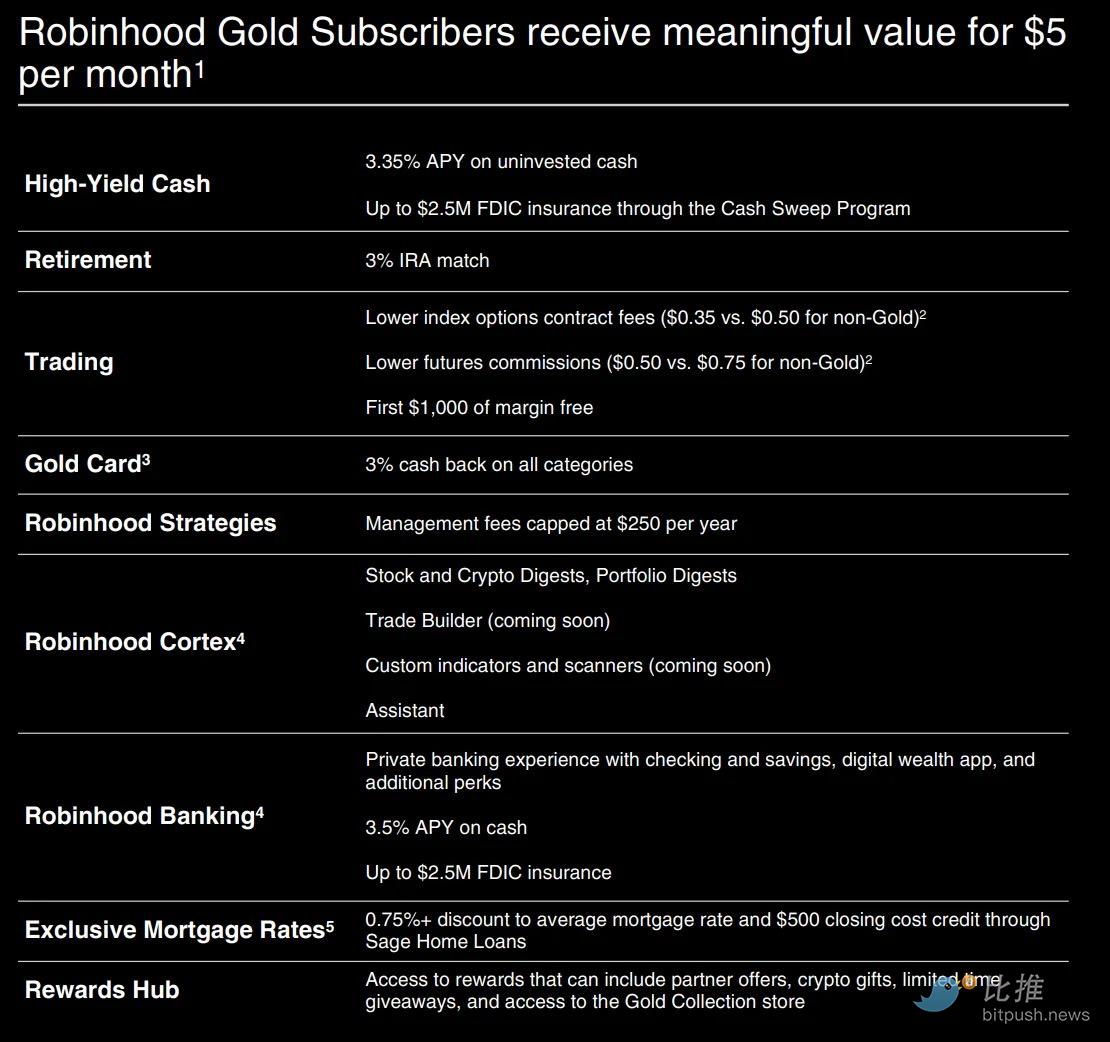
@Q2Earnings
This cross-adoption can be accurately measured. Verma notes that customers in the forecasting market are more likely to have retirement accounts with Robinhood at the same time. As a result, a person betting on a soccer game on Robinhood's prediction market is also using Robinhood's retirement account to achieve compound interest growth in their IRA.
Robinhood's financial products supermarket doesn't stereotypically segment its customers into “gamblers” and “serious investors.” It sells products to the same customer, and every product the customer uses increases the probability that they will use another product.
Despite having such a strong distribution moat, I still don't think Robinhood has made its most exciting move.
Two major catalysts
I used to think that the blockchain itself makes little money, and doesn't need to make any money. At the time, I conceived Robinhood Chain as a connecting layer to make other businesses more sticky. I'll adjust my outlook for Robinhood slightly after reading the second-quarter earnings report. Its blockchain and the upcoming launch of Robinhood Social (Social News) will be the two biggest catalysts across its entire product suite and driving cross-selling of more than a dozen of its businesses.
Imagine the power of blockchain: a customer buys a tokenized stock. The token acts as collateral in the lending market. The loaned funds are directly used to establish perpetual futures positions. One dollar spanned three products in a single session, and the money never left the app. In the past, in the fragmented broker ecosystem, these three behaviors occurred in three isolated locations. Each of these locations has user registration thresholds and requires customers to make fresh decisions. Composability removes this friction.
Blockchain directly weaves cross-selling into the underlying infrastructure, enabling customers to cross-consume themselves with extremely low or even zero friction.
Robinhood CEO Vlad Tenev said the company plans to open up its social feeds to the public at the end of the third quarter. Tenev expects this internal social dynamic to add more credibility to trading ideas, as the content on the platform will be supported by a verifiable mix of real positions on the Robinhood trading platform within the same ecosystem. Under the traditional model, trading inspiration usually comes from the outside world—traders may obtain trade ideas from Twitter, podcasts, or friends, form trade intentions, and then come to Robinhood to execute. Robinhood Social can pull this step directly within its own “wall.”
This is the most underrated aspect of its social dynamics. The level of trust it brings to its 30 million funded users is unmatched by screenshots or podcasts on any external platform. When this social dynamic goes live to the public, the last step in the Robinhood funnel that originated externally — the moment to generate transaction intent — will also be completed internally.
I don't see Robinhood Chain and Social as separate lines of business. Instead, I see them as a catalyst to activate all other businesses. A community of 30 million people discussing the latest events and contracts, sharing lives built through retirement account self-regulation, and exchanging the latest stock tokens (which give them pre-IPO investment opportunities in unlisted companies such as Anthropic) — the yearning and impulse this stimulates in the hearts of other users will far surpass any user acquisition marketing campaign.
Loyalty script
Robinhood's value capture strategy is very similar to what we saw at Costco (Costco). As the third-largest retailer, Costco's vast majority of profits come almost entirely from membership fees, and their shopping shelves run almost at a cost price just to attract members to keep coming in. The neutral layer (neutral layer) is not where profit lies. But usually these neutral layers create adjacent capacity, which allows value to accumulate there. Just as Costco's shelves and product categories drive people to buy their membership subscriptions.
Robinhood Chain and Social are like this neutral layer; they create a hierarchy where value accumulates. Both provide investors or traders with a reason to buy a Robinhood Gold subscription and buy multiple products from various shelves in financial supermarkets.
One of the biggest question marks Robinhood has faced over the years has been cyclical issues. Despite Robinhood's record stock and options trading volume in the second quarter, its cryptocurrency trading volume has been declining for three consecutive quarters. Even on Robinhood Chain, over 80% of trading volume is still driven by memecoin speculation.
Skeptics may see a crisis in it, but I disagree.
Robinhood's diverse and deep (ARR $100 million) line of business ensures that its integrated overall business is no longer at the mercy of market cycles. When trading volume declines, interest-bearing assets don't necessarily decline with it. Its margin book (margin book) increased 127% year over year to $21.6 billion.
On platforms like Robinhood, the prediction market, which was mainly driven by sports and elections, took a different shape. The Rothera joint venture with Susquehanna International Group gave Robinhood a predictive market exchange license regulated by the CFTC, enabling it to create its own event contracts. This enabled the company to eliminate the cyclicality of seasonal categories such as sports and elections, and provide year-round event contracts linked to macroeconomics and S&P 500 announcements.
Gold subscription revenue is a fixed monthly revenue that doesn't care at all about how the market performs each month. Robinhood spent five years bringing together these businesses that peaked in revenue at various times, making the entire company more cyclical than any single line of business.
This is directly reflected in the ARPU data. ARPU has surged 24% because the average customer is now connected to more business simultaneously; and a customer connected to 5 unrelated revenue streams is essentially a more enduring and stable asset than one that only connects to a single fluctuating revenue stream.
The more products each customer is exposed to, the smoother and more stable Robinhood's own revenue curve becomes. Every trough in one line of business is filled by the peak of another business line, and this is usually driven by the same person's account.
Coinbase is simply reshuffling crypto capital between existing consumers and institutions; traditional brokers have assets but are unable to generate user engagement; and Robinhood is in a unique position: it can transform a single customer relationship into a revenue node capable of self-compounding and self-diversifying across traditional and crypto businesses — both of which can be connected and amplified by its native blockchain.
