


Coinbase plummets: in a bear market, “universal exchanges” are also difficult to handle

In the US market on July 31, Coinbase's stock price closed down about 10.6%. At one point in the intraday period, it fell to $139.17, a drop of more than 12%.
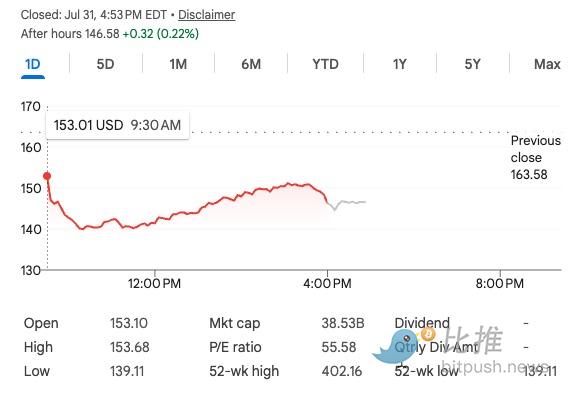
For a cryptographic concept stock that has always been highly volatile, this kind of market is no stranger. But the signal from this sell-off is clear: it is difficult for a strong, compliant exchange like Coinbase to make steady profits in a bear market.
More than just a loss
In the second quarter, Coinbase's total revenue was about US$1.22 billion, down 19% year on year; net loss was US$359.5 million, or US$1.36 per share, which was significantly worse than analysts' expectations. Adjusted EBITDA fell to US$208 million, down nearly 60% from the same period last year.
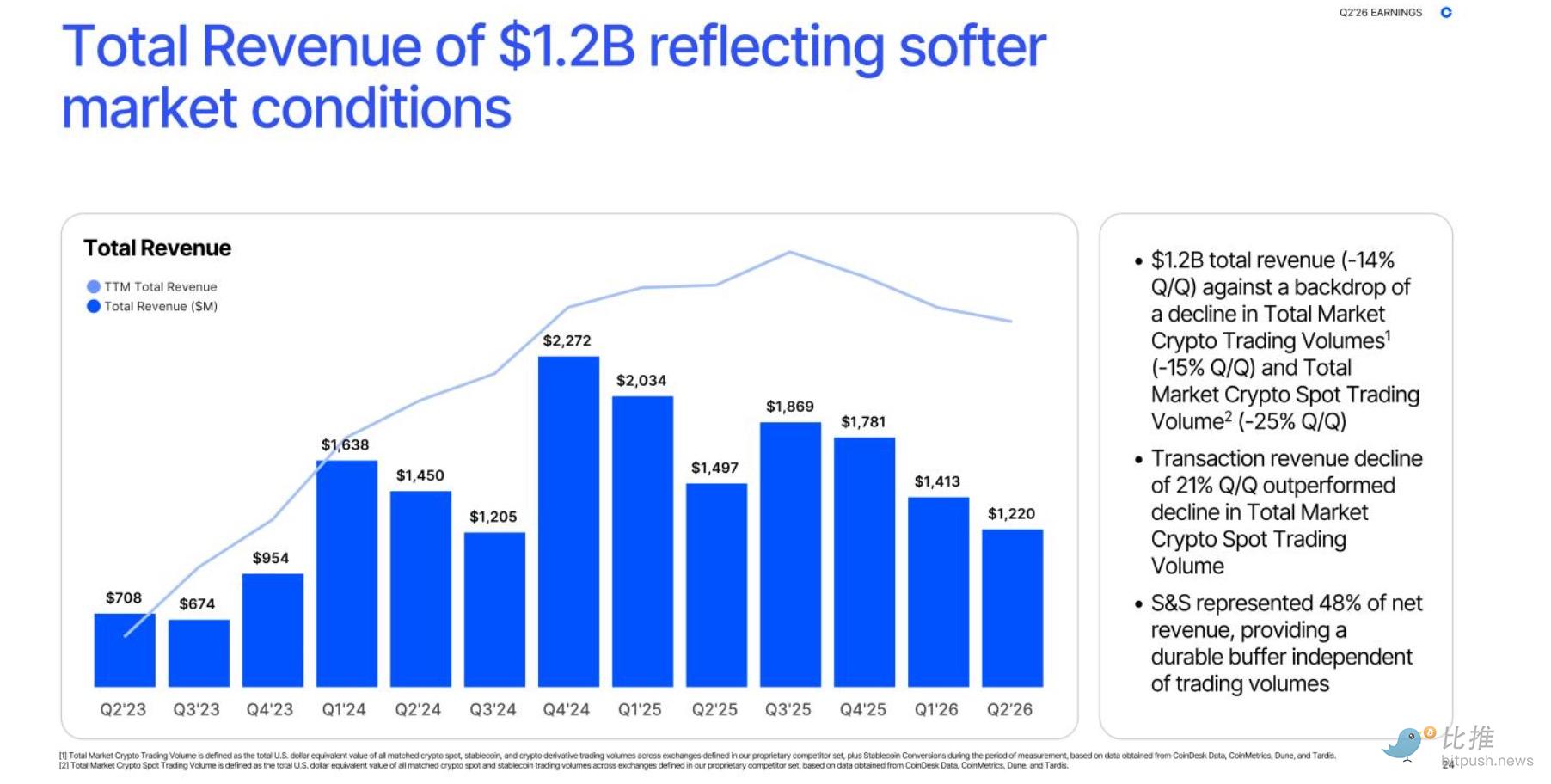
Of this loss, about US$210 million came from valuation losses on the company's crypto holdings, and an additional $52.4 million in restructuring expenses. Looking at these numbers alone, it seems like the problem can be attributed to one-off projects. But what is more alarming is the main business itself: transaction revenue fell 21% year over year to US$599 million, and subscription and service revenue also fell 12.2% to US$555 million.
The reason is not complicated. As currency prices fall and volatility shrinks, user transaction frequency declines, Coinbase's most important fee revenue is naturally under pressure. In a bull market, trading volume, currency prices, and position returns can go up at the same time; in a bear market, they also go down together. This makes Coinbase still look like a “crypto cycle stock” with operating leverage added.
The slogan “Universal Exchange” is beginning to show results
Of course, Coinbase is changing, too. The management wants to expand the platform from a cryptocurrency exchange to a “universal exchange” where stocks, derivatives, predictive contracts, and tokenized assets can be traded.
In the second quarter, the company's market share in crypto trading volume rose from 9.1% to 10.3%, a record high for the third consecutive quarter; the subscription and service business accounted for 48% of net revenue; and the average USDC balance within the platform reached $20 billion. What is more noteworthy is the forecasting market. Its contract volume and revenue increased 106% month-on-month, and annualized revenue exceeded 100 million US dollars.
Coinbase also emphasized that 88% of net revenue no longer comes from Bitcoin spot trading. This figure shows that the revenue structure is indeed richer than in the past, but it cannot simply be understood as having broken out of the crypto cycle. Other token transactions, stablecoin interest, staking, escrow, and crypto derivatives will still be affected by currency prices, interest rates, and on-chain activity. The simultaneous decline in subscription and service revenue in the second quarter indicates that this level of connection still exists.
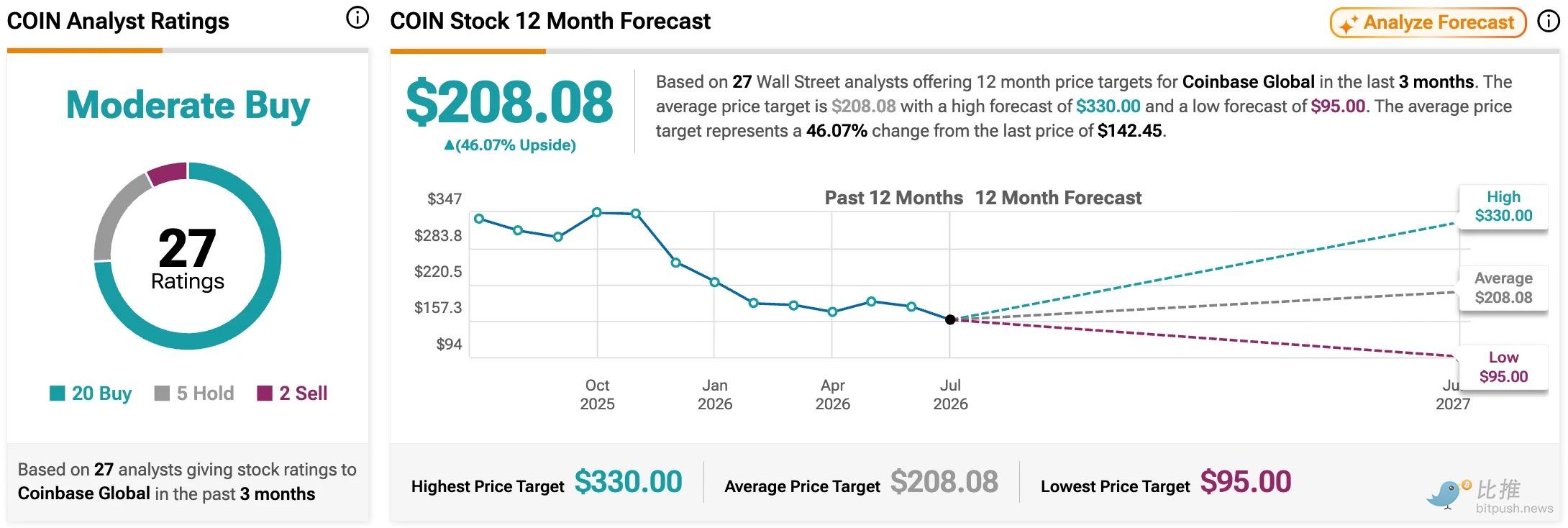
This is why Bernstein continues to be bullish. The agency maintains a “outperforming the market” rating and a target price of $330, and believes that in the current market environment, extending to stablecoins, payments, perpetual contracts, predictive markets, and tokenized assets is Coinbase's most reasonable strategy.
The problem is that the right direction doesn't mean you're already ahead.
Predicting the market: growing fast, but there is a big gap
Coinbase's predicted market revenue of over $100 million per annum indicates that the business has moved out of the early testing phase. However, after a horizontal comparison, this number is less impressive.
Robinhood's second-quarter incident contract revenue reached US$156 million, including $17 million in Rothera-related revenue. If it is simply annualized on a quarterly basis, the scale is about 624 million US dollars, which is about six times the current level of Coinbase; the event contract volume reached 13.6 billion, and Rothera contributed about 2.1 billion shares.
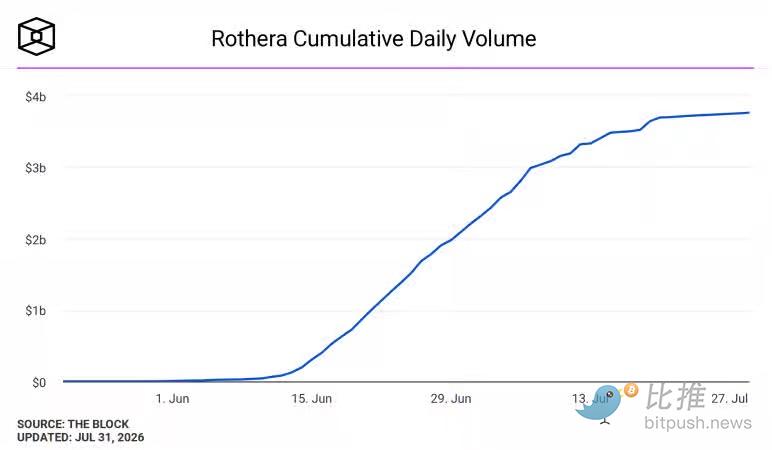
More importantly, Robinhood has been extended to trading and clearing infrastructure through the associated Rothera exchange. Judging from the available data, it is temporarily ahead of Coinbase regardless of revenue scale, turnover, or infrastructure participation. Bernstein is optimistic about Coinbase's overall strategy, but admits that it has yet to become a prominent leader in any of these new tracks. The prediction market is the most typical example: Coinbase has proven that users are in demand, yet it hasn't proven that it can win.
Tokenized assets, temporarily or a forward check
Tokenized businesses also need to be looked at with caution. Coinbase announced in June that it will launch tokenized stocks backed by real stocks one-on-one for non-US customers, and has laid out perpetual stock and pre-IPO perpetual products. Judging from imaginative space, round-the-clock trading, on-chain settlement, and collateral lending may indeed change the way traditional securities are traded.
However, as of the second quarter, the company did not separately disclose the trading volume and revenue of tokenized stocks. In other words, the business is currently more like a strategic layout than a pillar of growth that has already been realized.
The competition went even faster. Kraken has expanded xStocks to 100 tokenized US stocks and ETFs, and launched tokenized stock perpetual contracts. Third Bridge analyst Jacob Zuller bluntly stated that tokenized stocks and perpetual contracts could hedge against weak spot trading, but Coinbase is still lagging behind in these two areas.
Why is Robinhood more resistant to falling?
Coinbase's real tricky rival is not just traditional crypto exchanges, but Robinhood, whose business boundaries are getting wider.
Robinhood's net revenue for the second quarter was US$1,308 million, up 32% year on year, and net profit of US$573 million. Despite a year-on-year decline in crypto trading revenue of around 38% to $100 million, businesses such as stocks, options, event contracts, and interest continued to hold back overall growth. What needs to be clarified is that its net profit includes about US$129 million in income related to matters such as fund statements, but profit resilience is still significantly stronger than Coinbase.
The revenue scale of the two companies is already close, but as a result, one profit and one loss. The difference is that Robinhood users can move between stocks, options, cash management, prediction markets, and cryptocurrencies; although Coinbase's product shelves are getting full, the revenue focus is still highly correlated with the crypto market.
For investors, what Robinhood sells is the stability of cross-asset platforms, while Coinbase still sells more about elasticity when the crypto market rebounds.
The real test questions, before the next round of the bull market
Regulation could be a turning point. If passed, the CLARITY Act will further clarify the US digital asset regulatory boundaries and provide more stable expectations for Coinbase and institutional customers. However, the bill is still in intensive negotiations, and there are variables in the timeline and final provisions.
Analysts are also very divided as a result. Bernstein and William Blair are optimistic about stablecoins, retail derivatives, and increased market share; Raymond James warned that trading conditions are still difficult, and there is a lack of visibility when trading volume will resume. Optimists are betting on future platforms; cautious people are eyeing immediate profits.
Therefore, Coinbase's earnings report did not deny the direction of a “universal exchange,” but reminded investors not to take the blueprint as an outcome ahead of schedule.
The increase in market share, the expansion of USDC, and forecasting that the market will exceed 100 million dollars in annualized revenue all indicate that the company has not stopped; however, the forecast market lags behind Robinhood, tokenized assets have not yet formed a verifiable revenue contribution, and the subscription business is still affected by the crypto cycle.
What Coinbase really needs to prove is not how much it can make when Bitcoin soars again, but whether it can rely on stablecoins, payments, derivatives, and new asset transactions to continue to make profits during the days when currency prices are sluggish and transactions are lackluster.
Only by doing this can a “universal exchange” be considered a real achievement.
Author: seed.eth
Twitter:https://twitter.com/BitpushNewsCN
Compare the TG exchange group:https://t.me/BitPushCommunity
Compare TG subscriptions:https://t.me/bitpush
