


Crypto Agent commercialization is accelerating, why are stablecoins the most critical part?

Core ideas:
For AI agents to become real economic agents, the core obstacle is that traditional payment systems cannot support their autonomous payments. Stablecoins represented by USDC, along with dedicated infrastructure launched by companies such as Coinbase, Circle, and Stripe, are building a native programmable, all-weather, small, high-frequency “currency layer” for AI agents, spawning a program-driven on-chain microeconomy.
Key elements:
1. The four major barriers to traditional payments: Agents cannot pass the identity barrier (no ID card), authorization (verification code required), time (not 7 x 24 hours), and cost (high fixed processing fee), and cannot perform small-amount high-frequency transactions.
2. Native advantages of stablecoins: programmable (automatic code execution), no license (self-generated wallet), 7 x 24 hours, transparent accounts and stable value, perfect for agent payment needs.
3. Implementation practices of leading companies: Coinbase launched AgentKit and X402 protocols (more than 50 million transactions have been processed); Circle launched the CCTP cross-chain protocol and AgentStack; Stripe launched a stablecoin API and supported USDC subscription payments.
4. Typical application scenario 1 (ultra-small payment): The x402 protocol and Circle's Gateway Nanopayments achieve $0.000001 micropayments, unlocking the long-term economy of pay-per-use billing for API calls, data access, etc.
5. Typical application scenario 2 (automatic generation): AI agents can achieve “self-hematopoiesis” through yield-bearing stablecoins (such as aUSDC), cover operating costs with interest, and platforms such as Ymax can achieve 8-12% annualized stablecoin returns.
6. Large-scale implementation challenges: Private key management is vulnerable to attacks (such as the Owockibot incident), gaps in compliance (agents cannot be identified), and inaccurate AI intentions may lead to irreversible financial losses.

Generative AI is changing from a “chatbot” to an AI agent (AI agent) that can do things by itself. A real question then popped up: How do these silicon-based “employees” receive money and how do they pay?
Traditional banking stuff — real-name authentication, manual authorization, public accounts — inherently disapproves of AI agents.
One answer that is rapidly evolving is to use stablecoins (USDC, USDT, and stablecoins with interest) to create a native “currency layer” for AI.
This article will break down the implementation of leading companies such as Coinbase, Circle, and Stripe in this field, while also discussing compliance and security risks.
The technical infrastructure is ready, but how to drive it is still a big problem.
I. “Payment breakpoints” encountered in the commercialization of AI Agents
Today's AI agents are very capable: book tickets, write codes, adjust interfaces... but they get stuck as soon as they get to the “payment” step.
Traditional payment systems are designed for humans — you have to have an ID card, enter a verification code, operate on weekdays, and have a low processing fee for each transaction.
These are all barriers for agents.
Specifically, the traditional payment system sets up four levels for agents:
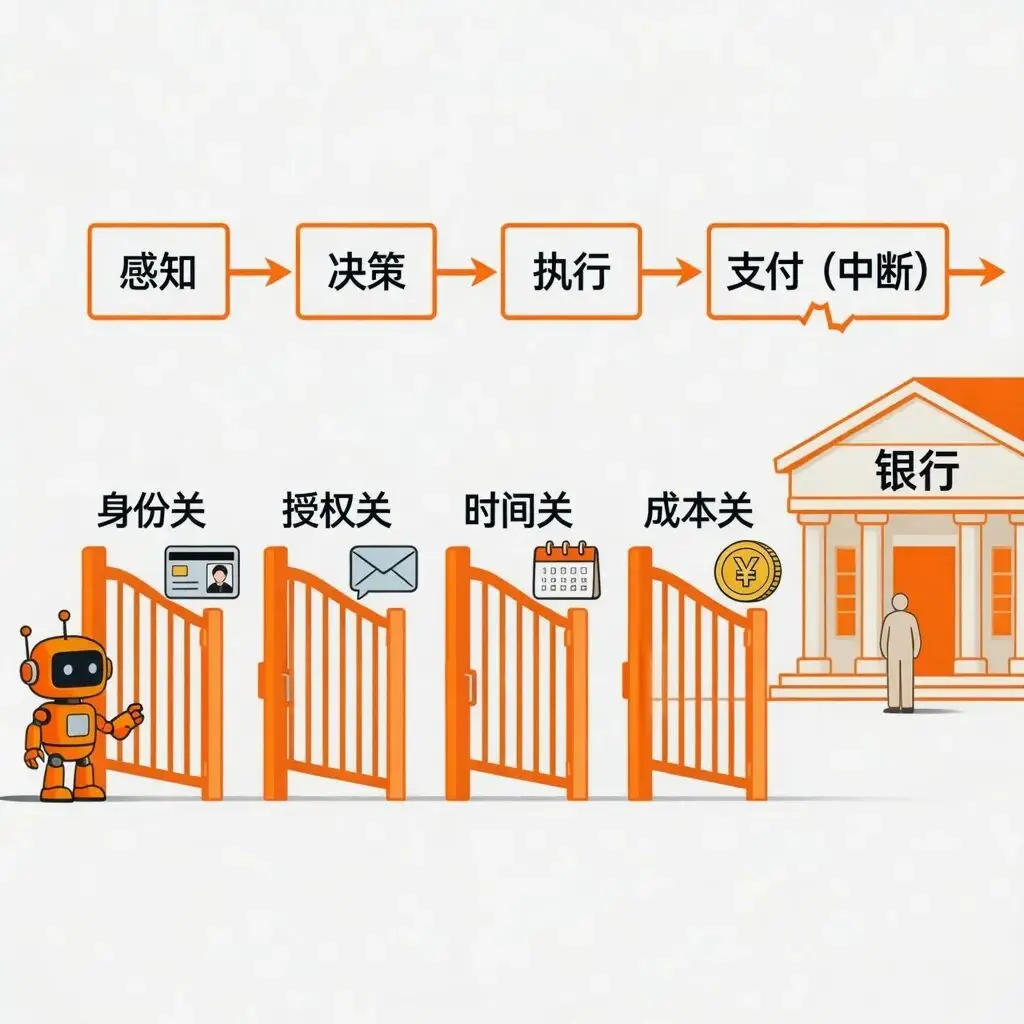
Identity control: Opening a bank account or credit card requires an ID card, face recognition, or even bank statements, and agents can't take it out either.
Authorization: SMS verification codes, manual confirmation, and 3D security authentication are often required during payment, and agents cannot click buttons even if they cannot receive SMS.
Time limit: Banks only process transfers on weekdays and business hours, while agents work 7×24 hours.
Cost barrier: Each transaction has a fixed processing fee, such as starting at 30 cents for credit cards, so the pay-per-use model of $0.001 doesn't work at all. However, the financial behavior of agents requires exactly this kind of small, high-frequency charge (such as per number of API calls, per usage).
The more fundamental problem is that the entire payment system has never considered direct “program to program” transfers. Even between two technology companies, the process is often: the agent generates an order → sends an email → person approves → person logs in to online banking to transfer money → each other's financial reconciliation. The agent can only do the first two steps and the final record. The most important step, “money from A to B”, must be done by hand.
Current attempts: they are all imitating humans instead of creating new accounts for agents
Virtual credit card+API: The agent calls an interface such as Stripe to pay, but the person's identity and card are bound behind it. Once the risk control feels abnormal (too fast, the amount is strange), it pops out and requires manual verification.
Robotic process automation (RPA): let agents click online banking pages like humans. As soon as the bank website was revised, the verification code changed from a number to a slider, or one more step of verification was added, this script became obsolete.
Delegate payment: The person first approves an amount for the agent, and the agent spends this amount. However, approval quotas, renewals, and account checks still have to be done by someone.
The common problem with these programs: Agents don't have their own accounts and can only “live behind closed doors.” Its autonomy can be taken back by the bank or platform at any time.
Why stablecoins are a better solution: Give Agents a native “money bag”
For an Agent to truly manage its own money, it needs to be programmable, requires no human identity, operates 7 x 24 hours,
A monetary system where all accounts are publicly viewable and the value is relatively stable. Stablecoins provide exactly this:
Programmable: Write directly into the code, and pay automatically when conditions are met, without anyone pressing a button.
No permission required: Agents can generate their own wallet address without having to go to the bank and line up to open an account.
All-weather: No weekends, no holidays, no time off work.
Transparent accounts: Every transfer is on the blockchain, so anyone can see it, making it easy to audit.
Stable value: It does not rise and fall like Bitcoin and Ethereum, and is suitable for pricing and long-term settlement.
Stablecoins aren't completely secure either. Those that rely on fiat currency, such as USDC and USDT, rely on centralized hosting and auditing, and have also experienced a brief period of de-anchoring in history;
Pure algorithmic stablecoins have proven to be unviable. The stablecoins discussed in this article mainly refer to mainstream fiat-backed stablecoins that are subject to regulation.
2. Who is arranging payment agents?
The direction is clear, so who will pave the way? In the past year and a half, leading companies such as Coinbase, Circle, and Stripe are no longer just discussing concepts.
Instead, usable tools and protocols have been rolled out one after another. They each took a different approach: some specialize in agent wallets and payment tracks, and some solve cross-chain settlement.
Some open up a bridge between fiat and stablecoins.
Coinbase: Base Chain+AgentKit Toolkit
AgentKit launched by Coinbase is a development kit that allows developers to equip AI agents with on-chain wallets and payment capabilities. In February 2026, they also released Agentic Wallets, which has five core functions: authentication, savings, payment, transactions, and income. The underlying layer uses the x402 protocol made with Cloudflare, which is specifically designed for “machine-to-machine” payments.
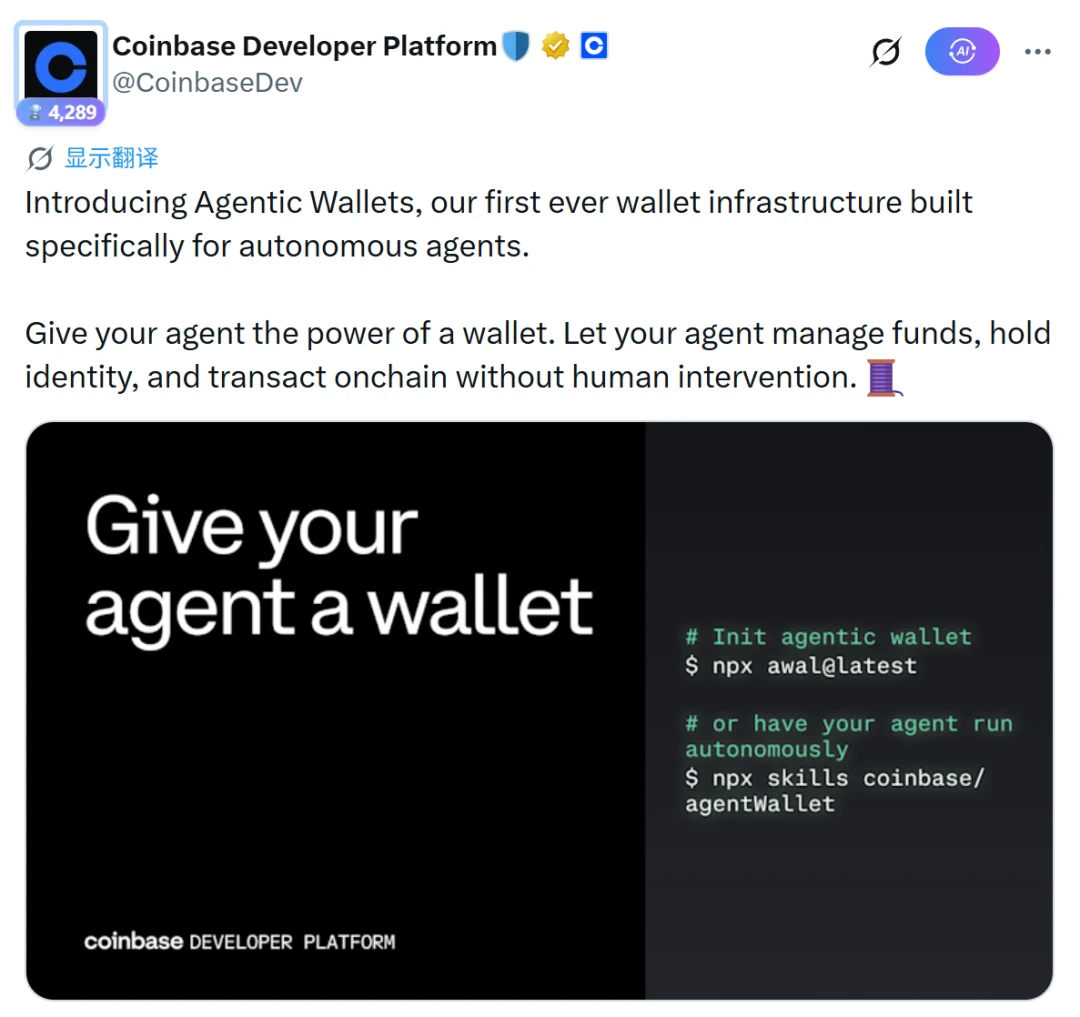 By early 2026, the agreement had processed more than 50 million transactions. In terms of security, Agentic Wallets supports setting limits such as “maximum amount of money per session” and “maximum amount of money spent per transaction”.
Circle: CCTP cross-chain protocol+AgentStack
Circle's CCTP (Cross-Chain Transfer Protocol) addresses the issue of secure transfer of USDC between different blockchains. It uses a “destroy-casting” mechanism,
It does not rely on a third-party cross-chain bridge, which is naturally safer and more compliant. Based on this, Circle launched AgentStack in 2025, including: Agent wallet (supports gas-free transactions), CCTP,
Gateway micropayment (minimum support of $0.000001), and an Agent service marketplace. CCTP has added Hooks (hooks) functionality,
When transferring money across chains, AI agents can easily bring in business information to achieve “automatic account entry or financial management after cross-chain payment” with one click.
In March 2026, Circle also launched the Circle Skills open source library, which allows AI agents (such as Claude) to decide for themselves:
When should you use CCTP and when should you use Gateway micropayment.
Stripe: Stablecoin API, connecting traditional commerce to the on-chain world
Stripe officially launched the stablecoin API in 2025 and built a compliance bridge from traditional commerce to the on-chain ecosystem through the acquisition of stablecoin infrastructure company Bridge.
In October of the same year, Stripe introduced stablecoin subscription payments, which first supported USDC subscriptions on the Base and Polygon chains.
They've also written smart contracts to solve the problem of “having to manually sign every payment” — users can save their wallets as a payment method and authorize regular automatic deductions.
Stripe uses its own ledger and KYC/AML compliance monitoring in the back office to block complex things at the bottom of the blockchain, such as private key management and gas fees.
When AI agents need to transact with traditional merchants, Stripe provides a legal and compliant US dollar exchange and settlement channel.
In addition to the three major companies mentioned above, some traditional leading Internet companies have also begun to deploy in this field:
AWS+Stripe+Coinbase (May 2026): The three parties jointly launched a USDC-based payment infrastructure to enable AI agents to pay for digital services such as cloud services and API calls. As a payment layer, Amazon Bedrock's AgentCore Payments takes about 200 ms to settle on the Base Chain and costs less than 1 cent per transaction. Stripe has implemented its own MPP (Machine Payment Protocol) and supports “streaming payments” — real-time billing based on the amount of computation or tokens consumed per second. On the same day, Stripe and Tempo also released the MPP open source standard, and Visa announced support.
Google+Coinbase (September 2025): Jointly launched the Agent Payments Protocol (AP2), which combines Google's inter-agent communication framework (A2A) with Coinbase's x402 payment track, so that Agents can complete the entire process of “price discussion → payment → receipt”. The first partners include ServiceNow, Salesforce, PwC, Shopee, Worldpay, etc.
VirtualsProtocol+ Ethereum Foundation (March 2026): Co-proposed ERC-8183 (Agentic Commerce), an on-chain commercial settlement standard for AI agents. The core is the concept of “job (job)”: Party A, Party B, and the referee lock up funds through smart contracts and settle according to the “Creation → Funding → Delivery → Completion/Rejection/Expiration” state machine.
III. Typical application scenarios in silicon-based economies
With the above facilities, if AI Agents actually have their own stablecoin wallets that can collect and pay, cross chains, and generate income, then they are no longer isolated tools, but can form a microeconomy that operates on their own. Here, we selected application scenarios that have already been partially implemented in the short term and are most likely to maximize the value of silicon-based economies for analysis.
Scenario 1: DeFi yield optimization - let agents “make money” themselves
In traditional finance, putting idle cash in a current account basically does not generate income.
But in the DeFi world, stablecoin holders can deposit money into loan agreements (such as Aave, Morpho, Compound) for interest.
The problem is that interest rates in different agreements and chains change all the time, making it difficult for people to keep an eye on it and adjust positions at a high frequency. This is the strength of AI Agent.
For example, the Walbi platform processed 187,000 transactions initiated independently by AI agents in 14 weeks, involving 9,500 independent agents — no one intervened.
The agent automatically scans the loan interest rates of each chain, calculates the net profit after deducting the gas fee, and moves the money from the low yield pool to the high yield pool.
Let's take another look at ZENITH's solution: put an independent AI agent on each mainstream public chain such as Ethereum, Arbitrum, Optimism, and Base,
Each only cares about DeFi protocols (Aave, Morpho, Compound, etc.) on its own chain.
Once it is discovered that the interest rate of one chain is higher than the other, and that the difference can cover cross-chain costs, the Agent transfers the funds through agreements such as CCTP.
Why can't agents do this kind of task? Manual operation has three difficulties: the first is to track changes in multi-agreement interest rates at the same time; the amount of data is too large;
Second, cross-chain operations are cumbersome, and every transaction must be signed manually; third, the processing fees and time costs of high-frequency position adjustments are too high.
Equipped with stablecoins, AI Agent can achieve 7×24 hour monitoring, millisecond response, automatic execution, and every transaction is traceable and auditable.
Scenario 2: Ultra micropayments — unlocking the “pay-per-use” long-tail economy
Traditional payment systems have fixed processing fees for every transaction (starting at 30 cents for credit cards), making micropayments (like $0.001) not economically viable.
However, for AI services (billed by number of API calls, number of images generated, and number of queries), micropayment is the most natural pricing method.
The low processing fees of stablecoins and the characteristics of supporting extremely small units make micropayments possible again.
The x402 protocol, jointly developed by Coinbase and Cloudflare, embeds payments directly into HTTP requests.
When the client accesses a protected API, the server returns a 402 status code (payment required) with a payment request (such as “Please pay 0.001 USDC”).
Clients can get data or services by automatically paying through the built-in Agent wallet — by the beginning of 2026, the agreement had processed more than 50 million transactions.
Typical scenarios: API paywalls, high-value data sets per visit, real-time market data subscriptions.
Circle's Gateway Nanopayments go a step further, designed for high-frequency, extremely small transactions, supporting USDC transfers as low as $0.000001, and the recipient doesn't have to pay gas fees.
The principle behind it is “batch settlement plus status channel”: multiple micropayments are aggregated off-chain, and in the end, the net amount is only settled once on-chain.
In this way, the agent can pay for every API call, each megabyte of storage, and every second of computing time in real time, with almost zero processing fees.
Without micropayment, the commercialization of AI Agents can only follow the old path of package subscription or prepaid recharge;
With it, agents can be billed as accurately as water and electricity meters, and collaboration between agents (such as A calling B's model inference service, paying only a few cents at a time) can also be completed with extremely low friction.
Scenario 3: From “idle funds” to “automatic generation” -- yield-bearing stablecoin upgrade practices
In traditional finance, the money in a company's current account basically does not generate interest. Financial management requires people to research products, sign agreements, and transfer in and out manually. The process is cumbersome and time-efficient.
Small and medium enterprises often simply give up.
Stablecoins plus AI Agent completely overturned this logic.
When the Agent holds yield-bearing stablecoins (such as aUSDC, sDAI, eUSD),
Wallet balances automatically accrue revenue — these stablecoins are essentially deposit certificates for DeFi protocols, and interest is directly reflected in rising token exchange rates.
Agents can “live without doing anything.” More importantly, a well-designed revenue management agent can also automatically switch between different interest-bearing assets, so that “both profit and payment can be made at any time.”
The revenue orchestration platform launched by Ymax in February 2026 is a typical example: users only need to sign a license once,
Agents can automatically distribute money to multiple vaults such as Morpho, Aave, Compound, etc., and automatically rebalance according to real-time interest rates. Users don't care about the whole process, and profits accumulate every second.
Another AI-managed treasury provided by AarnaFinance integrates more than 20 revenue sources (loans, staking, treasury strategies) on the chain.
The Agent dynamically builds the portfolio, and the stablecoin-based annualized return is 8-12%.
For comparison: traditional bank demand deposit interest rates are usually less than 0.5%, and the annualized rate of dollar funds is about 4-5%.
For AI agents, the ability to survive is not just the icing on the cake; it may change the underlying economic logic: an agent that can automatically live can use interest to pay its own operating costs (gas fees, API call fees).
Save even more capital to perform more complex tasks. Agents are no longer a burden of “burning money,” but have become a “self-hematopoietic” microeconomy.
When hundreds of millions of such agents run simultaneously, it will spawn a completely new financial sub-market that is entirely program-driven.
IV. Necessary challenges for large-scale implementation
The facilities are there, and the scene has worked, but don't be in a hurry to cheer — until the following hurdles are over, large-scale commercial use is still empty talk.
Private key management and security
Many AI Agent wallets today have a major flaw in their design: they hand over private keys or API credentials directly to the Agent.
Once attacked by a “prompt injection attack” (for example, a bad person induces an Agent to perform a malicious action through input), the private key may be leaked.
Audit firm Sherlock listed “malicious third-party skills,” “indirect prompt injection,” “credential disclosure,” and “improper wallet permission design” as the biggest risks to Web3Agent security in 2026.
On-chain transactions are irreversible, and a single mistake can result in permanent loss.
A real lesson: In the Owockibot accident in February 2026, autonomous AI agents leaked the private keys of their hot wallets in several places.
Finally, the project party had to cut off the Agent's access to the Internet and cryptographic operations. The founder of the project acknowledged: “I seriously underestimated the safety difficulty of this project and must be restructured from a safety priority perspective.”
Solutions currently being explored:
Isolated signature layer: The agent can suggest “how much should I pay to whom”, but the actual signing process is done in a separate hardware security module or hosting layer.
MetaMask Smart Account Solution: Agents can initiate transactions, but they will never get the private key. Fine-grained control of permissions through ERC-4337 smart accounts and ERC-7710 delegated authorization.
Compliance and regulatory gaps
Traditional KYC is about to become a “Know Your Intelligent Body” (KYA), but the law doesn't have this category at all.
Agents are not legal entities and cannot own assets, sign contracts, or be liable for breach of contract. Who is responsible if the agent makes the wrong payment or is transferred by a hacker?
There is still no answer to this question. Let's also look at cross-border fund monitoring — high-frequency and complex transfers between multiple agents. Anti-money laundering (AML), tax, and compliance controls are all technical and legal gaps.
Although Circle's Agent Stack has built-in spending limits and black and white lists, international agent payments can easily step into the grey area of regulation, and Stripe's stablecoin API is currently only open to US companies.
The attribution of responsibility is also vague: Agentic Wallets is managed by the user's own quota, but if the agent makes a mistake, is the user or the developer responsible?
The AP2 agreement undergoes some compliance checks (such as travel rules, sanctions screening) before transferring funds, but this is only a prototype.
Technical risk and AI intent accuracy
Smart contract vulnerabilities don't automatically disappear because the controller is AI.
AI-managed capital pools may still be attacked by flash loans or manipulated by oracles, yet there are currently no protocols specifically designed to defend against malicious agents.
Even trickier than that is the AI's intention to mismatch. Even if the wallet and payment channel are secure, how do you ensure that agents actually follow the user's true intentions when performing complex, multi-step financial tasks?
Audit firm Sherlock pointed to a key issue: a hint can “guide” an agent's actions, but guidance is not equal to control.
There are too many ways to go wrong — model inference errors, external information contamination, third-party malicious skill injection... all of which can cause irreversible financial losses.
The industry is still far from sufficiently researching security boundaries and verification mechanisms for “intent-driven execution”.
Conclusions and prospects
Smart contract vulnerabilities don't automatically disappear because the controller is AI. AI-managed capital pools may still be attacked by flash loans and manipulated by oracles.
Currently, no protocol has been specifically designed to defend against malicious agents. Even trickier than that is the AI's intention to mismatch.
Even if the wallet and payment channel are secure, how do you ensure that agents actually follow the user's true intentions when performing complex, multi-step financial tasks?
Audit firm Sherlock pointed to a key issue: a hint can “guide” an agent's actions, but guidance is not equal to control.
There are too many ways to go wrong — model inference errors, external information contamination, third-party malicious skill injection... all of which can cause irreversible financial losses.
The industry is still far from sufficiently researching security boundaries and verification mechanisms for “intent-driven execution”.
The deep integration of AI agents and stablecoins is fundamentally changing the way global digital commerce settles.
The infrastructure built by companies such as Coinbase, Circle, and Stripe has opened the closed loop of “smart body → cross-chain → fiat currency world.”
Stablecoins were upgraded from “hype tools” to “native money bags for silicon-based economies.”
In the short term, private key management and security are the biggest roadblocks. It is expected that more hardware isolation signature schemes and smart account authorization standards will be introduced.
In terms of compliance, some regions (such as the EU's supplementary guidance under the MiCA framework) may begin piloting KYA (Know Your Smart Body).
From a medium- to long-term perspective, who can seamlessly integrate interest-bearing assets, provide easy-to-use cross-chain hooks, and meet the needs of multiple agents for ultra-small payments,
Who could become the critical infrastructure for the next generation of the Internet digital economy.
At the same time, AI intent verification mechanisms (such as formal verification, proof of intent based on zero-knowledge proof) are expected to gradually mature, reducing the risk of “signature errors.”
In this economy, agents can earn their own money, spend their own money, invest their own money, and sign contracts with other agents to settle rewards themselves.
Humans are no longer approvers of every transaction; they are more like system designers and border delineers. This is both exciting and unsettling.
And the starting point for all of this is the infrastructure restructuring that has already occurred today.
At the end of the day, the real question isn't “can we do it technically” anymore, but rather are we ready for an on-chain economy made up of hundreds of millions of AI agents running their own?
Twitter:https://twitter.com/BitpushNewsCN
Compare the TG exchange group:https://t.me/BitPushCommunity
Compare TG subscriptions:https://t.me/bitpush
