


Will the next storm in US stocks be caused by US debt? The week ahead is critical

Original author: Xu Chao
Source: Wall Street News
The US Treasury bond market is sending increasingly strong pressure signals to other asset classes, with the stock market bearing the brunt.
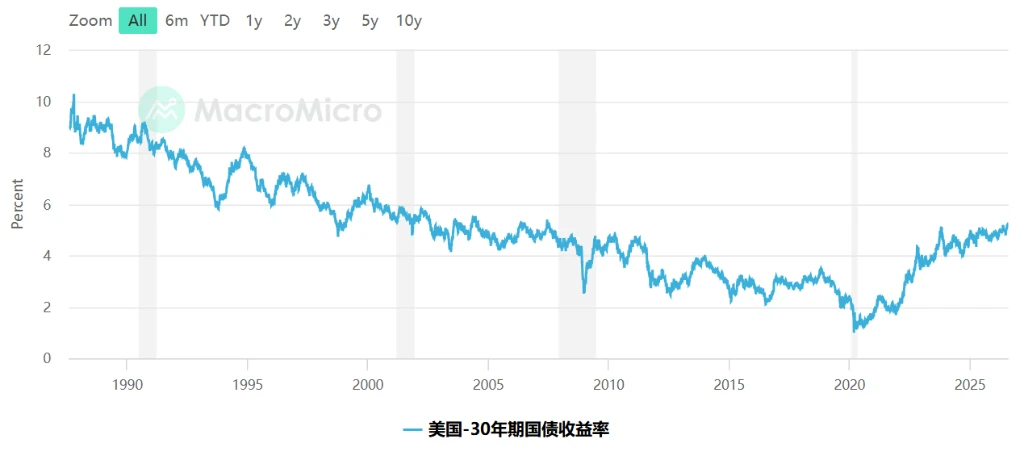
The yield on long-term US bonds rose sharply last week.The yield on 30-year treasury bonds hit the highest level since 2007, and the yield on 10-year treasury bonds also broke through the trading range maintained since the end of 2023.
Meanwhile, the ICE Bank of America MOVE Index, which measures the expected volatility of the US bond market, rose to its highest point since May, and demand for put options betting on falling bond prices surged. Chicago Options Exchange data showed,The one-month put option bias linked to the iShares 20-year US Treasury bond ETF soared to its highest level since the 2008 financial crisis.
In the coming week, the details of the US Treasury's financing plan were revealed and the July non-farm payrolls report was released one after another. The shock in the bond market may further intensify.
Bob Elliott of Unlimited Funds recently wrote in a review: “It is difficult to determine how long other asset markets such as stocks can support at current interest rates without being dragged downward.” Gennadiy Goldberg, head of US interest rate strategy at TD Securities, also warned that the uncertainty surrounding the Federal Reserve's policy guidelines compounded multiple noises such as geopolitics, making the market dangerous.
The credibility of the Federal Reserve has been questioned, and long-term bond yields have broken through an upward position
The core driving force behind this round of rising US bond yields comes from the market questioning the credibility of the Federal Reserve's policies.
Since Federal Reserve Chairman Kevin Warsh (Kevin Warsh) took charge of the Federal Reserve, he has taken a tough stance on fighting inflation, but the inflation rate has been higher than the Fed's 2% policy target for five consecutive years, and investors are beginning to wonder whether the Fed is actually willing to raise interest rates again.
On Wednesday, the Federal Reserve Interest Rate Decision Committee had a rare disagreement — three regional Fed presidents voted for interest rate hikes, contrary to the position of most members of the committee. When Walsh finished last week's press conference, long-term bond yields suddenly jumped, while short-term bond yields declined at the same time, and the spread between the two narrowed sharply. Analysis of Dow Jones market data shows that this is the biggest compression of the “Federal Reserve Interest Day” yield curve since 2023.
Goldberg of TD Securities said:“The market is questioning how firm the Federal Reserve is in controlling inflation.”At the same time, he pointed out that under the benchmark situation, interest rates will not be raised this year or next, but the probability of interest rate hikes has “increased significantly.”
The volatility of the bond market is rising, and demand for hedging has expanded dramatically
Changes in yield quickly spread to the derivatives market, and hedging demand heated up sharply.
The ICE Bank of America MOVE Index hit a high level since May, indicating that traders are actively hedging the risk of further upward interest rates.
Meanwhile, the trading volume of put options linked to iShares's 20-year US Treasury bond ETF (TLT) increased markedly compared to the ratio of bullish options. Chicago Options Exchange analysts pointed out that the one-month TLT put option bias has soared to the highest level since the 2008 financial crisis.
What is particularly noteworthy is that this round of rising long-term yields and crude oil prices showed a divergent trend — oil prices fell rather than rising at the same time as yields. This further weakened the correlation between yield and oil prices, increasing market uncertainty.
Spillover effects are looming, and the risk of stock market pressure is rising
The turmoil in the US bond market has always been a harbinger of risk in the stock market. The current situation has also left investors in the equity market sitting at ease.
Bob Elliott pointed out in his comments that whenever US bond yields hit or approach current levels, pressure often begins to spread to other markets, and the stock market is dragged down first. Currently, the yield on 30-year treasury bonds has reached 5.239%, and the 10-year yield is 4.693%, all in the historically high range.
Goldberg also admits that the geopolitical uncertainty brought about by the Iranian situation, the fuzziness of the Federal Reserve's policy guidelines, and the combination of other multiple market noises all make up the current weak market environment.” “All kinds of uncertainties are intertwined,” he said.
Multiple event windows are approaching, and the test of a critical week is imminent
The next week will be a critical window period for whether this round of pressure on US debt can spread.
Later this week,The US Treasury will announce the details of the latest government financing plan. Anything that exceeds expectations may trigger a new round of fluctuations in the bond market. A number of important economic data will be released one after another this week, ending with Friday's July non-farm payrolls report. The employment data will have a significant impact on the market's expectations about the direction of the Federal Reserve's policy.
Meanwhile, the US Treasury Department and the Federal Reserve joined the Japanese authorities in a historic coordinated intervention last week to stabilize the yen, which continues to fall. Analysts believe thatThe US side joined the intervention, partly motivated by preventing another outbreak of fluctuations in the US bond market.
The $30 trillion US Treasury bond market is the cornerstone of the global financial system. It is not only the core collateral for short-term institutional liquidity, but also the benchmark pricing anchor for the world's trillion-dollar debt.Once this “sleeping giant” continues to be restless, its vibrations will go far beyond the bond market itself.
Twitter: https://twitter.com/BitpushNewsCN
Compare TG Community: https://t.me/BitPushCommunity
Compare TG subscriptions: https://t.me/bitpush
