


SpaceX's first listing earnings report is out, why did Bernstein look at $239?
Source: Groove BlockBeats
Original title: Bernstein interprets SpaceX's first earnings report. How was the target price of $239 established?
Current profits depend on Starlink, and future valuations depend on AI and Starship
Core points:
· SpaceX's second-quarter revenue was $7.81 billion, up 92% year over year. Bernstein maintained an “outperforming market” rating and a target price of $239.
· The Bernstein model still assumes that the design price falls back to about $10 per watt for a long time, and the 30 to 50 US dollars/watt proposed by Musk is not fully included in the target price.
· Connectivity provides the current profit base. AI computing determines revenue elasticity, and Starship's complete reuse determines whether forward costs can actually be reduced.
SpaceX's first quarterly results since launch brought a more aggressive growth story to the market: the Connectivity business continues to contribute to profits.
AI computing revenue is growing rapidly, and Musk has also brought forward the target year of annual revenue of 1 trillion US dollars from 2031 to 2030.
It also said it could be achieved as soon as 2029.
According to SEC filings from the company, Space Exploration Technologies Corp.
Class A common stock has been traded on Nasdaq and Nasdaq Texas under the SPCX code.
After the company released results for the second quarter ending June 30 on August 4, Bernstein maintained an “outperforming the market” rating and a target price of $239.
Based on the closing price of $125.33 on August 4 as listed in the research report, this corresponds to about 91% of potential upside.
However, the target price of $239 is not based on the full achievement of the $1 trillion revenue target.
Bernstein's own revenue forecast for SpaceX 2031 was US$554 billion, which is significantly lower than management's vision;
Its AI computing price model also still assumes a long-term fall back to around $10 per watt.
In other words, higher calculated prices and more aggressive revenue targets are more of a potential upside in addition to current valuations.
SpaceX shares fell further to $108.27 on August 5, down 13.6% in a single day.
This shows that the market is not only looking at this quarter's results, but is also weighing AI capital expenses, stock supply pressure brought about by the lifting of the lockdown period after listing, and whether Starship can enter the high-frequency, low-cost launch phase.
Revenue grew 92%, and connectivity remains a pillar of profit
SpaceX's revenue for the second quarter reached $7.814 billion, up 92% year over year.
Axios cites an S&P Visible Alpha consensus of $6.9 billion, and the Bernstein report uses a market consensus of $6.546 billion.
Despite differences in statistical caliber, both point to the same conclusion: revenue for the quarter clearly exceeded expectations.
The company lost $0.09 per share after dilution in the second quarter, which was also better than the market's forecast loss of $0.24 per share.
The three business segments had a combined operating loss of US$143 million, far better than Bernstein's US$1.73 billion market estimate.
Mainly due to the narrowing of AI business losses and higher-than-expected Connectivity profit margins.
By business, the most stable connectivity business with Starlink at the moment is still the Starlink core.
At the end of the second quarter, the number of Starlink users reached 12 million, an increase of 1.7 million over the first quarter, and the average monthly user revenue remained at $66.
Connectivity had quarterly revenue of US$4.291 billion and operating profit of US$1,656 billion, corresponding to an operating margin of approximately 38.6%.
Higher than Bernstein's 37% market expectation.
It is also currently the only business segment of SpaceX that has achieved operating profits, providing important support for the company to continue investing in AI and Starship.
The Space business completed a total of 38 launches in the second quarter, of which 10 were customer launches and 28 internal launches.
Total mass to orbit (MTO) reached 485 tons.
The sector's revenue was US$962 million, which was higher than market expectations of US$874 million.
However, due to Starship's increased R&D investment, operating losses still reached $542 million.
The AI business also has the greatest revenue elasticity and capital requirements. At the end of the second quarter, SpaceX's nominal computing capacity reached 1.4 GW, up from 1.0 GW in the first quarter.
It is expected to exceed 2GW by the end of 2026. The AI sector's revenue for the quarter was US$2,561 billion, up 247% year over year.
Of this, revenue from AI solutions and infrastructure reached $2.194 billion.
The operating loss of the AI business was US$1,257 million, and the corresponding operating margin was negative 49.1%, but it was significantly narrower than the operating loss of US$2,469 million in the first quarter;
After segmentation adjustments, EBITDA changed from a loss of $609 million in the first quarter to a profit of $1,146 million.
Meanwhile, the AI business's capital expenditure for the second quarter reached US$15.828 billion in a single quarter, up from US$7.723 billion in the first quarter.
SpaceX's total capital expenditure reached US$18.369 billion in the second quarter. Whether the huge investment can be converted into continuous revenue and cash returns is still one of the biggest concerns of the market
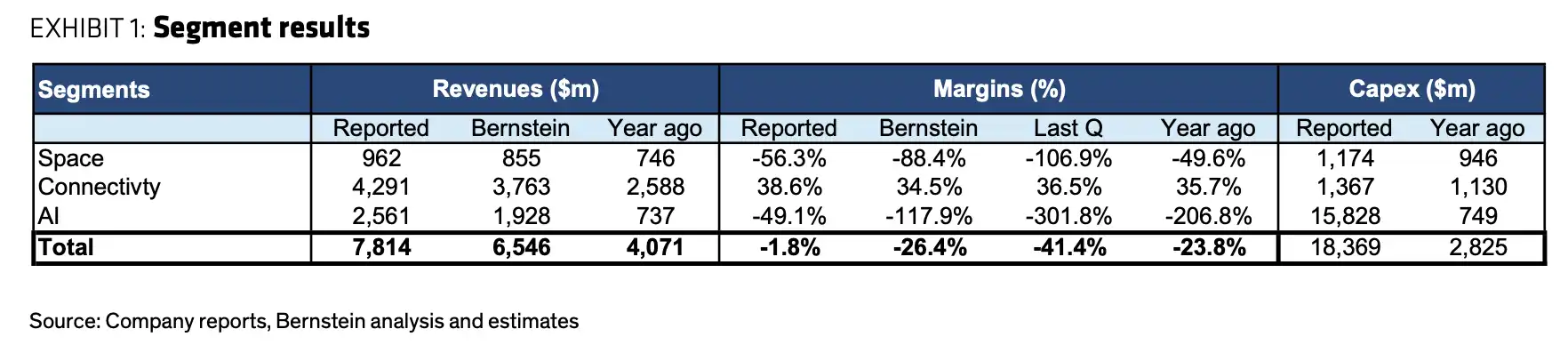
SpaceX's second quarter results table for the three major business segments. Connectivity contributed major profits, and the AI business capital expenditure reached $15.828 billion.
Source: Bernstein
AI computing opens up revenue space; trillions of revenue cannot be relied on satellite internet alone
The change that received the most attention during this call was Musk's advance of reaching the target year of annual revenue of 1 trillion US dollars from 2031 to 2030.
It also said it could be achieved as soon as 2029. The management also proposed an annual revenue run rate of at least 100 billion US dollars.
However, this summary of the Bernstein study did not clearly indicate the corresponding point in time.
To get close to this goal, SpaceX clearly can't just rely on Starlink user growth.
Connectivity needs to continue to expand individual, enterprise, and government customers; AI businesses need to turn huge computing capacity into long-term contracts and stable revenue;
Starship, on the other hand, needs to reduce the cost of satellite deployment and orbital data center construction. Among them, AI calculates the price as the most sensitive variable.
Musk said that the price of the computing service is likely to remain at $30 to 50 per watt.
It also said that this judgment is consistent with the deal price agreed by SpaceX, Anthropic, and Google.
In contrast, Bernstein's current model still assumes that the design will eventually fall back to about $10 per watt.
This means that $30 to $50/W is not a basic assumption that Bernstein has included a $239 price target, but rather a potential upward model.
If SpaceX can maintain higher prices while expanding computing capacity, its forward revenue and EBITDA could significantly exceed Bernstein's current predictions.
However, there is still uncertainty about whether this price range can be maintained for a long time. Term and cancellation terms of customer contracts, AI computing power market supply and demand,
Semiconductor supply and competitor capacity expansion may affect actual transaction prices.
Capacity expansion targets are equally aggressive. At the end of the second quarter, SpaceX's nominal computing capacity was 1.4 GW.
The company expects to surpass 2 GW by the end of 2026, approach 10 GW by the end of 2027, and move towards 20 GW by 2028.
If this pace is realized, SpaceX's business structure will not only be a rocket launch and satellite internet, but will extend further to large-scale AI infrastructure.

Key financial and valuation forecasts. Bernstein expects SpaceX's revenue from 2025 to 2027 to be $18.674 billion, $40.236 billion, and $84.99 billion, respectively, while the EV/adjusted EBITDA ratio will drop from 245.7 times to 37.2 times.
The prerequisite for high-frequency transmission is for Starship to achieve complete reuse
In SpaceX's valuation system, Connectivity answered “is there currently no profit base?”
The AI calculation answers “how fast can revenue grow”, and Starship's answer is “can the long-term scale be achieved at a sufficiently low cost.”
If SpaceX were to approach $1 trillion in annual revenue around 2030, Starlink user growth alone would not be enough.
Starship's launch frequency, payload capacity, and degree of complete reuse will directly affect the deployment of the next generation Starlink satellites,
The cost of orbital data center construction and expansion of other space businesses.
Management is still setting very aggressive progress targets. The company plans to continue to advance Starship orbital flights and the deployment of the V3 satellite.
Also try more complex Level 1 and Level 2 recycling operations. Its long-term goal is to launch close to once a day by the end of 2027,
It also operates five launchers, two in Texas and three in Florida.
To achieve this frequency, SpaceX not only needed to reuse boosters, but must also address Starship Level 2 recycling issues.
Bernstein believes that a durable heat shield is the key to the complete reusability of the second level.
Musk said the 13th flight may have solved the Heat Shield issue, but the relevant analysis has not yet been completed, and further verification is still needed for subsequent flights.
Regulatory approvals, launch pad construction, flight accidents, and reprocessing cycles may also affect the speed at which Starship moves from high-frequency testing to industrial operation.
Therefore, complete reuse is still the most important and most uncertain part of Bernstein's valuation model.
The target price of $239 depends on the three main lines to be realized
Bernstein is based on the 2031 EBITDA for each SpaceX business,
Using the segmented valuation method and the forward EV/EBITDA ratio to calculate the enterprise value in 2030, the valuation of each sector was discounted separately until mid-2027.
Get a 12-month target price of $239. Among them, Connectivity and AI use late-stage venture capital discount rates of 25% and 35%, respectively.
Notably, the Bernstein model anticipates SpaceX's 2031 revenue of $554 billion.
Significantly lower than the $1 trillion target proposed by management. The long-term calculation price also assumes a fall back to about $10 per watt.
Not the 30 to 50 dollars/watt that Musk proposed.
As a result, the $239 target price does not require SpaceX to fully fulfill management's full vision, but it still contains strong business expansion assumptions.
It requires at least three steps to be realized together: Connectivity profits continue to grow, AI computing transforms high capital expenditure into large-scale revenue,
Starship completed full reusability verification as planned.

SpaceX's stock price declined markedly after listing, and Bernstein still maintained the $239 target price and Outperform rating. Source: Bernstein
This also explains why SpaceX's second-quarter revenue and earnings per share both exceeded expectations, yet the stock price fell sharply after the results were announced.
The single-quarter results only prove that current growth is still strong, and cannot directly eliminate the return on the market's investment in AI,
The lifting of the stock ban on supply and concerns about Starship's execution risks.
If the AI computing price can stay at $30 to $50 per watt for a longer period, Starship is fully reusable and progresses as planned.
Starlink's individual and business customers continue to grow, and Bernstein's current model still has room to improve.
Conversely, if the fulfillment of the computing power contract, semiconductor supply, or Starship progress falls short of expectations,
The $239 target itself will also come under pressure.
Twitter:https://twitter.com/BitpushNewsCN
Compare the TG exchange group:https://t.me/BitPushCommunity
Compare TG subscriptions:https://t.me/bitpush
