


After cutting positions for three years in a row, Buffett suddenly took action! What did nearly $20 billion buy?
Source | Odaily Planet Daily
Author | Azuma
Original title |After losing stock positions for three years in a row, Buffett finally took action
A few months ago, I dared to laugh “the old man is not as good as me,” but now I only know “your grandpa is still your grandpa.”
Core ideas:
Berkshire Hathaway ended 14 consecutive quarters of net stock sales in the second quarter of 2026.
Shifting to a net purchase of nearly $19.8 billion and investing in Google's parent company Alphabet with a 10-billion-level private equity fund,
It marks an adjustment of its investment strategy under the leadership of the new CEO Abell, and a shift from long-term wait and see to an active layout.
After the US stock market on August 9, Beijing time, Berkshire Hathaway announced financial results for the second quarter of 2026.
According to financial data, Berkshire's total revenue for the second quarter of 2026 reached US$101.888 billion, an increase of about 10% over the previous year.
Net profit attributable to shareholders was US$25.667 billion, which doubled from the same period last year (an increase of about 107%).
Both operating profit and net profit greatly exceeded market expectations.
However, the more signalling point in the financial report is that Berkshire Hathaway has finally ended net stock sales that continued for more than three years (14 quarters) and switched to net purchases.
With $400 billion in cash, Berkshire finally takes action
According to financial data, in the second quarter, Berkshire Hathaway bought shares for about 23.47 billion US dollars and sold only 3.69 billion US dollars.
Net purchases were close to $19.8 billion, ending a long period of net sales since 2023.
What is more worthy of investors' attention is where the funds are going.
Financial reports revealed that Berkshire Hathaway's biggest move in the last quarter was
An additional $10 billion was invested in Alphabet (Google's parent company) through a private placement.
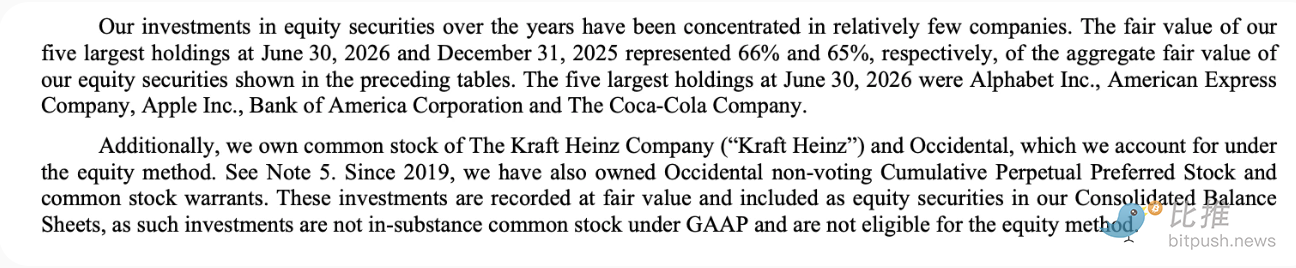
It also officially placed Google among the top five largest stocks in Berkshire Hathaway by market capitalization — along with American Express, Apple, Bank of America, and Coca Cola.
As of the end of June, these five major holdings together accounted for 66% of the stock portfolio, and position concentration is still extremely high.
Although Buffett himself has been cautious about technology stocks for a long time, Buffett previously revealed when he first opened a position with Google,
The investment in Google is his and Greg Abell
(Berkshire Hathaway's current CEO, officially took over as Buffett on January 1 this year) The decision was made together after discussions.
Buffett also confessed that missing out on Google in the early years was a “historic mistake.” This ticket replacement is based on value investment logic.
What is important is the barriers to its search monopoly and stable cash flow.
However, the current 10 billion dollar increase in holdings is an investment decision made under the new CEO, Commander Abel.
This may indicate that under the new pattern where Buffett is behind the scenes and Abell is in power,Berkshire Hathaway's tolerance and participation in the cutting edge of technology is growing.
In addition to restarting net purchases in the market, the second quarterBerkshire Hathaway also carried out its first share buyback in two years.
According to financial reports, Berkshire Hathaway spent a total of about US$4.527 billion on repurchases in the last quarter, a record high in a single quarter since 2021;
More than $3.3 billion was added to the repurchase in July.
In March of this year, Berkshire Hathaway officially announced the restart of the stock repurchase plan.
Abel said at the time that the buyback was because management believed that the “intrinsic value” of its stock was higher than its market price.
As the pace of investment and repurchases changed, Berkshire Hathaway's long-term cash reserves also began to change.
Over the past few years, one of the company's biggest labels has been “cash machine.” Due to the lack of large-scale opportunities that meet Buffett's investment standards,
The size of the company's cash and short-term US debt continued to rise and reached a record high of nearly $400 billion at the end of the first quarter of this year.
However, as stock holdings increased,
Stock buybacks and industrial mergers and acquisitions (mainly to acquire petrochemical company OxyChem and housing developer Taylor Morrison) have been launched one after another.
Berkshire Hathaway's cash reserves are beginning to enter a downward channel.
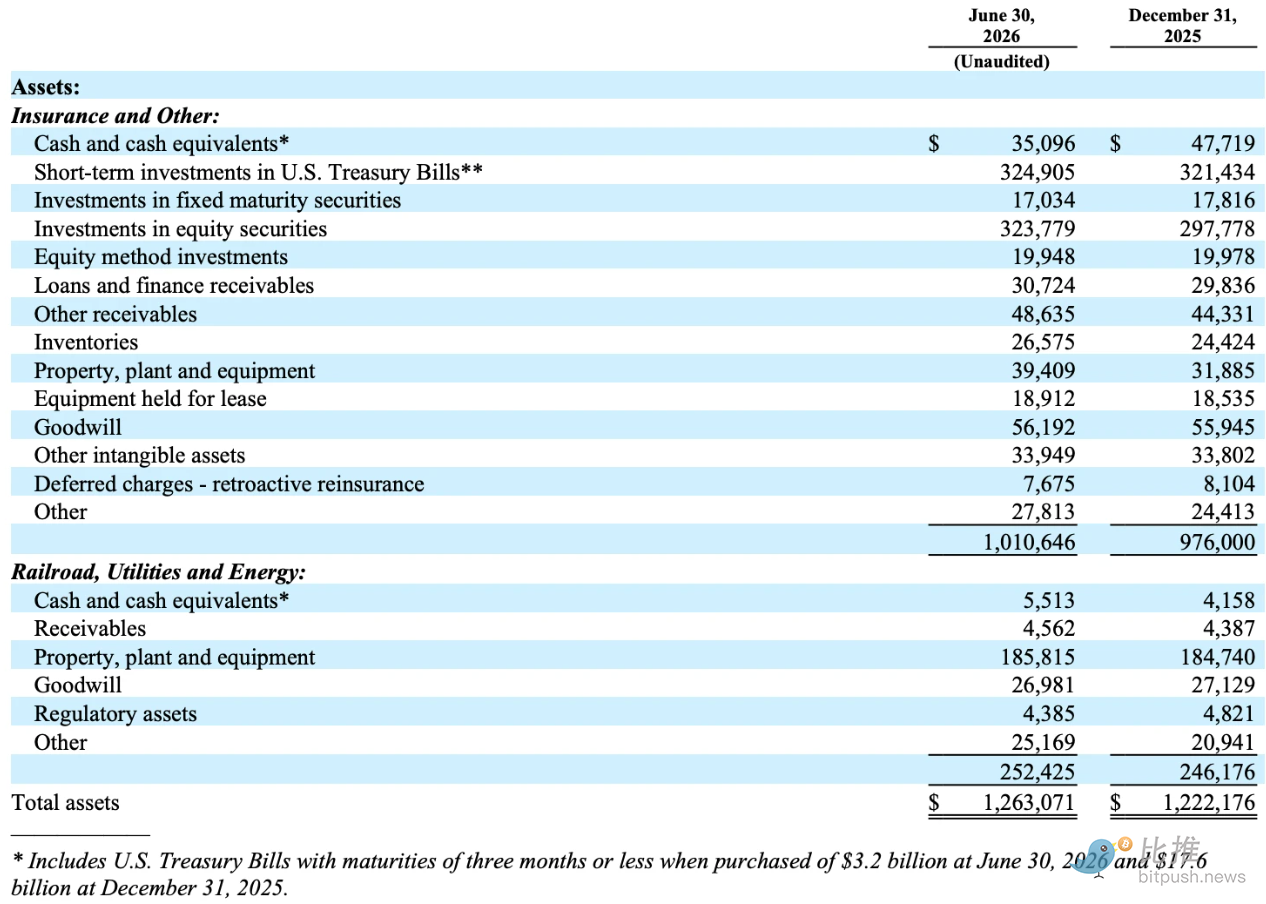
As of June 30, Berkshire held about US$31.5 billion in cash and cash equivalents, and the size of short-term US Treasury bonds was about US$324.9 billion.
The total was approximately US$364.7 billion, a significant decrease from US$397.38 billion at the end of the first quarter.
It was once mocked for “not being able to keep up with the times”; in fact, it was quietly watched “on the shores of the turbulent times”
The time is set back to 2023 to early 2026.
Over the past few years, the technological wave of AI has completely detonated the global capital market.
The chip and semiconductor industry chain represented by Nvidia, SK Hynix, Samsung, and Micron has become the most crowded trading circuit.
The market is full of “All in AI” fanaticism, and any fund manager that doesn't have a heavy semiconductor position is viewed as being left behind.
And while Buffett and Berkshire Hathaway had hundreds of billions of dollars in cash lying on their books, they chose to watch almost indifferently.
Mockery ensued. “Buffett can't keep up with the times”, “value investing is dead”, “in the face of the AI revolution, the moat theory is out of date”,
“The old man is not as good as me”... similar questions continue to be heard.
People relish that semiconductor stocks tend to rise several times or even tens of times. Compared to the apparently modest performance of Berkshire Hathaway's stock price,
The hasty conclusion was that this old school investment guru in his 90s, and his designated successor, Abel, had lost judgment on the technological revolution.
But Biberkshire Hathaway's choice clearly had its own logic. In the financial report for the second quarter of 2026,
Biberkshire Hathaway reiterated his iconic warning:“The amount of investment gain/loss for any given quarter is generally meaningless, and there is little analytical or predictive value.”
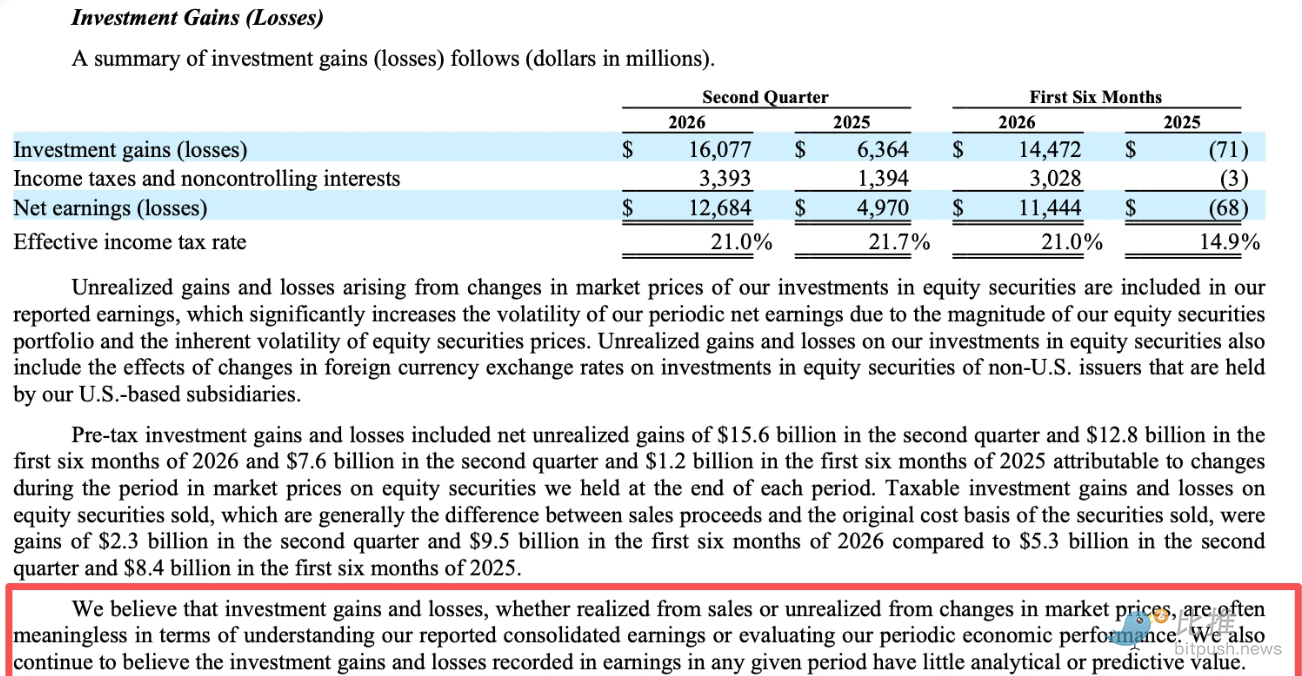
This statement appears to be about GAAP accounting standards; in fact, it is a consistent attitude towards short-term market hype.
In the eyes of Buffett and Abell, they probably still have doubts about whether the semiconductor industry can break away from cyclicality.
There is also uncertainty as to when the explosive demand for AI hardware will translate into sustainable cash flow.
After the market entered a carnival phase and semiconductor companies' stock prices were high,
The market environment at the time was completely inconsistent with Berkshire Hathaway's discipline of “buying a great company at a reasonable price.”
So when the market sank into FOMO sentiment, Berkshire Hathaway chose the most boring strategy, but one that was in line with its DNA — wait.
Until the last few months, with the sudden decline in semiconductor fanaticism, the market that had been overhyped up in the early stages experienced a sharp correction.
Investors who once mocked Buffett for “going short” suddenly discovered that the surplus on the books of high semiconductors quickly evaporated during the pullback.
And Berkshire Hathaway's hundreds of billions of dollars of cash not only provided it with an unparalleled margin of safety, but also gave it the strength to be greedy when others were afraid.
Net purchases of $19.8 billion in the second quarter are proof of this discipline.
It is worth noting that Berkshire Hathaway is not rising at the highest point in the market.
It was only after experiencing market fluctuations and the price of high-quality assets returning to a reasonable range that large-scale action was taken.
This is the truth Buffett spent decades practicing — investing isn't about who runs faster than who runs faster, but rather than who lives longer and has the last laugh.
Twitter:https://twitter.com/BitpushNewsCN
Compare the TG exchange group:https://t.me/BitPushCommunity
Compare TG subscriptions:https://t.me/bitpush
