


How did DeepMind change lead to a sharp increase in Google Cloud's revenue?
Author: Groove BlockBeats
Original title: DeepMind changes direction, why is Google Cloud likely to be the biggest winner?
TL; DR · SemiAnalysis believes that after DeepMind's leadership adjustments, Google Cloud may become the biggest short-term beneficiary. ·Alphabet's second-quarter Google Cloud revenue increased 82% year-on-year to $24.768 billion, and the backlog of cloud business orders reached $514 billion. ·The report estimates that more than $150 billion in TPU system orders could push Google Cloud's 2027 revenue growth rate to around 150%. ·This forecast relies on the pace of order delivery, customer financing, and revenue recognition, and the valuation of system sales may also be lower than traditional cloud services.
On August 7, SemiAnalysis released a report stating that after Google DeepMind's leadership adjustments, Google Cloud may become the biggest financial beneficiary in the short term.
The report links personnel changes to the distribution of computing power within Google. TPU is a scarce resource that Google relies on to grow its cutting-edge model and expand its cloud business. More computing power for Gemini training will help Google catch up with cutting-edge models; more TPU flowing to external customers can be more quickly converted into Google Cloud revenue, backlog orders, and profits.
Based on this, SemiAnalysis gave a set of aggressive predictions: TPU system sales may push Google Cloud's 2027 revenue growth rate to around 150%, significantly higher than the 64% seller consensus estimate listed in the report, and contribute about $3 per share to Alphabet's earnings for the year.
DeepMind changed hands, and the market began to reassess the flow of computational power
According to Axios, Demis Hassabis stepped down as Google DeepMind CEO and became DeepMind Chairman and Alphabet Chief Scientist; former DeepMind CTO Koray Kavukcuoglu took over day-to-day management and reported to Alphabet CEO Sundar Pichai.
Meanwhile, Jeff Dean, Sanjay Ghemawat, Oriol Vinyals, and Quoc Le left Google to co-found AI research firm Discovery Loop. Google will participate as a founding investor and partner with it to establish cloud services.
This round of adjustments has prompted the market to re-evaluate Google's computing power allocation strategy. The same batch of TPUs should not only support Gemini training and inference, be made available to external AI labs and enterprise customers through Google Cloud, or sold as a package to special purpose entities operating AI data centers.
Different distribution methods correspond to different returns. Investing in Gemini's computing power is linked to Google's competitiveness in the cutting-edge model field; investing in TPU for commercial customers can enter Google Cloud's revenue and backlog orders more quickly.
According to SemiAnalysis, Google Cloud leader Thomas Kurian's influence in internal computing power competition is rising. As more TPU and supporting infrastructure flows to external customers, Google Cloud is likely to gain greater revenue elasticity.
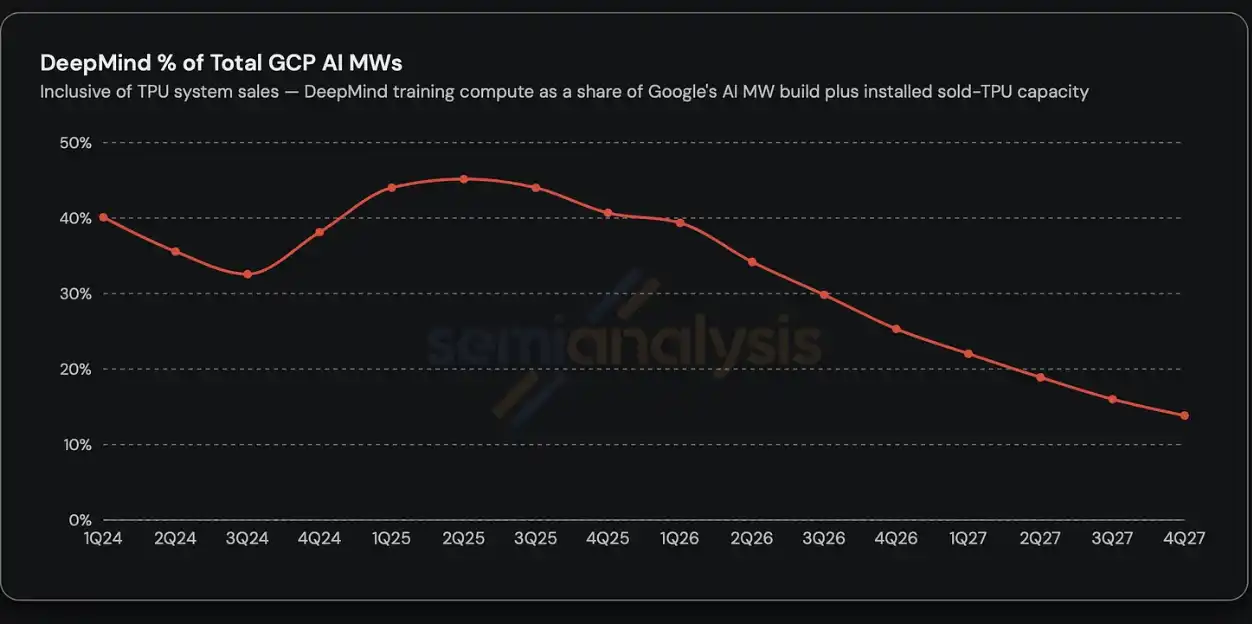
DeepMind's share of Google's AI computing power has declined
However, Alphabet did not attribute this organizational change to a blockage in Gemini development. The company said at the second-quarter earnings conference that Gemini 4 is undergoing the most ambitious pre-training so far, and AI services are still limited by supply. Pichai also emphasized that the primary task of TPU allocation is to ensure that Google has the computing power needed to compete at the cutting edge of AGI.
Currently, Google has yet to announce a reduction in Gemini's computing power priority. “Gemini priority reduction” is SemiAnalysis's inference of personnel changes and resource flows, not a strategic adjustment confirmed by Google.
Cloud revenue surged 82%, and sales of TPU systems began to change the growth structure
Alphabet's second-quarter earnings report shows that Google Cloud revenue increased 82% year over year to US$24.768 billion, and the backlog of cloud business orders increased to US$514 billion. Google's proprietary model API processing volume reached approximately 22 billion tokens per minute, compared to 16 billion in the previous quarter.
Google Cloud's rapid growth isn't entirely due to traditional cloud services. Alphabet has begun delivering complete TPU systems to customer data centers and confirmed related revenue for the first time in the second quarter. The company said that the TPU system sales contract has been factored into the cloud business backlog, and most of the revenue from existing contracts is expected to be recognized in 2027.
That means Google Cloud's revenue structure is changing. In the past, cloud revenue mainly came from ongoing services such as computing, storage, databases, and AI platforms; now, sales of complete TPU systems are beginning to become a new source of growth.
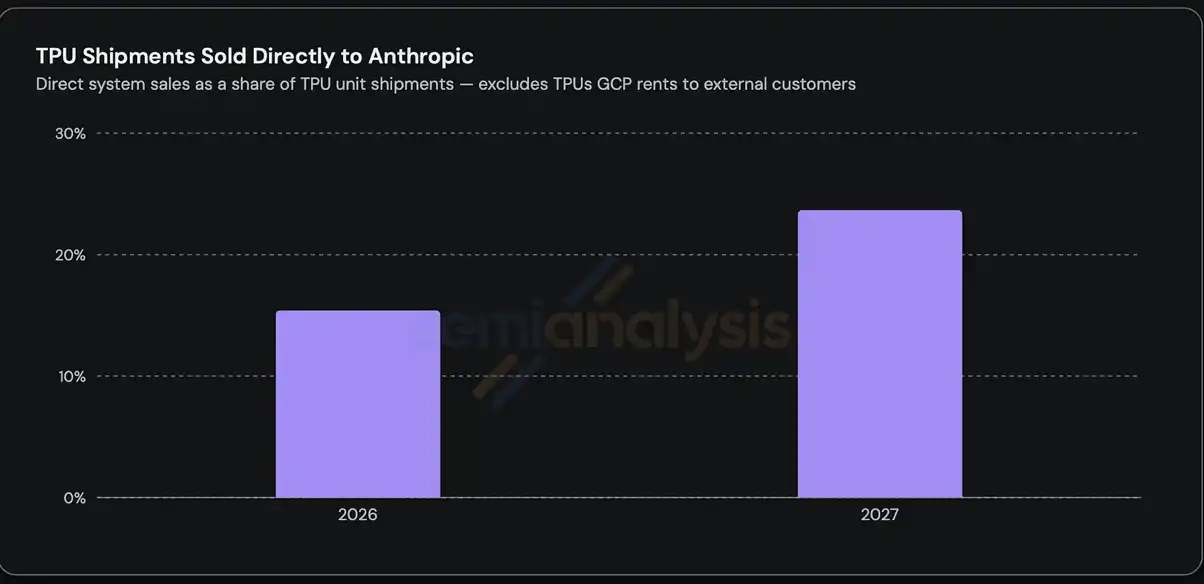
Percentage of TPU shipments sold directly to Anthropic
SemiAnalysis estimates that revenue recognized by total sales of TPU systems is approximately $35 billion per GW, and the related revenue recognized in the second quarter of 2026 is approximately $1.2 billion. According to its estimates, if this portion of revenue is excluded, the year-on-year growth rate of Google Cloud's core business is still around 70%; after incorporating TPU system sales, the overall growth rate rose to 82%.
The economic attributes of the two types of income are not the same. Traditional cloud business mainly depends on customer renewals, computing power usage, and platform stickiness; TPU systems are sold closer to large-scale AI infrastructure projects, and once delivered centrally, they may significantly increase revenue growth in a single quarter or year.
$150 billion in orders to be confirmed, and the growth rate may be 150% in 2027
SemiAnalysis's most impactful prediction comes from backlog orders for TPU systems.
The report estimates that the current backlog of orders related to Google Cloud's TPU system has exceeded 150 billion US dollars. If these orders are delivered as planned and confirmed in 2027, Google Cloud's revenue growth rate for the year could reach around 150%, compared to the seller consensus forecast in the report of about 64%.
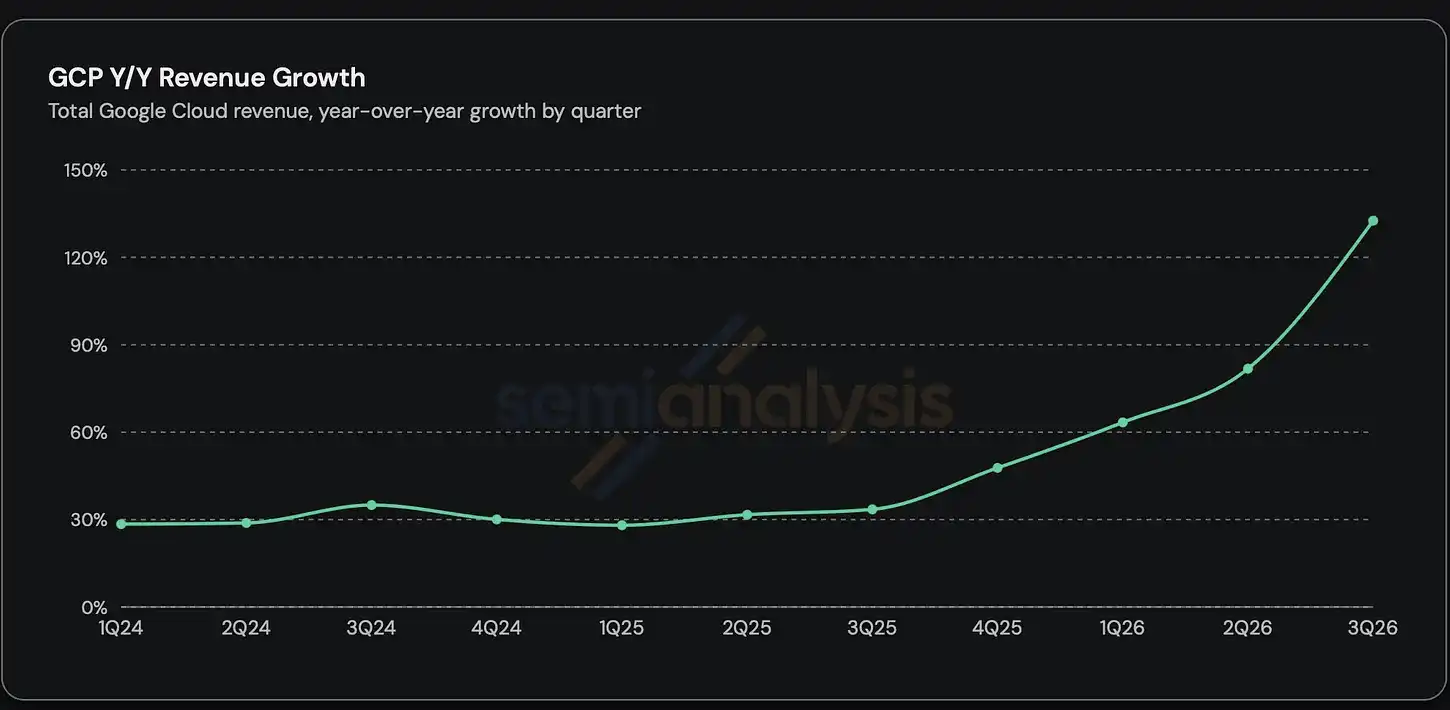
Google Cloud revenue growth forecast
Alphabet's official disclosure of the $514 billion cloud business backlog includes TPU system sales, but the size of the TPU order was not separately announced. As a result, over $150 billion of figures came from SemiAnalysis model estimates.
According to the approximately $35 billion/GW revenue recognition caliber used in the report, a few GW level projects would be enough to significantly change Google Cloud's growth curve. SemiAnalysis also predicts that as AI Labs continue to procure large-scale computing power, there may be more GW transactions in the coming quarters and adding more than $250 billion in TPU orders to Google Cloud's remaining fulfillment obligations.
The profit side may also be supported. SemiAnalysis estimates that the EBIT profit margin for TPU system sales is slightly below the level of the core cloud business of around 30%, but Google Cloud's overall EBIT margin is likely to remain at 35% to 39%. Combined with high revenue growth and higher profit margins, related businesses are likely to contribute around $3 to Alphabet's EPS in 2027.
As a result, SemiAnalysis has strung an AI department personnel adjustment into a complete financial chain: Gemini organizational changes affect computing power allocation, more TPU flows to external customers, system sales expand the backlog of cloud business orders, and eventually enter Google Cloud revenue and Alphabet profits.
Even if Gemini falls behind, Google can still make money from the AI race
SemiAnalysis is clearly pessimistic about Gemini's long-term competitiveness, but for investors, the question that is more likely to pass financial verification is who will eventually use the expensive TPU cluster, who will pay for it, and whether these orders can be converted into Google Cloud revenue.
The report indicates that Gemini's first-party API token growth rate has slowed. In the first quarter of 2026, its processing volume increased from 10 billion units per minute to 16 billion units, an increase of 60% over the previous quarter; in the second quarter, it further increased to 22 billion units, but the increase fell to about 38%.
This doesn't mean Gemini usage has declined, but rather that its growth rate has slowed. Google also officially stated that demand for model APIs is strong, the company is facing computing power supply restrictions, and pre-training for Gemini 4 continues to advance.
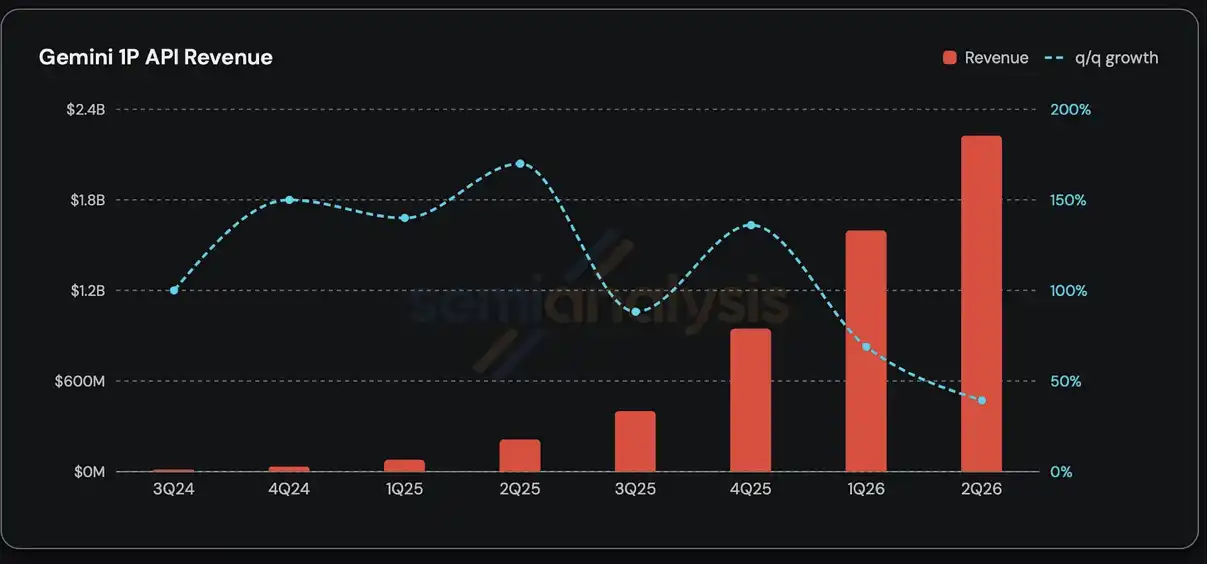
Gemini First-Party API Revenue and Growth
At the same time, Google's enterprise AI platform not only hosts Gemini, but also provides customers with third-party models such as Claude. Even if Google's self-developed model is no longer always leading, Google Cloud still has the opportunity to capture capital expenses across the AI industry by selling computing power, platform services, and TPU systems.
The Discovery Loop could also enter this cycle. Google is not only a founding investor in the agency, but will also partner with it on cloud services. SemiAnalysis further speculates that researchers who have left Google may obtain financing from external investors and Google-related capital, and then use part of the funds to purchase computing resources on Google Cloud.
This has a counterintuitive business outcome: Google may continue to rely on cloud infrastructure to generate revenue from external AI investments even under pressure from cutting-edge model competition.
Investor indicators: behind the 150% growth rate, the gold content of TPU orders is still to be tested
Sales of TPU systems can quickly increase Google Cloud revenue, but how highly valued this portion of revenue is still dependent on how the market judges its sustainability.
Traditional cloud services rely on customer renewal and usage growth, revenue is relatively stable, and platform migration costs can also enhance customer stickiness. TPU systems are sold closer to large-scale infrastructure projects, and the single transaction amount is high, yet revenue is easily affected by delivery schedule, data center construction, and customer financing. Even if centralized confirmation of orders leads to rapid growth, the market may give lower valuations in reference to the hardware business.
SemiAnalysis predicts that Google Cloud currently has a backlog of more than 150 billion US dollars of TPU system orders, and may add more than 250 billion US dollars in the next few quarters. These figures have not been separately disclosed by Alphabet, and ultimately how much revenue can be converted into depends on whether TPU can be supplied on time, whether customer data centers can be put into operation, and whether related financing can be successfully implemented.
Gemini's long-term competitiveness will also affect this business model. In the short term, outbound sales of more computing power can boost Google Cloud revenue. If Google continues to lag behind in the field of cutting-edge models, the cloud platform's reliance on third-party models such as Anthropic may increase, and Google's bargaining power and customer stickiness in the model ecosystem will also be pressured.
Next, investors need to focus on two metrics: the scale of revenue recognition for TPU system orders in 2027, and whether Google Cloud profit margins can maintain 35% to 39% as predicted by SemiAnalysis.
After successful delivery of orders, Google Cloud's 2027 revenue growth could be close to 150%, and Alphabet's AI growth will also gain a new fulcrum. If deliveries are delayed or profit margins fall short of expectations, this round of growth is more likely to be reflected in a revenue jump driven by large hardware orders, and the room for valuation improvement will also be limited.
Twitter:https://twitter.com/BitpushNewsCN
Compare the TG exchange group:https://t.me/BitPushCommunity
Compare TG subscriptions:https://t.me/bitpush
