


20,000 US dollars signing fee+30,000 US dollars monthly salary, Pump.fun wants to “hollow out” FOMO

Source | Odaily Planet Daily
Author | Golem
Original title | $20,000 contract fee+$30,000 monthly salary, behind Pump.fun digging for FOMO's corner
Today's meme market is quite fragmented. Whether it's the chain ecosystem or the trading tools used, there is almost no intersection between overseas users and Chinese users. This fragmentation not only diverts global meme funds to various ecosystems, but even “gossip” can't be heard.
Recently, a gossip about “Pump.fun invests huge sums of money to dig into competitors' corners” went viral in overseas meme communities.
The news was initially revealed by overseas user CLR, which stated that Pump.fun is using incentive programs to attract users to migrate from the FOMO platform to Pump.fun.
According to the agreement documents disclosed by it,Pump.fun intends to provide eligible users with a one-time signing bonus of $20,000 and a fixed monthly fee of $30,000.The agreement requires contracted users to transfer their FOMO platform funds and trading positions to Pump.fun; use a new wallet not previously used by other platforms as an exclusive wallet; bind the X account to the Pump.fun wallet; publicly declare the wallet as the only public wallet on the X homepage; and permanently delete and close the FOMO platform account.
Additionally, users are required to meet actual transaction requirements, including completing at least $25,000 of monthly trading volume at Pump.fun (or 25% of the previous average monthly trading volume on the FOMO platform). As can be seen, in order to grab users of the FOMO platform, Pump.fun is this timeDecide to take the lead.
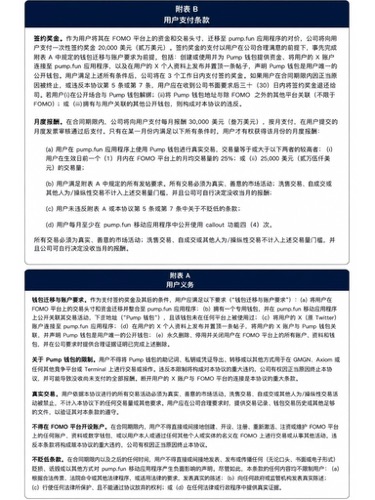
Chinese translation of the full text of the agreement (Source:0xAA)
From a commercial point of view, this is a normal corporate competition. There are no legal issues. In entertainment platforms or user-centered business models, companies often pay KOLs or users with high fan influence, requiring them to leave the competitor's platform and maintain the platform's exclusive agent. This competitive model is also quite common in China. For example, early short video streaming platforms such as Douyin, Kuaishou, B-station, and Huya signed exclusive contracts for influencer anchors at sky-high prices.
But the first question that confuses those who eat melons in the first place is, who is FOMO?
Pump.fun is the largest overseas token distribution platform. Fee revenue ranks in the top five on-chain agreement lists all year round. Why is it trying to rob FOMO platform users? What magic does the FOMO platform have enough to make Pump.fun nervous about business rivals? Daily Planet Daily will use “gossip” to analyze the current surges and dramatic changes in the overseas meme market.
FOMO has become the main meme trading platform for users
FOMOIt is a multi-chain meme trading platform with similar business and services to GMGN. The platform was launched in May 2025 and has only been in operation for more than a year, but according to RootData, FOMO has now completed 3 rounds of financing, with a total financing amount of 94 million US dollars, and a valuation of over 550 million US dollars.
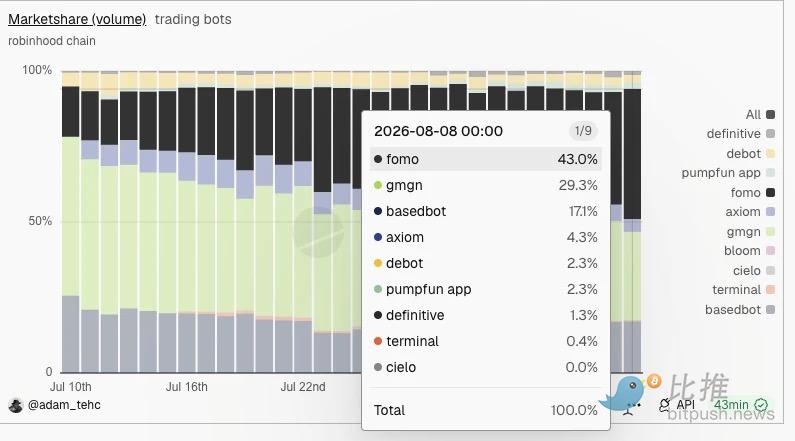
FOMO mainly serves overseas meme communities and mainly promotes mobile terminal transactions. Most users in the Chinese region probably haven't even heard of FOMO. What's even more shocking is that this platform, which you've probably never heard of or used before, has already surpassed Uniswap and Phantom in the past 30 days, and Trading Bot's market share surpassed GMGN to become number one in the market.
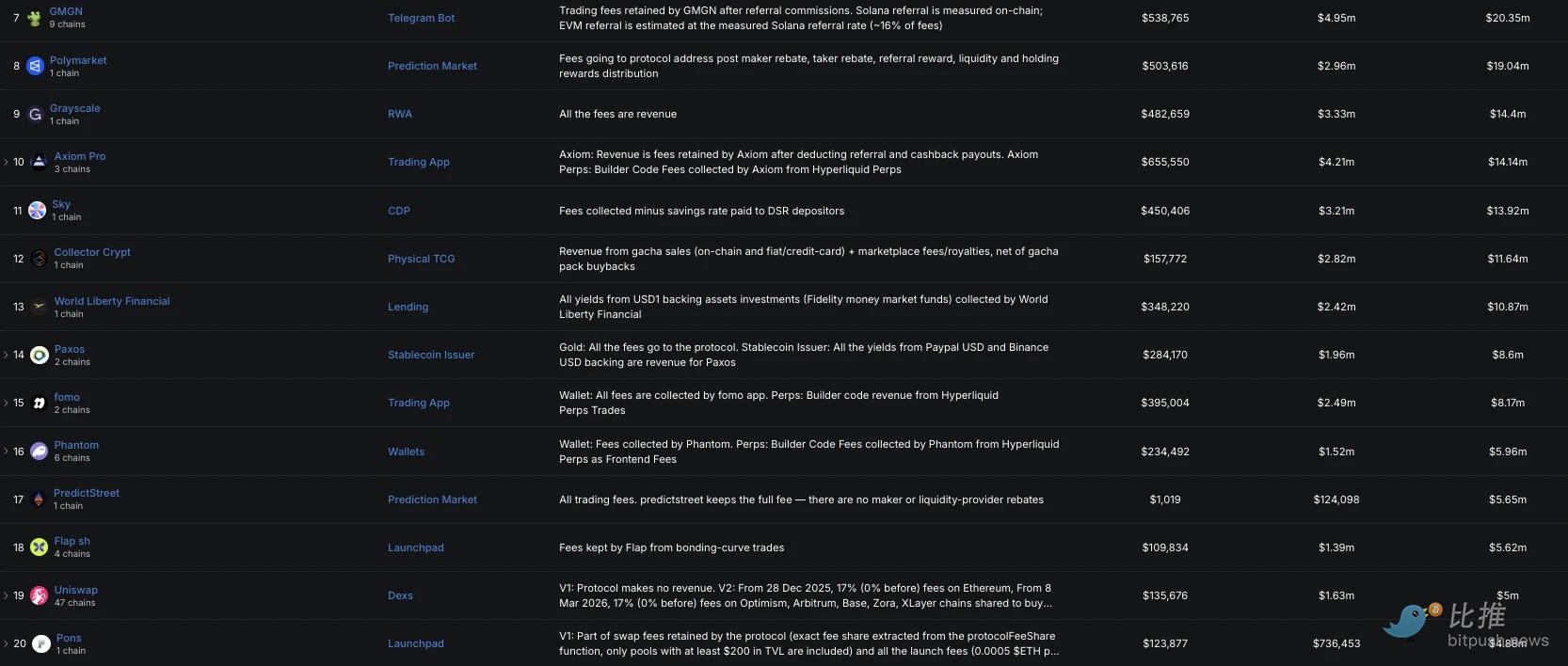
According to DeFiLama, FOMO's revenue of $8.17 million over the past 30 days, while still falling short of GMGN and Axiom, has surpassed mainstream launchpads (Flap and Pons) on Phantom, Uniswap, and Robinhood.
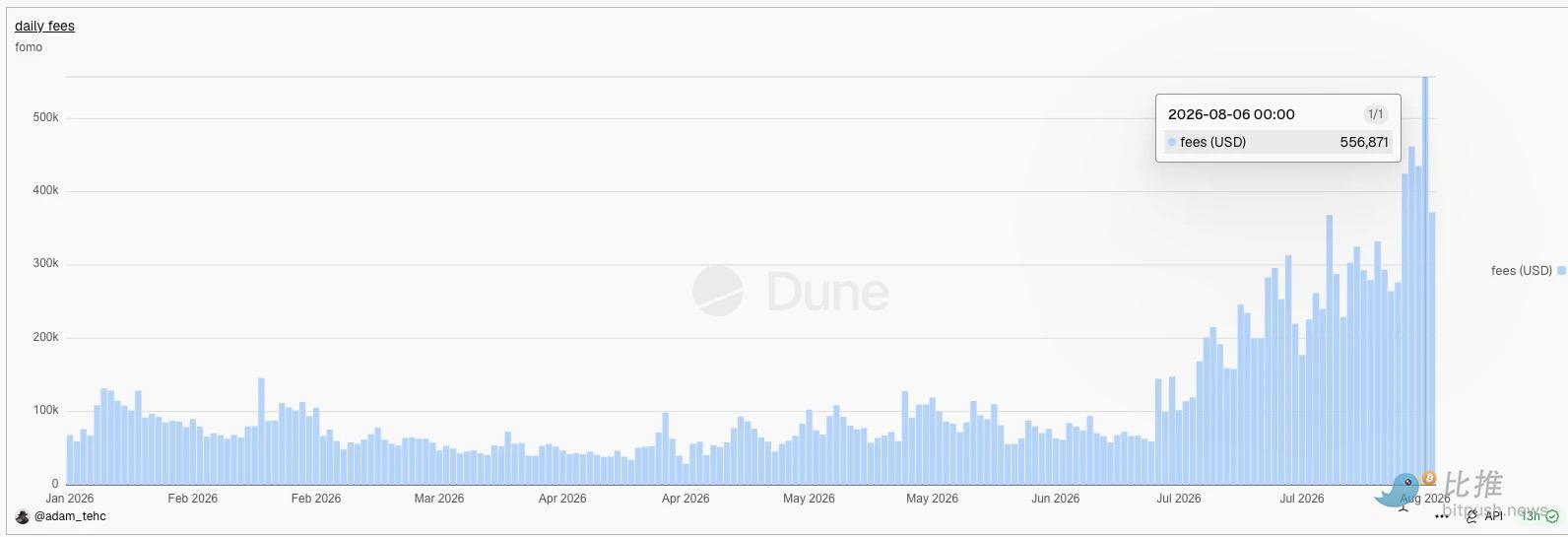
Meanwhile, according to Dune data, the total cost of the FOMO platform was US$30.39 million before press release. In the chart below, judging from the daily cost, the FOMO platform has experienced rapid growth since July. The average daily cost has exceeded 200,000 US dollars, and until now it has maintained an average value of $10. As of press time, the FOMO platform hit a new daily cost of $556,000 on August 6.
After entering August, the FOMO platform continued to maintain high growth. As of August 8, the FOMO platform's market share in Trading Bot had risen to 43%, surpassing GMGN as the market leader. Previously, GMGN had been the market leader.
How much influence does FOMO have now? Take a recent example so everyone can understand it. On August 4, the Solana meme coin CATE crashed 65% in one minute, and its market capitalization fell from over $80 million to about $20 million. The community summed up two reasons. One was that CATE's X account was blocked, and the second was that FOMO was down, and users were unable to trade during the outage. Of course, there is still a lot of controversy on this matter, so interested readers can expand their reading on their own.
Regardless of the truth, this incident is enough to explain the FOMO platform's current influence in the meme ecosystem. So, judging from the nature of the product, what makes FOMO stand out from its many competitors?
The answer lies in FOMO's product design. FOMO's core services are similar to most meme trading platforms, but its slogan is “the only social-first (social-first) trading app.” This is reflected in the product, the introduction of a profit ranking board (leader board) and an information stream (feed) that provides dynamic alerts for top traders.
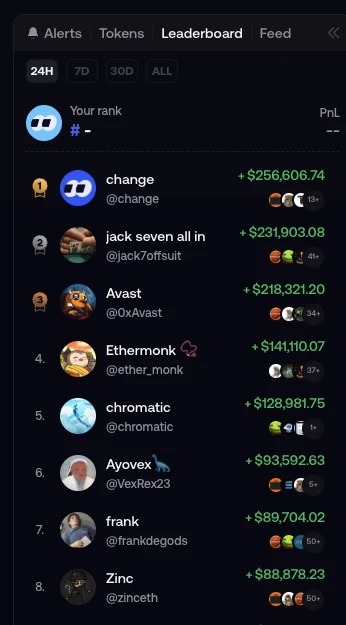
LEADERBOARD AND FEED ON FOMO PLATFORM
The meme market is naturally worshipped by “money first” powerhouses. As long as they make enough money, they can be called “smart money” and gain a large number of fans and follower accounts. The FOMO platform uses the characteristics of this group to artificially “create gods”, using leaderboards and other pages to deliberately push some high-profit users to the front of the stage to help them gain influence. FOMO team members@villagebythexyzAn article was posted on the X platform on August 9, stating that compared to the previous cycle, anyone with a slight influence in the cryptocurrency field now must be an excellent trader, and emphasized that “it is transactions that shape your fans, not fans.”
This model has been a huge success. For example, the reason why the Solana meme coin CATE was able to skyrocket was not because of its sexy storyline, but because of the traffic and nameplate support of Poorgoat known as “Little Ansem.”PoorgoatIt is a member of the FOMO Hall of Fame (the FOMO Hall of Fame that achieved huge profits on FOMO and was included in the FOMO Hall of Fame list), so when surrounded by fans, the CATE coin can still create “myths” even if the story is unsexy.
Pump.fun also saw the huge potential of this model for platform growth, so on August 7, the Pump.fun ApppronouncementsThe social function has been upgraded. The core of the upgrade is the replication of FOMO's social function. Now, when I enter the Pump.fun homepage, what I see is no longer an overwhelming stream of new meme coin information, but the information flow and operation monitoring push of meme traders/KOLs.
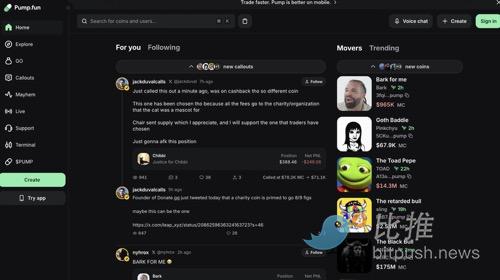
Pump.fun homepage
Alon, founder of Pump.fun, has also recently been posting to welcome many overseas meme traders/KOLs to join the Pump.fun app. In order to attract more famous overseas meme traders to join the Pump.fun platform, Pump.fun did not hesitate to start digging into FOMO's corner and asked meme traders to sign an “exclusive agreement”.
Alliance co-founder Imran said on the X platform that competition between Pump and FOMO may become an important driving force for on-chain finance (onchain finance) to enter the mainstream market. The competition between the two major platforms will drive the evolution of on-chain finance from the current niche field in Crypto Twitter to products aimed at mass consumers.
However, in essence, Pump.fun's commercial competition also reflects that the overseas meme market has entered the “influencer delivery model”. Whoever signs up with KOLs with the strongest ability to carry orders will occupy the market.
Overseas meme market enters influencer delivery mode
From the rise of FOMO to Pump.fun's wall digging, it can be seen that the overseas meme market is undergoing an important transformation: the core of market competition is no longer about distribution tools, transaction speed, or on-chain liquidity, but rather competition around “attention resource players.”
When the cultural consensus and celebrity coin narrative that the early meme market relied on began to fail, the meme market switched its attention from the meme coin itself to the people trading the meme coin. The FOMO rapid growth logic was based on this shift in market gameplay. Under this model, traders have replaced memes as new content subjects. Through rankings, transaction dynamics, and order tracking mechanisms, the platform packages the originally scattered on-chain transaction behavior into a content stream similar to entertainment consumption, and people have become a new consensus carrier.
For a large number of retail investors who lack professional analytical skills, following a trader who once made a profit of one million dollars is obviously easier than studying a meme project that has just been created and has no history.
But this trend also means that the meme market is entering a more internal phase. When trading traffic and market attention are focused on a few top traders, competition between platforms will naturally shift from competing for users to competing for “supernodes” that can bring in users, that is, Meme influencers.
This is very similar to the competition between anchors in the early days of the domestic short video live streaming industry. At the time, platforms such as Douyin, Kuaishou, Huga, and Betta competed for top anchors through high contract fees; essentially, they were also competing for attention. The difference is that competition for leading anchors in the short video live streaming industry takes place in an emerging market that is rapidly expanding, and the user scale and commercial value are still growing, thus ultimately driving the live streaming industry to maturity.
However, the meme market is now experiencing a similar competitive pattern, but it reflects a completely different signal.
As platforms begin to compete for the same batch of “trading influencers,” the winners may be able to gain short-term growth, but it also means that the entire meme circuit is losing the vitality initially formed by community culture and spontaneous communication. For memes, this is the biggest risk.
Twitter:https://twitter.com/BitpushNewsCN
Compare the TG exchange group:https://t.me/BitPushCommunity
Compare TG subscriptions:https://t.me/bitpush
