


As soon as US stocks stopped falling, capital went crazy rising -- Wall Street was suddenly wary

Source: Wall Street News
Author: Xu Chao
Original title: After the sharp fall in July, capital surged again, and the “panic index” of US stocks plummeted, but Wall Street began to be wary
Summary:
The strong rebound in US stocks created a calm image of a sharp drop in volatility, but Wall Street is sounding the alarm: the options market is now “biblically” rising and distorted.
Under ostensible prosperity, the market position structure is extremely weak.
As Nvidia's earnings report and the central bank's annual meeting approach, any external catalyst could set off a severe one-sided storm at any time.
US stocks rebounded strongly from sharp deleveraging in July. Investors scrambled to catch up, and volatility indicators quickly fell back to a near-calm level.
However, Wall Street traders and strategists are warning: under the surface calm, the market structure already conceals fragility.
Any external catalyst can trigger a rapid, self-reinforcing directional shock.
The VIX Index plummeted from a July high of around 21 points to around 15 points — a level that has historically been on par with absolute calm in the market.
Meanwhile, Goldman Sachs's internal panic index plummeted from 7.9 at the end of July to less than 1, hitting its lowest point since June 2024.
Bloomberg market strategist Jan-Patrick Barnert pointed out that the position structure left over after large-scale deleveraging last month,
So that the market is ahead of important risk events such as upcoming inflation data, Nvidia's earnings report, and the Jackson Hole Central Bank's annual meeting,
It is extremely vulnerable to upheaval in direction caused by mechanical capital flows.
The three Wall Street trading platforms gave a nearly consistent description of the current August market:Investors are selectively chasing gains, but not out of full conviction.
Fundamentals may provide support for current index points, but market sentiment is far from being fully optimistic.
Traces left by the rise: the options market is now “biblically” distorted
After a severe round of deleveraging in July, buyers' institutional positions were generally light, yet it just happened to be one of the strongest earnings seasons in recent years.
At the same time, the market rotated, and stocks outside the AI sector and high-quality AI targets both became the core of risk taking.
Charlie McEligott, a cross-asset strategist at Nomura Securities, said,“The customer was caught off guard” and the rise immediately began.
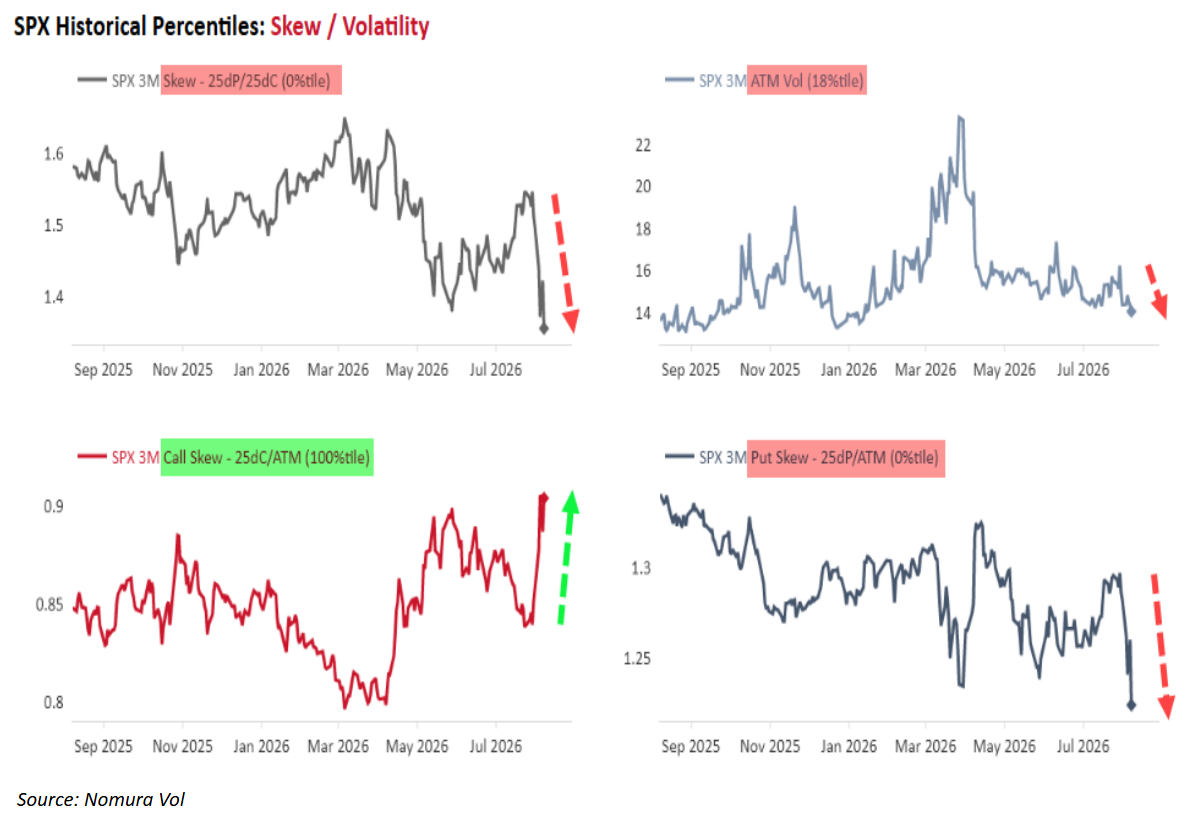
The evidence of this upward movement is not reflected in price trends, but is clearly imprinted in the options market: bullish options are being snapped up.
And as the index soared away from everyone's hedging price, put options quickly lost value.
McEligott described the resulting skewed bias as “biblical level.”
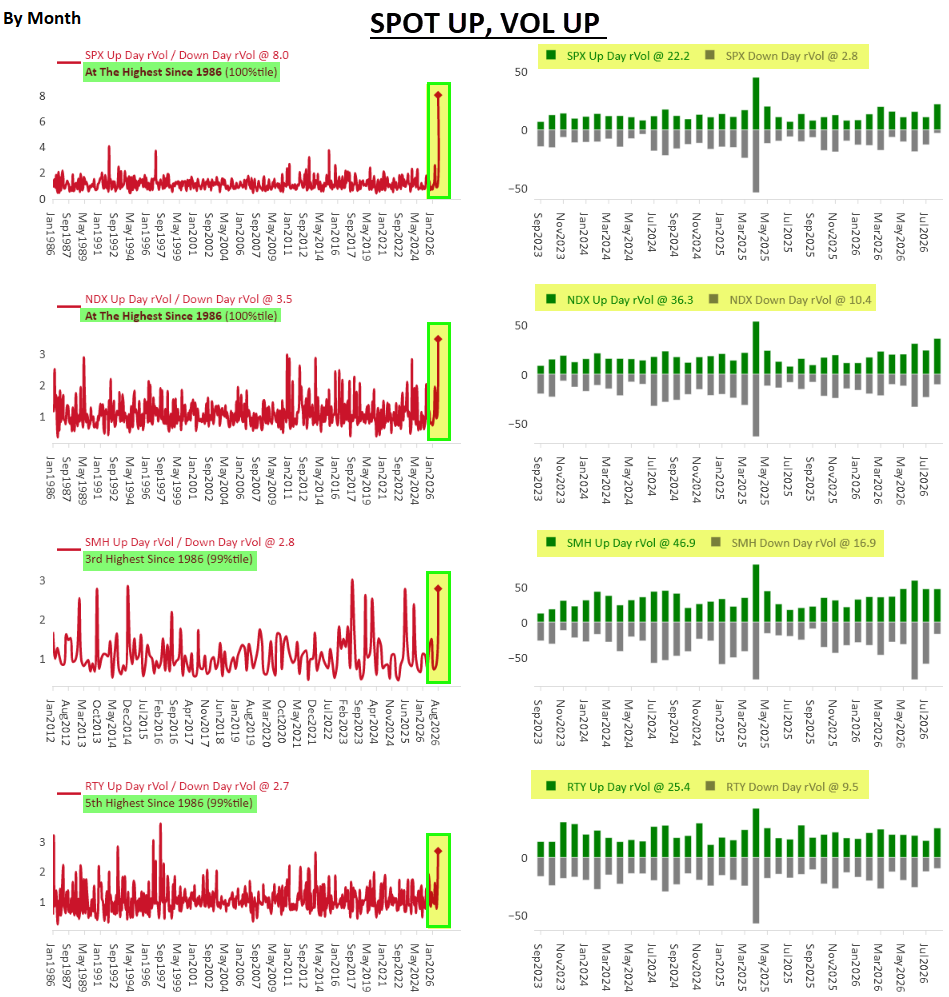
The one-month 25-Delta call option bias for the S&P 500 and Nasdaq 100 indices both fell to the lowest level in history.
The volume of S&P 500 call options simultaneously hit record highs.
Over the past week, the achieved volatility was significantly higher on rising days than on falling days — the only thing the market seemed to worry about was shorting subsequent gains.
The volatility of individual shares has been destroyed, and the risks behind the calm have not been eliminated
Volatility at the individual stock level has been broadly erased in this process.
Goldman Sachs derivatives and capital flow expert Lee Coppersmith pointed out that
The average monthly implied volatility of NASDAQ's 100 constituent stocks fell 9.1 percentage points in three trading days.
The decline in S&P 500 constituent stocks also reached 6 percentage points.
Coppersmith said, “In the AI era, we have seen larger fluctuations, only the fluctuation shock in August 2024 and the tariff incident in April 2025.
“At that time, VIX broke through 60 points. However, in the past month, the highest point of VIX reached only about 21 points, then quickly fell back.
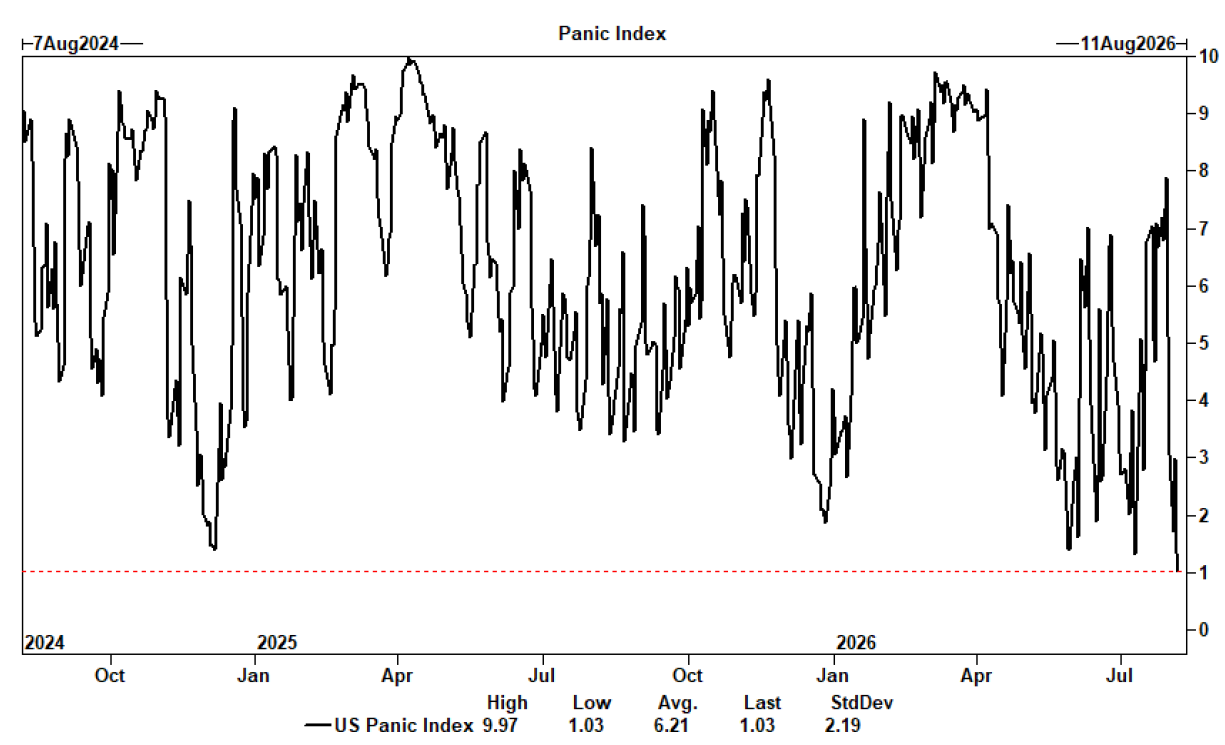
However, this is probably where the trouble lies. Goldman Sachs's internal panic index has certainly fallen to a low point,
However, a recent episode showing a non-farm payroll report showing a 23,000 reduction in employment, US bond yields hovering around 4.7%, and yen intervention,
Together with the unresolved conflict in Iran, they form a picture of macro-risks that should not be underestimated.
Financial data is impressive, but the macroeconomic background is far from confirming that everything is improving.
AI is no longer an overall position, but a stock selection list
At the index level, overall exposure appears to have completely shifted to risk appetite.
But underneath the surface, skepticism persists. Artificial intelligence trading is still the core of the market, but the basket of leading thematic gains is fragmenting.
Not all of the targets that were hit hard in July experienced a strong rebound — memory chip stocks are a typical example.
Nick Savone, Global Head of Equity Advisory and Accounts at Morgan Stanley, wrote:
“This may be a broader revelation of a week where familiar deals have come back to life without simply returning to the old script.
The level of dispersion is still extremely high, and investors are putting their money back to work after deleveraging in July — but with more screening.”
According to Morgan Stanley's data, the dispersion among S&P 500 constituent stocks was at the 92nd percentile over the past five years.
However, the ratio of inter-sector to intra-sector dispersion is only at the 35th percentile. This means that the ability to select stocks is overriding the theme allocation to become the dominant logic of the market.
AI is no longer a transaction that needs to be held in its entirety; it has become a list of targets that need to be carefully selected from it.
Position structure is a double-edged sword, the next catalyst may trigger a chain reaction
The current upward trend has transformed the position structure into a double-edged sword.
Aggregate market maker Gamma is currently slightly short, and above the exercise price of 7,900 points, there are a number of market maker short bullish option positions.
Once the market rises further, it will accelerate the “melt-up” market.
The problem is on the other side. The current position of the put option, which was previously “burnt”, is far below the spot price.
However, the trend tracking strategy's shorting signal reversal point corresponds to a decline of about 4% — which highly overlaps with the range where market makers' short put options are concentrated.
In terms of macro narrative, today's inflation data is not seen as the core risk for August; the market is focusing more on Nvidia's earnings report and Jackson Hole annual meeting at the end of the month.
These two major events are highly consistent with the pattern of seasonal increases in volatility in the fall of previous years.Bloomberg strategist Barnert concluded that after large-scale risk removal in July, the position was gradually re-established.
Combined with the continued demand for downside hedging, they have created conditions for the market to move rapidly and vigorously when the next catalyst appears.
Given that investors may have neither sufficient downside protection nor sufficient upward exposure, the probability that the market will remain highly dynamic is quite high.
(This article does not constitute personal investment advice; invest on this basis at your own risk.)
Twitter:https://twitter.com/BitpushNewsCN
Compare the TG exchange group:https://t.me/BitPushCommunity
Compare TG subscriptions:https://t.me/bitpush
