


Behind Hermes' rise to the top: A Web3 team's path to advancement

Author: Jacob Zhao
IOSG Weekly Brief|Behind Hermes' rise to the top: A Web3 team's path to advancement #340
Hermes' phenomenal growth does not stem from an exclusive technology that cannot be replicated in OpenClaw's principles, but rather because it most accurately closed a “challenger growth system” during the critical window of individual agent category formation: taking on OpenClaw's mature user pool and establishing “trustworthiness” (trustworthiness trust), a more realistic experiential difference than the “self-evolution” narrative. As professional execution agents become more and more powerful, users still need a manager who is online for a long time and is worth entrusting.
Open OpenRouter's public application rankings. Hermes Agent ranked first on all platforms with 30.5 trillion token usage, and also ranked first in the four categories of Productivity, Coding Agents, Personal Agents, and CLI Agents, leading well-known agents such as OpenClaw and Claude Code in a cliff-style manner.
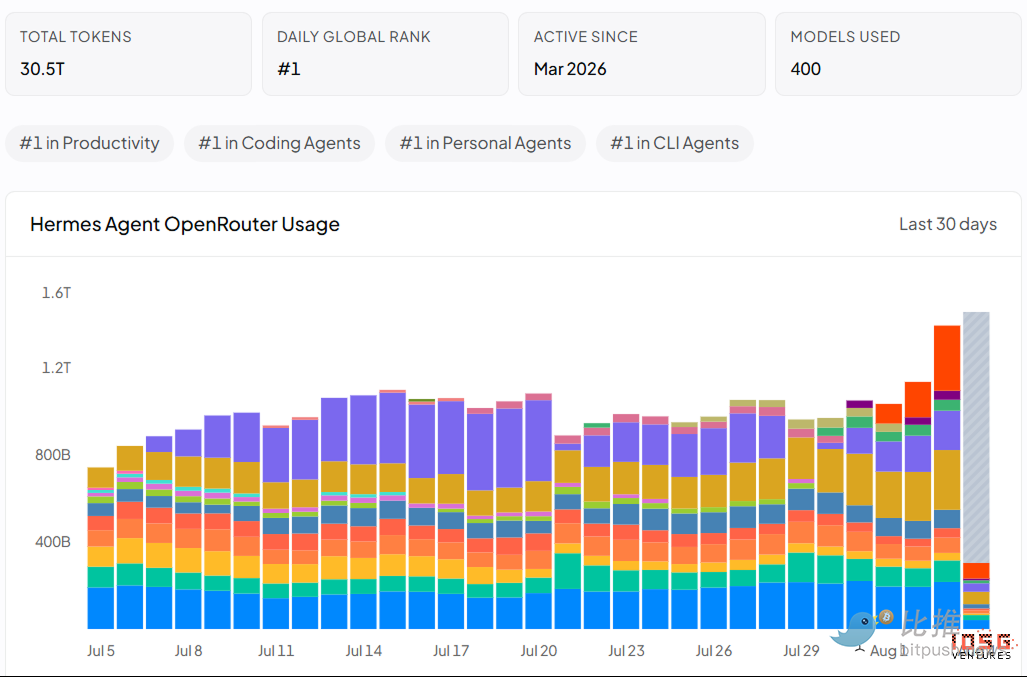
▲ Figure 1 · Hermes Agent's historical data snapshot on OpenRouter (taken on August 4, 2026, dynamic page data will change over time)
Although OpenRouter's statistical caliber does not cover industry-wide token consumption directly connected to official APIs (such as Claude or Codex native subscriptions), as the world's largest AI model routing and aggregation platform, its list is extremely significant as a “weather vane”. Although at the level of high-end professional tasks, the core business workflows of many users — complex code generation, architecture design, and high-value data analysis — still flow to Claude Code and ChatGPT, Hermes maintains an advantage in use scenarios such as back-office automation, message entry response, long-term online monitoring, and lightweight task scheduling. As an Agent product created by the Web 3 team, Hermes has achieved far more successful communication, community, and usage than expected, so we can't help but pay attention to:
· How can Hermes reverse OpenRouter inference calls?
· What is the real field between it and OpenClaw?
· How does Hermes maintain “differentiated coexistence” rather than “head-on competition” in the relationship with Claude Code and Codex?
From development frameworks to personal AI systems - the path to OpenClaw
Why did the early Agent framework not produce consumer products
Before the advent of OpenClaw, although the agent field already had mature infrastructure, there was a fundamental limitation: the unit used was a “development project enterprise workflow” rather than an “individual user.” The common characteristics of early frameworks were developer-facing, outputting code, or configuration—they built the Agent's infrastructure without delivering the Agent itself. Too high engineering thresholds have always been stuck in the “developer tool” stage, there is a lack of a closed loop of commercialization that transforms technology into “personal assets”, and the “personal agent product layer” directly aimed at end users is almost empty.
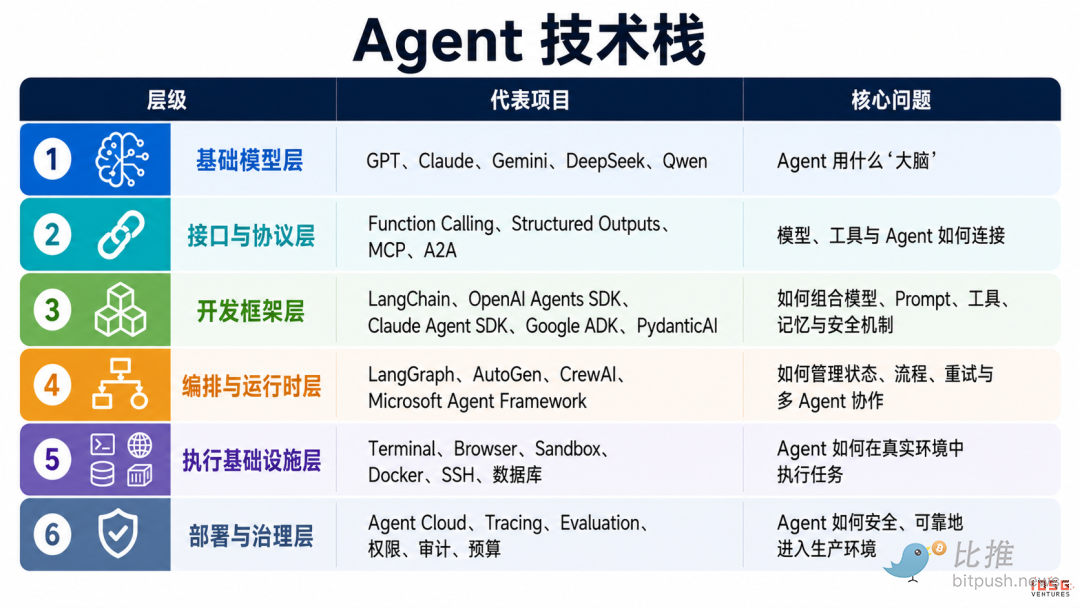
▲ Figure 1 · Six-layer structure of the Agent technology stack (model layer → protocol layer → SDK development framework layer → orchestration runtime layer → execution infrastructure layer → deployment governance layer)
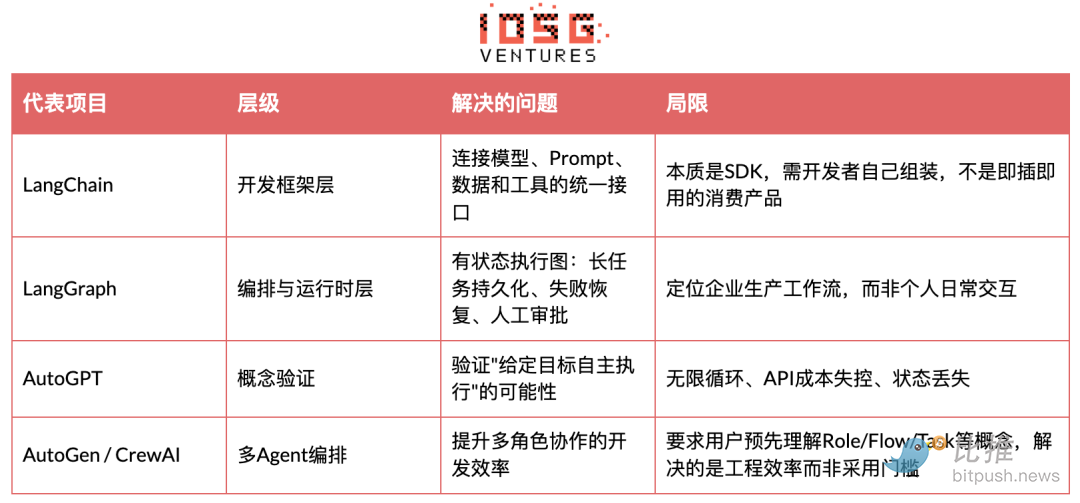
▲ Figure 1 · Hermes Agent's historical data snapshot on OpenRouter (taken on August 4, 2026, dynamic page data will change over time)
What OpenClaw has really changed
OpenCLAW did not re-invent Agent Loop or task scheduling technology at the bottom; its core contribution lies in product-level systemic packaging. LangChain solved “how to build an agent”, while OpenClaw solved “how to own an agent”. It skips the middle layer of the technology stack, integrates scattered framework capabilities into a complete product that individuals can directly configure and use for a long time, and realizes a fundamental shift in adoption units from “development projects” to “individuals”, which is reflected in six dimensions of product innovation:
·Personalization of identity: Give agents a consistent name and identity, breaking the tool-feel of stateless API calls.
·Routinizing the entrance: Use high-frequency communication software such as Telegram/WhatsApp as an interactive interface to replace complex command lines or IDEs.
·Permanent status: It runs online for a long time as a back-office process to achieve a transition from passive “standby” to active “presence”.
·Permission materialization: The user's file system, browser, terminal, and actual ability to act are deeply incorporated into the agent's operational boundaries.
·Scalable capabilities: Through Skills, Memory, and Community plug-ins, processes are consolidated into reusable capabilities to expand the boundaries of action.
·Intellectual Ownership: The core transformation — the shift of users from “using an AI tool” to “having an exclusive digital partner.”
Why doesn't lobster fever form a second mentality
The popularity of OpenClaw has spawned numerous imitations. These products solve real user problems: complicated installation processes, difficult environment configuration, lack of channels such as WeChat and Feishu, compatibility with domestic models, rapid deployment of cloud hosting, automatic updates, and security isolation. They all have their own user groups and reasonable business logic. But almost none have formed an independent brand mentality — because they answered the question “how to use OpenClaw more easily” rather than “where should individual agents evolve after OpenClaw”. Narrative challenger positions are extremely scarce in the overall personal agent market.
Why did Hermes take the lead in the end
Nous's Model, Community, and Crypto-Native Background
Nous Research originated from Discord's open source AI research community in 2022 and officially completed corporatized operations in 2023. The core founding team includes Jeffrey Quesnelle, Karan Malhotra, Teknium, and Shivani Mitra, whose business covers:
·Hermes model series: Nous's most representative open source model brand, has long focused on post-model training, instruction fine-tuning, and agent capabilities, and has established a huge developer adoption base in Hugging Face.
·DISTRO (Distributed Training Over-the-Internet): By drastically reducing the cross-node communication cost of distributed training, the cross-node communication requirements in distributed training are significantly reduced, making it a more viable engineering path for cross-region and heterogeneous hardware to participate in collaborative training under Internet bandwidth conditions.
·Psyche Decentralized Training Network: DiStro will be further networked to coordinate globally distributed computing nodes through Solana, so that GPUs in different networks and hardware environments can participate in large-scale model training.
·Hermes Agent: Nous's personal agent product for end users integrates Hermes models, tool calls, memory, skills, messaging channels, and long-term operation capabilities into a permanent agent.
In April 2025, Nous Research closed a Series A funding round of $50 million led by Paradigm, with a post-investment token valuation of $1 billion. Prior to this round of financing, the company had accumulated approximately $20 million in early financing, with investors including well-known institutions such as Distributed Global, North Island Ventures, and Delphi Digital.
Nous has built a closed loop of technology for “Hermes (model capability), DiStro (distributed training), Psyche (decentralized computing power network), and Hermes Agent (personal terminal product)”. The release of Hermes Agent was not a temporary fork chasing popularity, but rather a strategic extension initiated by Nous to the demand side (real users, tasks, workflows) after long-term accumulation on the supply side (data, models, training, open weights) — this provided a deeper starting point for establishing differentiation than ordinary prototyping.
OpenCLAW's O&M Pain Points Become Hermes' Growth Engine
There is no significant difference between Hermes and OpenClaw in terms of the underlying package (model + tool + memory + scheduling). The phenomenal explosion did not rely on technological differences, but instead accurately closed a chain of systemic growth: direct acceptance of OpenCLAW's educated, mature users and suffering from pain points in operation and maintenance through seamless migration tools formed the core growth engine in the early days.
Product Power Transition: Establishing “Trustability” (Trustworthiness Trust)
Hermes' core product hypothesis is to resolve the “transfer of responsibility for operation and maintenance” and promises “absorption and repair by internal system absorption after errors”:
·Reliability trust: Ensure that tasks continue to advance and recover from failures (persistent Kanban, /goal mode, tool self-healing).
·Security trust: Prevent unauthorized access, misdeletion, or data disclosure (approvals approval flow, sandbox, strict permission boundaries).
·Verifiable trust: Prove that tasks are actually completed (completion contracts and grounded citations).
Conceptual analysis: “self-evolution” (narrative advantage) vs. “autonomous recovery” (difference in experience)
In Hermes' product narrative, there is a significant difference in product value between “self-evolution” and “self-recovery”:
·Self-improvement: Essentially, process adaptation based on memory and skills. Given that competitors have similar infrastructure, their differentiation lies more in pioneering integration into a default system with lifecycle management, which takes the narrative advantage of a “will grow” mentality rather than a proven, insurmountable technical barrier.
·Autonomous Recovery: This is currently the most verifiable difference in experience. Thanks to structured error returns and automatic provider fallback, Hermes is able to digest faults within the system. This kind of system-level stability of “not bothering users frequently” is a more direct and perceptible difference in product power.
Structural bonus: ability to delegate and supervise professional agents
Hermes's core value is not to personally perform all professional tasks, but to act as an Orchestrator (Orchestrator) responsible for requirements completion, task disassembly, route monitoring, and final acceptance. By delegating external CLIs such as Claude Code/Codex to perform specific tasks through built-in skills, the community has settled on the practical paradigm of “Hermes Master Control + External CLI as Worker” (such as the /goal mechanism and oh-my-hermes collaboration tool), reflecting its architectural advantage of driving up the upper limit of task complexity through scheduling professional agents.
From Crypto-native to Crypto-Invisible: Hermes' Web 3 behind-the-scenes operating system
Simply attributing Hermes' success to a “Web 3 context” is an oversimplification. Web 3 provides Nous with an “organizational operating system” that is difficult for other AI startup teams to obtain at the same time, enabling it to enter the mainstream market with the smooth experience of standard AI products:
·Venture capital patience: Crypto-Native capital supports long-term, high-uncertainty and multi-line parallel investment, enabling Nous to simultaneously lay out models, training, runtime and cloud without having to converge to a single revenue verification prematurely.
·Ready-made user marketplace: It provides a group of Crypto AI users familiar with Telegram, servers, APIs, and self-hosted Crypto AI, greatly reducing the cost of cold start education, and spawning intensive use, tutorial dissemination, and skill contributions.
·User sovereignty values: Adhering to the self-hosted, open, migratable, and anti-platform locking approach, it is directly implemented as an underlying architecture with MIT License, multi-provider support, BYOK, and Memory/Skills migration.
·Community R&D and verticalization: Relying on a global remote collaboration and open source culture, users spontaneously become contributors, skill authors, and product designers for vertical scenarios.
Hermes hardly exposed Crypto to the user front desk. Using its Agent, Memory, Skills, and automation capabilities, there's no need to connect to a wallet, buy tokens, or understand Solana. Meanwhile, Paradigm Capital, Psyche, distributed training, and Crypto AI communities still exist behind the product. This has formed a product form that can be summed up as “crypto-native in organization, crypto-invisible in product” — the organizational level retains the most valuable parts of Crypto (capital, global community, user sovereignty and coordination capabilities), and the product level removes the parts most likely to hinder mainstream adoption (wallets, tokens, speculative narratives, and on-chain operational friction).
Why does OpenClaw reject Crypto and why does Hermes hide Crypto
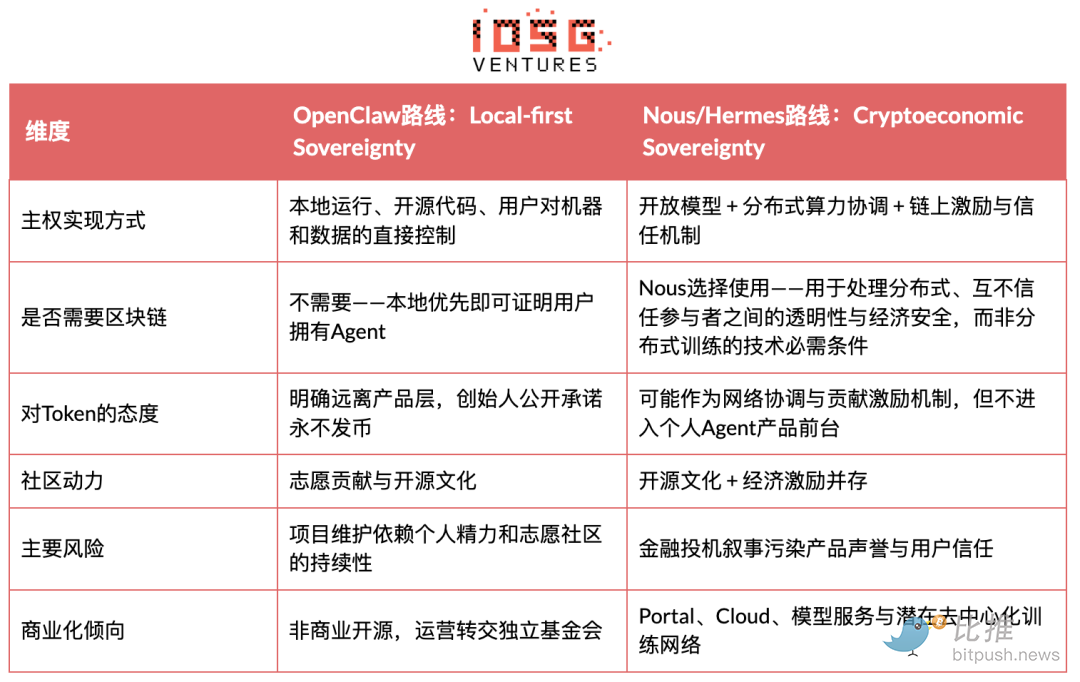
The apparent opposition between OpenClaw and Hermes on the Crypto issue is not an ideological dispute between “exclusion” and “hug”. Judging from the product results, they all reflect an orientation of open source, user control, and reducing platform locking; the difference is that Nous further uses cryptographic economy mechanisms for distributed training coordination, while OpenCLAW mainly achieves user sovereignty through Local-first architecture:
·OpenClaw (Local-first Initiation): Resist financial speculation and defend “local-first” sovereignty. Due to early counterfeit currency scams, it has adopted “zero tolerance” for Crypto. Through pure open source and local operation, non-blockchain defense of user sovereignty is realized, and financialization at the product level is resolutely rejected.
·Hermes/Nous (Cryptoeconomic Threats): Engineering-oriented, Crypto is only a low-level coordination tool. Introducing blockchain is a pragmatic choice to address engineering challenges (such as the Psyche Network using Solana to coordinate heterogeneous computing power) rather than constructing financial narratives for end users.
Hermes' advanced mode—from individual agent to mission manager
This section aims to answer a more fundamental question: What is Hermes's reason for being a standalone product when Claude Code and Codex are already capable of performing most professional tasks with high quality?
·Model A: Direct collaboration (limited gain): Users are used to manually generating prompts in LLM and handing them over for execution, and manual handling of results and review. Although the quality of a single output is high, it is necessary to undertake full project management and coordination with multiple agents. For such hands-on users, Hermes' automation was viewed as a “middle layer that increases opacity” and failed to effectively reduce the burden.
·Model B: Delegated management type (significant gain): The user uses Hermes as the permanent general controller and only issues the ultimate goal. Hermes is responsible for dismantling tasks, delegating subtasks, tracking GitHub/CI status, and automatically triggering rework. Community practices (such as oh-my-hermes) show that Hermes' core value is to replace tedious cross-agent coordination and project management.
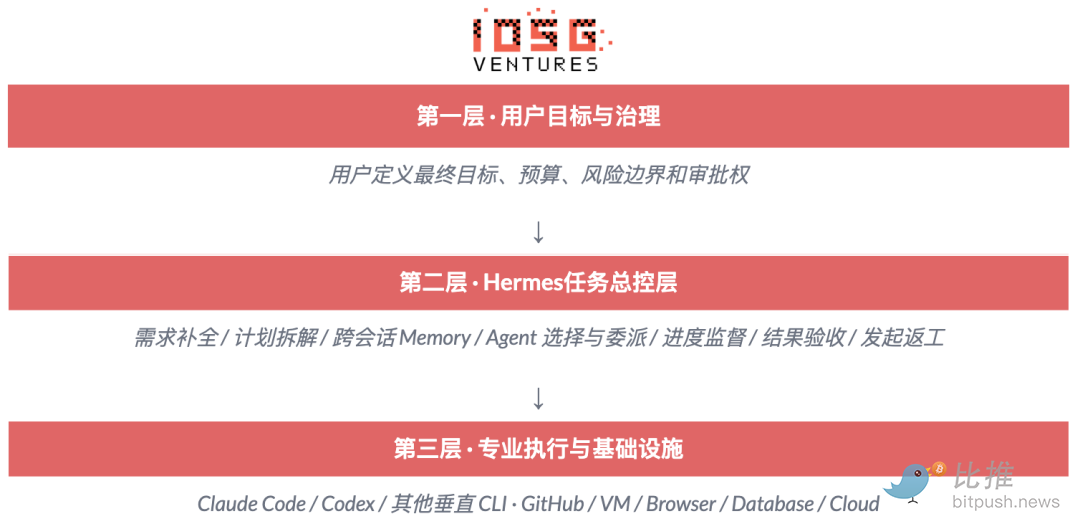
Under this framework, Hermes and Claude Code/Codex are not an alternative relationship, but a hierarchical relationship: the latter provides a third level of execution quality, and the former provides a second layer of persistence, cross-session state, and cross-agent coordination. The value of Hermes is not evenly distributed across all users, but is likely to be highly focused on a group of advanced users who work across agents, across systems, and asynchronous tasks for long periods of time. This judgment is more accurate than the general “individual agent second mind has been formed”, and is also more suitable for guiding commercialization and product prioritization.
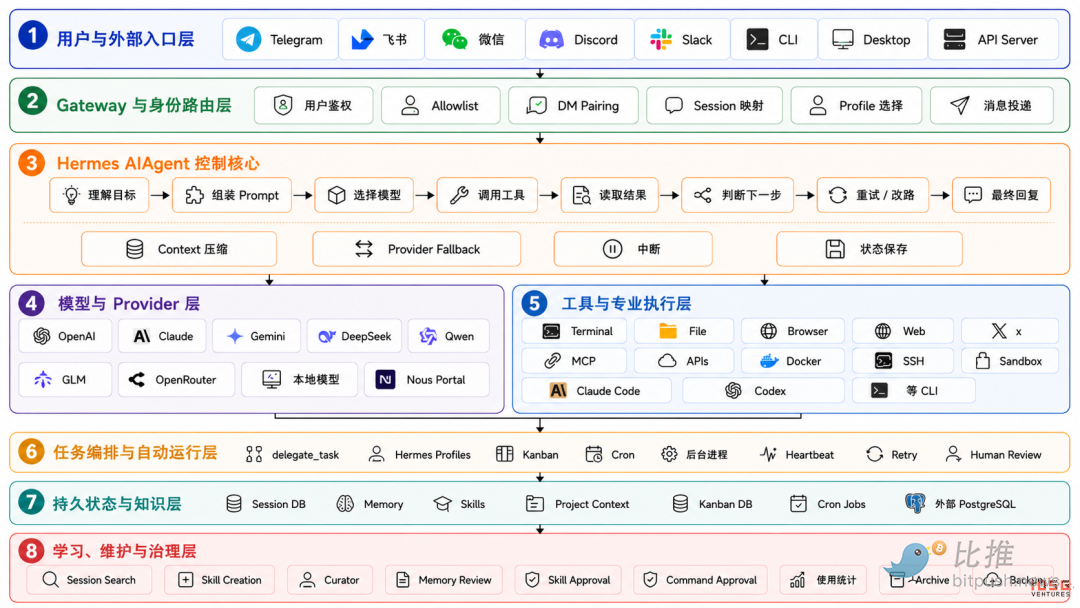
▲ Figure 2 · Hermes Agent technical architecture panorama (user portal → gateway → control core → provider layer → execution layer → orchestration layer → status layer → governance layer)
Based on official documentation community research, the Hermes Agent technical architecture panoramic framework covers the entire link from user interaction to learning governance:
·System-level support for autonomous recovery: The “control core” clearly includes Context compression, Provider Fallback, and interrupt state saving, providing a technical foundation for fault recovery and system self-healing capabilities when a task fails.
·“Delegate rather than replace” execution logic: “Tools and Professional Execution Layer” juxtaposes external CLIs such as Claude Code and Codex with Hermes native tools (Terminal, Browser, etc.), confirming its position as a scheduling hub.
·The governance attributes of “self-evolution”: The “learning, maintenance, and governance layer” includes nodes such as Curator and Skill/Command Approval, which indicates that experience accumulation is a governance process with manual intervention mechanisms rather than a fully automated black box.
Business model - who pays for “Hermes”?
Comparing only its token cost with a direct subscription to Claude Code/Codex would be misleading. Because this algorithm overlooks Hermes' core values: replacing user-hands-on project management, context handling, and cross-agent coordination.
User value formulaHermes user value = saved manual coordination time + asynchronous and unattended value + cross-system automation benefits − Token and tool costs − Manual intervention costs − Failure and security risks
Hermes' economics are therefore not absolute, but highly dependent on the “depth of entrustment” of users:
·High commission depth (economical establishment): If Hermes can turn tasks that originally required hours of manual tracking into true unattended execution, even if the token cost is slightly higher, its overall time cost and efficiency benefits will still be positive.
·Low commission depth (economic collapse): If users still need to frequently intervene to correct errors and fight fires, Hermes is reduced to pure token consumers and fault amplifiers.
This mechanism accurately explains why different user groups evaluate Hermes's economic efficiency quite the opposite, and also suggests that the key to verifying its business logic is to quantify the “unattended completion rate” and “number of manual interventions per task” rather than simply comparing the unit price of the model API.
Commercialization base: Nous Portal and Hermes Cloud
Hermes Agent uses the MIT protocol as an open source and is positioned as an ecological growth engine. The true closed loop of commercialization focuses on Nous Portal. Its core value proposition is “one subscription, integrating multiple types of API keys”, covering three modules:
· Model Routing: Aggregates 252 models (provides inference through OpenRouter and direct connection provider).
· Tool Gateway (Tool Gateway): Built-in high-frequency tools such as Firecrawl (web search), FAL (image generation), Browser Use (cloud browser), Modal (sandbox execution), and OpenAI Audio (TTS).
· Hosted service: Out-of-the-box Hermes Cloud instance (daily running fee, excluding inference and tool call fees).
Nous's actual revenue is highly dependent on users' usage paths, and currently shows clear structural differentiation:
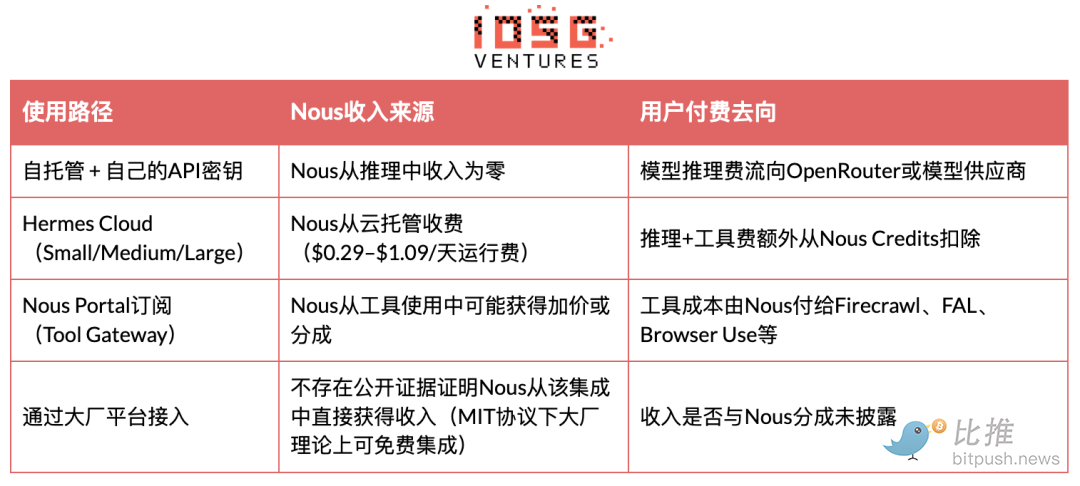
Open source and commercialization, will Hermes become the “Linux of the Agent World”
While Hermes' MIT open source strategy is driving explosive growth, it also forms a structural constraint on commercialization. The self-hosted free model requires that its paid version must have irreplaceable additional value, but there is currently no clear path to differentiated monetization. The deeper risk is “value retention”: if Hermes continues to be widely integrated by cloud vendors as an optional runtime, it may repeat the classic dilemma of Linux or K8s, and core commercial value will be withheld by cloud vendors that provide computing power and hosting. While exchanging ecological prosperity, the MIT agreement also meant relinquishing absolute control over distribution channels. As long as users are free to choose “self-hosting + own API” or “third-party cloud deployment,” huge usage cannot be forcibly converted into direct revenue, causing Nous to face the severe test of “increasing ecological status” and “mismatch with actual commercial returns.”
Agent Ecosystem - the tripartite pattern of personal manager, professional tools, and big manufacturer Claw
OpenClaw, Hermes, Claude Code, Codex, and major hosting products have significant differences in target users and core propositions, and belong to different segmented circuits. In order to clarify the current market pattern, AI Agent's panoramic core competition matrix is as follows:
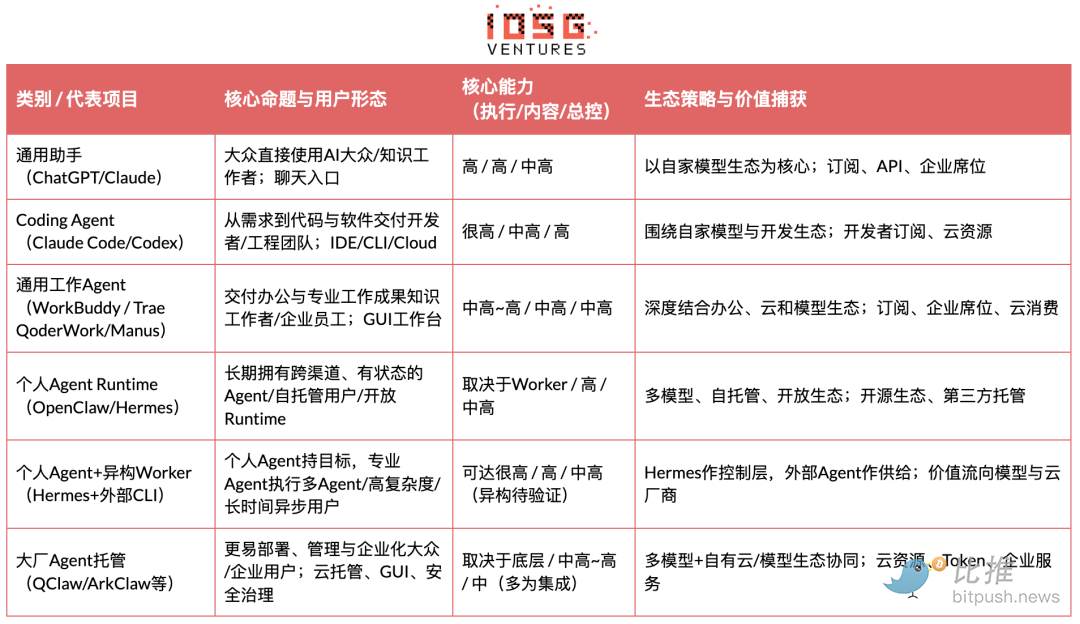
Instead of pursuing a pan-mass market, Hermes accurately penetrated into four types of high-density power users, which formed the cornerstone of its phenomenal dissemination:
·Self-hosted and infrastructure players: Familiar with VPS/Docker/SSH, seeing Hermes as a natural control layer for existing infrastructure.
·Multi-model arbitrageurs: Refusing to be locked by a single vendor and used to dynamically schedule cutting-edge or local models based on tasks.
·Multi-agent coordinator: There is an urgent need to automate complex serial workflows across platforms and tools.
·Open Source and Crypto AI Community: Highly agree with the concept of user sovereignty and decentralization, and deeply resonates with Nous's organizational culture.
Although this group has a small base, it has extremely high token consumption, code contribution, and technical evangelism capabilities, and is the core engine that promoted early word-of-mouth communication.
Claude Code/Codex: Both a Supplier and a Threat
# Short-term symbiosis: push up execution limits
In the actual workflow, Hermes acts as the general control layer and invokes Codex (code implementation) and Claude Code (architecture and review) through a delegation mechanism. The stronger the underlying professional agents, the higher the upper limit of task complexity Hermes can deliver, forming a symbiotic relationship where “Hermes is responsible for routing and acceptance, and professional agents are responsible for execution”.
# Could eat away at Hermes' independent value in the long run
Model makers are speeding up their infiltration into the general control, and the threat is closer than expected. Anthropic's Claude Managed Agents already support the parallel orchestration of multiple agents; OpenAI also clearly positions the Codex App as a “command center for agents”, which supports parallel, automated, and long-term background operation of multiple agents. This means that Codex's ability to control multiple agents within the software engineering boundary is relatively mature, even partially surpassing Hermes, and is no longer simply a “lower-level performer.”
Hermes temporarily has a personal control plane advantage across channels, models, and projects; however, Codex already has strong task ownership and multi-agent management capabilities within the software engineering boundary, and the competitive advantage within this boundary may be stronger than Hermes. The core competitive issue is: can Hermes deposit users' project status, approval rules, skills, memory, and cross-agent workflows on its own layer before model vendors, forming assets that users are unwilling to migrate? Or will it end up being absorbed by the model's native product as a standard feature?
Internet giant agent route selection
To discuss the strategies of major manufacturers to cope with the wave of individual agents, we need to first clarify their product boundaries: permanent agent hosting for individuals (such as Tencent QClaw, byte ArkClaw) is very different from the positioning of general-purpose work agents (such as WorkBuddy, Trae) for office/enterprises:
·Dachang Claw route: Lower the threshold through one-click deployment, pre-set templates, and local ecosystem access. However, the deep divide is that platform incentives are untrustworthy: no matter how many external models are supported, users naturally think that the ultimate goal is to channel to their own cloud and model system.
·Hermes Runtime integration: Byte: ArkClaw and Tencent Cloud have both officially connected Hermes Agent to their cloud console as an optional plug-in or exclusive template, establishing a clear multi-runtime strategy: manufacturers maintain their own cloud hosting, billing, security, and enterprise-level control bases, while treating Hermes as pluggable advanced components to achieve complementary symbiosis between open source ecosystems and commercial cloud platforms.
·Universal office agent transformation: Currently, major companies are shifting their core resources from Claw to general-purpose office agent platforms (such as WorkBuddy) with clear requirements, easy inspection, and direct monetization. Such tasks can be deeply tied to proprietary ecosystems such as WeChat, DingTalk, and Feishu, and converted into revenue.
Hermes' Implications for Crypto AI
Instead of directly turning Hermes into a smarter agent, Web 3 gave Nous a different set of capital structures, organization, seed users, and sources of values from traditional AI startups. Hermes proposed at least a more mature Crypto AI path: making Crypto an organization and infrastructure rather than a product interface that users must face.
Hermes has completed the migration from a Crypto AI research brand to a global open source Agent product, and has established large-scale attributable reasoning activities and a clear second mentality — but this mentality is still focused on the OpenRouter ecosystem and global developer community, and has not transformed into a complete overtake of OpenClaw in terms of GitHub Stars or the overall community size. It has no exclusive technology that OpenClaw cannot replicate; instead, it has completed an iteration of challenger products worth studying by accurately taking on high-intensity users and establishing “can be commissioned” and “self-evolved”.
·Implication 1: Crypto can be used as an “organizational operating system” rather than a product feature: The true value of Web 3 can be reflected in the capital structure, early high-intensity user pool, and value base without mandatory exposure to wallet or token interactions. Achieving “organizational level Crypto-native, product level Crypto-invisible” is an effective strategy that takes into account innovation momentum and user experience.
·Implication 2: Decentralized infrastructure must anchor demand-side entrances to form a closed loop: Pure supply-side distributed training networks (such as DiStro, Psyche) are difficult to prove their commercial value without real user entry and execution data support. Hermes Agent is the key verification for Nous's transition from the underlying computing power infrastructure to the real demand side.
·Revelation 3: Moats can be built on “entrustment trust” rather than simply “model ability”: The differentiation of individual agents does not necessarily stem from a stronger ability to execute a single time, but rather “whether the user dares to assign long-term responsibility to it.” This soft trust asset is an often overlooked yet extremely barrier dimension in Crypto AI projects.
·Revelation 4: The relationship with Cloud Big Factory is not a zero-sum game, but rather an ecological complement: The manufacturer connected Hermes as an optional runtime, proving that the open source runtime can coexist with the factory control plane. For entrepreneurs, “being integrated” is a viable commercialization path, but they need to be wary of the risk of core values being withheld by the cloud vendor's hosting layer.
·Revelation 5: In the end, competition will shift from “ability to execute a single time” to “task ownership and trust accumulation”: The most valuable model for the future is not necessarily the strongest model for the execution layer, but rather an “upper level general control system” that can receive ultimate goals, maintain long-term context, intelligently schedule professional executors, and allow users to confidently deliver responsibilities.
OpenClaw made “personally owned agents” a clear product category; Hermes promoted “long-term contract agents” into a more systematic product direction through persistent state, task recovery, evidence acceptance, multi-model supply, and professional agent delegation. The real test is: as Claude Code and Codex's overall control capabilities within the software engineering boundary continue to increase, and the large cloud platform makes multi-runtime integration smoother, whether users are still willing to hand over the ultimate goal and long-term trust to this open runtime from the Web 3 context — and continue to pay for it.
Twitter:https://twitter.com/BitpushNewsCN
Compare the TG exchange group:https://t.me/BitPushCommunity
Compare TG subscriptions:https://t.me/bitpush
