


Kimi K3 Coin Circle Diagnosis: Scanned 501 Projects and 1,280 High-Risk Hazards in Two Weeks
By Claude, Deep Wave TechFlow
Original title: Kimi K3 Coin Circle Diagnosis: Sweeping through 501 Bitcoin Projects and 1,280 High-Risk Hazards in Two Weeks
Deep Tide Guide:The “Bitcoin Red Team” formed by volunteers used Kimi K3 from the dark side of the Moon to sweep 501 Bitcoin open source projects in two weeks and recorded 7,958 discoveries, of which 1,280 were rated as dangerous or serious.
The reason the Chinese model did this was because OpenAI and Anthropic rejected these defenders on security grounds. If your coins are in a wallet or node software that hasn't been updated in years, this is worth reading.
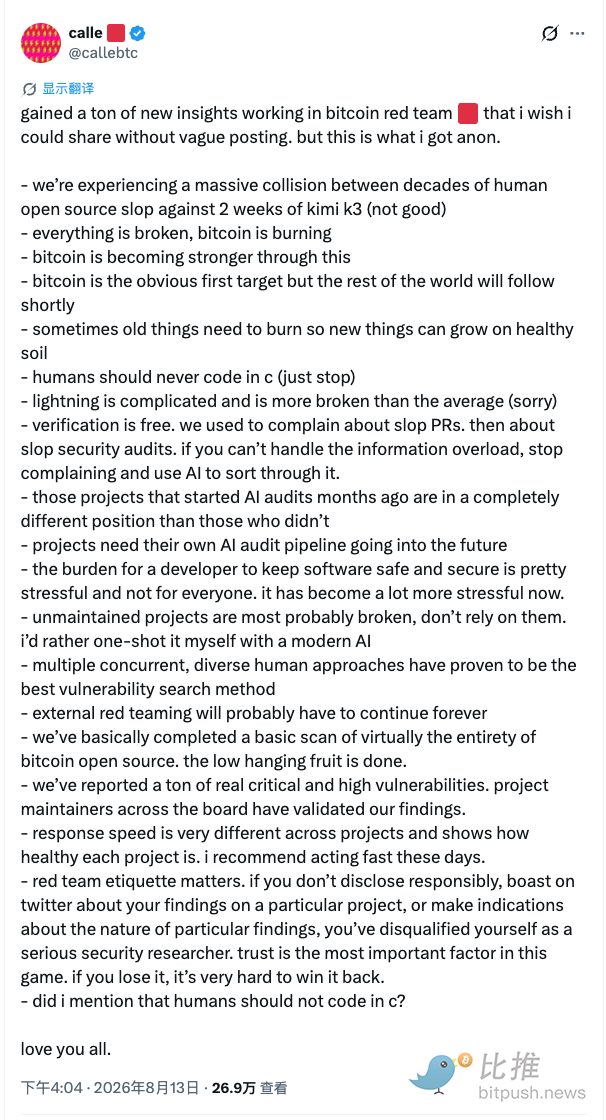
On August 13, Calle, a member of Bitcoin Red Team and founder of the Cashu Protocol, summed up the phased conclusions of this operation on X, and the tweet received nearly 260,000 views. His original statement was straightforward: “Decades of open source code collided with two weeks of Kimi K3, and the result was that everything was broken and Bitcoin was burning.”
It all started with a wallet flaw that swept away $100 million
On July 30, the hardware wallet Coldcard revealed a firmware flaw: the device fell back to a predictable software process when generating mnemonics. The security chip only provided 32 bits of entropy, leaving only about 4.3 billion possibilities in the effective key space. The attackers followed the map and emptied users' wallets in multiple waves, confirming losses of more than $100 million, and the total loss is suspected to be close to $130 million. Bitcoin Magazine issued a rare “Immediate Transfer of Funds” emergency notice.
This disaster directly spawned the Bitcoin Red Team. Calle and Rob Hamilton, CEO of escrow insurance company AnchorWatch, led by dozens of contributors. The non-profit organization OpenSats reimbursed most of its computing power expenses and conducted an AI audit of almost the entire Bitcoin open source ecosystem.
Two weeks to clean 501 projects, but finding a bug doesn't equal
By August 8, the team spent hundreds of hours cleaning up 501 projects, recording 7,958 findings, and 1,280 were rated as high risk or serious. These numbers need to be broken down: on the 108th hour node, only 24.7% of findings were dynamically reproduced, 29.4% were reported to the project party, AI audits would be misreported and repeated, and manual verification was still ongoing.
However, the “moisture theory” cannot stop the toughest case. According to the official release records of the payment software BTCPay Server, a serious vulnerability (two-factor authentication bypass) reported by Red Team members Bruno Garcia and Ben Carman was actually exploited before it was fixed. The attackers used this to obtain the node's management credentials, thereby controlling the associated Lightning Network wallet. BTCPay released two secure versions in a row. The community set up recovery rewards for victims, and the foundation allocated another 0.21 bitcoins to the Red Team Fund. The maintainers used their actions to vote of confidence in this group of findings.
The American model is apologizing, and the Chinese model is looking for loopholes
Why is the workhorse Kimi K3 and not GPT or Claude?
Because American models don't take on this job. Rob Hamilton stated that after completing all authentication, he used OpenAI's model to analyze a publicly disclosed codebase and was rejected in less than 20 minutes. The comparison between Bitcoin's core contributor PortlandHodl went viral in the community: in the same code, America's leading model's answer was “You're right!” China's open source model directly identified 78 serious vulnerabilities. Hamilton's comment is even more serious: “I'm basically asking Xi not to let my software be hacked right now.”
On August 10, more than 70 custodians, exchanges, mining companies, and development organizations jointly signed an open letter from the Bitcoin Policy Institute requesting that cutting-edge AI labs open access to credible defenders. Alex Thorn, head of research at Galaxy, wrote in a joint message: “Americans should not be forced to rely on Chinese AI to protect themselves. The red team needed these models.” However, we also need to pour cold water on the carnival: a joint evaluation by the British AI Security Research Institute and CAISI in the US showed that Kimi K3 was better than GLM-5.2 in vulnerability development tests, but it still lags behind the strongest closed source model in the US. Defenders don't choose the strongest; they choose what they can use.
A prompt makes the vulnerability easier to attack
In Calle's summary, what is really worth remembering for coin holders is this sentence: “In the past, finding a buffer overflow wasn't enough; it required an expert hacker to turn it into a usable attack; today only a prompt is needed.”
The threshold between discovery and weaponization has fallen, which means three realistic deductions. Old, unmaintained projects are suspicious by default. Stop using “many years of operation without incident” for security reasons; the speed of a project's response to bug reports has since been a public indicator of its health; Calle clearly suggests “moving faster during this period”; he himself named Lightning Network “more broken than normal projects,” and the associated wallet and channel balances are worth taking a closer look.
As for those 501 projects, the low-hanging fruits have been harvested, and the basic disk scan of the Bitcoin open source ecosystem has been completed. But Calle himself said that Bitcoin was only the first to hit this wall. A prompt can turn an old bug into a weapon, and all the software in the world that relies on “no one discovered it for years” to maintain a sense of security is queuing up for its own collision.
Twitter:https://twitter.com/BitpushNewsCN
Compare the TG exchange group:https://t.me/BitPushCommunity
Compare TG subscriptions:https://t.me/bitpush
