


Gold tokenization: How does regulation force gold to move onto the chain?

Source: Token Dispatch
By Thejaswini M A
Compiled by Foresight News
Original title: The tokenization of gold, a financial revolution forced by regulation
Overcrowding in New York, slow delivery,Basel's “tight spell” — a secret battle for the London treasury's ledger.
In February 2025, the market anticipated that the US would soon introduce a tariff policy, and traders took gold from the Bank of England treasury and shipped it to New York.
The waiting time for gold bar withdrawals has been extended from a few days to 4 to 8 weeks, and all withdrawal reservations are about full.
The Bank of England's Deputy Governor for Market Affairs Dave Ramsden told reporters
The process of entering the building that morning was extremely cumbersome because a cargo truck was parked in the treasury area.
Gold ownership certificates are traded on a daily basis at the London Gold Market, while physical gold is stored securely in vaults.
But in those uncertain times,
The extractability of gold directly changes the price: the price of gold under the name of the Bank of England fell due to weeks of queues for withdrawals;
The price of gold in commercial vaults has risen, and buyers are willing to pay a premium to be able to withdraw and transfer physical gold immediately.
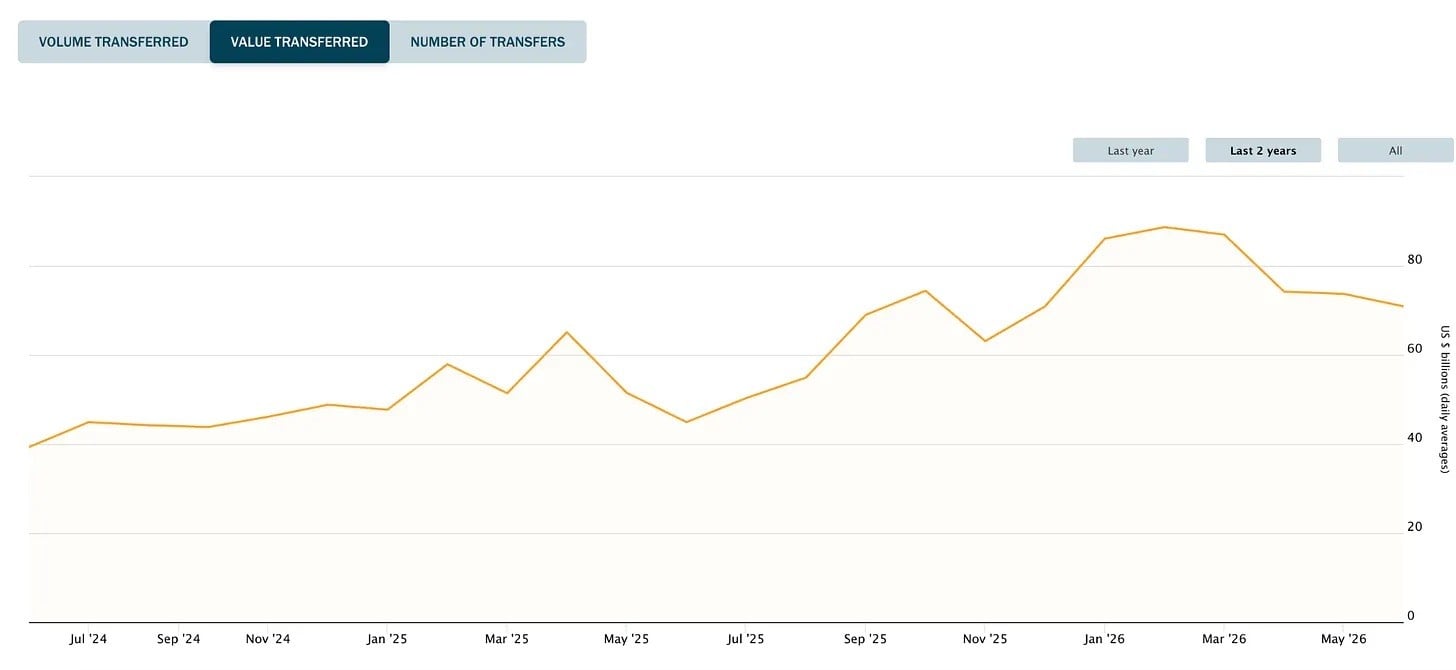
On an ordinary trading day in May, the banks responsible for the gold clearing business in London had an on-market gold transaction volume of 73.7 billion US dollars, and there was no need to move physical gold throughout the process.
As of the end of July, there were 9534 tons of gold in various gold stocks in London, worth 1.2 trillion US dollars, or about 762,000 gold bars.
The clearing agency said that this mechanism already works — moving physical gold is expensive, and comes with security risks.
This article will explore why the UK Financial Conduct Authority (FCA) has begun to develop regulatory rules for tokenized gold.
And why the relevant regulations place the focus of supervision entirely on the ledger system.
London is a global gold trading hub.
The London Bullion Market Association (LBMA) is an industry trade organization and is responsible for setting industry standards.
The final settlement of the parties' debts and liabilities was completed by four clearing banks: HSBC, ICBC Standard Bank, J.P. Morgan Chase, and UBS Group.
The electronic reconciliation clearing agency operated by the above banks is London Precious Metals Clearing Limited (LPMCL, also known as AURUM).
 The UK Financial Conduct Authority (FCA) has been communicating with major banks to discuss how to regulate tokenized gold.
And whether such assets can be used as collateral in the wholesale market.
Prior to that, the UK Financial Conduct Authority, the Bank of England, and the Prudential Supervisory Authority had jointly issued a report on May 18, 2026.
It is proposed that tokenized gold can be used as collateral for non-liquidated OTC derivatives; there are already precedents to follow in related fields.
The UK Financial Conduct Authority issued a policy statement in April confirming that all types of money market funds (including tokenized funds),
They are all eligible to be collateral for non-liquidated transactions in accordance with the UK version of the European Market Infrastructure Regulation (UK EMIR).
Currently, a total of 16 institutions in the UK are carrying out tokenization-related pilot projects within the regulatory sandbox.
The UK government estimates that tokenization technology could add £33 billion to the UK economy every year by 2035.
The first tokenized government bond is expected to land in early 2027.
It coincides with the Bank of England upgrading its collateral system; by 2028, various types of digital ledgers are expected to be interconnected with the digital pound.
There is a common opinion that London's promotion of gold tokenization is due to concerns about losing business to the Asian market.
But the truth is that this technology was independently developed by the Local Clearing Bank of London.
At the end of 2023, HSBC will split the standard 400-ounce gold bars in the London Treasury to generate small digital shares to facilitate transactions for institutional investors.
The bank then launched a version for retail customers in Hong Kong, with a cumulative transaction volume of US$2.2 billion, but this innovation originated in London.
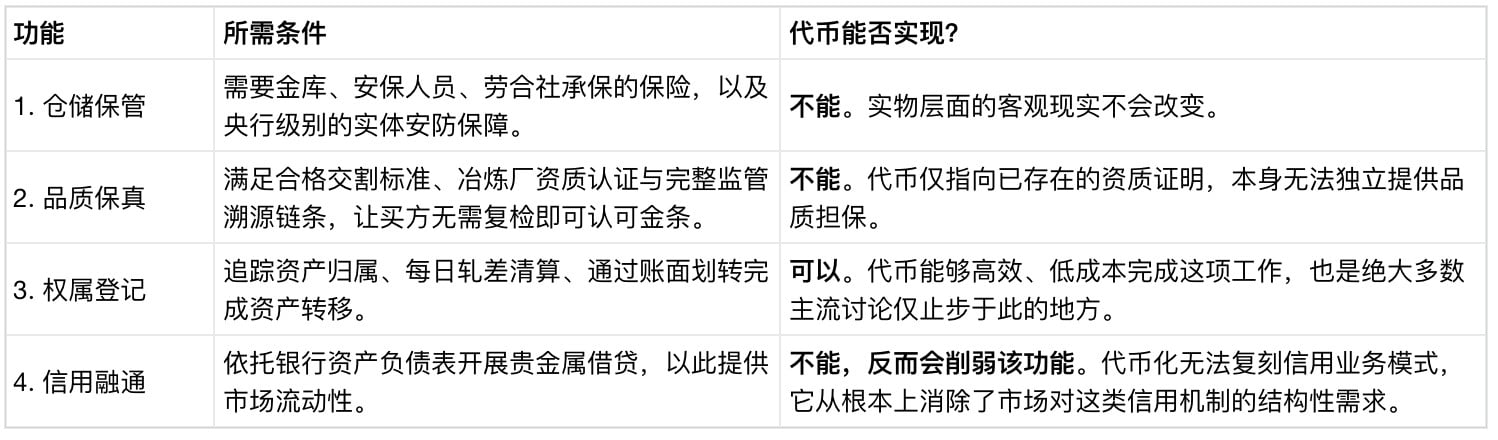
The London gold market has four core functions: the first two are physical storage (treasury and security) and quality inspection.
Quality verification also confirms that the purity of the gold is compliant; buyers do not need to re-check the molten gold.
The token clearly can't do these two jobs; it can only do business based on physical infrastructure.
Third function: Register ownership of gold. There is a consensus that the token performs very well in this regard and is inexpensive.
The fourth function is credit business, which is also the key to the conflict. Tokenizing gold will make banks' existing credit systems irrelevant.
With tokens, ownership of physical gold can be transferred instantly. Investors do not need to deposit gold with banks in exchange for convenient transaction channels.
 The vast majority of gold in the London market is held and traded on an unallocated account model.
Customers do not own a specific number of gold bars; they only have a general claim right for the corresponding amount of gold.
The London Bullion Market Association likens this model to bank deposits denominated in ounces.
The customer is an unsecured creditor of a liquidation member.
The gold in the vault will be consolidated by the bank to maintain the operation of the entire trading system.
After the transaction is completed, the bank can complete account billing immediately, leaving a few days to process physical delivery in the back office.
Buyers have two options: First, to claim specific physical gold bars, they need to pay storage fees, and the asset transfer process is slow;
The second type, holding undistributed gold, is essentially a loan issued by a bank. Investors are responsible for bank credit risk, but transactions can be completed instantly.
The vast majority of market participants chose the second option.
The average size of a single transaction in the February market was about 5 gold bars. Relying on this mechanism, gold did not need to leave the treasury throughout the process.
What will happen after switching to the token model? Tokens also have the transaction speed of borrowing and the validity of corresponding physical gold bars.
When both advantages are available, investors have absolutely no reason to bear bank credit risk.
The London market itself is already highly electronic, so simply upgrading settlement technology is not the biggest change.
The reason the UK Financial Conduct Authority prioritizes the collateral scenario over the transaction scenario is that the collateral business is highly dependent on speed.
The time limit for additional security deposit notifications to institutions is very short, and the traditional gold settlement system is too slow to circulate.
As a result, $1.2 trillion worth of gold could not be put into collateral, and institutions could only use cash or British Treasury bonds as collateral.
Regulators are clear that posting gold information on the chain can solve this pain point: ownership can be split and transferred instantly and accurately.
All vault gold can be used as high-quality collateral.
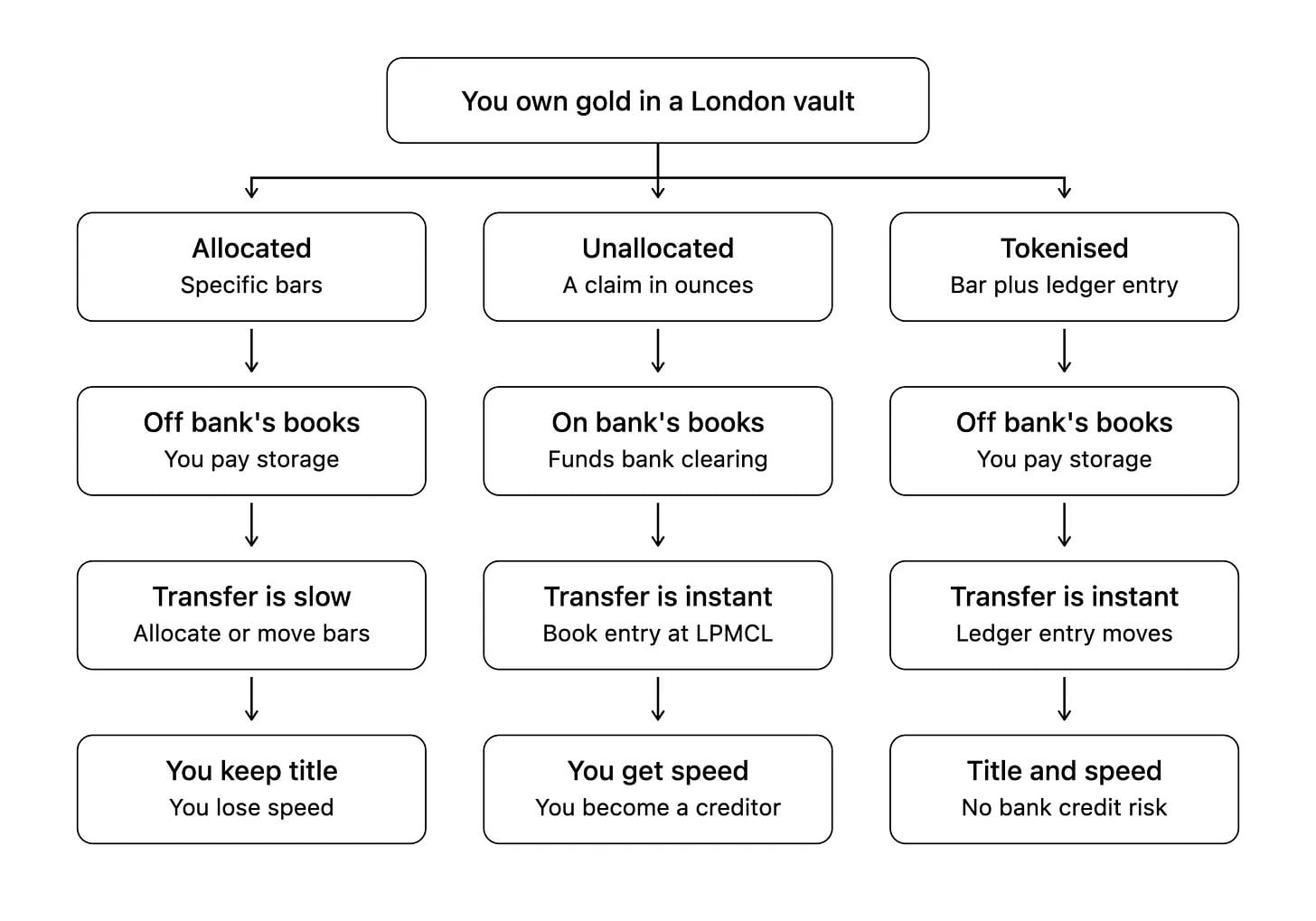 Compared with the London Treasury's three gold holding methods: actual distribution of gold has physical ownership, but transfers are slow.
Undistributed gold transfers are quick, but they are only bank creditors and bear credit risk.
Tokenized gold combines physical ownership with instant transfer capabilities, and no bank credit risk.
The securities industry has already implemented similar solutions. The HQLAX service supports leading institutions such as BNP Paribas, Mingxun Bank, and J.P. Morgan Chase.
Trade collateral ownership without moving the underlying physical assets.
The US Securities and Exchange Commission also released it in May 2026, allowing US brokerage firms to access it. The pilot period is 36 months.
This change lays the groundwork long before the rise of cryptocurrencies, stemming from stringent banking regulations.
When global regulators introduced the Basel III Stable Funding Ratio (NSFR) rule, undistributed account gold was recognized as an illiquid asset.
Banks are required to accrue an 85% stable funding buffer. The London precious metals industry protested strongly, warning that clearing banks may withdraw from the market.
Today, tokenization technology is completing the transformation initiated by Basel III.
I have some concerns about this: it is the major banks that have tried their best to maintain the old system that are driving the implementation of this technology.
The treasury business of storing 12.5 kg gold bars was not originally covered by the UK Financial Conduct Authority;
However, to hold gold tokens in the future, it is necessary to obtain full regulatory qualifications.
In February of this year, the UK Parliament passed a new regulatory framework for crypto assets, and the legal environment changed accordingly.
The UK Financial Conduct Authority has since officially overseen crypto asset escrow and trading platforms.
Companies will have a 5-month window to submit qualification applications starting September 30, and the full set of regulations will officially come into effect in October 2027.
The relevant rules are still being improved, and the UK Financial Conduct Authority continues to optimize customer asset custody regulations.
Lawmakers are also trying to extend traditional market exemption rules to the token sector.
There will be no changes to the underlying physical gold itself, and the treasury, insurance, and security personnel will operate as usual.
Once the ownership record is converted to a token, the relevant business immediately falls under supervision.
This is the boundary defined by regulation: the core of regulation is the legal right corresponding to gold.
Tokens transfer ownership in a new way, so the UK Financial Conduct Authority must introduce new regulatory rules.
If bookkeeping costs are reduced to nearly zero by software, value will flow directly to scarce physical assets.
The barriers to the London Treasury Circuit are extremely high. There are only four clearing banks and three security carriers. There have been no new entrants for over 10 years.
Tokens will not disrupt such physical service providers, and codes cannot replicate physical treasury security systems.
Even tokens will further enhance the importance of physical custodians. Behind every digital certificate, physical escrow services must be relied upon.
Relevant enterprises only need to adjust their business model, and the source of profit is changed from customer gold deposit business to standardized service fees for warehousing, auditing, and collateral support services.
The idea of tokenizing London gold has been around for a long time. Paxos and the European Settlements Bank tried to launch as early as 2016, and the project was shut down after 13 months of operation.
Today's model works. The core difference is that the dominant party has become the major clearing banks, and it is no longer an external startup imposing technical solutions.
Take HSBC as an example. The bank built a self-developed system to handle all transactions, built a closed ecosystem, and independently controlled the pace of transformation.
The final direction of this market transformation depends on the UK's Financial Conduct Authority.
Regulators need to make a key ruling: whether gold tokens issued by HSBC are allowed to circulate outside the HSBC system.
If regulation and circulation are liberalized, the market pattern will be completely restructured; if prohibited, the old banking model will only change the shell and continue to operate.
How can we tell if tokenization is really popular? The transformation process can be tracked through public data from the London Bullion Market Association.
The London Bullion Market Association published two sets of data: total market trading volume and traditional central ledger settlement volume.
Once the market makes extensive use of tokens, the total transaction volume will remain high, and investors will continue to trade; however, traditional liquidation volumes will decline.
Because token transactions complete instant transfers on the blockchain, they completely bypass London's traditional clearing system.
The scale of transactions under the old system is still huge at this stage. The liquidation ledger completes ownership changes of about 20 million ounces of gold every day.
At the same time, about 306 million ounces of gold have been sitting in vaults for a long time. In other words, about every 15 ounces of gold on a daily basis,
Only 1 ounce is transferred through paper transactions, and not a single gold bar is moved throughout the process.
Humans created mathematics, cryptography, and the global network, and went round and round; in the end, their foothold was still gold stored quietly in underground vaults, wasn't it?
(This article does not constitute investment advice)
Twitter:https://twitter.com/BitpushNewsCN
Compare the TG exchange group:https://t.me/BitPushCommunity
Compare TG subscriptions:https://t.me/bitpush
