


They are all stealing earlier data. Where exactly is VC Alpha hidden?

Author: insights4vc
Compiled by Deep Wave TechFlow
Original title: Private Equity Market Intelligence Warfare Heats Up: In the AI Era, Where Does VC Alpha Come From?
Guide to Deep Wave: Venture capital returns are extremely concentrated, and finding a good company in the early stages is almost the life and death line of a fund. This article breaks down the latest evolution of private equity market data tools and whether they can actually bring in excess profits. This is a sobering map for investors who are using AI and research tools to find projects.
Venture capital has always been an information business. The advantage often lies in timing: founders tell former colleagues instead of updating data first; new companies start recruiting people before they appear in the database; investors start watching a team before the funding is announced.
This advantage is important because VC returns are highly concentrated. According to data from the 2026 Oxford Academic Study, 4.5% of the investment amount contributed to a return of about 60% in a long-term LP data set. [1] Therefore, missing a few excellent companies can affect the entire fund. But finding them early is only part of the problem. Investors also need to develop beliefs, get credits, obtain meaningful holdings, and keep things right for a few years.
The private equity market data industry is now getting closer to the moment the company was born. PitchBook, Crunchbase, Dealroom, Tracxn, and CB Insights remain core recording systems for transactions, funds, valuations, and company history. PitchBook generated revenue of $174.7 million in the second quarter of 2026, equivalent to nearly $700 million in annualized revenue. [2] The new platform is not replacing this layer. They're extending this layer with faster updates, behavioral data, and signals that predate traditional company records.
Three changes stand out the most.
First, companies such as Harmonic and Specter are building a continuously updated map of companies and people, rather than relying mainly on regularly updated data. Second, specialty products are looking for earlier behavioral signals. Evertrace tracks metrics formed by founders, including company registrations, technical activity, research, and domain names. Frontrun monitors changes in selected venture capitals' interest maps on X. Third, the API and Model Context Protocol (MCP) are moving this data into the fund's own software and AI workflows. Crustdata represents the infrastructure side of this market, while Affinity complements first-party relationship data from emails, calendars, and CRM events.
Adoption is visible, but evidence of excess return on investment is not clear. Harmonic says hundreds of venture capital teams use its platform, and Specter reports more than 300 investment institutions, Evertrace more than 200 funds, and Affinity more than 3,300 private equity firms. Listed company Tracxn disclosed that it had 2,289 customer accounts in fiscal year 2026. [3] [4] [5] [6] Most of these figures are self-reported by companies. Vendors rarely disclose the complete set of companies unearthed by their models, making it difficult to assess accuracy, recall rates, false positives, and the economic value of individual leads.
No single signal alone is enough. Employee departures may be early but vague. Company registration is objective but common. GitHub activities are valuable in developer-led markets, but have limited relevance in other areas. Hiring speed and employee migration provide broader signals, while revenue, customer, and usage data are often more valuable for decision-making, but come later. When several credible industry experts focus on the same company, investors' attention can provide early signs, even though this signal is platform-dependent and may reinforce itself.
The strongest defensive sources are likely to be hidden deeper in the data stack: historical time series that cannot be reconstructed later, accurate physical analysis across people and companies, authorized first-party fund data, and distribution through CRM systems, APIs, and agents. Public data is not necessarily proprietary. However, five years of correctly time-stamped change history can become a proprietary asset.
AI is more likely to make these infrastructures more easily queried rather than eliminate the need for them. As research, classification, and workflow costs drop, clean data, sources, and institutional context become more valuable. Investment decisions, quotas, and relationships are still not something a simple layer of automation can solve.
The likely outcome is that a broader market for private market intelligence will emerge, rather than an independent search for project software categories. A mature database will add discovery and predictive capabilities. CRM will become an orchestration layer. Large institutions will combine external data streams with proprietary data and internal scoring systems, while smaller funds will rely on integrated products plus a few professional signals.
By 2030, using natural language to find projects in company, people, behavior, and relationship data may become routine. A completely autonomous investment option is less credible. The scarce investment in venture capital is still judgment, quota, trust, and shareholding.
Partner highlights
At insights4vc, we focus on teams building infrastructure for emerging market categories.
Umia is developing a new operating model for the native token project. The platform integrates fund-raising, law-making, fund management and governance into one system, so projects can be launched from day one with a more clear structure and more accountable decisions.
For more information about Umia, please contact office@insights4.vc
1. Venture capital has always been an information business
Looking for venture capital projects starts with fund math. The return concentrated on one or two investments can determine the performance of the entire fund. The cost of missing the right founder is therefore unusually high: missing the right person is probably more important than improving the analysis of dozens of ordinary projects.
This doesn't mean that maximum project flow is the goal. More companies could mean more noise, less attention, and weaker relationships. The goal is to increase the probability of seeing companies that match the fund's positioning, while leaving enough time to evaluate them and seek credits. Looking for project software is only useful if it improves this equation or reduces the cost of doing so.
The financial returns can be significant. Imagine a $100 million seed fund with the goal of holding 10% of the shares. If it was discovered earlier that it would allow you to hold 10% instead of 5% of the shares, and the company eventually exited at $2 billion, the gross margin would be $100 million before considering dilutions, additional investments, and performance sharing. But the probability of seizing this advantage is very small. A signal that generates 500 irrelevant leads, consumes analysts' time, and doesn't improve quotas can destroy value rather than create value.
The expected value of early detection can be expressed as:
Identify the probability of an eventual heterogeneous company × the probability that the fund will act and win × increased shareholding or price advantage × the final result, then subtract the cost of data, software, and attention.
Early detection is most important where quotas are scarce: elite serial entrepreneurs, rapidly evolving financing rounds, and emerging technology clusters. It is less important in late-stage investments, capital-intensive industries with long verification cycles, or processes mediated by bankers and extensive auctions. Contacting the founder too soon without a credible reason to approach them can also be counterproductive.
At the same time, the pool of opportunities has become more difficult to monitor manually. Dealroom's 2026 ecosystem work covers 77 countries and over 325 cities. Startup Genome studies millions of companies in hundreds of ecosystems. [7] The NVCA recorded more than 15,000 US venture capital transactions in 2025. [8] Dealroom tracks around 4900 active, focused VC companies. If companies, accelerators, and cross-investors are included, there are approximately 9,500 active investors. [9]
The amount of activity that can now be observed exceeds what any partner network can continuously handle. Project acquisition issues aren't just about getting information; it's about deciding what information is worth paying attention to.
2. From business card holders to private equity databases
Traditional venture capital acquisition projects have always relied on multiple channels. Personal networks connect investors with founders, operators, angel investors, lawyers, bankers, limited partners, and investee company executives. Universities, accelerators, demo days, and conferences focus on discovery sessions. Referrals and active delivery allow funds to reach out of the direct network.
These channels are still valuable because they carry context and trust, not just names. Their weak point is coverage. Networks reflect geography, career history, and social structure. The activity is cyclical. Active delivery usually only appears after the founder has decided to finance it. A recommendation may indicate quality, or it may just be a sign of strong connections.
Private equity databases solve another problem: making companies, deals, investors, and funds searchable on a large scale. PitchBook, Crunchbase, Dealroom, Tracxn, and CB Insights are most useful when entities are recognizable. Identification channels include company name, domain name, financing, or investor relations. The PitchBook report covered 12.9 million companies, 3.2 million transactions, and 1.71 million funds. Crunchbase says it processes 30 million verified updates each year. Tracxn tracks millions of companies and financial and equity structure data. [10] [11] [12]
The relationship platform adds another layer. Affinity, 4Degrees, and self-developed systems organize conversations, notes, holdings, and warm paths. The company database can identify which startups fit the investment theme. A relationship map shows who can reach it and what the company already knows.
These categories are increasingly overlapping. Mature databases are adding predictive scoring and AI research. Discovery products are accumulating history. CRM is integrating external data and agents. The boundaries are merging, but the underlying issues are still different.
3. Startup company information timeline and risk intelligence stack
A startup company is gradually becoming visible. The departure of the founder, the registration of a new legal entity, or domain name may occur long before the financing announcement. GitHub events, early recruitment, or changes in the investor network may also occur. Each additional signal reduces uncertainty, but often at the cost of lead time.
The trade-off is straightforward: signal confidence usually increases as early sex declines. Researchers who leave the lab may start businesses, join other teams, or stay in academia. The newly registered entity may be a holding company. The registered domain name may never go live. At its earliest stages, software sequenced company assumptions that might not yet exist. Once a business starts hiring, launching a product, or generating appeal, it's much more clear who's being measured.
This timeline has spawned multiple overlapping layers of risk intelligence rather than a single new category of software.
Founders' intentions and pre-establishment intelligence
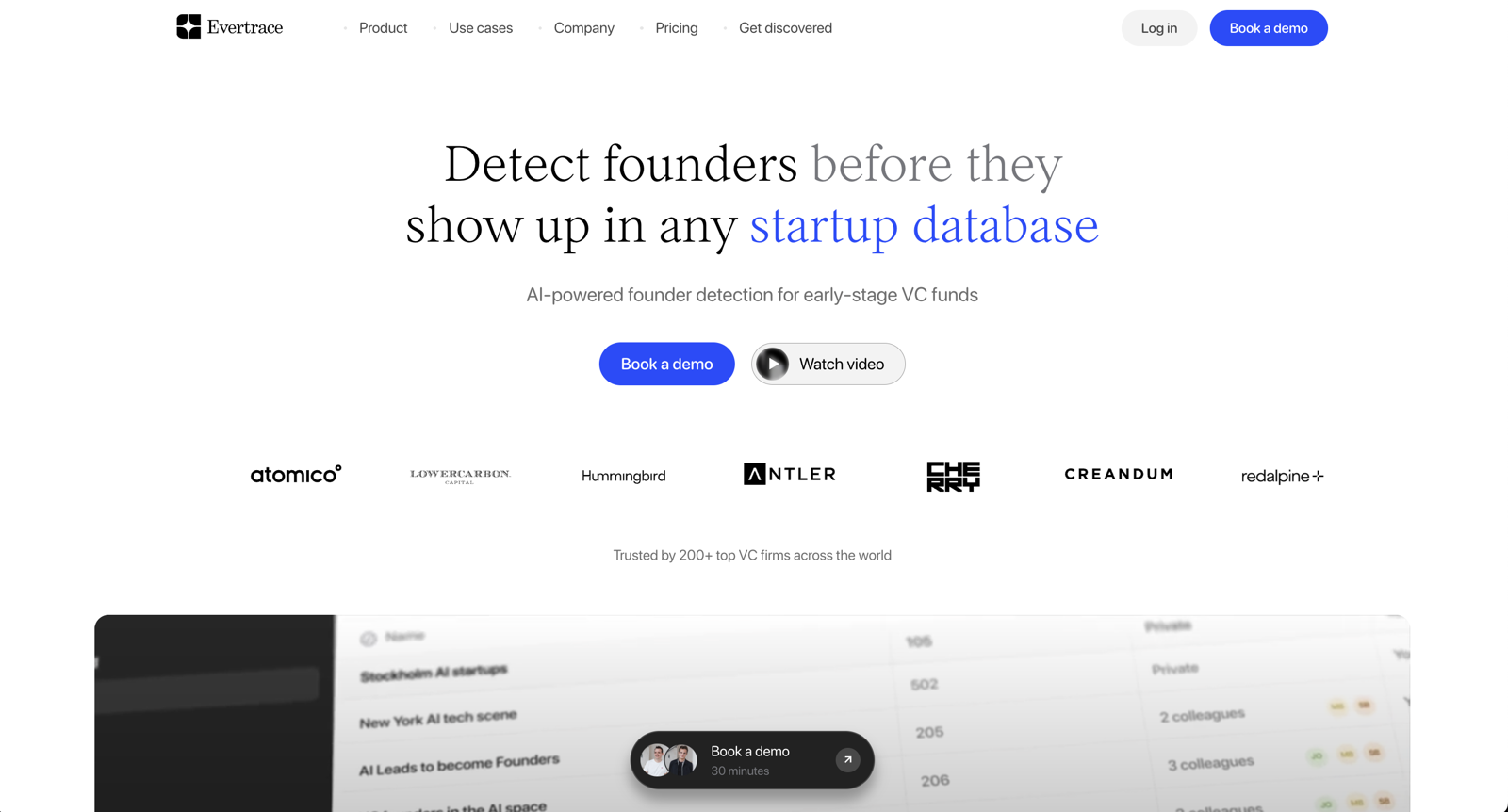
Evertrace is the most dedicated expert. Harmonic and Specter also monitor founder movements and early company formation. Signals include registration information, employment changes, technical activities, research, funding, and domain names.
Investors are concerned about intelligence
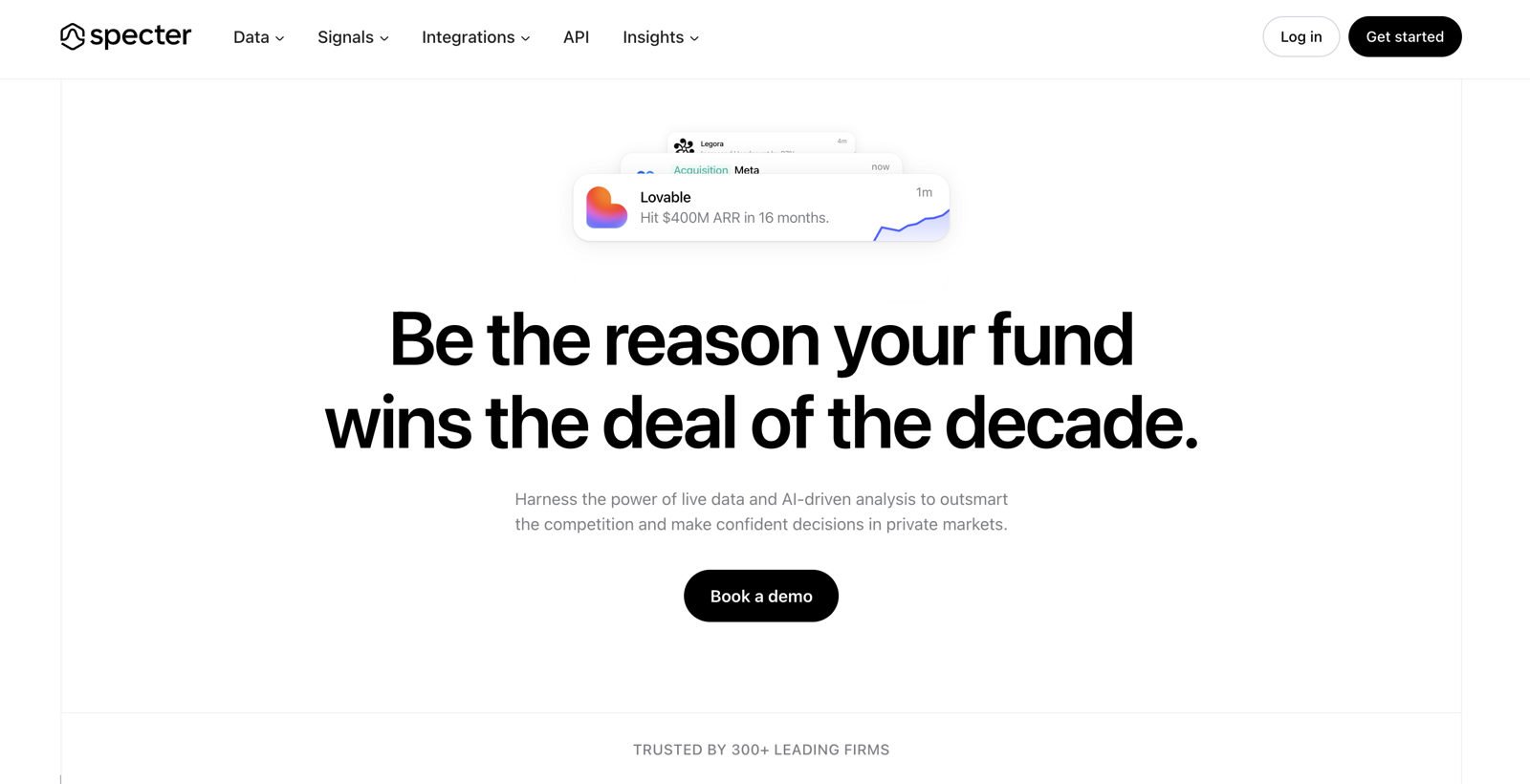
Frontrun monitors changes in the chart of selected investors on X. Specter incorporates investor interests into a broader data set. These products view relevant investor behavior as a sign that the entity is worthy of attention, rather than proof of the company's quality.
Ongoing company intelligence
Harmonic and Specter maintain continuously updated company and people maps. Dealroom, Tracxn, Crunchbase, and CB Insights are moving in the same direction through alerts, growth metrics, predictive scoring, and AI research. The difference from traditional databases is increasingly the refresh rate and data structure rather than clear category boundaries.
Private market data infrastructure
Crustdata, People Data Labs, Coresignal, and Aviato provide API, batch data sets, and agent-ready access. They serve companies that build their own project acquisition systems. Grata and SourceScrub provide similar programmatic access, with a greater focus on private equity and mergers and acquisitions. The trade-off is control versus complexity: the buyer gains flexibility, but is responsible for entity analysis, scoring, and workflow design.
Relationship intelligence
Affinity and 4Degrees utilize authorized communication records and institutional history. Attio provides a more flexible AI-native CRM with APIs and MCP, but requires more configuration for venture capital workflows. This tier is particularly defensive because competitors can't buy other funds' conference history, notes, or referral paths.
A mature private equity market platform
PitchBook is still a large-scale recording system. Dealroom is strong in the startup ecosystem and regional cooperation. Tracxn is strong in global classification systems and structured company research. Crunchbase is a strong contributor and user network. CB Insights is strong in market research and forecast scoring.
These layers run more and more like an architecture:
External Data Flow + Fund CRM, Email, Calendar, and Notes + Entity Map + Signal Model + LLM or Agent + Human Investment Workflow
Much of this tech stack can already be assembled. The harder problem is less visible: match the same person or company across sources, preserve accurate historical timestamps, and get reliable results labels. It is also necessary to maintain access to the underlying data and establish investment processes that actually act on signals.
Interfaces are becoming easier to build. The quality of the underlying data and connections remains a constraint.
4. Founder Testing: Find Your Company Before It Exists
Founder testing pushes venture capital acquisition projects to the earliest point: before the company is fully formed or publicly visible.
Evertrace was founded in 2024 in Copenhagen and is one of the quintessential experts in this category. The company says more than 200 VC funds use its platform to monitor signals. Signals include business registration, GitHub activity, patents, research, grants, domain names, app stores, product hunts, and social platforms. [5] It raised at least $600,000 in a publicly reported 2025 funding round. [13]
Value comes from combining weak signals rather than relying on any single event. A senior researcher may leave the company, register a new entity with a former colleague, create a technical organization, and register a domain name. These actions alone are not decisive. Taken together, they can be a reason for further attention.
This approach is particularly applicable in deep tech, AI, and university-related investments. Research outputs and technical activities often appear long before commercial developments occur.
Its limitations are structural. Registration data coverage varies from country to country, and most professional titles are self-reported. Domain names or company records may be delayed, obscured, or reused. GitHub is rich in information in the open source and developer-led marketplace. But in biotechnology, industrial manufacturing, or many corporate services, it has a much lesser effect.
There are also modelling risks. Systems trained on historical venture capital results may overly prefer familiar models, including well-known employers, universities, and established startup centers. A model that relies too much on the founder's prototype may replicate biases investors want to get rid of.
As a result, the founders found it best to be used as a ranking system rather than a prediction engine. The key question is not whether the software can identify every future company, but whether it can continuously screen out a controlled number of high-quality leads earlier than existing channels.
Useful metrics include weekly lead accuracy, geographic and industry coverage, and time of first investor review. Also included is the percentage that translates into high-quality founder conversations. Current public evidence reflects adoption rates and workflow effectiveness more than proven return on investment.
There is also a practical limitation in Extreme Early Days. Founders of companies that have not been disclosed may not respond well to automatic touch based on inferred intent. A better use is usually to first identify the relevant signals and then approach them through a trusted relationship or clear reason.
As a result, the founders found relational intelligence more complementary than competitive. One decides who to focus on, and the other determines if and how the fund will reach them.
5. Investor attention as alternative data
Investors' attention provided another early sign. The premise is simple: investors can disclose information through observable behavior before the financing is disclosed. Following a founder, connecting with a new company, or multiple industry experts gathering on the same account can mean something is happening behind the scenes.
A single focus says nothing. Relevant investors are more informed if they focus on acting in the short term, especially when they have expertise in the company's industry.
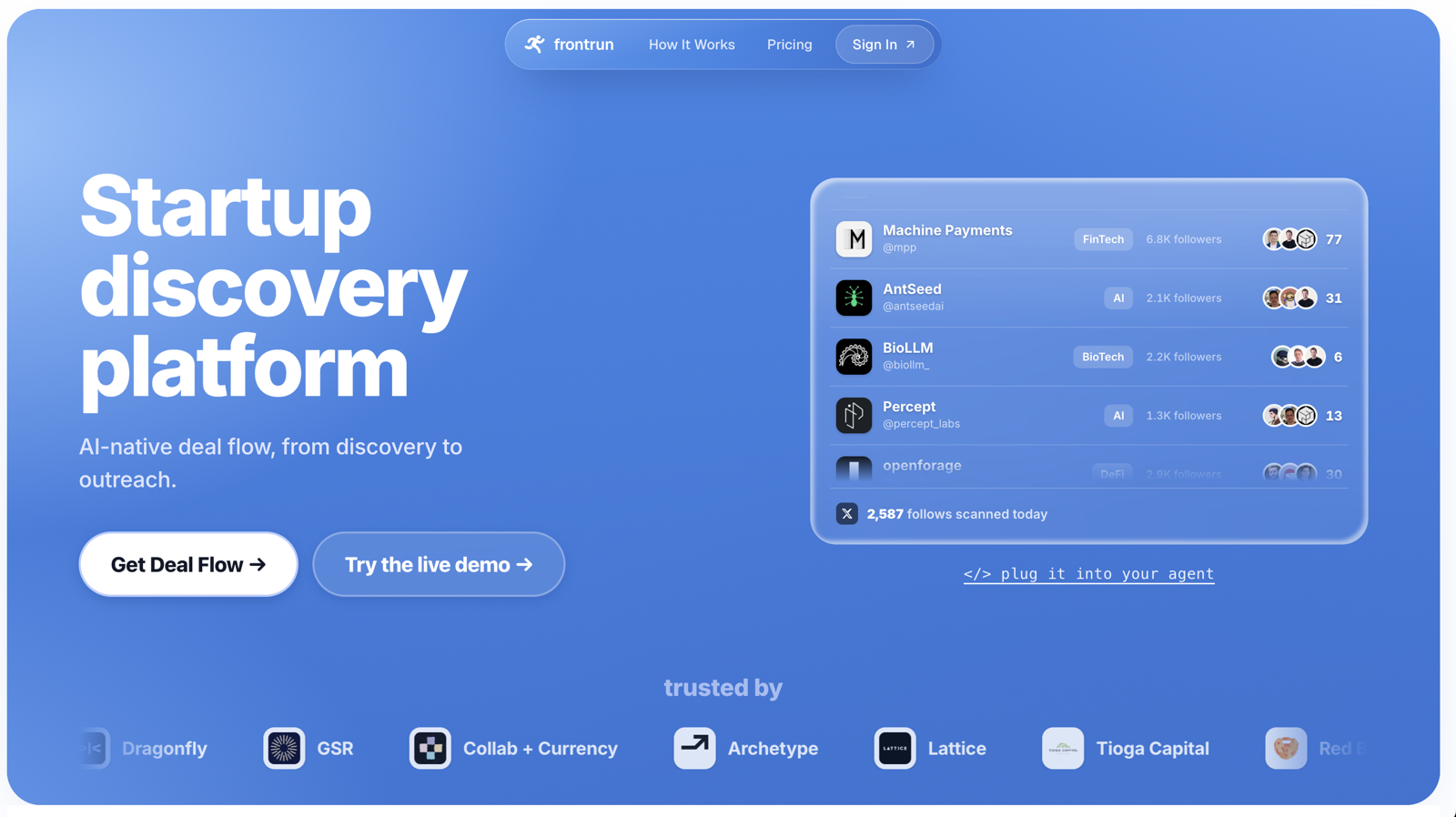
Frontrun is the most clearly defined professional product around this idea. The product says it tracks the attention graph of more than 2,000 venture capitalists on X. It identifies the focus of attention around small or unpublished accounts, then analyzes founders and categorizes companies. The Starter plan is $49 per month to track 100 accounts; the $99 Pro plan covers 250 and increases API and MCP access. [14] This makes it more like a professional signal source than an institutional-grade private market database.
The company also continues to publish records of startups it claims to have identified prior to funding announcements. In July 2026, Frontrun reported 46 rounds of such funding, an average of 83 days in advance, and subsequent funding totaling $2.36 billion. [15] Examples include Orthogonal, which was flagged 213 days before the $4.3 million funding round. Ornn was flagged 162 days before the $33 million funding round led by a16z. naturalpay was flagged 159 days before the $30 million A round led by Forerunner.
This difference is important. Public records show that investors' attention signals may have predated public financing announcements. But it didn't disclose all the companies that the system marked. There is no public denominator indicating how many signals have not been followed, how many corporate investors have long known, or are unrelated to a certain fund.
Without this denominator, the data can't prove predictive accuracy or investment alpha. It shows lead time rather than whether funds using this signal can continue to make better investments.
The quality of the observers themselves is also important. A security investor who focuses on early-stage security companies is more informative than a generalist doing the same thing. Two independent experts are probably more useful than ten investors from the same social circle. Therefore, an effective attention model requires weighted industry expertise, independence, and timing, not just statistical attention numbers.
This signal is also a platform risk. Frontrun relies heavily on X, and X's API access and pricing may change, especially in commercial scenarios. [17] [18] The act of concern itself may also be repulsive. If investors know their concerns are being monitored, they may delay, hide, or delegate the act. A widely watched signal may no longer be effective.
Therefore, investor attention is more appropriate to be viewed as a layer of prioritization rather than an independent measure of a company's quality. Its value is even greater when combined with founder changes, recruitment, company activity, and the fund's own relationship data.
The lasting advantage comes from identifying the right observers, maintaining a long time-stamped history, and proving that attention signals can provide incremental information that exceeds simpler metrics such as recruitment growth, accelerator engagement, or general social popularity.
6. Continuously updated private company intelligence
The bigger change in venture capital data is likely to be a continuous portrayal rather than predicting the company before it is established. Instead of maintaining regularly updated company files, the new platform tracks how teams, products, networks, and business signals change over time.
Harmonic says it tracks more than 35 million companies and 195 million people, from registration to scale up. It combines corporate portraits, team data, historical changes, and an online background. [3] Its platform connects external company data to LinkedIn contacts, emails, calendars, and CRM events. It now also includes the AI research agent Scout, which also provides API, batch data, and MCP access. Harmonic has raised $30 million and says hundreds of venture capital teams are using the product. [19]
Specter takes a similar approach on the broader spectrum. The company reports covering more than 50 million companies, 500 million people, and 300,000 investors. Signals cover deals, talent, revenue, news, and investor interest. [4] It provides API, batch data, and MCP access, and integrates with Affinity, Attio, and Salesforce, and says more than 300 investment institutions use the platform.
Both are better understood as a continuously updated knowledge map rather than a database of startup company files. This difference is important. Traditional searches may identify European infrastructure companies. The real-time map can go on to ask: Which of these companies added two senior compiler engineers last quarter, increased open source activity, and have yet to enter the fund's project pipeline.
This requires more than just gathering large amounts of data. Entity analysis is one of the core technical problems. A company might have a legal entity, business name, domain name, GitHub organization, and X account. The same founder may also hold multiple overlapping positions. Funding events may occur on different dates, currencies, and company names. An erroneous correlation may turn multiple accurate observations into one wrong conclusion. And the AI interface might make this mistake seem more convincing.
Mature private equity platforms are also shifting to the same model. Dealroom now combines company data with signals, alarms, AI research, and MCP access. The premium plan starts at $14,500 per year, and the MCP tier is $20,000. [20] Crunchbase said it updates 15 million forecast signals every week and said it can predict 84% of financing events, but the published figures did not show a corresponding false positive rate. [11] CB Insights has long included predictive scoring through Mosaic.
Synaptic is in a similar but late-stage position in the tech stack. The platform was initially developed within Vy Capital and combines alternative signals such as recruitment speed, internet popularity, product reviews, and company-level data to identify private companies that are gaining momentum. It focuses less on findings at the time the company was founded, and more on measuring acceleration once the company has a visible operating footprint, and is therefore particularly suitable for growth, cross-cutting, and portfolio monitoring workflows.
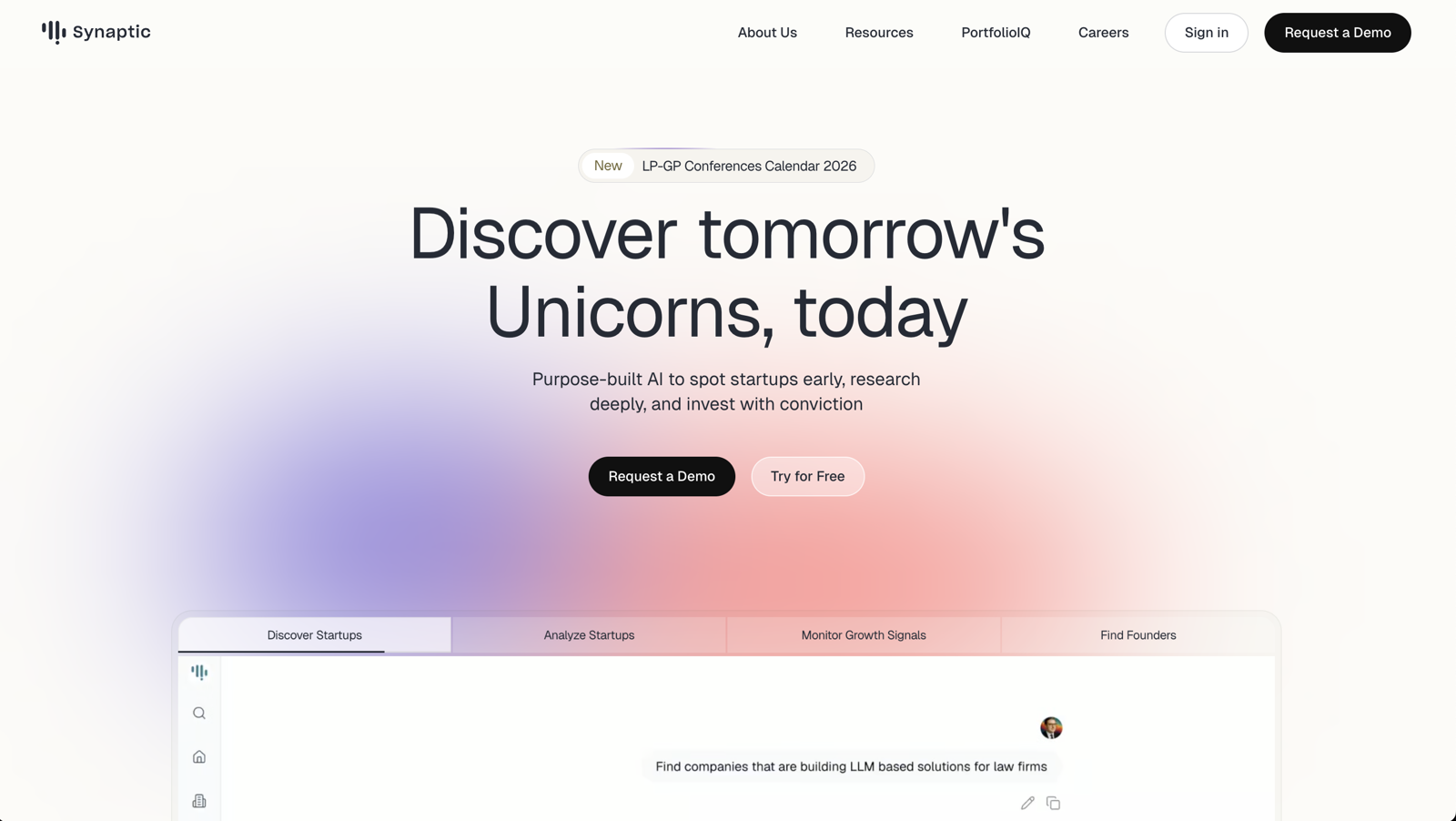
As a result, the line between static databases and continuous intelligence is being narrowed. Originally a differentiating feature of the new platform, it is becoming a standard feature for private equity market data.
The question of competition is shifting from who has the largest database of companies to who can maintain the cleanest historical records of how companies, people, and networks change over time.
Twitter:https://twitter.com/BitpushNewsCN
Compare the TG exchange group:https://t.me/BitPushCommunity
Compare TG subscriptions:https://t.me/bitpush
