


Demystifying the driving force behind the DeFi craze: Framework Ventures

Cryptocurrency venture capital agency just established in 2019Framework Ventures(hereinafter referred to as Framework) has not been in the market for a long time, but it is worth everyone's careful attention. Currently popularDeFiIn the (Decentralized Finance, Decentralized Finance) investment wave, this one is “”Native venture capital in the crypto sectorAnd proud up-and-coming institutions are probably the biggest profiteers and the most important “driving force behind the scenes.”
If you don't believe me, I'll tell you some truth:
According to blockchain media Decrypt, Framework is a synthetic asset issuance platformSynthetixThe native token of SNXMaximum holder, it may also be a decentralized oracle providerChainlinkThe largest holder of the native token LINK (if you don't count the Chainlink team's own holdings) — you know, Synthetix and ChainLink are among the hottest and most impressive in the current DeFi boom”Double brakes”;
Frameworks are always overshadowed by DeFi projects that make people's hearts flush. They recently invested in decentralized trading platformsFutureswap, led the investment in a decentralized lending projectTellerThey also bought decentralized lending projects on the cuspAaveThe token.
For all of the above Frameworks participate in investment projects, the Framework isActively interveneIt also affects the direction of development of projects, and in particular helps these projects design exciting new token economy models — inLiquidity miningAfter detonating the DeFi ecosystem, this is a powerful skill that this investment institution has received a lot of attention from the small circle of people in this DeFi boom. Framework boosts cross-chain stablecoin projectsKAVAImprovements in the governance and economic model; in addition, information obtained by Chainwen shows that with the help and guidance of the Framework, Dang Heng Lending Project Aave is also redesigning the token economy model, and the new model will be introducedLiquidity mining和 Staking rewardsWait for a new way to motivate.
The two founders of Framework have repeatedly stated,Blockchain technology和Decentralized networksIt represents the next major paradigm of computing technology. They saw that the blockchain industry is fundamentally different from the traditional Internet industry in how value is created and captured, and that crypto assets are “different from the unique existence of all asset types in the past, so the current evaluation model is not suitable for crypto assets, and the crypto world needsA new investment concept and investment service framework”.
As a result, they have emerged as a new kind of leader in the blockchain venture capital industry. They are breaking the traditional investment service model and trying to build a new investment service framework in the crypto field. In this framework, they have redefined the role of crypto venture capital: not a bystander, butconstructorsIt's the entire open blockchain networkImmersive participants。
So what kind of innovation did this up-and-coming venture capital institution bring to the crypto worldInvestment philosophy and investment service framework, what kind of things have been built so farportfoliosAlso, how do you “immersively” serve these blockchain startups?
Who is Framework: both an investment company and a development company
According to Framework itself, this is a company founded inJuly 2019The venture capital fund, a team of technical experts, researchers, and investors, is committed to investing in open crypto networks (open crypto networks) and helping to build their products and services. The team's main areas of focus includeDecentralized finance(DeFi),Web 3.0, token-basedgamingAs well as decentralized media.
There are two founders of Framework:Michael Anderson 和 Vance SpencerThey all have rich experience in investment banking consulting, strategy management and product development.

Vance Spencer (left) and Michael Anderson (right), Source: Forbes
Michael Anderson graduated fromYaleMajoring in computer science, he first worked as an investment bank analyst at Barclays Capital (Barclays Capital), then worked as a product manager at two star Silicon Valley tech companies, Dropbox and Snapchat. He has nearly 5 years of experience as an internet product manager.
Vance Spencer graduated from the USUniversity of Southern CaliforniaMajoring in economics and econometrics, he initially worked at Monitor Deloitte (Deloitte) as a corporate management consultant for two years, then went to the Netflix streaming platform to take charge of corporate strategy matters, and helped the company expand its business in Japan.
Prior to founding Framework, in 2018, Spencer and Anderson also co-founded a company calledHashletesgame company. The gaming company can trade blockchain-based Major League Football (NFL) player cards, was supported by venture capital firm Khosla Ventures, and was eventually acquired by JDS Sports (a sports company).
Of course, these two founders have long since begun their exploratory journey into the crypto world. According to Spencer, the two have been investing in the crypto sector since 2013, so they have rich experience and their own experience in evaluating, valuing, and executing transactions. The duo participated in the Oracle project in the early stagesChainlinkToken fundraising.
About a year ago, Anderson and Spencer created the Framework, and the initial start-up fund was about$20 million。
As for the original purpose of starting a business, Anderson and Spencer believe that just as the internet democratizes content and information, blockchain willDemocratize value and trustAs blockchain technology continues to mature, they believe they will see explosive growth in innovative products and new business models in the fields of finance, marketing, insurance, gaming, media, and entertainment, and hope to seize investment opportunities in these fields.
They believe that blockchain-based cryptographic digital assets are unique and different from all previous capital asset classes. Therefore, the traditional evaluation model is not suitable for crypto assets, and the needs of networks and companies in this emerging industryA new model of support and growthThis is exactly the original purpose of creating the Framework, and it is also where the Framework is used.
On the Framework's official website, the first thing that catches your eye is a catchy slogan:
“The global transition to decentralized technology requires a new framework (Framework).
The Global Transition to Decentralized Technology requires a New Framework.”
At the beginning of the fund, the two founders, Anderson and Spencer, wrote an article introducing the Framework:
“At the core of the Framework is atechnology company, throughEstablishing products and servicesto support an open blockchain network. To achieve this goal, Framework combines its own investment strategy with technical experts and research teams to bring together multiple forces to find, support, and build the best blockchain networks and companies.”
This means that, specifically in terms of investment and operation, the Framework will be aA complex of investment companies and development companies—— An entity that is different from existing investment companies and technology companies in the market.
Introduction to investment strategies: “builders” rather than “bystanders”
Determined to enter the crypto field, Anderson and Spencer naturally thought and analyzed this field a lot. In their opinion,Blockchain industry and Internet 1.0/2.0 industryAlthough there are many similarities between them, there are also many fundamental differences. The two analyzed these differences in detail on the Framework's official website, and the links were compiled into a table as follows:
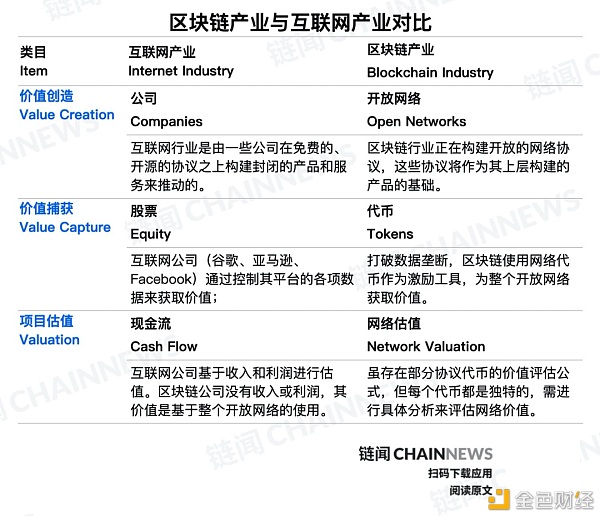
They believe it is these subtle differences that determine how this emerging industry creates value, who will capture that value, and what is the best strategy for constructing or investing in this field.
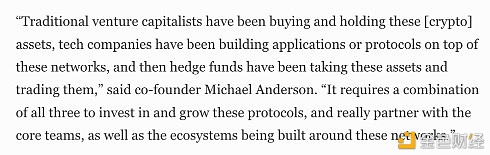
In an interview with Forbes in March of this year, Anderson gave a good summary of what he sees as the “best investment strategy” in the crypto space:
“Traditionalventure capitalistshave been buying and holding these “crypto” assets,technology companyhave been building applications or protocols on these open networks,hedge fundThese assets are being acquired and traded all the time. The crypto sector, on the other hand, requires a combination of the above three to invest in and develop these agreements, and to actually cooperate with the core team and the ecosystem built around these networks.”
In the process of investing in blockchain enterprises over the past year, Framework will not only buy a certain percentage of network tokens, but also personally participate in the initial network verification, token pledging, liquidity construction, community governance, etc. of various blockchain networksEcological construction activitiesAmong them, we work with the community to develop related tools and services.
Unlike traditional investment models, Framework combines multiple actors in this process. Not only does it buy tokens as investors to inject capital, but it also takes the lead in becoming the most active blockchain network it invests inMaintainers and users, immersively experience the network's services, and help build ecological applications and tools as a developer.
In other words, in addition to capital, they are actually promoting the growth of the entire network with more practical actions. And this kind of investor is deeply involved in the ecosystemInteractive investment service modelIt is a unique challenge and a unique opportunity to invest in the blockchain industry.
Framework's portfolio: favoring DeFi
According to disclosed public information, at the time of press release, the Framework had invested~10 crypto projectsThe vast majority of these are DeFi projects that have continued to increase in popularity recently.

Some examples of Framework Ventures' investment in the cryptocurrency sector
Analyzing Framework's current portfolio, you'll find that unlike traditional internet investment models, most of the investments in these crypto projects are funded in the form of purchasing the project's native tokens. Furthermore, Framework choseMostly in the DeFi sectorproject.
According to the two founders of Framework, they areChainlinkAngel investors participated in its token fundraising in 2017 and became one of the largest holders of LINK tokens. In later portfolios, Framework also continued to promote new DeFi projects, and successively invested in synthetic asset issuance platformsSynthetix, decentralized exchange Futureswap, and decentralized lending protocols Teller and Aave, etc.
In addition to this, Framework also has a small number of cross-chain ecosystems. The two most popular cross-chain project ecosystems are involved, such as investing in the Cosmos ecosystem's cross-chain DeFi mortgage lending platformKava, the development team of Boca Ecosystem PoS blockchain project EdgewareCommonwealth LabsIt has also received investment from Framework.
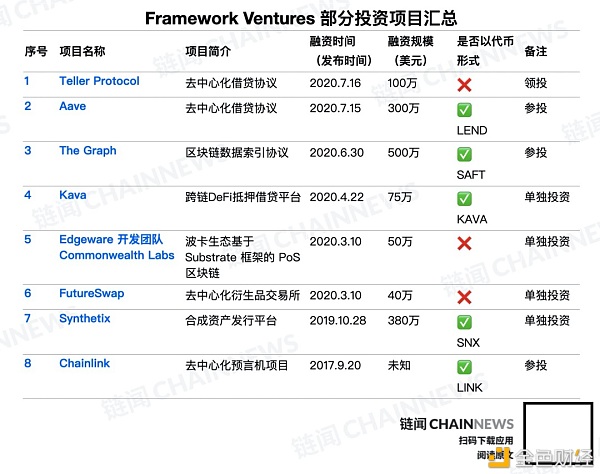
Framework Ventures' partial investment summary
In numerous interviews and public conversations, both the founders Anderson and Spencer have made no secret of their views on the future of DeFiDetermination and preference。
In an interview with The Defiant in June of this year, Anderson said that after studying the blockchain ecosystem, they think Web 3.0 might be needed5-10 years, it was even 15 years before products like Twitter and decentralized Facebook were implemented, butUniswap 和 CompoundSuch projects have proven to the market that DeFi can now provide value. He saw that within the DeFi vertical, innovators have challenged traditional financial services based on blockchain technology.
Of course, they are also well aware of the challenges and dilemmas that currently exist in the actual development of DeFi.
In another media interview, Anderson once said: Looking at it now, DeFi is still a slow and inefficient financial processing method, but as time goes by,value curveIt will move and replace traditional financial institutions such as banks in some ways. Among these,BorrowingIt's going to be the core theme.
However, he also emphasized that to build a mature DeFi industry, “multiple players are needed, includingInsurers、Credit infrastructure side, and those that provide the ability to borrowhedge fundThese will take time to achieve”. Until now, identity, credit scores, and all credit data required for bank loans have not been tied to the blockchain.
However, they are still strongly optimistic about this field. Anderson believes that “blockchain is about value transfer, and value transfer is carried out in a decentralized network. DeFi has a real chance to become the blockchain industry in 2020Fastest growingfield”.
According to Anderson, in the future, the Framework will focus on investing in derivatives and loan projects.stablecoins(Stablecoins) is also a focus of attention because they think stablecoin projects are ideal as infrastructure for building consumer apps.
How to interact with the projects you are investing in?
Maybe simple investment theory still doesn't allow you to intuitively understand the new investment logic that Framework has brought to cryptography. You might as well learn how it works with the blockchain projects invested in through Framework's investment service cases over the past year.”Deep interaction” Of.
After analyzing multiple cases, Chainwen concluded that in the process of supporting blockchain projects within its portfolio, Framework mainly participated deeply or paid the most attention to the following modules:
Buy tokens to invest
Mainly through this method, capital is injected into the blockchain network and the distribution of this token is promoted. Framework not only participated in first-level investments in the early stages of the project's establishment, when tokens had not yet been issued, but also dared to boldly invest in token projects after the tokens had already been traded in the secondary market — they were interested in last yearSynthetixThis is the case with this year's investments in KAVA and Aave.
Assist in building a token economy model
The token economy model has been emphasized many times by the two founders, Anderson and Spencer. They believe that the biggest shortcoming in the current DeFi field is that many projects lack a sound token economy model and governance model. They believe that if decentralized finance (DeFi) wants to replace centralized finance, it is necessary to establish a stable token economy model and one that can replace centralized exchanges or major lending platforms such as BitMEX and BinanceGovernance models。
Promote the improvement of network mobility
The supply of liquidity is critical to many DeFi projects, especially the early development of the project. The Framework will invest a certain amount of tokens (used for collateral or borrowing) to help build liquidity on each DeFi protocol network.
Community Proposals and Network Governance
New blockchain networks often have many flaws. The Framework will initiate community proposals and suggestions for improvement in response to the problems discovered, and at the same time, as token holders, they will participate in network governance through token staking and voting.
Partnering with the community to build ecological products and new features
Finally, the Framework will use its technical strength to cooperate with the community of the invested blockchain project to build new functions for top-level applications or new products to promote the growth of the ecosystem.
Case study
Let's take a look at a few examples of Framework's investment services in detail.
Case 1: Synthetic asset platform Synthetix
Synthetix is an Ethereum-based synthetic asset issuance platform. Anyone can join the network and provide collateral to support the issuance of synthetic assets such as gold, Bitcoin, and US dollars on Ethereum.

Framework is considered one of the earliest investment institutions to support Synthetix. On October 29, 2019, Synthetix announced on its official blog that it had been purchased from the Synthetix Foundation5 million SynthsThe (SNX) token supports the development of Synthetix and has become one of the few SNX “large coin holders”, worth $3.8 million based on the current price of $0.76 per coin. And most of these tokens are setUp to 24 monthsThe escrow period indicates that Framework intends to invest in Synthetix in the long term.
Synthetix emphasized that the Framework has been contributing to the Synthetix system, increasing supply for the entire system by staking SNX, and at the same timeParticipate in community governanceprocess. Additionally, the Framework team helped Synthetix set a long-term vision for the project, resolve short-term project issues, and promote Synthetix's connections with some influential blockchain individuals and teams.
Framework co-founder Anderson said the investment in Synthetix was due to Synthetix's”Limitless liquidityThe “(infinite liquidity)” model has a huge advantage over its competitors.
According to Anderson,”synthetic assets(Synthetix assets) is a primitive financial instrument that can achieve inclusiveness and innovation outside of traditional financial markets, and is likely to represent the next stop in DeFi. Protocol liquidity can be viewed as a barometer of the success of the Web 3.0 network, and Synthetix's model is superior to other synthetic asset platforms. Superior liquidity, extensive asset licensing, and good governance will make Synthetix successful”.
In November 2019, the Framework's official website published Synthetix's investment analysis report. In the report, Framework says it wants to “build Synthetix intoDecentralized BitMEX”.
Framework believes that native investors in the crypto sector cannot just be bystanders; most venture capital firms are subject to existing limited partnership agreements (LP agreements), huge asset management scales (AUM), and traditionalBound by equity investment mentality。
However, the investment style that Framework adheres to is that venture capital can be made in tokens or shares, and the focus is on active participation to drive the blockchain network forward. For the Synthetix project, they made the following investment commitments:
Invest money to help build SNX trading pairsmobility;
Actively staking SNX helps build a collateral pool;
Writing SynthetixProposals for improvements(SIPS) to facilitate the resolution of problems found in this network;
Build related products based on the Synthetix network;
Most importantly, it helps the core team at Synthetix.
On July 23 of this year, Synthetix published the latest list of investment institutions on its official blog and announced that venture capital firms or institutional partners such as Framework Ventures, ParaFi Capital, Three Arrows, IOSG, DTC Capital, and Hashed will become institutional partners and liquidity providers for the Synthetix network. According to Synthetix, these institutions have now invested in totalOver $4 million。
Additionally, according to Synthetix, the Framework's share of the Synthetix network has continued to grow over the past few months, while the Framework helped drive the release of SNX.tools and helped guide other community-based proposals such as margin trading.
Case 2: Decentralized Lending Protocol Aave
Aave Protocol is an Ethereum-based decentralized lending protocol. On July 15 of this year, Aave announced on its official blog that it has raised $3 million by selling tokens, a venture capital firmFrameworksand cryptocurrency hedge fundsThree Arrows CapitalParticipating in the investment, the two institutions purchased Aave's native Aave token Lend worth $3 million (that is, 30 million tokens were purchased) at a price of 0.1 US dollars each. At current prices, these tokens are currently worthOver $9 million。

Additionally, Aave also announced that both the Framework and Three Arrows are planning to work directly with the Aave Protocol to guide and participate in its decentralization process. Stani Kulechov, founder and CEO of Aave, said that the participation of these two venture capital firms would go a long way in expanding the institutional use of the Aave agreement.
According to the Aave team, Framework and Three Arrows will be deeply involved in the ecosystem construction of the four modules of the Aave agreement:
New token economy model(New Token Economics)
The first is to build a new token economy model. Both investment institutions have provided many feedback suggestions on Aave's new token economy model, from LEND toAAVEAfter the migration, mechanisms such as token staking, liquidity supply rewards, and new smart contracts are all parts that need to be considered in the new token economy model.
Chain News: Aave previously confirmed to Chainwen that it will launch a new token, AAVE, to replace the currently issued token LEND through token swaps. The economic model designed for the new token AAVE will include mechanisms for liquidity rewards and token staking rewards.
Aave protocol governance
Both investment institutions will actively participate in the governance of the Aave agreement, which mainly includes submission of agreements, risks, and specific market policiesAave improvement proposals(AiPs, Aave Improvement Proposals) and vote.
Market access and depth(Market Access & Depth)
Both investment institutions plan to change existing OTC borrow/lend (OTC borrow/lend) activities to help boost the growth of assets on the Aave platform, while also helping to increase liquidity and market depth, and facilitate the entry of large institutional participants.
Additionally, they are planning to introduceCredit Entrustment(Credit Accumulation) The new service, which allows Aave depositors to entrust their credit lines so users can borrow without collateral, is an innovative DeFi component that will expand Aave's influence on traditional financial markets.
Insurance funds(Insurance Fund)
The two investment institutions will also participate in the pledge of Aave's insurance fund, which is also part of the new token economy model and can provide a backup support mechanism in the event of any problems with the Aave agreement.
Case 3: Kava cross-chain DeFi collateral lending platform
Kava is based onCosmosA cross-chain DeFi collateralized lending platform.
On April 22 of this year, Framework announced that it had purchased 1% to 5% of its native tokens to KavaFunding of 750,000 US dollars. Prior to that, Framework had provided many suggestions for improving Kava's monetary policy, and Framework co-founder Anderson said he plans to provide ongoing technical support to the Kava team.
On March 17 of this year, Framework posted an article on its official blog explaining the details of its push to improve Kava's monetary policy.
The article points out that Framework and Kava will work together to improve Kava'smonetary policyto drive user growth. To overcome the initial liquidity problem of Kava's stablecoin USDX, the two sides plan to launch an incentive mechanism to generate more than $10 million in USDX through more than $30 million in collateral assets. Specific methods include:
Modifying the KAVA tokeninflation rate curveto generate additional KAVA for growth incentives;
Token holders in the Kava protocol will receive incentives, and the amount of incentives depends on the amount and time they generate USDX;
To avoid a significant increase in initial market supply, additional KAVA generated for incentives will be locked in for 52 weeks before circulation.
According to the plan, Kava's first yearIncentive inflation rate of about 15%The staking inflation rate is 4.75%, then it will gradually decrease, and drop to 2.5% and 3% by the fourth year.
Since then, on March 17, the Framework initiated a vote on the Kava monetary policy improvement proposal in the Kava community, recommending the establishment of an incentive mechanism through token inflation to promote the initial flow and growth of the Kava stablecoin USDX on the network. The proposal was approved by the Kava community on April 8, and it was agreed that 48 million KAVA (worth $25 million) would be weighted by the vote. Kava officials stated that the proposal would be implemented in future network upgrades.
other
In addition to Synthetix, Aave, and Kava mentioned above, Framework is also actively participating in the ecosystem construction of other portfolio projects.
According to The Block, in March of this year, Framework moved to decentralized futures exchangesFutureswapInvested $400,000 in the Boca Ecology ProjectEdgewareCommonwealth Labs's development team invested $500,000 and locked 20,000 ETH in Edgeware to help facilitate network distribution.
Additionally, Framework founder Anderson revealed that they helped Futureswap build a token economy system and plan to provide million-level liquidity to the Futureswap network after the project is launched.
The Commonwealth Labs team also received corresponding support, and Framework was involved in running the Edgeware networkFirst batch of verification nodes(validator nodes) while participating in the election council (similar to DAO seats). Furthermore, the Framework also helped the Commonwealth Labs team clarify some strategic decisions, such as determining which applications should be sought in the future. The Framework also intends to build some products and new features based on the Edgeware blockchain.
Summarize
Blockchain technology is seeking new breakthroughs, the DeFi market is seeking new growth, and crypto investment institutions are also trying to find something suitable for this new fieldInvestment logic and service framework。
As an up-and-coming investment institution on the crypto circuit, Framework has its own unique understanding of the crypto field and brought a new set of investment service concepts. From its investment service journey over the past year, we have seen that it is trying to use the agency's resources and strengthHelping these startups grow, and tried to do it in a way unique to the field of cryptographyPost-investment services。
We don't know if this is the best investment strategy and service framework for the crypto sector, but we believe that more and more institutional investors will personally participate in the ecosystem construction and community building of decentralized networks, which will inject new strength into the crypto world and the DeFi sector.
Author: Yin Yaoping
Source: ChainNews
