估值 · 7897

The global bond market is currently selling off, and the scale of panda bond issuance has reached a record high

Comparative news. According to CCTV financial reports, the yield on long-term treasury bonds of the world's major economies has continued to rise recently, and the sell-off pressure on the bond market is heating up. However, the Chinese bond market and exchange rate have maintained a relatively smooth operation, and the scale of panda bond issuance has reached a record high for the same period in history. According to the data, as of August 21, the cumulative issuance scale of panda bonds in 2026 reached 209.975 billion yuan, an increase of over 73% over the previous year. Against the backdrop of drastic fluctuations in global bond markets, international institutions are increasing domestic RMB financing, drawing attention. According to industry insiders, we are in a completely different economic and monetary cycle than overseas. Foreign capital accounts for only about 5%-8% of China's bond market, and domestic capital has absolute pricing power. Combined with our monetary policy, we insist that I am the main focus, and overseas shocks cannot reverse the overall trend of the domestic bond market. Looking ahead to the future market, industry insiders believe that the yield on overseas bonds is likely to remain high, the allocation value of RMB bonds is prominent, and the medium to long term may welcome a continuous increase in foreign capital allocation. However, it is also important to note that higher yields on US bonds have raised the return threshold for global allocated funds, and may disrupt the will of overseas institutions to increase their holdings of RMB bonds. Furthermore, the rapid rise in bond yields in overseas developed countries may also limit domestic risk asset valuations.

1m ago

Anthropic's valuation targets $2 trillion, funding may exceed $100 billion

Comparing the news, according to the “New York Times”, two people familiar with the matter revealed that Anthropic recently stated during discussions with potential investors that the San Francisco-based company may seek to raise more than 100 billion US dollars in an initial public offering. According to people familiar with the matter, the offering could also raise the company's valuation to $2 trillion. If successful, Anthropic, which is only five years old, will set the record for the largest public offering in history, surpassing the record set by Musk's SpaceX in June this year — the latter was valued at $1.77 trillion when it went public and raised $85.7 billion. It would also be a major leap forward for Anthropic. The company reached a valuation of $900 billion in a private funding round this year and submitted a listing application in June.

12h ago
[Comparative Daily News Picks] Anthropic plans to include anti-AI sentiment as the main risk factor in the prospectus; Strategy's stock price hit a two-month high, and STRC returned above $96; Bernstein: Even if the “Clarity Act” is not passed, the SEC and CFTC will speed up rule-making; Dalio: The US debt crisis may break out within three years, and it is recommended to increase gold holdings

[Comparative Daily News Picks] Anthropic plans to include anti-AI sentiment as the main risk factor in the prospectus; Strategy's stock price hit a two-month high, and STRC returned above $96; Bernstein: Even if the “Clarity Act” is not passed, the SEC and CFTC will speed up rule-making; Dalio: The US debt crisis may break out within three years, and it is recommended to increase gold holdings

Daily AI · Crypto · Macro · Market Highlights, Bitpush helps you set priorities ↓ AI · News [Anthropic plans to include anti-AI sentiment as the main risk factor in the prospectus]. According to CNBC, Anthropic is expected to list the public's negative sentiment about artificial intelligence and data centers as a risk factor in the IPO prospectus to be released in the next few weeks. According to people familiar with the matter, Anthropic recently held a pre-listing “market trial” meeting with bankers and investors. Investors focused on competitive pressure, the impact of open source models on profit margins, and the risks that may be brought about by a slowdown in data center construction. Anthropic is currently valued at close to $1 trillion in the private equity market and is preparing to hit a major IPO. However, as Americans' concerns about AI replacing employment and data center expansion heat up, the related backlash sentiment is becoming a new challenge facing the company's listing. The company has previously achieved an annualized revenue operating rate of more than 65 billion US dollars. [Apple cuts Siri and Vision Pro team positions, and resources shift to AI and new devices] Compared to news, Apple (AAPL.O) is laying off employees from various teams responsible for Siri's digital assistants and Vision Pro headsets. The total impact of this layoff is more than 200 people. Of these, about 100 jobs in the Vision Pro department have been abolished, and about 100 other positions in the Siri and software teams have been cut. The move is part of the company's efforts to focus resources on new devices and artificial intelligence. People familiar with the matter said that in this adjustment, Apple has basically shut down a team dedicated to the Vision Pro game business, while also reducing the size of the department responsible for producing immersive video content for the device. Apple admitted in a statement that the company is making adjustments to some teams “to drive business development and provide the best experience for users.” [Castle Securities: Over 80% of the overall risk in the Situational Awareness Fund portfolio has been divested] According to the Financial Times, Castle Securities founder Ken Griffin responded to the company's acquisition of Situational Awareness assets under Leopold (Leopold) in a letter to clients on Friday. According to a letter obtained by CNBC, Griffin told clients that Castle Securities had divested more than 80% of the overall risk in the original purchased portfolio by conducting more than 100 major transactions (with a market value of more than $4 billion). In his letter, Griffin wrote, “A transaction of this scale would not have been possible without the full cooperation of the transaction teams and lead brokerage teams of the banks serving the two companies. I am very grateful for their dedicated efforts to complete the portfolio transfer quickly.” Griffin also confirmed that the company's flagship multi-strategy fund, the Wellington Fund, had a return of 5.94% in July, which is the fund's best monthly performance since 2022. [AI cloud company Nscale seeks to raise 3 billion US dollars in US IPOs] In comparison, AI cloud company Nscale is reportedly seeking to raise 3 billion US dollars in a US IPO. In the crypto market [Strategy stock price hit a two-month high, STRC returned above $96], the Bitcoin treasury company Strategy (MSTR) stock price rose to a two-month high today as the Bitcoin price briefly broke through $79,400. It broke through $120 during the intraday period, then partially regained its gains. Meanwhile, the price of STRC, Strategy's preferred stock product, also surpassed $96 for the first time since June. Previously, STRC's price once fell below $70 due to concerns about its ability to pay dividends and the ability of the stock price to maintain the $100 target for a long time. [Bernstein: Even if the Clarity Act is not passed, the SEC and CFTC will speed up rulemaking] Comparing news, the Bernstein analyst team led by Gautam Chhugani released a report stating that regardless of the procedural voting results of the “Clarity Act” on September 15, the certainty of US crypto regulation is expected to increase. They expect the SEC and CFTC to accelerate rulemaking in areas such as native crypto asset issuance, tokenized stocks, perpetual futures, computing power derivatives, and predictive markets. This regulatory clarity of expectations has become one of the broader supporting factors in the crypto market. 【A...

14h agoBitpushNews#Compare Daily Picks

The Bitcoin Ahr999 indicator has left the bottom reading zone, and the bottom reading window for this round lasts about 82 days

Comparative news, according to third-party data, as Bitcoin continues to rise in the current round, the Ahr999 bottom-down indicator has reached the fixed investment range and is now reported at 0.5073. Looking back at this round of Ahr999 bottoming signals, the window period (May 29 to August 19 this year, the indicator was below 0.45) lasted about 82 days. Note: The Ahr999 indicator helps Bitcoin fixed investment users make investment decisions based on opportunity strategies. This indicator implies the yield of short-term Bitcoin investments and the degree of deviation of the Bitcoin price from the expected valuation. For 655 days in Bitcoin's history, the Ahr999 index was below the bottom line (0.45).

20h ago

J.P. Morgan warns of the risk of a fall pullback in US stocks, the AI boom may repeat the 2000 tech bubble

Comparing news, JPMorgan (JPMorgan) warned that although the world's major stock indexes are still on an upward trend, the market may face the risk of a pullback in late summer to early fall. The bank said that recently the internal structure of the US stock market is deteriorating, capital has begun to shift to defensive assets, and investors' confidence in artificial intelligence (AI) related stocks has also weakened. Jason Hunter, a strategist at J.P. Morgan Chase, pointed out that the current AI trading boom is similar to the 1999-2000 tech stock bubble. The market's excessive concentration of positions in the technology sector may increase the risk of adjustment. Furthermore, the continued rise in US Treasury yields, geopolitical tension in the Middle East, and slowing consumer spending have also been identified by J.P. Morgan as potential sources of market pressure. J.P. Morgan believes that the current AI investment cycle still has potential for long-term growth, but market valuations, capital congestion, and investor expectations in the short term may put technology stocks at greater risk of volatility.

23h ago

Bitcoin treasury firm BSTR terminates merger plan with Cantor Equity Partners

Bitcoin treasury company BSTR Holdings announced that it has reached an agreement with Cantor Equity Partners to terminate the business merger agreement signed by the two parties on July 16, 2025. The reason for the termination is that in the current market environment, valuations of Bitcoin and listed Bitcoin treasury companies continue to be under pressure, leading to mismatches in the capital market, limiting the amplification of financing instruments such as convertible bonds and sustainable preferred stocks in the Bitcoin treasury strategy. BSTR said that once the market environment stabilizes, it will continue to promote institutional-level Bitcoin asset management services. (Businesswire) This article is sponsored by GENG, Build Your Fortune on GENG (https://geng.one)

1d agoburnking

UBS raised the S&P 500 target level, optimistic that AI and profit growth will continue to drive the bull market

Comparatively, UBS raised its target level in the S&P 500 index. It is expected that the target level in December 2026 will rise to 8100 points, and the target level will rise further to 8,400 points in June 2027, due to strong corporate profit growth and continued economic resilience. UBS expects S&P 500 earnings per share (EPS) to reach $350 in 2026 and $400 in 2027, mainly driven by performance in the technology, semiconductor and energy industries. The bank continues to be optimistic that the US economy will remain resilient, the Federal Reserve's policy will remain patient, and the application of artificial intelligence will accelerate, believing that there is still room for continuation of the current bull market. However, UBS also suggests potential risks, including factors such as rising oil prices, re-heating inflation, and falling short of expectations in AI investment, which may put pressure on market valuations and upward momentum.

1d ago
They are all stealing earlier data. Where exactly is VC Alpha hidden?

They are all stealing earlier data. Where exactly is VC Alpha hidden?

Author: insights4vc Compilation: Shenchao TechFlow Original title: Private Equity Market Intelligence Warfare Heats Up: In the AI Era, Where Did VC Alpha Come From? Guide to Deep Wave: Venture capital returns are extremely concentrated, and finding a good company in the early stages is almost the life and death line of a fund. This article breaks down the latest evolution of private equity market data tools and whether they can actually bring in excess profits. This is a sobering map for investors who are using AI and research tools to find projects. Venture capital has always been an information business. The advantage often lies in timing: founders tell former colleagues instead of updating data first; new companies start recruiting people before they appear in the database; investors start watching a team before the funding is announced. This advantage is important because VC returns are highly concentrated. According to data from the 2026 Oxford Academic Study, 4.5% of the investment amount contributed to a return of about 60% in a long-term LP data set. [1] Therefore, missing a few excellent companies can affect the entire fund. But finding them early is only part of the problem. Investors also need to develop beliefs, get credits, obtain meaningful holdings, and keep things right for a few years. The private equity market data industry is now getting closer to the moment the company was born. PitchBook, Crunchbase, Dealroom, Tracxn, and CB Insights remain core recording systems for transactions, funds, valuations, and company history. PitchBook generated revenue of $174.7 million in the second quarter of 2026, equivalent to nearly $700 million in annualized revenue. [2] The new platform is not replacing this layer. They're extending this layer with faster updates, behavioral data, and signals that predate traditional company records. Three changes stand out the most. First, companies such as Harmonic and Specter are building a continuously updated map of companies and people, rather than relying mainly on regularly updated data. Second, specialty products are looking for earlier behavioral signals. Evertrace tracks metrics formed by founders, including company registrations, technical activity, research, and domain names. Frontrun monitors changes in selected venture capitals' interest maps on X. Third, the API and Model Context Protocol (MCP) are moving this data into the fund's own software and AI workflows. Crustdata represents the infrastructure side of this market, while Affinity complements first-party relationship data from emails, calendars, and CRM events. Adoption is visible, but evidence of excess return on investment is not clear. Harmonic says hundreds of venture capital teams use its platform, and Specter reports more than 300 investment institutions, Evertrace more than 200 funds, and Affinity more than 3,300 private equity firms. Listed company Tracxn disclosed that it had 2,289 customer accounts in fiscal year 2026. [3] [4] [5] [6] Most of these figures are self-reported by companies. Vendors rarely disclose the complete set of companies unearthed by their models, making it difficult to assess accuracy, recall rates, false positives, and the economic value of individual leads. No single signal alone is enough. Employee departures may be early but vague. Company registration is objective but common. GitHub activities are valuable in developer-led markets, but have limited relevance in other areas. Hiring speed and employee migration provide broader signals, while revenue, customer, and usage data are often more valuable for decision-making, but come later. When several credible industry experts focus on the same company, investors' attention can provide early signs, even though this signal is platform-dependent and may reinforce itself. The strongest defensive sources are likely to be hidden deeper in the data stack: historical time series that cannot be reconstructed later, accurate physical analysis across people and companies, authorized first-party fund data, and distribution through CRM systems, APIs, and agents. Public data is not necessarily proprietary. However, five years of correctly time-stamped change history can become a proprietary asset. AI is more likely to make these infrastructures more easily queried rather than eliminate the need for them. As research, classification, and workflow costs drop, clean data, sources, and institutional context become more valuable. Investment decisions, quotas, and relationships are still not something a simple layer of automation can solve. The likely outcome is that a broader market for private market intelligence will emerge, rather than an independent search for project software categories. A mature database will increase discoveries and...

1d agoburnking

The wave of AI infrastructure financing is competing with US bonds for long-term capital, and market concerns are driving up interest rate pressure

Comparing news, AI infrastructure investment is becoming a new variable in the US bond market. As tech giants expand the construction of data centers, chips, and computing power, AI companies' demand for financing grew rapidly, and they began to compete with the US government for capital from core bond buyers such as insurance companies, pensions, and long-term asset management institutions. According to the data, as of August, the issuance of US investment-grade corporate bonds reached about 1.7 trillion US dollars, a record high for the same period. According to Goldman Sachs data, the four major US technology companies have issued more than 170 billion US dollars in bonds since this year, which is more than the full year of 2025. Meanwhile, Broadcom is seeking chip and infrastructure financing for AI companies such as Anthropic, and the potential debt may be close to $100 billion. Market institutions pointed out that AI brought not only an increase in the supply of US bonds, but also a long-term expansion of supply in the entire bond market. When the government and technology companies simultaneously increase long-term financing needs, and the long-term capital pool is limited, the market may require higher returns to attract buyers. St. Louis Federal Reserve Chairman Mussalem said earlier that capital competition is forming between the US government's financing needs and AI infrastructure construction. Recently, the US bond market continued to be under pressure. The yield on US 30-year Treasury bonds once rose to 5.34%, a record high since 2007, and the 10-year US bond yield rose to 4.7%. The high interest rate environment is likely to further raise corporate financing costs and influence market pricing for AI companies through valuation discount rates. Meanwhile, US consumption data showed signs of weakness. Walmart's stock price fell about 9% in a single day, the biggest drop since 2022. The reason was that its same-store sales growth rate fell to its lowest level in six years, falling short of market expectations, indicating that consumer spending is slowing down. Against the backdrop of slowing economic growth and ongoing inflationary pressure, the Federal Reserve's policy faces a dilemma. The US Treasury recently expanded the scale of long-term US bond repurchases, raising the maximum single repurchase limit for 10-20- and 20-year US bonds from $2 billion to at least $4 billion. The market believes that the move is more of a signal. It has relieved the pressure on yield in the short term, but it has not changed the long-term supply and demand conflict. Analysts believe that future market attention will focus on US fiscal financing needs, AI capital expenditure expansion, and long-term interest rate trends. If long-term US bond yields continue to rise, the market may rediscuss policy tools such as yield curve control (YCC) or quantitative easing (QE). This article is sponsored by GENG, Build Your Fortune on GENG (https://geng.one)

1d agoburnking
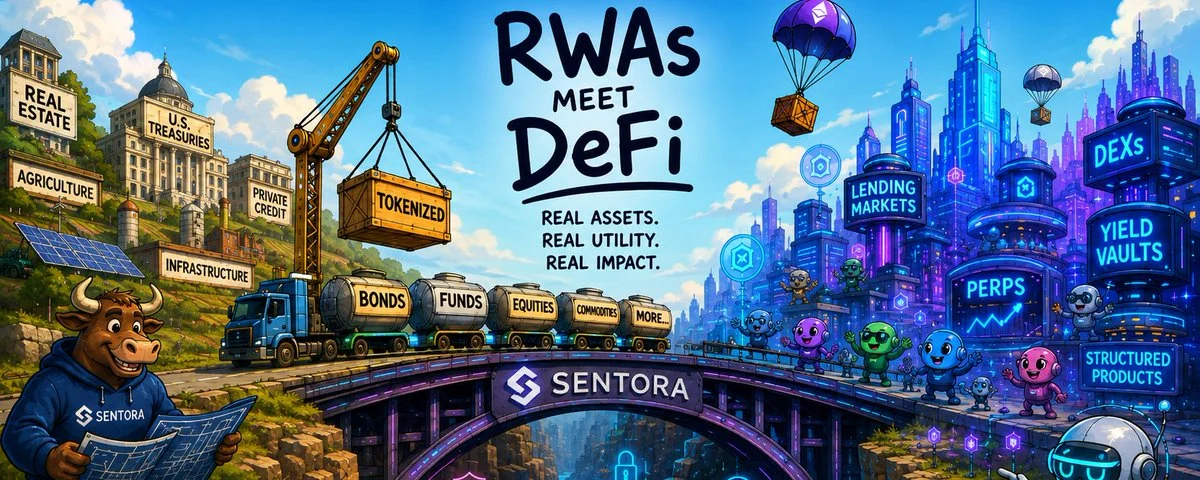
If it's just tokenized assets and doesn't connect to DeFi, what's left of RWA?

If it's just tokenized assets and doesn't connect to DeFi, what's left of RWA?

Author: Jesus Rodriguez, co-founder of Sentora Compiled by: Luffy, Foresight News Original title: Does RWA still make sense without DeFi? Discussions in the RWA industry often begin with a simple vision: take a treasury bill, fund share, stock, invoice, megawatt hour, or GPU for one hour, then mint a token representing it. Is it useful? It's really useful. But can it be called transformative? It's far from there. This is like putting a bar code on a container and claiming that a global trade problem has been solved. Barcodes make containers recognizable and machine-readable, but they don't create ports, cranes, customs, insurance, financing, shipping routes out of thin air, or bring in buyers from afar. A token is simply an addressable token of interest, and DeFi is a marketplace operating system. The question really worth discussing is not how many types of assets can go on the chain, but how many assets can complete valuation, financing, hedging, transaction monetization, and loss disposal in a stressful environment, and there is no need for offline meetings and coordination every time a transaction occurs. Tokenization completes the representation of equity; what DeFi brings is actual utility. Tokenization is just a bar code, and a similar scene has happened in the history of the supply chain finance market. The reason why mortgages can be scaled up is not as simple as turning a paper document into an electronic record. To actually achieve large-scale expansion, a complete set of operating mechanisms was created around this type of asset: credit review, post-loan services, securitization, credit rating, warehousing and financing, repurchases, hedging, clearing and settlement, and loss allocation rules. RWA also needed to go through the exact same evolutionary process. An asset that can be adapted to DeFi requires six levels: legally enforceable rights, reliable data sources, clear transfer and redemption rules, enforceable secondary market liquidity, collateral parameters that match actual behavior, and a credible settlement and loss disposal path. Most tokenization projects, on the other hand, tend to stop at the top five levels. There is a simple test that can be used to test the maturity of an asset. It only requires answering three questions: How much is this asset currently worth? Can the agreement complete withdrawal and monetization at this point? If the first two judgments are all wrong, who bears the loss? When smart contracts can definitively answer the above three questions, RWA can truly become a basic component of finance. Before that, it was mostly just a digital packaging shell. The deepest technical contradiction of RWA's quadruple time clock is that RWA runs under multiple sets of different time clocks at the same time. The blockchain can complete settlement in seconds and operate uninterrupted for 7 x 24 hours; oracles may update prices every hour or every day; underlying traditional exchanges are closed at night and on weekends; custodians follow bank working days; and the asset redemption process may take 1 day, 5 days, or even 30 days. If you use such a slow-paced RWA asset to support fast-maturing DeFi liabilities, such as stablecoin loans. This is the term shift, and it is also the core model that banks have relied on for hundreds of years: using short-term debt to fund long-term slow assets. This model has practical value, but the risk must be reasonably priced. Imagine a scenario: At 2 a.m. on Sunday, assets hit the liquidation threshold. Smart contracts can seize tokens immediately, but the underlying real-world market won't open until Monday, and the issuer's redemption business will not be processed until Tuesday. On-chain liquidation has been completed, and real-world asset disposal has only just begun. This creates a clearing gap. DeFi requires immediate withdrawal for monetization, but the real world does not allow it. The time difference between the two. This gap has counterintuitive consequences. Even treasury bonds with very low volatility are riskier than native crypto assets that are more volatile when used as collateral. The price of ETH fluctuates drastically, but it can be traded around the clock; the price of RWA assets appears to be stable, and it may only be up to a dozen hours without a new price tag. A flat price sometimes represents safety, and sometimes it's just a disguise of stale data. Liquidity is an exit channel, not TVL. The digital public also has common misunderstandings about liquidity. Liquidity is not equal to TVL, does not equal the existence of a trading pair, nor does it mean that the issuer promises to eventually redeem it according to net worth. Liquidity refers to the ability to convert a position into the settlement asset you need at an acceptable discount within the time window allowed by your debt. Take a crowded theater for example: the size of the hall cannot determine whether it is safe in the event of a fire; what really matters is the width of the exit channel. One copy of RWA to...

1d agoForesight News#DeFi #RWA