
区块链网络 · 2586

BounceBit Chain updates vulnerability attack progress: will permanently shut down the chain and migrate to BNB Chain

Comparatively, cross-chain revenue protocol BanceBit issued a security incident announcement stating that its blockchain network was attacked by a protocol-level vulnerability attack between 8:02 UTC on August 19 and 01:54 UTC on August 20. The attackers used authorization flaws in the Evmos underlying architecture to transfer BB tokens from 9 main network accounts without the authorization of the account owners. According to the announcement, the attackers transferred a total of approximately 286.5 million BBs through 14 transactions. The impact of the incident was limited to BanceBit Chain itself, and did not involve private key leaks, signature forgery, wallet, hardware devices, or exchange account security issues. BanceBit CeDeFi Strategy, Promo Vaults, Prime, and RWA products were not affected. BounceBit stated that the vulnerability stemmed from a protocol native module authorization verification flaw in the Evmos architecture. When calling the relevant module through a smart contract, the attackers bypass security checks that should verify the authorization relationship of the fund source account, making it possible to specify any account as the source of funds. After the incident, BounceBit Chain stopped generating blocks at block height 20,702,857, then the team decided not to upgrade the chain, but to permanently shut down Bouncbit Chain and re-issue BB as an BEP-20 token based on BNB Chain. BounceBit stated that the new BB token supply will be based on an on-chain snapshot before the first abnormal transfer (block height 20,697,260), and the 286,543,148 BBs transferred by the attackers will not be included in the new token balance. Users do not need to submit an application or migrate their wallets, and the official plan is to automatically distribute the new BB to the corresponding BNB Chain addresses. Regarding the BB in the pledge, BounceBit said it will be restored as soon as the snapshot is in time, and there is no need for coin holders to perform unbundling or redemption operations. Currently, BounceBit has submitted requests for suspension and assistance to relevant exchanges, and reminds users to be wary of scams and not to click on any BB migration or receipt links that have not been officially confirmed. The team said that the new BEP-20 BB contract address and reissue progress will be announced later. This article is sponsored by GENG, Build Your Fortune on GENG (https://geng.one)

1d agoburnking
They all say stablecoins are suitable for cross-border payments; is it really faster and cheaper than Wise?

They all say stablecoins are suitable for cross-border payments; is it really faster and cheaper than Wise?

Author: Jonah Compiled by: Saoirse, Foresight News Original title: Do cross-border payments really need stablecoins? Everyone says stablecoins are better suited for cross-border payments. Is that really true? If the recipient of your transfer wants stablecoins themselves, then stablecoins are indeed an excellent cross-border solution. You can transfer money around the clock at almost zero cost and instant settlement. But the more difficult question, which is also the focus of this article, is the cross-currency scenario: what happens when one end inputs US dollars and the other end exports foreign currency (such as Mexican pesos). Most crypto industry opinion leaders will claim that stablecoins can fundamentally reduce the speed and cost of transfers in this scenario. However, people who are optimistic about stablecoins deliberately avoid the fact that fintech companies have already achieved low-cost, high-efficiency businesses of the same kind, and there is no need for stablecoins at all. So what problem do stablecoins solve? This article will sort out how the traditional agency banking system works, and also analyze the innovations made by modern fintech companies such as Wise to clarify the actual value of stablecoins. The proxy banking business assumes Alice, who is in the US, wants to send a peso to her friend Bob in Mexico. Both banks do not have branches in each other's countries, so payments cannot be completed directly. The two banks need to use a larger bank, or correspondent bank, to establish a connection. Alice's depositary bank holds funds in US dollars at this correspondent bank called GlobalBank; GlobalBank also holds pesos at BancomX Bank in Mexico. After Alice initiated the transfer, her bank withheld the funds in her account and issued instructions to GlobalBank. GlobalBank transfers $100 from the dollars stored by Alice Bank, completes the exchange according to its own exchange rate, earns the exchange rate spread, then tells BancomX to credit Bob's account and deduct its own processing fee. The entire process relies on the SWIFT system to coordinate information, and SWIFT itself also charges for messages. This underlying transfer mechanism is expensive and slow. The root cause is that all layers of intermediaries are profiting from it. In an ordinary consumer remittance scenario, the comprehensive cost of the agent banking system is about 15%, including transaction fees and foreign exchange spreads embedded in the exchange rate. In addition to this, a transfer usually takes 1 to 5 business days to complete, and each intermediary takes time to complete its own operation process. Modern fintech solutions In 2011, two friends in London had complementary financial needs: one person earned in euros but needed pounds to live in the local area; the other received a salary in pounds and had to repay a mortgage in euros to Estonia. As a result, they bypassed banks and paid each other locally: the British pound was deposited into the London account, the euro was deposited into the Estonian account, and the two funds did not flow across the border. This system later evolved into Wise. The two founders believe that this model of hedging and offsetting capital flows can be implemented on a large scale, and this model has indeed worked. Many other fintech companies have taken the same approach. Let's take another example of Alice sending money to Bob, this time using a service similar to Wise. Alice transferred dollars to the fintech company's US account; the company used its own peso funds stored in Mexico to complete the payment directly to Bob. The funds did not cross the border from beginning to end. Alice's perception of a cross-border transfer is essentially a financial institution that receives and withdraws money at the same time. Because of this, the user experience was almost instantaneous, and the fintech company needed to bear the asset liability risks associated with holding large amounts of foreign currency. In order not to touch the traditional banking system as much as possible, fintech companies will distort transactions. For example, if other users remit pesos overseas in reverse, fintech companies can internally hedge off the two capital flows. Once a currency's capital pool is seriously unbalanced, it is only necessary to seek help from the traditional banking system. At the bottom, fintech companies cobble together partner banks and various license resources, and local partners handle regions that cannot be covered by their own business. Under the premise of normal operation, this model is far superior to the traditional system. Wise only charges a small, publicly disclosed processing fee, using the actual mid-market exchange rate, no hidden exchange rate spread, and the comprehensive rate is only 0.52% (this value is mixed with some transfers in the same currency, and the foreign exchange rate is not disclosed separately). According to World Bank data, the average ratio of digital remittance services...

1d agoForesight News#agent #AI #Claude #GPT #wallets

Gnosis Chain received approval from GnosisDAO to transform into an EEZ Rollup, which will be the first production-level instance

Comparatively, GnosisDAO approved the transformation of the blockchain network Gnosis Chain from an independent Layer 1 network to an Ethereum Economic Zone (EEZ) Rollup with zero knowledge certification. The network will eliminate the set of independent validators and let Ethereum validators complete transaction settlement instead. The proposal received 123,158 GNOs in favor, 115 against, and 151 abstentions. The vote involved 54 participants, and the total number of participants reached 123,425 GNOs, which is above the quorum threshold of 75,000 GNOs. The upgrade is initially scheduled to begin in late 2026 or early 2027, depending on EEZ technical preparations. After the upgrade, Gnosis Chain's native smart contract can call Ethereum and use return results in the same transaction, while also connecting to Ethereum mainnet assets and liquidity. Gnosis Chain will be the first EEZ instance to be deployed and will preserve existing apps, balances, and xDAI fuel tokens.

2d ago

Circle's Arc mainnet will go live on September 16

Comparatively, stablecoin issuer Circle announced that its blockchain network Arc mainnet will be officially launched on September 16. Arc is positioned as a financial infrastructure for global financial markets and aims to support related applications and settlement scenarios. According to reports, the Arc testnet has processed more than 500 million transactions so far, with close to 3 million wallet addresses participating. More than 100 other partners are already active on the private mainnet. The initial validator community is expected to participate in network operations with Circle. Circle said it will continue to promote the construction and ecological expansion of Arc as a low-level facility in the financial market.

3d ago

Hyperliquid Policy Center Announces Support for US SEC to Abolish “Penetrative Trading Rules”

According to Twitter, the Hyperliquid Policy Center announced that it has recently submitted a joint opinion letter with Douro Labs to the US Securities and Exchange Commission (SEC) to support the SEC's proposal to repeal Regulation NMS Rule 611 (“Trade-Through Rule”) and to call on regulators to establish a more clear Best Execution (Best Execution) regulatory framework for the on-chain market. The Hyperliquid Policy Center believes that the current transactional rules are based on the traditional securities market structure and are clearly incompatible with the blockchain's native transaction model. HPC and Douro Labs made three recommendations in a joint opinion: First, support the SEC's revocation of the Trade-Through Rule. The two companies believe that the rules rely on the traditional quotation system, and that the system does not accurately reflect the on-chain transaction environment, and continued application may hinder the development of the on-chain financial market. Second, the SEC should establish clear best execution guidelines for on-chain transactions. The on-chain market has new factors that don't exist in traditional markets, such as unquoted trading, 24/7 operation, blockchain network fees, and MEV (maximum extractable value). Brokers need more clear regulatory standards to ensure they can execute transactions on behalf of clients. Third, the regulatory framework should be guided by principles and recognize an independent price reference mechanism. HPC and Douro Labs suggest that when traditional NBBO is unable to cover the on-chain market, the SEC should recognize independent price reference data based on transparent, manipulation-resistant mechanisms. For example, Pyth Network, which Douro Labs participated in the construction of, provides price prediction services for the on-chain market by collecting data provided by exchanges and market participants in real time. This article is sponsored by GENG, Build Your Fortune on GENG (https://geng.one)

5d agoburnking
The amount of USDT issued on the Bochang TRON chain surpassed Ethereum and then entered the world's largest USDT distribution network

The amount of USDT issued on the Bochang TRON chain surpassed Ethereum and then entered the world's largest USDT distribution network

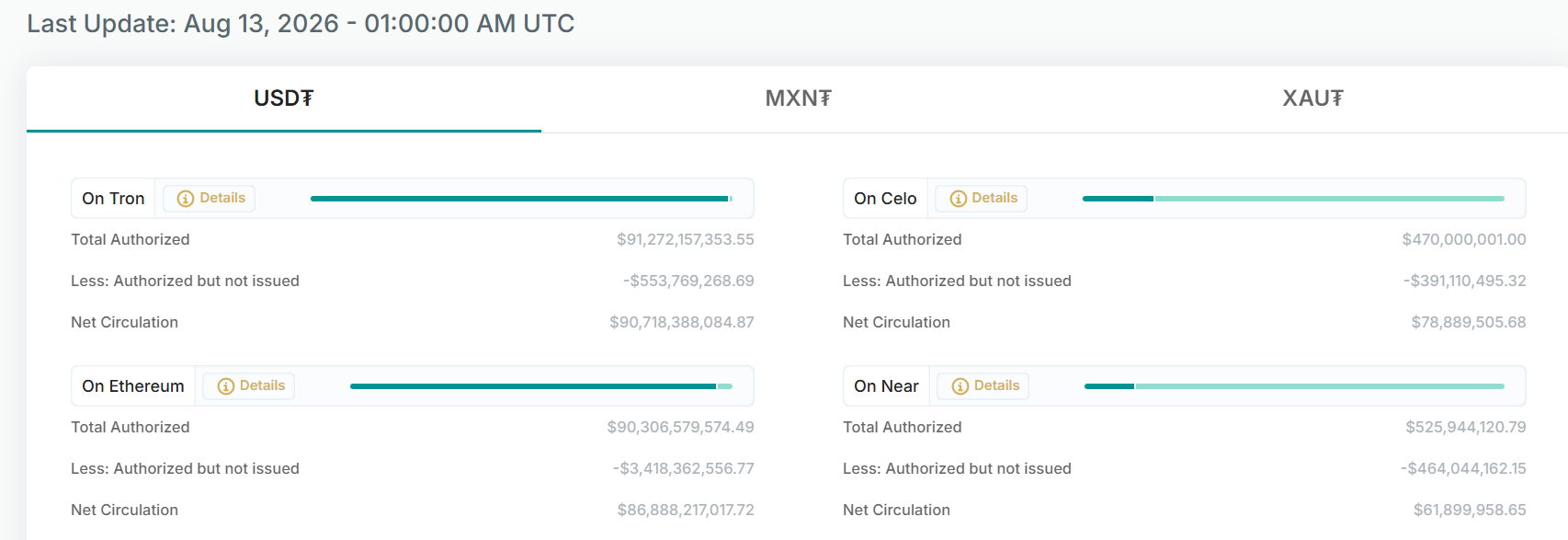
According to official Tether data, as of August 13, 2026, USDT on the Bochang TRON network chain once again increased by 1 billion US dollars, reaching 91.2 billion US dollars. The circulation volume once again surpassed the amount of USDT issued by the Ethereum network (90.3 billion US dollars), ranking first among blockchain networks. This historic milestone marks the further consolidation of Wavefield TRON's dominant position in the stablecoin field, and once again confirms the continued appeal of low-fee, high-efficiency settlement networks to global stablecoin funds. From trading assets to settlement tools, TRC20-USDT usage scenarios continue to expand the growth of USDT on the TRON chain, starting with sustainable real usage requirements. As of August 2026, the distribution volume of TRC20-USDT on the Bochang TRON network officially exceeded 91.2 billion US dollars, setting a new historical record. During the year, a total of about 10 billion copies were added, and the number of accounts held reached about 75.47 million. This size has enabled Wavefield TRON to carry half of the world's USDT issuance for a long time, accounting for about 50%. Judging from the usage structure, the actual payment attributes of Wavefield TRON are becoming more and more clear. According to CoinDesk Research data, in the first quarter of 2026, the average quarterly daily active account value of Bochang TRON rose to about 3.2 million, a new quarterly high. Meanwhile, in retail USDT transfers under $1,000, Bochang TRON's share is about 50%. It still maintains a dominant position in the $1,000 to $100,000 range, and continues to strengthen its “friendly” public chain position for retail and small to medium value settlement. This means that one of the main uses of USDT on Wave Field TRON is always the actual transfer of value between wallets. Looking at a longer period of time, the scale of on-chain transfers and settlements confirms this judgment. According to a research report released by Messari, in the first quarter of 2026, the amount of USDT transfers processed by the Bochang TRON network reached about 2.04 trillion US dollars, and the total number of transactions across the network was about 950 million. The average daily transactions rose from about 10.2 million in the previous quarter to about 10.9 million, which also set a new quarterly record; since 2026, Bochang TRON has led all public chains with annual USDT transfers of about 4.2 trillion US dollars. It depicts not a ledger within a single trading platform, but rather a scenario where multiple wallets directly transfer value on a public blockchain. Specifically, an overseas worker can send USDT to a family's wallet, and the payee can exchange it for local currency; cross-border e-commerce merchants can use USDT to settle with suppliers to reduce the impact of bank business hours and intermediary processes; freelancers can receive rewards from overseas customers and confirm on-chain payments within minutes; and digital asset service providers can transfer liquidity between exchanges, custodian wallets, and market-making accounts. The amount and purpose of the different cases are not the same, but the common requirements are fast payment, transparent fees, and 24/7 operation. Furthermore, cost stability is particularly important in a market environment where network fees fluctuate drastically. Since August 2025, Bochang TRON passed Governance Proposal No. 104 and lowered the unit price of energy by about 60%, on-chain transfer costs have been further reduced. Ecological access and secure collaboration go hand in hand. Whether the stablecoin infrastructure continues to improve and the stablecoin network can develop over the long term depends not only on circulation volume, but also on entry coverage, depth of liquidity, developer support, and risk management capabilities. Wavefield TRON is simultaneously constructing infrastructure in these directions. In terms of application entry, wallets, trading platforms, payment service providers, and DeFi protocols have extensive support for TRC20-USDT, enabling users to deposit, withdraw, transfer, exchange, and interact on the chain relatively easily. As new stablecoins such as USDD are integrated into the TRON ecosystem, stablecoin asset types have been further enriched; agreements such as JustLend DAO have extended the use of stablecoins to collateral and loan scenarios. Stablecoins are gradually shifting from a single transfer tool to the underlying asset for on-chain financial activities. In terms of user experience, mechanisms such as GasFree try to solve a common pain point: although new users hold USDT in their wallets, they may not be able to initiate transactions because there are no native tokens. By supporting stablecoins to pay associated network fees, these solutions help simplify the first-time usage process. For merchants, wallets, and payment applications, reducing the cost of user understanding bandwidth, energy, and native Gas tokens will also help stablecoin services enter a wider range of consumer scenarios. More importantly, scaling up needs to be synchronized with security governance capabilities. In September 2024, Wavefield TRON, Tether and TRM Labs joined forces...

9d agoburnking

The amount of USDT issued on the TRON chain surpassed Ethereum and became number one in the entire network

Comparing news, Tether's latest data shows that the total circulation of USDT on the TRON network has risen to about 91.2 billion, surpassing Ethereum's approximately 90.3 billion, making it currently the largest blockchain network with USDT issuance volume in the world. This means that in the USDT global distribution chart of nearly $200 billion, Wavefield TRON already has the largest share of a single chain. As demand for stablecoin payments, transfers, and transactions continues to grow, the focus of USDT's on-chain issuance is further concentrated on the TRON market.

9d ago
Apple didn't make up with a loss of 7 billion dollars. Why did Musk kill X Money?

Apple didn't make up with a loss of 7 billion dollars. Why did Musk kill X Money?

Source: Fintech Blueprint Author: Michiel Milanovic Compiled and edited by: bitPushNews Elon Musk finally launched the product he had been aiming to build since 1999. X has begun gradually rolling out X Money to US Premium and Premium+ subscribers, bundling cash accounts with 6% annualized returns, Visa debit cards with 3% cashback, and free instant transfers between X accounts. These motivational numbers are quite aggressive, and the timing of the launch is also quite delicate for this social media app. X now belongs to SpaceX. The stock price has dropped by about 30% since the IPO, and the current valuation is 1.51 trillion US dollars. This article will thoroughly analyze X Money's core, analyze its opportunities, selected financial technology stacks, and strategies to turn 550 million users into bank customers. X (formerly Twitter) remains one of the world's largest social media companies. The app reports that it has 550 million monthly active users and posts around 350 million daily posts. However, its core business now belongs to Musk's sister company Xai, which acquired X in March 2025. SpaceX also acquired xAI in February 2026, merging this platform into a company with a total value of 1.5 trillion US dollars today. According to SpaceX's S-1 files, X was not described as a media asset. Instead, it is positioned as Grok's “basic distribution and data engine,” providing a real-time daily stream of posts, which the company believes will improve the timeliness and context-awareness of the model. The logic is as follows: X provides data for Grok, Grok makes X more useful, and more useful X makes users willing to pay for it. X Money is the latest attempt to shape X into a “one-size-fits-all app” — the document clearly states that this will cover payments, banking, and business services. The move comes at a time when ad revenue is declining steadily and subscription revenue is gradually rising. In the first quarter of 2026, X's annualized advertising revenue was US$1.37 billion, down 40% from 2023. Meanwhile, subscription revenue (a major component under AI solutions and infrastructure) continued to grow over the same period. In 2025, subscription revenue increased by $365 million. This shows that the company is replacing its advertising business with a subscription-led model; X Money is one part of it. The service is only open to Premium and Premium+ subscribers. These two categories total 4.4 million users, accounting for only 0.8% of the 550 million total users. Its strategy is to provide attractive X Money benefits to attract more users to subscribe to Premium and Premium+ services. X Money itself is not a bank, but rather partners with Cross River, which holds deposits and provides FDIC insurance. This is the same cooperative banking model behind Chime, Cash App, and Klarna, and it also brings the same trade-off: sharing the financial benefits in exchange for a lighter regulatory burden. This makes the 6% annualized return a particularly expensive benefit. Dollars stored in Cross River are almost impossible to earn far more than a risk-free interest rate of about 3.5% until anyone shares the profits. Even if X takes the full spread, it still has a gap of about 235 basis points in the promised returns to savers. Assuming Cross River retains its usual share, the gap will widen to around 400 basis points. The same is how cashback works. Cross River's assets are less than $10 billion and are therefore not subject to the Durbin Amendment fee cap, which allows it to earn unregulated exchange fees of around 1.1-1.2% of the transaction amount. That's less than half of X's 3% cashback. As such, subscription fees are likely a source of funding. The 6% annualized revenue is only available to Premium+ subscribers, who pay $40 per month, or $480 per year, which can cover approximately 4% of the revenue gap on the $12,000 deposit. But if you count cashback, users will soon run out of that budget. Our guess is that Musk is happy to accept losses from this business. Even if X Money absorbed $1 billion in deposits, the loss of several hundred basis points was only a fraction of the total loss of 2.5 billion US dollars in the AI sector in the first quarter of 2026. If X eventually gets its own banking license, earn...

16d agoWendy#X Money #license plate #apples #banks #Musk

Mastercard closes up to $1.8 billion BVNK acquisition deal

According to Twitter, Mastercard has completed the acquisition of stablecoin payment company BVNK to incorporate its on-chain settlement and wallet infrastructure into the global network. The final purchase price of the deal was not disclosed. When the agreement was announced in March, the transaction was valued at up to $1.8 billion, including $300 million in contingent payments. BVNK was founded in 2021 to provide businesses with the infrastructure to send, receive, store, and convert funds between traditional currencies and blockchain networks. Mastercard said that BVNK's existing customers will continue to use the same products, integrations, and support teams, and no action is required at this time. Mastercard's Chief Product Officer Jorn Lambert said that digital currencies, and stablecoins in particular, are increasingly meeting real needs. The combined platform is expected to enable banks to connect customer accounts to digital wallets and provide 24/7 merchant settlement capabilities for payment service providers.

16d ago

BlackRock's Tokenized Reserve Fund received the highest principal stability rating from S&P Global Ratings

Comparatively, S&P Global Ratings awarded BlackRock Daily Reinvestment Stablecoin Reserve Vehicle (BRSRV) a “AaAm” rating to BlackRock, a new tokenized money market fund on Monday, as its highest principal stability fund rating. The rating is based on investment and counterparty credit quality, term structure, and management's ability to maintain a stable net asset value. S&P Global Ratings said it found no weaknesses in the management and organization of BlackRock consultants, credit research and analysis, risk management and compliance. It also said that the fund's tokenization framework is operationally resilient and uses a permissioned architecture to limit transactions to whitelisted wallets to reduce network, smart contracts, and blockchain cyber risks. BRSRV launched Monday as an open managed investment company with the goal of making its shares meet the eligible reserve asset requirements to pay stablecoin issuers under the GENIUS Act. The fund will hold cash, US Treasury bonds maturing within 93 days, and overnight repurchase agreements secured by treasury instruments, maintaining a weighted average term of no more than 60 days and a weighted average lifespan of no more than 120 days. S&P Global Ratings released a separate stablecoin stability assessment summary on Tuesday, saying that 6 of the 11 stablecoins it covers have “sufficient” or better ability to maintain fiat currency anchoring. USDT is still level 5 “weak”; TUSD and USDe are level 5; USDC, EURC, USDG, and USDP are level 2 “strong”. This article is sponsored by GENG, Build Your Fortune on GENG (https://geng.one)

17d agoburnking