华尔街 · 5110

Wall Street and Washington Jointly Drive BTC Rally: ETF Inflows and Short Liquidations Accelerate the Market

Comparing news, Bitcoin has continued to rise recently. This round of rise was driven by multiple factors such as the return of institutional capital, improvements in the macro environment, warming US regulatory expectations, and large-scale short liquidations. In terms of capital inflows, US spot Bitcoin ETFs have recently re-attracted institutional capital. On August 19 and 20, US spot BTC ETFs recorded net inflows of approximately $517 million and $606 million, respectively, according to the data. The ETF bought around 7,500 BTC in a single day, the highest level since April, according to CoinShares research director Julio Moreno. The market believes that the US Treasury's expansion of the long-term treasury bond repurchase program weakens the performance of the US dollar, pushes currency depreciation transactions to heat up, and further flows of capital to Bitcoin and gold. Meanwhile, the Trump administration's push for legislation on the structure of the crypto market has also lessened investors' concerns about regulatory uncertainty. Furthermore, the US Congress is advancing the construction of crypto regulatory frameworks such as the Clarity Act to clarify the responsibilities of the US Commodity Futures Trading Commission (CFTC) and the Securities and Exchange Commission (SEC) in digital asset regulation. Analysts believe that Bitcoin currently has a high level of regulatory certainty, and the relevant legislation's direct impact on BTC is limited, but it can help reduce the regulatory risk premium for the entire crypto market. The rise in the market also triggered large-scale short positions to be closed. The data shows that over the past two to three days, the crypto market has liquidated more than $40 billion, of which around $2.7 billion was liquidated in a single day, then another $1.2 billion was liquidated. Analysts say that this round of shortfall has become one of the biggest shortfall recovery events in the crypto market recently. Market participants believe that if institutional capital continues to flow in and the regulatory environment is further improved, Bitcoin's upward trend in the medium term may continue.

9h ago

The US composite PMI hit a four-year high in August, and expectations of interest rate cuts have cooled

Comparing news, on Friday, S&P Global released the latest PMI survey data. The data showed that the US composite output index rose strongly to 56.0 from 54.5 last month in August, the highest level since April 2022. This overall acceleration was driven entirely by an unexpected spike in the service sector. The initial service sector PMI recorded 56.8 in August, significantly higher than 54.6 in July, setting a new record high since December 2024. Normally, a PMI reading above 50 indicates that related economic activity is expanding. The data completely shattered Wall Street's previous cooling expectations. Economists generally expected the services PMI to fall back to 54 in August. S&P Global predicts that the current third-quarter survey data shows that the US annualized economic growth rate is approaching 3.0%. Compared to the 1.5% growth rate in the second quarter, this figure achieved a solid double jump. However, the rapid pace of the economy is still accompanied by latent risks of inflation. The latest report shows that although inflationary pressure subsided slightly in August, the growth rate of investment costs and sales prices remained high.

22h ago

Analysis: Gold may break out of the Q2 collapse, and structural support and core catalysts are in place

Comparing news, the price of gold experienced a sharp sell-off after hitting a record high of nearly 5,600 US dollars earlier this year. In the three months to June, gold recorded its worst quarterly performance since 2013, and the current continuous rebound is quickly repairing this technical gap. Driven by a combination of factors, gold is expected to break out of the haze of having previously recorded its worst quarterly performance in ten years. In a two-way game of long-term structural deficits and short-term pullbacks, Wall Street is anchoring the gold price target for the next 12 months at 5,400 dollars. Despite long-term structural factors that are biased towards optimism, many analysts warned that gold will still face significant macroeconomic resistance and potential pullback pressure in the short term. (CNBC)

23h ago

Nvidia expands AI infrastructure layout and invests in power developers

Comparatively, according to the Wall Street Journal, the potential deal will expand Nvidia's layout in the field of artificial intelligence infrastructure and help the company secure future data center production capacity for its chips. Nvidia has recently invested heavily in other power developers, including Lancium and SoftBank's SB Energy.

1d ago
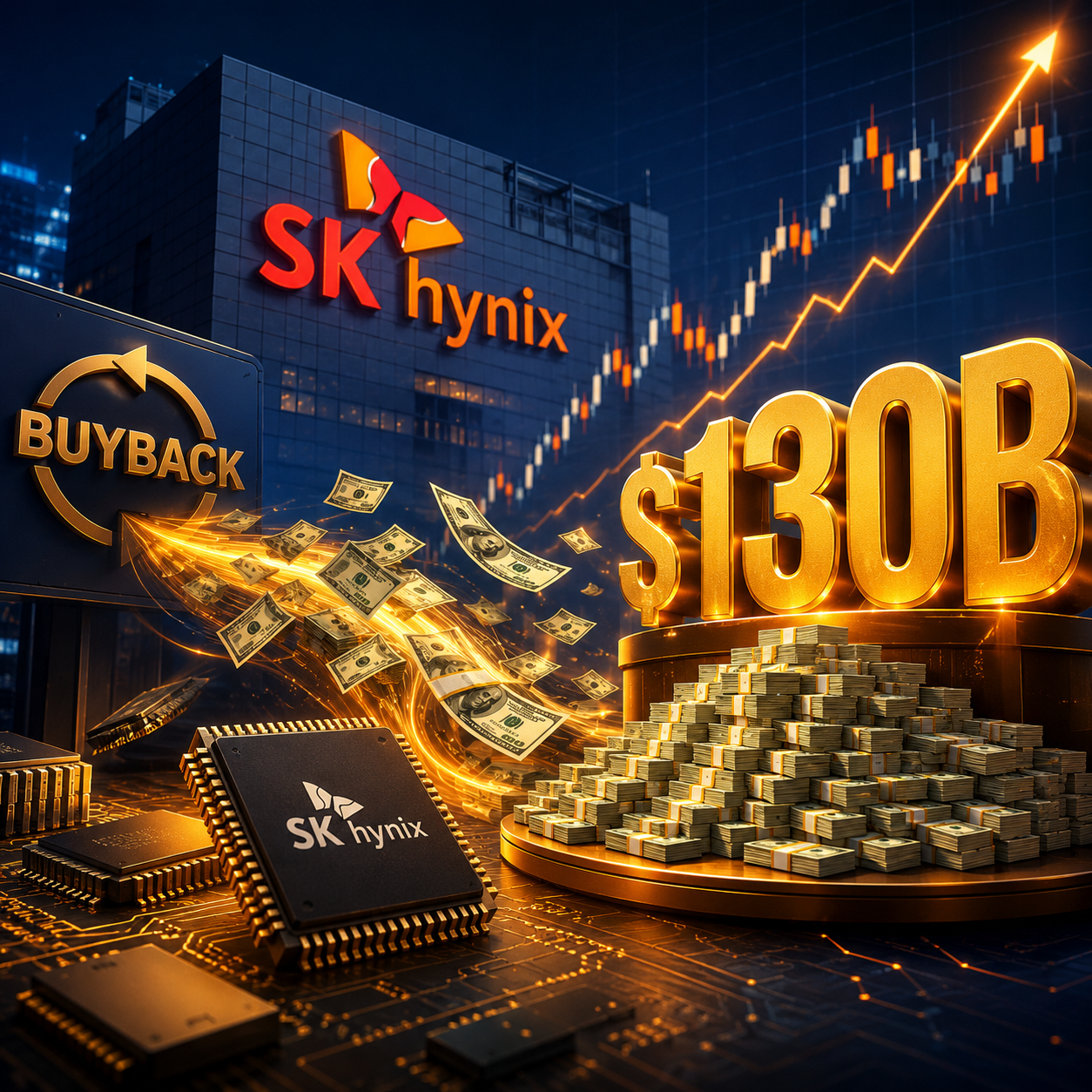
Is 40 trillion just an “appetizer”? The Hynix buyback landed ahead of schedule. Is 130 billion US dollars still ahead?

Is 40 trillion just an “appetizer”? The Hynix buyback landed ahead of schedule. Is 130 billion US dollars still ahead?

Source: Wall Street News Editor: Dong Jing Original title: Wall Street interprets Hynix's repurchase plan: Shareholder return of up to 8% next year, or return at least $130 billion to shareholders by 2027 Summary: J.P. Morgan believes that the shareholder return policy was upgraded from “no more than 50% free cash flow” to “no less than 50%”, changing from the upper limit to the lower limit, sending a clear signal to the market: future shareholder returns will only be greater, not less. Goldman Sachs predicts an 8% shareholder return in 2027, and expects an additional repurchase of approximately 7 trillion won in the future. J.P. Morgan expects additional return of over 16% of its market value by the end of 2027. Follow-up focus will be on the results meeting at the end of October. While the market was still debating the continuation of the AI storage cycle, and SK Hynix's stock price plummeted from a June high, the storage giant suddenly threw a huge bomb on the market. A historic repurchase, which was implemented early, reshaped the market's valuation logic for Hynix! SK Hynix officially announced the market's long-awaited shareholder return policy after closing on August 19, 2026 — it plans to repurchase and cancel 40 trillion won worth of shares, involving 24.07 million shares (3.3% of the shares issued as of the end of the second quarter of 2026), equivalent to about US$28.9 billion. This scale is not only the largest share repurchase in the history of a Korean listed company, but also exceeds the approximately 26.5 billion US dollars that Hynix raised through ADR financing in the US in early July this year. According to Chase Trading Desk, the two top Wall Street agencies, J.P. Morgan Chase and Goldman Sachs, both gave highly positive comments on the announcement in their latest research report on August 20. J.P. Morgan believes that the shareholder return policy has been substantially upgraded from “no more than 50%” to “no less than 50%”, and the policy ceiling has become the policy floor. Following the announcement of a 40 trillion won ($29 billion) share repurchase plan, SK Hynix may return at least $130 billion to shareholders by 2027, according to J.P. Morgan Chase. Goldman Sachs predicts a shareholder return of up to 8% in 2027, and expects an additional repurchase of approximately 7 trillion won in the future. Both J.P. Morgan Chase and Goldman Sachs maintain buying ratings: J.P. Morgan's target price is 2.75 million won (about 84% upside compared to the current price), and Goldman Sachs's target price is 3.5 million won (implying an upward margin of about 133%). The next key catalyst is the third quarter results conference call at the end of October 2026, when the company will reveal a more complete roadmap for shareholder returns. Analysts believe that this aggressive capital action directly proved to Wall Street that the company is “printing money” faster than market expectations. For the stock price, which has plummeted 49% since its high on June 22, this not only completely offset the dilution effect of the recent ADR issuance, but also established a valuation bottom (current annualized price-earnings ratio of only 3.8 times). The scale of the repurchase: The largest in history and earlier than expected. J.P. Morgan analyst Jay Kwon clearly stated that the 40 trillion won repurchase announcement “landed earlier than expected” — previously, the market generally expected the announcement to be released around the end of September, but the company chose to directly disclose it after closing on August 19, showing management's high level of confidence in the company's cash flow situation. In terms of scale, this repurchase has multiple historical significance: 40 trillion won is the largest share repurchase announced by a Korean listed company so far; equivalent to US$28.9 billion, higher than the approximately US$26.5 billion raised by Hynix's US ADR offering in early July, which means that the company actually used the repurchase to “hedge” the previous equity dilution; this amount is equivalent to 63% of the rolling FCF (operating cash flow minus capital expenses) over the past 12 months, & nbsp; It is higher than the previous “no more than 50%” FCF allocation limit policy. At the same time, J.P. Morgan Chase pointed out that if viewed from a valuation perspective, the price-earnings ratio corresponding to Hynix's current stock price is 6.4 times (based on adjusted earnings per share for the past 12 months) or 3.8 times (based on annualized adjusted earnings per share for the first half of 2026). This valuation level can be regarded as a reference benchmark for management to initiate repurchases. Policy upgrade: From “ceiling” to “floor”, the core policy change in this announcement is that the shareholder return ratio statement was upgraded from “up to 50% (no more than 50%)” to “50%”...

1d ago22#SK Hynix #J.P. Morgan Street
Trump named Hyperliquid, and it wasn't a surprise

Trump named Hyperliquid, and it wasn't a surprise

On August 19, when Trump met with crypto and financial industry executives at the White House, he suddenly read out the name Hyperliquid. His original statement was that CFTC Chairman Michael Selig is working to bring Hyperliquid to the US in a “fully compliant and legal” manner. After Trump's speech, HYPE rushed from around $60 to above $70, rising 20% to 22% in the short term, once again approaching a record high of around $76.8 in June this year. HYPE had a minimum of about $3.2 when it first entered the market in November 2024, and it has increased tenfold in less than two years. However, the entire crypto market also surged on the same day. Bitcoin is at $7.2 million, and Ethereum is rising at the same time as other altcoins. Macro liquidity and US regulatory news are driving up risk appetite. Why is it called Hyperliquid? Other factors aside, it has evolved to the point where US regulators and traditional exchanges cannot ignore it. Hyperliquid's main business is perpetual contracts. According to The Block data, in March 2025, its monthly perpetual trading volume was about 3.5% of all centralized exchanges (CEX); by March 2026, this ratio was close to 6%, and the monthly turnover was close to 200 billion US dollars. It rose to 6.63% in May, reaching 14.4% compared to Binance's perpetual trading volume, both of which were new highs at the time. It is no exaggeration to say that it is eating away at CEX's business step by step. Not all of Hyperliquid's assets have been growing the fastest recently. HIP-3 allows third parties to deploy a sustainable market. Since this year, contracts for stocks, indices, commodities, etc. have been rapidly sold. In May, HIP-3 sold more than 62 billion US dollars in a single month; by July, it had contributed nearly half of Hyperliquid's average daily sustainable transactions. It also explains why Wall Street is staring at it. How did the low-key team get on with Trump? Hyperliquid's past style is very different from typical crypto projects. Jeff Yan said in a lengthy interview in 2025 that the core team at the time was only 11 people, about half of whom were engineers; the team did not have a dedicated BD department, nor a business team that connects agencies around the clock. Even HYPE was not a centralized exchange, they didn't invest much resources to promote it. The Hyper Foundation's official website still says “No investors. “No paid market makers” is clearly written. Judging from public sources, there is no public evidence of any personal relationship or commercial ties between Jeff Yan and Trump himself. All I can find is news related to my own business. In May 2025, Hyperliquid Labs officially submitted submissions to the CFTC to discuss how the US handles 24/7 derivatives and perpetual contracts. At the same time, the document also clearly stated that the front-end developed by Hyperliquid Labs was prohibited for US users to trade. In February 2026, Hyper Foundation supported the establishment of the Hyperliquid Policy Center with 1 million HYPE cards. According to the current currency value of about 29 million US dollars, this agency was doing policy research and regulatory communication in Washington. The person in charge, Jake Chervinsky, had previously been the chief policy officer of the Blockchain Association and is also a familiar lawyer in the US crypto regulatory community. The introduction to HPC is straightforward: introducing Hyperliquid to lawmakers and regulators, and promoting regulatory frameworks in DeFi, perpetual contracts, and more. As of July 15 of this year, “Hyperliquid Strategic Inc. and Hyperliquid Labs” appeared in the CFTC official minutes. In other words, Hyperliquid was already in formal contact with the CFTC prior to Trump's public nomination. So, what we can guess is that Hyperliquid wasn't good at, or even very bad at traditional business relationships; it started this past year...

1d agoBitpushNews#CFTC #HYPERLIQUID #SEC #original #Perpetual contracts #Trump #custodial #viewpoints

Anthropic AI Joint Venture Ode Acquires AI Consulting Company to Accelerate Claude's Launch

According to news, Ode, a corporate AI service company co-founded by Anthropic and Wall Street investment institutions, announced that it has completed its first acquisition since its establishment and will acquire AI consulting firm Casper Studios to promote the application of Anthropic's AI model Claude in the corporate market. Ode was founded in 2026 and is supported by Anthropic in collaboration with Blackstone, Hellman & Friedman, and other investment institutions, and is positioned as a service platform to help companies implement cutting-edge AI technology into actual business processes. The acquisition of Casper Studios aims to enhance Ode's ability to design and deploy AI applications for enterprise customers. As more companies explore generative AI applications, Ode hopes to help enterprises move from AI testing to large-scale application through professional consulting, engineering implementation, and customized solutions. (The Information)

2d ago
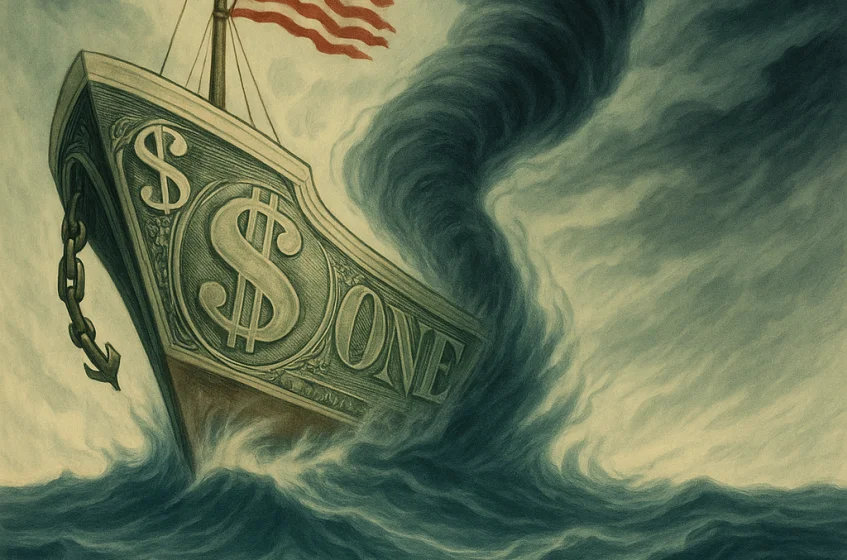
The Ministry of Finance took steps to reduce long-term interest rates, and gold and Bitcoin rose sharply in response

The Ministry of Finance took steps to reduce long-term interest rates, and gold and Bitcoin rose sharply in response

Author: Cookie Original title: Bond Market Fright, How Can a Buyback Detonate Gold and Bitcoin? On August 18, the US 30-year Treasury yield hit 5.337% intraday, a new high since April 2007. The last time this number appeared on the screen, the iPhone had just been launched, and Lehman Brothers was still a Wall Street giant. In less than 24 hours, the Ministry of Finance was in action. On August 19, the US Treasury Department announced that it would at least double the scale of liquidity-supported repurchase operations for long-term nominal treasury bonds, raising the upper limit of a single operation from 2 billion US dollars to no less than 4 billion US dollars, covering the two ranges of 10 to 20 years and 20 to 30 years, effective September 9 and continuing until November 4. Within minutes of the news, the 30-year yield plummeted from around 5.337% to 5.192%, a drop of about 15 basis points. Gold surged more than $125 to $4,487 per ounce in a single day, a new high since June 4. Bitcoin pulled up 8.7% from an intraday low of $64,112 to $69,700, approaching the $70,000 mark for the first time in two months. Ethereum rose nearly 19%, and the crypto market liquidated more than $20 billion in 24 hours, of which $1.44 billion was liquidated by bears. How did a buyback cause a huge shock in the global market? What is a buyback? Treasury buybacks and the Federal Reserve's QE are two different things. QE is when the central bank prints money to buy bonds, directly injecting new liquidity into the market. However, the Ministry of Finance buybacks up old bonds that the Ministry of Finance uses money from its own accounts to buy back those “old and no one wants to trade”. The purpose is to renew liquidity to the market so that market makers are not “priceless” in the long-term treasury bond market. For example, there is a used car market in your neighborhood, but recently no one is buying used cars. Car dealers have stocked up a bunch of used cars and can't sell them, and the price of new cars is being dragged down. At this point, the property came forward and said, “Used cars will be purchased uniformly by the property; at least this much will be collected. As a result, car dealers had cash in their hands, and the liquidity in the new car market also slowed down. The Ministry of Finance is doing this “property” job. It is buying back “off-the-run” bonds, that is, old securities that are no longer the latest issue and have a scarce trading volume. After institutions that sell old coupons get cash, they can reallocate them to new coupons with better liquidity. As a result, the trading price spread in the entire long-term market narrows, and transaction friction is reduced. The Ministry of Finance did not create money out of thin air. The source of funds for the repurchase was the Ministry of Finance's General Account (TGA), and the TGA money came from taxes and newly issued short-term treasury notes. This means that while long-term supply is declining, short-term supply is increasing, and the total amount of debt has not changed; only the term structure has changed. Why are yields out of control? To understand the urgency of this repurchase, we need to go back to what the bond market has experienced in the past five months. The war in Iran was the trigger. After the US-Iran conflict broke out in late February, passage through the Strait of Hormuz was blocked, and Brent crude oil climbed all the way from the pre-war range of $70 to $91 recently. The sharp rise in energy prices directly boosted inflation expectations, while the Federal Reserve kept interest rates unchanged (3.5% to 3.75% range) at the July interest rate meeting. Three members of the committee even voted against raising interest rates, and the market began to set prices “higher for longer.” But the rise in yield was not only driven by inflation. Fiscal deficits are a deeper structural strain. The monthly deficit in July reached US$432.3 billion, the largest monthly gap since March 2021. The annual deficit is likely to be over $2 trillion, accounting for about 6.4% of GDP. The total national debt is close to $40 trillion, and the public holdings are about to reach 100% of GDP. More importantly, over the next 12 months, $10 trillion of treasury bonds will need to be rolled over. This means that the Ministry of Finance must continue issuing a large number of new bonds in an already indigested market. The long-term market began to show signs of a “buyers' strike” in late June. The winning bid yield for both auctions set new records for more than ten years: the 10-year auction interest rate is 4.683%, and the 30-year auction interest rate is 5.216%. When the yield hit 5.337% on August 18, US Treasury Secretary Bezent's window of choice was already very narrow. The biggest significance of this repurchase of Bezent's undercard is probably to let the market see Bezent's bottom card. On the face of it, the Ministry of Finance said, “Market participants have given a large number of high-quality offers, so expand the scale of operations to provide better liquidity support.” But the city...

2d agoburnking#Bitcoin #gold

Federal Reserve microphone: US Senator asks Walsh to disclose Mandarin records with Trump, questioning the transparency of the Federal Reserve

Comparing news, Nick Timiraos, the chief economic reporter of the Wall Street Journal and known as the Federal Reserve's microphone, recently wrote that Federal Reserve Chairman Kevin Walsh is facing severe audit pressure from Congress. On Wednesday local time, four members of the Senate Banking Committee, led by Senator Chris Van Hollen (Chris Van Hollen), sent a joint letter to Walsh requesting that all details of their communication with US President Trump be publicly disclosed. Earlier, there were reports that Walsh maintained frequent telephone contact with Trump after taking office, but no related calls were recorded in the Federal Reserve's public schedule for Walsh's initial tenure. Lawmakers believe that this kind of selective transparency may raise concerns about the government interfering with monetary policy. White House National Economic Council Director Kevin Hassett said earlier that Walsh and Trump have maintained economic discussions for a long time, but said Trump will not put pressure on the Federal Reserve. Trump later denied the reports, saying that he had only had a brief conversation with Walsh a few days ago. Currently, the Federal Reserve said it is still delaying disclosure of the chairman's schedule in accordance with established rules. The market is concerned about whether Walsh will add relevant information and whether this will affect external confidence in the independence of the Federal Reserve.

2d ago