堆栈 · 907

Citrini analysts question SanDisk HBF performance comparison: demonstrate parameters or underestimate HBM's actual capabilities

In comparison, Citrini analyst Zephyr posted an article questioning the parameter setting bias in the HBF and HBM performance comparison shown by SanDisk on Investor Day, believing that the company deliberately underestimated HBM's performance during the presentation. He pointed out that in the comparison, SanDisk set the total bandwidth of HBM and HBF to 12.8 Tb/s, which is equivalent to 1.6 Tb/s per stack; at the same time, bfloat16 was used to run the Qwen3-480B-A35B model. According to Zephyr, the current model inference uses more FP4 or FP8, so the model requires about 240GB to 480GB of capacity under different quantization methods. Zephyr also stated that SanDisk fixed the HBM single GPU capacity at 192 GB, but the 16-tier HBM4E can reach 512 GB in 8 stack configurations and provide about 32 Tb/s of bandwidth, which is about 3 times the SanDisk demo parameters. It believes that the above parameter selection makes the HBF shown by SanDisk only require 1 to 4 GPUs, and the results of HBM requiring 8 GPUs are not sufficiently representative of actual performance under higher specification HBM configurations.

8d ago

Michael Saylor proposed the digital asset spectrum framework, BTC is digital capital, and STRC stands for digital credit

Comparatively, Strategy founder Michael Saylor proposed the “Digital Assets Monetary Spectrum” (Digital Assets Monetary Spectrum) concept, which classifies different types of digital assets according to their volatility, yield potential, and transaction function. Saylor said that the digital asset system can be divided into four levels: Bitcoin (BTC): Digital Capital (Digital Capital) STRC: Digital Credit (Digital Credit) SR-STRCusX: Digital Money (Digital Money) USDT: Digital Currency (Digital Currency). He believes that from left to right, asset volatility and profit potential are gradually declining, while stability and trading use continue to improve. Saylor said that Bitcoin is the “ultimate storage asset of value,” with high volatility, high potential returns, and digital asset attributes that do not require a third party's credit endorsement; stablecoins are the “ultimate medium of exchange,” which emphasizes stability and payment functions. In between, digital credit and digital currency act as a bridge between capital and money. Among them, STRC is defined by Saylor as “digital credit”, which is characterized by relative stability, high fixed income, and certain value storage properties. He further stated that digital currency combines digital currency technology with the economic attributes of digital capital, and has stability, profitability, transaction convenience, and value storage functions. According to Saylor, digital capital is a bearer asset (bearer asset), while assets such as digital credit, digital currency, and digital cash are created and managed by digital finance companies, and their ownership layer corresponds to “digital equity” (Digital Equity). Together, these components form the “Digital Finance Stack” (Digital Finance Stack) of the future. This article is sponsored by GENG, Build Your Fortune on GENG (https://geng.one)

9d agoburnking
2036: The world we will face in ten years

2036: The world we will face in ten years

Source: Tiger Research Authors: Ekko an, Ryan Yoon Compiled and edited by: BitPushNews Translator's Note/ TL; DR This article uses a fictional perspective from 2036 to reveal the core evolution of blockchain over the next ten years: no longer tell big stories, but completely infiltrate the underlying infrastructure. Extreme pragmatism (stablecoin): Say goodbye to hype, become an underground hard currency to replace fiat currency in regions with high inflation, and even reverse erode national finance and taxation rights. Everything can be traded (RWA): Stocks, real estate, and bonds are fully tokenized, and highly leveraged transactions without borders around the clock have become the daily investment routine of the younger generation. Infrastructure clean-up (wave of L2 bankruptcies): 99% of redundant public chains that depended on airdrops and subsidies completely disappeared, leaving only a few top monopoly public chains in the end. Restructuring Internet commerce (machine economy): AI traffic surpasses humans, and traditional advertising completely fails; with the rise of micropayment protocols (x402), AI agents pay as needed to become the main source of monetization for Internet content. Below is the text: ----------As of 2026, blockchain technology has not changed the world. But will it bring about significant changes by 2036? All aboard — the time machine is about to depart for 2036. 1. “Does anyone else use banknotes?” In 2036, Zutopia — a fictional, inflation-prone country — a currency exchange office. Judy, who has been working in this job for 34 years, pulled out a banknote counter from the drawer and began to count Buck notes. “There are people who use Buck.” That makes sense. Buck — the currency of this inflation-prone country — depreciates every day. It still exists by law, but no one actually uses it anymore. Everyone uses US dollar stablecoins in their daily lives. Tick-tick-tock. Judy listened to the banknote counter loudly counting banknotes, recalling all these years. In 2002, Judy was 22 years old. That year, Zutopia declared that the country had breached its contract. Banks have locked their doors, and people can't withdraw the deposits they have saved for the rest of their lives. “We have to replace it now.” Judy's father said. As soon as your salary is paid, you must immediately convert it to US dollars. Even after just one day, Buck's purchasing power will visibly shrink with the naked eye. People look at the black market dollar exchange rate more positively than reading the front pages of newspapers. “How much is the dollar today?” This question opens up every day. Buying dollars at the official exchange rate is almost impossible. The government sets a monthly foreign exchange purchase limit for each person, and no one knows when banks will freeze dollar deposits. Then, in the mid-2020s, young clients started asking her a question she couldn't understand. “Can USDT be exchanged?” At first, only a few freelancers and exporters would use it to receive overseas remittances. There is no need for a bank, and there are no long lines in front of the exchange counter. With a mobile phone, you can exchange Bucks for stablecoins, and then exchange them back when needed. At the time, Judy never thought this would replace her job. Older people still need cash, and so do many businesses. But the team got shorter little by little. Younger clients disappear first, followed by middle-aged people. By 2030, no one will even line up for payday. Once the company had no reason to hold Buck, they began paying part of their wages directly in stablecoins. Buck has become a currency you only need to pay taxes and utility bills. In 2033, the Inland Revenue Department changed its position. The calculation is simple: using stablecoins to collect tax arrears is more cost-effective than collecting Buck. A short notice was posted on the website: “USDC and USDT can be used as alternative payment methods for tax returns.” Buck still exists, but the country itself has just announced that it would rather accept other people's money than its own currency. In 2034, the Ministry of Finance followed suit. The auction of treasury bonds denominated in bucks failed one after another, and the Ministry of Finance eventually issued new bonds denominated in US dollar stablecoins. Civil servants' wages followed closely. In 2035, some state governments will begin to pay half of civil servants' wages in stablecoins — because those who only get paid Buck are the first to be hit by inflation and the hardest hit. Printing money, collecting taxes, paying public servants — these have always been powers unique to the country. Little by little, this power is being transferred to stablecoins. As of May 2026, the total market value of stablecoins was approximately US$320 billion, with an annual trading volume of US$28 trillion. Compared to the US wholesale payment network processing more than $2 trillion a day, this is less than three weeks of transaction volume. After excluding market washing transactions and false transaction volumes, less than 6% was actually used for actual payments. The remaining 88% simply circulates within the exchange — transactions, collateral, and back. The question is where exactly did that 6% happen...

18d agoWendy#AI #RWA #x402 #AI #Smart body #stablecoins

Dinari partners with Circle to provide tokenized stock services to US investors

In comparison, according to “Fortune” magazine, Dinari collaborated with stablecoin giant Circle to allow US investors to trade stocks through self-hosted wallets for the first time. Dinari's model replaces the traditional brokerage stack with a wallet-based system, and users can instantly fund their accounts using the USDC stablecoin. For decades, buying stocks meant going through a brokerage firm, waiting for the deal to be settled, and restricted when the stock market was closed. Dinari is trying to change that. On Tuesday, the San Mateo, California-based company that turns publicly traded shares into tokens announced that it has listed the entire S&P 500 index and made these tokenized stocks available to US investors. This article is sponsored by GENG, Build Your Fortune on GENG (https://geng.one)

18d agoburnking

Explain the Nvidia Rubin reduction rumor in detail: the standard version of Vera Rubin has been delivered to dozens of customers and released in the fall, and the Rubin Ultra specs have not yet been locked

Comparing news, analyst Qinbafrank wrote an article clarifying market discussions on the Nvidia Rubin HBM distribution reduction, pointing out that the actual situation is not a reduction in the distribution of the standard Vera Rubin NVL72 that has already been delivered, but rather that the configuration specifications of the upgraded Rubin Ultra, which was originally planned to be launched in the second half of 2027, have not yet been finalized. The standard version of Vera Rubin is progressing smoothly. Dell took the lead in delivering the first batch of NVL72 systems to CoreWeave in early June and completed the industry's first complete startup verification. By July, dozens of customers had received test racks or initial shipments, including Microsoft, OpenAI, Anthropic, Google Cloud, Oracle, Nebius, and SpaceX AI, some of which are already operating in customer data centers, and will launch a larger scale in the fall Delivery, the overall schedule was superior to Blackwell, and the frameless assembly time was drastically reduced to about 5 minutes. The Rubin Ultra aggressive configuration announced in GTC 2026 - 4 computing chips close to the limit size of the mask plus 16 HBM4E stacks to achieve about 1TB of memory in a single package - was questioned by reports from SemiAnalysis and other agencies at the end of June. Due to TSMC's CoWos-L substrate warpage, mask size limitations, and yield problems, the four-chip solution was supposedly cancelled, and may switch to the same dual-chip design as the standard version plus 8 HBM4E stacks, with a single package capacity of about 384GB, a significant reduction from the original target, but system level performance can be partially compensated through rack-level expansion. At the end of July, TrendForce further pointed out that Rubin Ultra's HBM specifications are still unlocked. Nvidia prioritizes shipping volume and I/O speed in the context of tight supply and continued price increases, and may consider lower specification options, including the HBM4E 8-tier stack. The core is the balance between capacity and supply certainty. The final specifications are expected to be finalized after verification in the second half of 2026, and Nvidia's goal is still to ship in 2027, but the overall pace has changed from aggressive to pragmatic.

20d ago
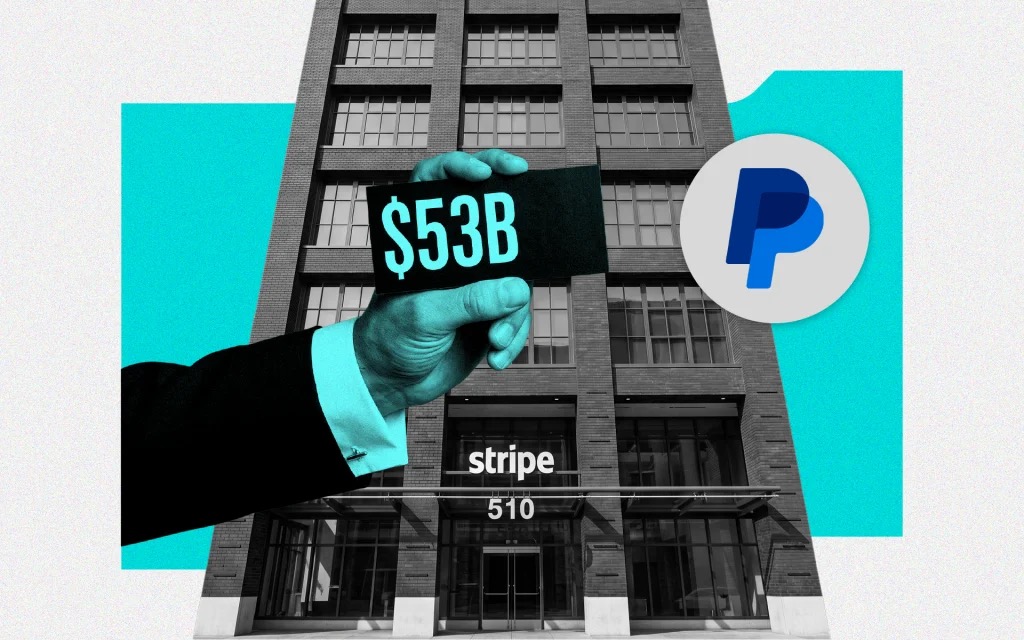
Buy PayPal for $530 billion? Stripe's wishful thinking abacus doesn't work

Buy PayPal for $530 billion? Stripe's wishful thinking abacus doesn't work

Source: Fintech Blueprint Compiled and organized by BitPushNews payments giant Stripe and private equity firm Advent International, as well as other potential players such as Block, are planning to privatize PayPal. PayPal is currently a $50 billion publicly traded company, which is far from its peak of $360 billion. As a comparison, card giants Mastercard (Mastercard) and Visa both have market capitalization of around $500 billion. Stripe's competitor Adyen's market capitalization fluctuates around $35 billion. Going public can be a tough job. Stripe can enjoy its $160 billion private equity valuation and much less demanding venture capitalists. The idea is that a consortium formed by Stripe and Advent will package a leveraged buyout plan for PayPal's entire open market capitalization, with a small premium — including approximately $17 billion in equity, $36 billion in debt, and other capital, for a total of $53 billion. It's unclear why Stripe isn't directly buying the company in its entirety, but this merger may have monopoly concerns. The entity will operate independently, but will obviously be jointly owned by all parties. This is similar to Tempo's gameplay, which targets retail consumers as an independent but controlled subsidiary of Stripe and takes out one of its smaller competitors (Venmo/Braintree legacy assets). The following numbers... do they mean something? Stripe is second only in size to Visa and Mastercard. If you look at the stock's performance over the past 5 years, you'll also notice that only the card organization has retained value, while the rest of the payment processing stack is in a state of loss. You might be asking why? Because they're in a very different position in the value chain. These networks have full market penetration in a duopoly, so they are used whenever and wherever there is anything new happening in the payments sector. The only exception is cryptocurrencies. So whether it's PayPal, Stripe, or Adyen, it doesn't matter to Visa or Mastercard. They will grow no matter what, so they are immune to competition for market share among their upstream service providers. So downstream, you have Stripe, PayPal, and Adyen, which all have transaction volumes between $1.5 trillion and $2 trillion, but the three have very different rates of change and growth. PayPal is managed by professional managers, and its talented startup gang — Elon Musk (Elon Musk) and Peter Thiel (Peter Thiel) — have apparently left long ago to run the world and launch space rockets. Stripe, on the other hand, still runs on the founder's aura (mana) and outperforms professional managers at all times. Let's take a look at these companies from a high level of fundamentals. From a revenue perspective, PayPal is the larger company—with total revenue of $33 billion, of which net revenue was $150 million. But its transactions are valued at only 1.2 times the total revenue multiple, as it has been struggling to grow and has instead been eaten by various competitors, from Stripe to the impenetrable Google Pay and Apple Pay. Once hyperscale businesses have devoured a feature, good luck in retaining your independent market share. Moreover, all payment processing startups targeting the checkout process are actually stealing PayPal's job. Stripe, on the other hand, continued to grow, and with its $6 billion revenue, its transaction valuation reached a revenue multiple of 27 times, almost 3 times that of its listed counterpart Adyen. This whole thing is a game of price-earnings ratio/valuation multiples, and multiples are a derivative of the cost of capital, which in turn depends on growth expectations. It's unclear if PayPal can do better, but this isn't a particularly good result. Maybe Tether and Circle can create a consortium, buy it for $100 billion, then stuff it with stablecoins and DeFi...

36d agoWendy#DeFi #Paypal #stripe #public #mergers and acquisitions #Stablecoin d
Not about feelings, just about efficiency: Why does traditional finance only need “blockchain” and not “DeFi”?

Not about feelings, just about efficiency: Why does traditional finance only need “blockchain” and not “DeFi”?

Written by Christian Crowley and Pyrs Carvolth Original title: Traditional finance doesn't want decentralized finance (DeFi); it wants blockchain. Many people thought traditional finance would embrace DeFi, and the two eventually merged into some kind of elegant hybrid. The truth is even harsher: Wall Street only wants to use blockchain to reduce costs, improve efficiency, and seize customer relationships, but it will never relinquish control. This is not a compromise, but a carefully designed architectural choice that is spawning a new category — programmable financial infrastructure. An almost classic future story circulates in the crypto industry: DeFi and traditional finance will merge, unlicensed liquidity will meet the distribution capacity of institutions, and eventually create an elegant hybrid that combines the best of the two — the new system will replace the old one. It's a reassuring story. But it's basically wrong. The more honest version is: as long as blockchain can make existing businesses of traditional finance better, it will be used. Not because it embraces decentralization, but because it's a compelling cost-cutting story — the technology just cuts costs, improves settlement, expands distribution, and tightens its control over customer relationships. That means institutions aren't merging with DeFi. Instead, they are selectively using parts of DeFi that meet their own operating constraints and discard those that don't; they are reconfiguring DeFi around institutional needs. The results are unlikely to be like traditional finance, or DeFi today. We're beginning to see the emergence of a new category, built on the blockchain track, but optimized for institutional constraints: programmable financial infrastructure. This dynamic is likely to evolve as regulatory frameworks mature. Legislation like the CLARITY Act may eventually make it easier for agencies to directly access unlicensed systems. But no matter what becomes legally possible, the risk attitude of traditional finance will not be reset overnight. Institutions will still adopt technology from a perspective that matches cost, risk, control, and operations — which is why this presents the industry with two opportunities rather than one. The first opportunity is to help agencies adopt the infrastructure they are ready for today. Every primitive used by the institution — from atomic settlement to programmable money to tokenized collateral — is validating the technology, building shared tracks, and bringing real transaction volume and capital to the chain. The second opportunity is to continue building an open, crypto-native financial system that institutions are not ready to use. It's not a competitive bet. They can and should exist in parallel, and if done well, each enhances the other. Open networks and ecosystems will continue to produce the primitives, markets, and innovations that institutions will eventually adopt. If both are successful, integration will naturally occur — not because one system completely replaces the other, but because both are increasingly dependent on the same underlying infrastructure. What does traditional finance actually do? Traditional finance uses a primitive phrase and needs to simultaneously satisfy two things: improving cost, risk, or distribution, and being compatible with control and accountability. Primitives discarded by the agency — open access, pseudonym, immutable execution — passed the first test but failed the second. That's why the adoption pattern is predictable rather than arbitrary, and why builders can use it as a design test. In other words, if a feature can only deliver value by removing institutional control, no matter how elegant it is, it will almost certainly be reshaped or rejected. Let's test some primitives. Atomic settlement narrows the gap between transactions and finality, eliminates counterparty risk, and releases collateral that institutions have parked for unsettled transactions. Shared ledgers turn the biggest hidden cost in the back office — reconciliation — into something you don't need to do. Programmable money allows coupon payments, deposit recovery, and corporate actions to run as code rather than a series of manual instructions. AMM curve math, stripped of its permissionless shell, re-emerged as a pricing engine for net value in on-chain forex and tokenized money markets. Each improved the numbers on the income statement or eliminated an line of operational risk and associated costs, yet none required institutions to believe in decentralization. So let's explain exactly what's happening with J.P. Morgan's institutional deposit-licensing blockchain, or BlackRock and Franklin Templeton's tokenized money market funds: these aren't corporate experiments with DeFi. They're using blockchain to do what they already do—settling interbank payments, managing fund subscriptions, and distributing interest-bearing tools—but using better channels. These deployments use blockchain's technical attributes (programmability, transparency, atomic settlement) and deliberately discard the original...

38d ago谢伟伦#DeFi #blockchain #finance
Circle CEO 10,000 words long article: The agent economy is reconstructing everything, and the corporate era will come to an end

Circle CEO 10,000 words long article: The agent economy is reconstructing everything, and the corporate era will come to an end

Author: Jeremy Allaire, Co-founder and CEO of Circle Compiled by Jia Huan, ChainCatcher Original title: Circle CEO 10,000 characters long article: The Agent economy is disrupting value creation and circulation 1. Technology integration and the dissolution of companies Every platform-level transformation in the Internet era does not rely on a single invention, but several mature technologies collide at some point. The birth of the Web required a graphical interface, a commercial open Internet, a sufficiently fast modem, and an open software layer of web pages, links, and servers. Digital media, mobile internet, cloud computing, and social platforms all follow the same path. There is a recurring pattern behind this: when multiple capabilities are integrated, the marginal cost of an otherwise expensive activity will collapse to close to zero; once the cost collapses, the speed of this activity will explode. The Web has detonated the speed of information publication, mobile and social networking have detonated the speed of interpersonal communication, and cloud computing has detonated the speed of software production and delivery. Now, two new “operating systems” are being integrated, applying the same mechanisms to two things that the Internet has never natively digitized: intelligence and economic activity itself. The first is an intelligent operating system, that is, artificial intelligence in the form of a basic model and an agent system built on it. The second set is an economic operating system, or blockchain network, where values, contracts, and collaboration can be expressed and executed with software. The former reduces the cost of cognition and work to zero; the latter reduces the cost of transactions, settlements, and collaboration to zero. The two reinforce each other. Intelligence enables economic activity to run at machine speed, and the economic foundation allows machine intelligence to trade, exchange value, collaborate, and execute contracts. The core assertion is that the smart economy and the on-chain economy are not neighbors, but the same economy. The two are converging into a force to reshape the global economic system. Let's look at smart operating systems first. It is comprised of cutting-edge foundational model capabilities, as well as inference and agent infrastructure that enables models to execute at scale. Today, representatives include platforms such as Claude and Claude Code, OpenAI, and Codex. This is a new type of computer: instead of programming in traditional ways, it uses natural language to give instructions to produce results and complete work. The atomic unit of this type of work is an intelligent body, that is, a reasoning process that is sent to perform a certain task. Why is this important? First, let's look at what the company actually is. Without brands and buildings, a company is an information system organized around a set of familiar functions: product and engineering, marketing, sales, talent, finance, legal compliance, operations, and customer service. The vast majority of the cost of maintaining this system comes from manpower. Looking at the economy as a whole, manpower is the largest single operating expense. It usually accounts for one-quarter to one-third of revenue, and the service sector accounts for a higher proportion. Among intellectual and technology companies, this is almost absolute: almost all non-capital expenses are wages. In other words, such a company is essentially an “organized perception with a logo attached to it.” There is also a second huge market outside the company's walls: professional services such as consulting, lawyers, accounting, and agency agencies. In the end, it is also organized manpower rented from outside. These two huge cost pools are the target targets of intelligent operating systems. This is why the smart economy is disrupting classic business theories. Economists have long used transaction costs to explain why companies exist: the costs of coordinating, signing contracts, and trusting external labor are too high, so companies internalize “do it yourself cheaper.” Company boundaries are essentially delineated by coordination costs. When every non-physical work unit can be completed by an intelligent entity that can be discovered, contracted, and settled instantly, coordination costs begin to collapse, and the company's traditional boundaries become meaningless. The most intuitive result is a one-person company: one person directs a group of intelligence agents to do work that previously required multiple departments. Small, highly leveraged teams will also appear within large companies to execute the business on a scale far exceeding their own preparation. Economic accounts continue to be compounded because the three exponential curves are moving simultaneously: cognitive work continues to be transferred to smart devices, and the share of manpower in operating costs is declining; the cost of operating intelligent devices continues to drop, and the price of the same machine intelligence drops by about an order of magnitude every year; at the same time, the ability of intelligence continues to improve on almost all benchmarks. The combination of cheaper, more powerful, and more costly will unlock huge production potential. This disintegration will not happen evenly. It first appeared in software engineering because today's models are extremely good at understanding and writing code. Meanwhile, it...

39d agoWendy#Circle

PayPal USD officially launches Polygon chain

According to Twitter, Paxos announced that PayPal USD (PYUSD) is officially distributed natively on the Polygon chain and provides services to the market through Polygon's Open Money Stack (Open Money Stack). The move aims to provide institutions and enterprises with an on-chain dollar settlement solution under federal supervision, covering deposit, withdrawal and compliance functions. The Polygon chain currently has an average daily stablecoin settlement amount of more than 2.5 billion US dollars, and the total settlement amount exceeds 2.6 trillion US dollars. PYUSD is issued by Paxos, a national trust licensing agency under the supervision of the US Monetary Commission (OCC). This article is sponsored by GENG, Build Your Fortune on GENG (https://geng.one)

44d agoburnking

Decentralized AI protocol Prime Intellect closes $130 million Series A round led by Radical Ventures

Comparatively, decentralized AI protocol Prime Intellect completed Series A financing of US$130 million, led by Radical Ventures, with NVIDIA Ventures, Intel Capital, Dell Technologies Capital and existing investors participating, with a cumulative total of over US$150 million to build an open super-smart stack. Established in 2024, Prime Intellect is dedicated to building an “open super smart stack” to provide enterprises with a full-stack AI agent development infrastructure covering computing, large-scale reinforcement learning, sandboxing, evaluation, and deployment. Customers include more than 6,000 enterprises and startups such as Ramp and Zapier, with annual revenue exceeding $100 million. The company plans to expand the scale of computational clusters and reinforcement learning, and bet on cutting-edge directions such as long-term agents, recursive language models, and continuous learning.

44d ago#financing