


2036: The world we will face in ten years

Source: Tiger Research
Authors: Ekko an, Ryan Yoon
Compiled and organized by: bitPushNews
Translator's Note/TL; DR
Using a fictional perspective from 2036, this article reveals the core evolution of blockchain over the next ten years: no longer tell big stories, but fully infiltrate the underlying infrastructure.
Extreme pragmatism (stablecoins): Say goodbye to hype, become an underground hard currency to replace fiat currency in regions with high inflation, and even reverse erode national finance and taxation rights.
Everything can be traded (RWA): Stocks, real estate, and bonds are fully tokenized, and highly leveraged transactions without borders and around the clock have become the daily investment routine of the younger generation.
Major infrastructure cleaning (L2 Bankruptcy Wave): 99% of redundant public chains that are struggling with airdrops and subsidies completely disappeared, and in the end, only a few top monopoly public chains were left behind in the market.
Restructuring internet commerce (Machine economy): AI traffic has surpassed humans, and traditional advertising has completely failed; with the rise of micropayment protocols (x402), AI agents have become the main source of monetization for Internet content.
The following is the text:
----------
Blockchain technology has not changed the world as of 2026. But will it bring about significant changes by 2036?
All aboard — the time machine is about to depart for 2036.
1. “Does anyone else use banknotes?”

In 2036, Zutopia — a fictional, inflation-prone country — a currency exchange office. Judy, who has been working in this job for 34 years, pulled out a banknote counter from the drawer and began to count Buck notes.
“There are people who use Buck.”
That makes sense. Buck — the currency of this inflation-prone country — depreciates every day. It still exists by law, but no one actually uses it anymore. Everyone uses US dollar stablecoins in their daily lives.
Tick-tick-tock.
Judy listened to the bill counter loudly counting banknotes, recalling all these years.
In 2002, Judy was 22 years old. That year, Zutopia declared that the country had breached its contract. Banks have locked their doors, and people can't withdraw the deposits they have saved for the rest of their lives.
“We have to replace it now.”
Judy's father said. As soon as your salary is paid, you must immediately convert it to US dollars. Even after just one day, Buck's purchasing power will visibly shrink with the naked eye. People look at the black market dollar exchange rate more positively than reading the front pages of newspapers.
“How much is the dollar today?”
This question opens up every day. Buying dollars at the official exchange rate is almost impossible. The government sets a monthly foreign exchange purchase limit for each person, and no one knows when banks will freeze dollar deposits.

Then, in the mid-2020s, young clients started asking her a question she couldn't understand.
“Can USDT be exchanged?”
At first, only a few freelancers and exporters would use it to receive overseas remittances. There is no need for a bank, and there are no long lines in front of the exchange counter. With a mobile phone, you can exchange Bucks for stablecoins, and then exchange them back when needed.
At the time, Judy never thought this would replace her job. Older people still need cash, and so do many businesses. But the team got shorter little by little. Younger clients disappear first, followed by middle-aged people.
By 2030, no one will even line up for payday. Once the company had no reason to hold Buck, they began paying part of their wages directly in stablecoins. Buck has become a currency you only need to pay taxes and utility bills.
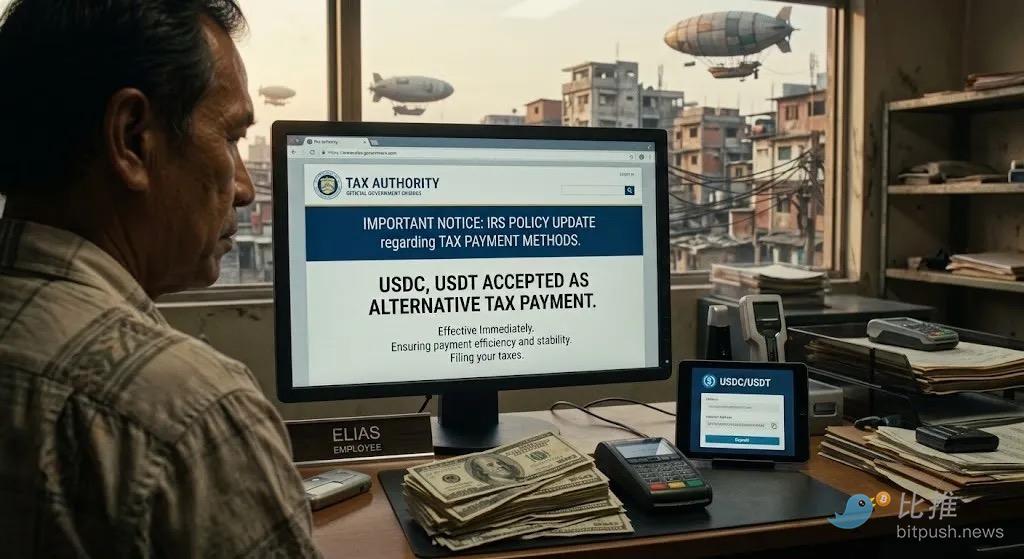
In 2033, the Inland Revenue Department changed its position. The calculation is simple: using stablecoins to collect tax arrears is more cost-effective than collecting Buck. A brief notice was posted on the website:
“USDC and USDT can be used as alternative payment methods for tax returns.”
Buck still exists, but the country itself has just announced that it would rather take other people's money than its own currency.
In 2034, the Ministry of Finance followed suit. The auction of treasury bonds denominated in bucks failed one after another, and the Ministry of Finance eventually issued new bonds denominated in US dollar stablecoins. Civil servants' wages followed closely. In 2035, some state governments will begin to pay half of civil servants' wages in stablecoins — because those who only get paid Buck are the first to be hit by inflation and the hardest hit.
Printing money, collecting taxes, paying public servants — these have always been powers unique to the country. Little by little, this power is being transferred to stablecoins.
As of May 2026, the total market value of stablecoins was approximately US$320 billion, with an annual trading volume of US$28 trillion. Compared to the US wholesale payment network processing more than $2 trillion a day, this is less than three weeks of transaction volume. After excluding market washing transactions and false transaction volumes, less than 6% was actually used for actual payments. The remaining 88% simply circulates within the exchange — transactions, collateral, and back.
The question is where that 6% actually happened. It probably started in New York and Silicon Valley, but the place where that money actually changed hands wasn't the US. Americans live well with credit cards and bank accounts. The people who really need stablecoins are people in countries where currencies evaporate little by little every day.
Judy put the counter back in the drawer. Will there be customers tomorrow?
2. At 2 a.m., it was liquidated for ten minutes
In 2036, a small rental house in Singapore.
 2 p.m. As soon as the notification sounded, Leah looked at her phone. Nvidia's price limit order reminder.
At 2 p.m., Singapore is yet to open the New York Stock Exchange. But on Leah's screen, Nvidia's K-line chart is still beating. She clicked BUY without hesitation. On the same screen, Nvidia has a panoramic view of treasury bonds, real estate REITs, and data center infrastructure funds lying next to it.
By 2036, you won't just be able to trade stocks — you can trade everything in the world.
“Investing never stops, no matter where you are.”
This is what Leah used to say. For her, the world has always been like this.
In 2021, when Leah was nine, US retail investors took the stock price of physical game retailer GameStop to the skies. It's an investment act, and participation itself is more important than asset value — and it is not a brokerage firm that organizes this kind of participation, but an online community.
According to a 2025 World Economic Forum survey of 13 countries, 30% of Gen Z will start investing as adults — far more than Gen X (9%) and Baby Boomers (6%). Gen Z is so interested in investing. 86% of people have learned how to invest before entering the workplace, compared to only 47% of baby boomers.
In the Coinbase Q4 2025 survey, 73% of young respondents said it was difficult to build wealth through traditional methods — higher than 57% of older adults.
For this new generation, investing has become a matter of course — they want access to more and more assets.
2025/6 Tokens with 1:1 collateral for major US stocks — Apple, Tesla, Nvidia — are flooding into decentralized exchanges (DEX). There are no nationality restrictions and no strict KYC checks. You only need a wallet address, US stocks are within easy reach, and in theory there is no upper limit on leverage.
Just try again tomorrow.
Leah signed in to Lemming Brothers, a borderless trading platform, to buy a Korean real estate tokenized index product. Ten minutes later, a liquidation notification popped up on her phone. She simply crossed off the warning on the screen as if it were all right.
For Leah, the 2036 phone notifications are like background music for everyday life. She glanced at the steady stream of signals in the trading app and picked up her phone again. This is in stark contrast to her parents — they only buy so-called “safe assets” in regular fixed amounts on regulated exchanges.
In the world that Lia lives in, every value is transformed into an asset and flows uninterrupted 24 hours a day. This huge, never-ending market tempts her day after day to the next deal — today, just like every day.
3. The day $2.2 billion evaporated
In 2036, the office of a startup company in Itabashi Techno Valley.

Do-hyun, an infrastructure engineer who has been in the business for 12 years, was looking at the network status dashboard on the monitor and suddenly stopped working. Looking at the public link list, which can now be displayed in full on one screen, he whispered to himself:
“Ten years ago you had to keep going backwards. Now there aren't even ten left.”
2024, the year Do-hyun began his career as an engineer, was the Age of Discovery for Layer 2 (L2) Rollup. Anyone can copy and paste a few lines of framework and stack code to launch a blockchain in their own name. Daohyeon's company has also taken advantage of this wave of infrastructure and is constructing validator nodes in a big way.
That chain is called Allchain. In June 2024, due to airdrop expectations, the total hedged volume (TVL) swelled to $2.2 billion. He still clearly remembers the scene where he clashed glasses and cheered with the team in the conference room.
“Following this trend, aren't we going to be the next Ethereum?”
But the joy of going online was fleeting. After the token was listed and the airdrop rewards were exhausted, the token price and on-chain usage fell precipitously. Those projects and users chasing rewards turned away the moment Allchain stopped “throwing money”. In just one year, 97% of their deposits evaporated.
Allchain's disastrous end is no exception. The countless independent networks that sprung up back then all collapsed in the same way. They lure development teams with rich incentives, but once funding is exhausted, the ecosystem instantly becomes hollow, leaving only a silent and empty infrastructure shell.
The huge fixed costs of running an independent chain are unbearable for a single project. Unable to support soaring infrastructure maintenance fees, Allchains announced shutdowns one by one, quietly entering history.
Only a very small number of survivors have endured a severe test of capital. Those hundreds of public chains that once seemed to change the world split less than 10% of the market share and then went extinct silently.
“At that time, we all thought we could survive and build a huge ecosystem...”
Back in 2026, people mistook the number of public chains for blockchain scalability itself. But a fragmented chain will only disrupt the user experience and push security costs to sky-high prices. What people really want is not a few hundred complex networks — but a few large basic infrastructures that provide unbreakable liquidity and optimal speed.
Do-hyeon-jang sighed, closed the monitor gently, picked up his bag, and set out on his way home.
4. Those human eyes that used to “click” are gone
In 2036, the office of a media startup in Sangam-dong.

When Ho casually browsed another platform, he saw a banner ad in the lower right corner and laughed.
“There are also companies that put up banner ads on the screen and wait for readers to see them.”
Jae Ho was right. The platform's daily traffic is at a record high every month, but traditional banner ad revenue just can't come in, so the entire advertising model is a thing of the past.
In the early 2020s, when Hao first entered the media industry, the formula for the online economy was very clear: write a good article, and readers will come. When readers come, advertisers spend money to buy banner positions.
“How many page views are there today?”
This question, which starts every morning in the conference room, decided the life and death of a media outlet at the time.
But that calm formula began to unravel in the late 2020s. By 2029, more than half of the world's web traffic will no longer come from humans, but from AI agents and robots. The AI will grab an article and summarize it within a second — but the machine doesn't have “eyes” at all to see the banner ad.
At first, like most media companies, they blocked these bots. Server costs have skyrocketed, and they can't help it. But the blockade has paid a painful price. After being completely buried outside of the AI search and recommendation ecosystem, their brand was simply forgotten. Media companies were faced with a painful choice at the time: block bots and then lose traffic, or keep their doors open and make no money.
“Who are we selling our content to?”
That desperate question filled the office. The answer isn't a billboard—it's about putting a price on the content itself.
What opens the floodgates of change is the x402 standard released by Coinbase in May 2025. Through technology, it revived the HTTP 402 response code — the “payment required” signal that had been abandoned in the Internet standards corner for 30 years.
Until 2029, the focus has been on building basic infrastructure: KYA (Know Your Agent) verification, settlement tracks, etc. The real explosion began in 2030, when a media company began selling data directly to AI through the x402 system. After this model was successfully verified, other media and data companies spared no effort to adopt x402, and jumped into the data sales ranks themselves.
There was a lot of ridicule at first — a small amount of money, tens of won at a time, it wasn't worth the effort at all. However, once hundreds or even millions of machine calls are piled up every day, real money begins to flow into the account continuously, far exceeding the revenue generated by banner ads in the past.
“There's no need to look at the advertiser's face anymore — the machine pays the full price, and the company runs on it.”
The old online model of using the human eye to capture attention to sell advertisements slowly came to an end. The machine economy, where agents trade through APIs, is fully on the right track.
In Ho, turn off the dashboard and pick up the coffee cup. The visitor curve still depicts that strange, almost vertical climbing trajectory, which is completely unreasonable by old standards — but now it's commonplace. He stopped checking how many people visited. He looked at how many AI agents paid today.
Tomorrow, hundreds of thousands of agents will once again knock on the doors of his server, and that stream of honest transactions — won't be short, never.
Twitter:https://twitter.com/BitpushNewsCN
Compare the TG exchange group:https://t.me/BitPushCommunity
Compare TG subscriptions:https://t.me/bitpush
