
孙宇晨 · 1181

Sun Yuchen Says Lawsuit Against WLFI Is About Blockchain Ownership Principles

Comparing news, Bochang founder Sun Yuchen wrote that his lawsuit against World Liberty Financial (@worldlibertyfi) was ostensibly a commercial dispute involving 45 million US dollars and 4 billion tokens, but it was essentially about blockchain's founding principles. He pointed out that the industry is built on “your keys, your coins,” meaning that everyone can actually own their own assets without permission. Sun Yuchen said that the case revealed that the other party secretly embedded the power to freeze users' assets in the contract. There was no disclosure, no governance, no procedure, and that their tokens were unlocked for use within a few days. He believes that this is contrary to the name of “freedom”. If the issuer were to seize holders' assets at any time, blockchain would be no different from the old world. He will carry out the lawsuit to the end, not only to recover assets, but also to establish a precedent in court that “your assets must really belong to you”. This article is sponsored by GENG, Build Your Fortune on GENG (https://geng.one)

5h agoburnking

First Digital CEO responds to Sun Yuchen's latest remarks: Sun has not shown any evidence to support it in court

Comparing news, First Digital CEO Vincent Chok tweeted in response to Sun Yuchen's remarks about FDUSD in the WLFI lawsuit on the same day, saying the content was untrue. In particular, in the 16 months since the relevant charges were filed, Sun Yuchen has never presented any evidence in court. Previously, First Digital had filed a defamation lawsuit against Sun Yuchen in Hong Kong in April 2025, and the case is still pending.

1d ago

WLFI Co-Creation: Sun Yuchen fictionalized a “major court victory”, and the court made no ruling at all

Comparing news, WLFI co-founder Zach Witkoff wrote an article stating that Sun Yuchen's claims about the latest trial results contained many false statements. Sun Yuchen previously claimed that the court supported his position and described the result as a “major victory,” but in fact, the court did not make any ruling. Zach claimed that Sun Yuchen packaged “personal claims for the time being in court” as a victory, but WLFI never requested that his individual claim be submitted to arbitration. WLFI's motion to dismiss these individual claims is still pending in court. In other words, the “court support” and “major victory” that Sun Yuchen claimed did not exist.

1d ago

Sun Yuchen's WLFI dispute was upheld by the court, and individual claims will be tried publicly

Comparing news, Sun Yuchen wrote that his lawyer recently appeared in California federal court to oppose World Liberty Financial (@worldlibertyfi)'s request to forcibly transfer the dispute between the two parties to confidential arbitration and seal the documents. The court ruled that all of Sun Yuchen's individual claims would continue to be tried in open court; at the same time, it rejected the opinion that all company-related claims should be submitted to arbitration, and requested both parties to negotiate to determine which claims remained in court and which went to arbitration. Sun Yuchen called this a major victory, stressing that token holders have the right to understand how the project treats their trusters. Sun Yuchen said that as one of World Liberty's earliest and largest investors, it invested 45 million dollars to obtain $WLFI tokens. The lawsuit alleges that after the investment helped raise about 550 million US dollars in token sales, the project party secretly implanted a back door in the smart contract, which could unilaterally freeze, restrict, or destroy holders' tokens, and illegally seize their tokens based on this, and also threatened criminal reporting when defending their rights. The lawsuit claims amount to hundreds of millions of dollars. He has previously obtained a court injunction prohibiting the other party from destroying and disposing of his tokens. Sun Yuchen also said that World Liberty also implants similar backdoor capabilities into its USD1 stablecoin, and mentioned public information such as the project party's use of a large amount of $WLFI tokens as collateral for Dolomite loans and past Dough Finance-related lawsuits by the co-founder, expressed concern about the solvency and transparency of the project, and called on investors to exercise due diligence and caution. The above are all unilateral statements and accusations.

1d ago
Sun Yuchen's worth = 2 Wang Jianlin; Zhang Yiming secretly sarcastically at DeepSeek? Yushu's IPO made Liang Wenfeng lie back and win...

Sun Yuchen's worth = 2 Wang Jianlin; Zhang Yiming secretly sarcastically at DeepSeek? Yushu's IPO made Liang Wenfeng lie back and win...

Dear readers, what have the KOLs on X been talking about in the past 24 hours? Note: The following content is compiled from the X platform. They are all personal opinions. They do not represent the platform's position, let alone constitute investment advice. Brother Sun is worth twice as much as Wang Jianlin's AI Agent's ideal and reality Zhang Yiming secretly sarcastically Deepseek?! Yushu Technology's IPO, Liang Wenfeng won against China's rich again and made up taxes! Twitter: https://twitter.com/BitpushNewsCN比推 TG Community: https://t.me/BitPushCommunity比推 TG Subscriptions: https://t.me/bitpush

15d agoWendy#KOL

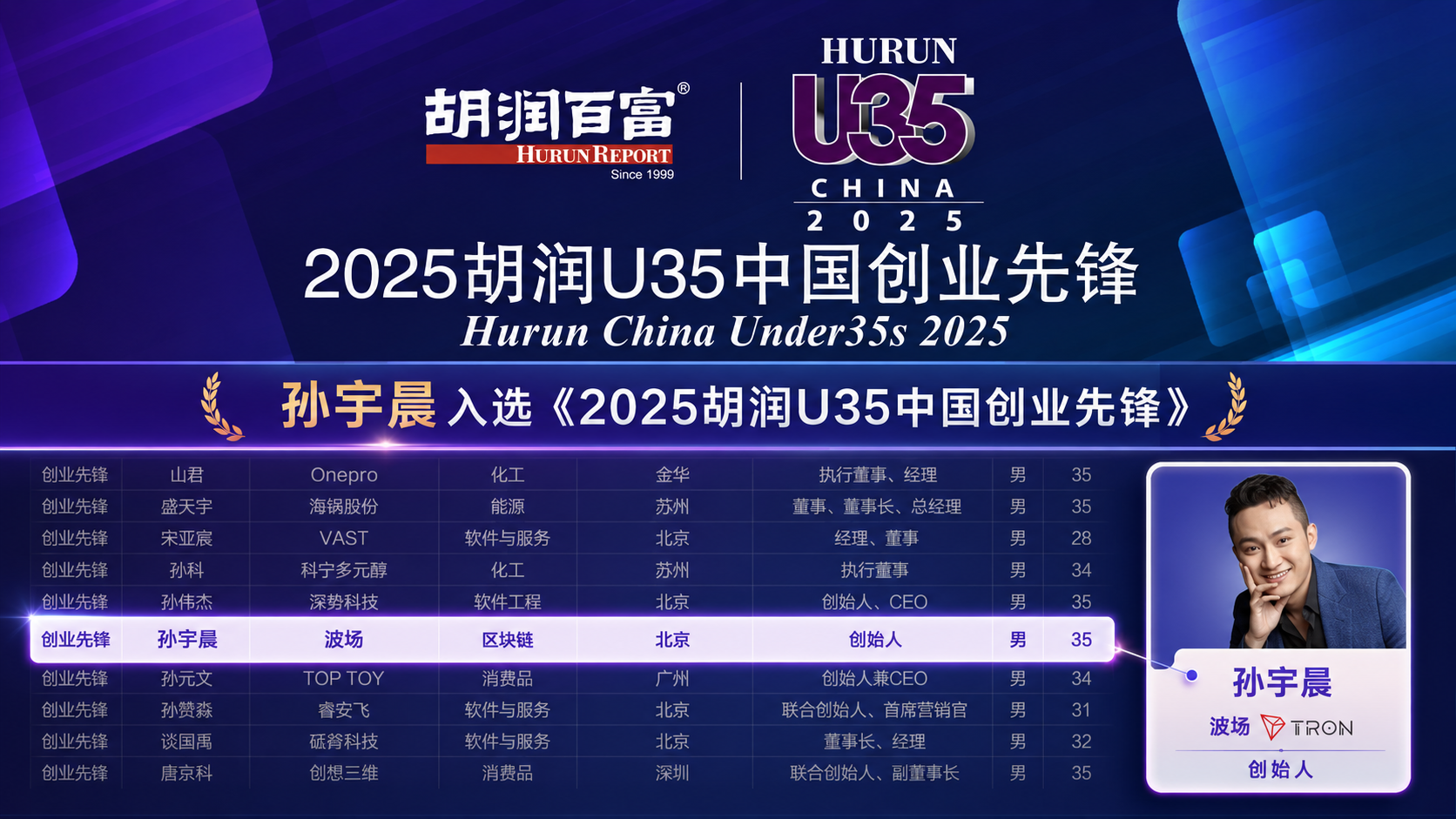
Sun Yuchen was selected as Hurun's U35 Chinese Entrepreneurial Pioneer, and Bochang TRON ranked first with a market capitalization of 2275 billion yuan

Comparing news, Hurun Research Institute released “2025 Hurun U35 Chinese Entrepreneurship Pioneer”, and Sun Yuchen, founder of Bochang TRON, was selected. According to the list data, Bochang TRON's enterprise value reached 2275 billion yuan, ranking first among U35 start-ups on the list, accounting for nearly half of the total value of all U35 generation startups on the list, showing its scale advantage and infrastructure value in the global blockchain industry. Currently, the circulation of TRC20 - USDT on the TRON chain has exceeded 90 billion US dollars, continuing to strengthen its important position in the global stablecoin issuance and settlement network. In an exclusive interview with Hurun Baifu earlier, Sun Yuchen said that innovation that can truly cross the cycle must be supported by real demand. This selection further reflects its long-term entrepreneurial practices, global vision, and the leading influence of Wavefield TRON in the Web3 ecosystem.

43d ago
Hurun U35 list released: Sun Yuchen selected, Bochang TRON ranked first in the value of starting a business

Hurun U35 list released: Sun Yuchen selected, Bochang TRON ranked first in the value of starting a business

Recently, Hurun Research Institute released “2025 Hurun U35 China Entrepreneurship Pioneer”. Sun Yuchen, founder of Bochang TRON, was selected based on his long-term practice in blockchain infrastructure, stablecoin payments, and global innovation. According to data from Hurun Research Institute, the value of the wave field reached RMB 227.5 billion, ranking first among U35 start-ups on the current list, accounting for nearly half of the total value of all U35 generation startups on the list. This significant leading edge further highlights Sun Yuchen's representation among young entrepreneurs in China and the infrastructure-level value of Bochang TRON in the global blockchain industry. Leading the corporate value list, long-term entrepreneurial practices have been recognized by authorities. “Hurun U35 China Entrepreneurship Pioneer” aims to find young entrepreneurs aged 35 and under who have both growth and social influence. A total of 187 people were selected this year, of which 116 are first-generation entrepreneurs, covering cutting-edge fields such as artificial intelligence, life and health, advanced manufacturing, and digital technology. As an important part of Hurun's “U Series”, previous editions of the list have discovered strong brain technology Han Bicheng, Shangtang technology Xu Bing, Bilibili Xu Yi, Keep Wang Ning, and representatives of the new economy such as Yang Zhilin, MiniMax Yan Junjie, and Zhiyuan robot Peng Zhihui. In this year's list, Sun Yuchen led a generation of entrepreneurs with Bochang TRON's corporate value performance. Hurun Research Institute's valuation of Wave Field reached 227.5 billion yuan, while the average value of current U35 generation startups is 4.2 billion yuan; if Wave Field is excluded, the average value of the remaining enterprises is 2.2 billion yuan. Bochang alone accounts for nearly half of the total value of all U35 generation startups on the list, reaching 47%, reflecting that after years of development, it has grown from a blockchain startup project to a digital infrastructure with global user scale, network effects, and continuous application requirements. Sun Yuchen founded Bochang TRON in 2017 and continues to promote its implementation in the fields of stablecoin circulation, on-chain payments, decentralized finance, and the global developer ecosystem. Previously, in an exclusive interview with Hurun Baifu, he summarized his entrepreneurial goal as to enable anyone in the world, no matter what country they are in or whether they have a bank account, to transfer and use their own funds easily and inexpensively. This vision also forms the core logic of Wavefield TRON's long-term development path. TRC20-USDT surpassed 90 billion US dollars, and real demand forms the basis for value, TRON's corporate value, based on continuously expanding demand for on-chain applications and stablecoin settlement. Since cooperating with Tether to issue TRC20-USDT in 2019, Bochang TRON has gradually become an important global USDT issuance, transfer and value settlement network due to its characteristics such as fast transfer speed, low processing fees, and stable network operation. According to the latest data, TRC20-USDT circulation on the Bochang TRON chain has officially surpassed 90 billion US dollars, setting a new historical record, accounting for about 48% of the global USDT circulation; the number of accounts held has exceeded 74.9 million, and the cumulative number of transfers has exceeded 3.5 billion. At the same time, the total number of accounts on the Bochang TRON network has exceeded 390 million, and the cumulative number of transactions has exceeded 14.6 billion. The global user base and network effects continue to expand. In an exclusive interview with Hurun Baifu, Sun Yuchen said that things that can actually cross the cycle must be supported by real needs. Every round of market adjustments will eliminate noise and bubbles, but the number of users and on-chain transactions continues to grow, indicating that the problems solved by blockchain actually exist. At the same time, he saw the launch of TRC20-USDT in collaboration with Tether as a key decision in the development of the wave field, and concluded: “If the general trend is right, you must dare to rush, but you must choose the strongest target.” From stablecoin issuance, cross-border transfers, and peer-to-peer payments, to on-chain settlement and the demand for digital dollars in emerging markets, Wavechang TRON is continuously expanding the application boundaries of global value circulation. This time, Sun Yuchen was selected as “2025 Hurun U35 China Entrepreneurial Pioneer”, which not only recognizes his entrepreneurial ability, global vision, and long-term investment, but also further confirms the leading position of WavechangTRON in the global Web3 ecosystem from the two dimensions of corporate value and actual business scale. For more information, see https://www.hurun.net/zh-CN/Info/Detail?num=NYEJQQ9X2ENL...

43d agoburnking#Tron

Data: Sun Yuchen's Ethereum staking scale reached US$430 million, with annualized earnings of about US$9.5 million

According to Onchain Lens monitoring, Justin Sun (Justin Sun) has continued to stake ETH through Lido Finance recently. 23 hours ago, Sun Yuchen once again pledged 13,000 ETH worth about US$23.08 million, bringing his total staking scale on Lido to 247,436 stETH, which is currently worth about US$402 million. According to the data, since February 2023, the pledge position has generated a total of 11,307 stETH staking earnings, worth about US$26.82 million. At the current level of earnings, Sun Yuchen's annualized income from this position is about US$9.5 million. This article is sponsored by GENG, Build Your Fortune on GENG (https://geng.one)
45d agoburnking

Sun Yuchen: The BitTorrent team has completed the BTTC cross-chain bridge retirement plan, and all funds are safe

Comparing the news, Sun Yuchen wrote on the X platform: “The BitTorrent team has informed me that they have completed the BTTC Bridge Sunset Program (BTTC Cross-Chain Bridge Decommissioning Program). In the future, the BitTorrent team will focus more on decentralized AI and the maintenance of the BitTorrent decentralized protocol. All funds are secure, and users can continue to access BTTC Bridge funds through cooperative centralized exchanges.”

45d ago
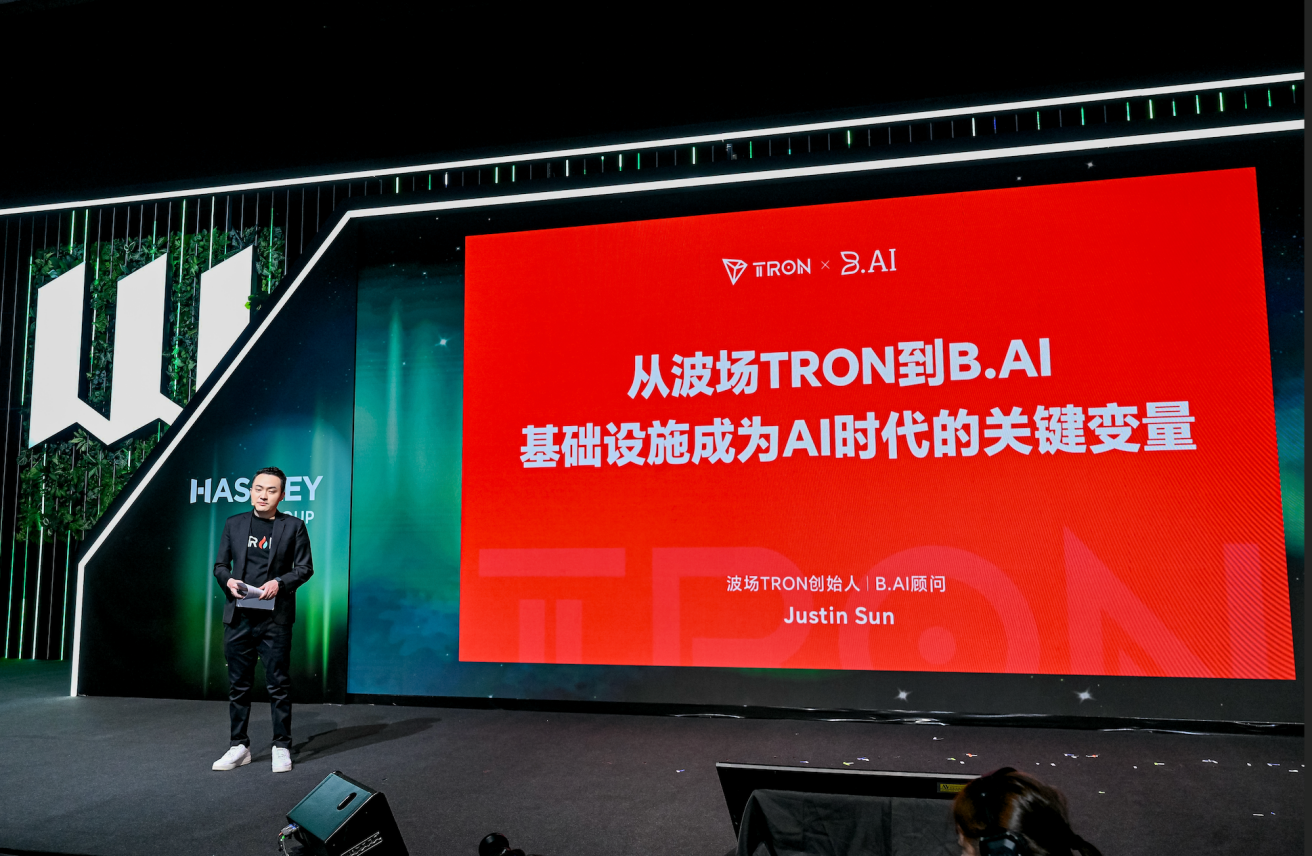
The number of Bai B.AI users exceeded 2 million, and the multi-model aggregation platform entered the refined service stage

The number of Bai B.AI users exceeded 2 million, and the multi-model aggregation platform entered the refined service stage

Recently, Bai B.AI, an AI model aggregation platform, ushered in a new growth node. According to the latest disclosure by Bai B.AI on its X platform's official account, the number of users on the platform has exceeded 2 million. At the same time, the actual call data of the platform is also increasing at the same time: recently, Bai B.AI's single-day token throughput reached a maximum of 18.69 billion, and the proportion of API calls rose to 99.7%, mainly carrying large-scale AI agents, automated processes, and enterprise-level core system applications. This means that the growth of Bai B.AI is no longer limited to front-office conversation scenarios, but is deepening into high-frequency scenarios such as developer calls, agent operations, and production-level system access, forming more sustainable actual usage consumption. The competitive focus of the global AI industry has changed over the past year. With the rapid iteration of large model capabilities, users and developers are no longer only concerned about whether a certain model is strong enough, but more concerned about how to efficiently choose between different models, how to control token costs, and how to stably connect AI capabilities to real business processes. The model aggregation and routing platform represented by OpenRouter continues to receive attention, indicating that multiple model coexistence has become an important direction for AI application development. The growth of Bai B.AI further points to another trend: AI model aggregation platforms are moving from a “unified portal” to more detailed service layers. The platform must not only provide model calling capabilities, but also allow different users to make more flexible choices between stability, price, payment habits, and usage scenarios. Multi-model calling is becoming more refined. In the context of the rapid expansion of the large model ecosystem, Bai B.AI enhances service hierarchical capabilities. Complex reasoning, code generation, long text processing, multi-modal tasks, and low-cost high-frequency calls often correspond to different model capabilities. For ordinary users, switching accounts, subscriptions, and payments between multiple platforms is inefficient; for developers and enterprises, connecting to different models separately can also bring additional engineering costs, billing pressure, and stability challenges. Bai B.AI cut right into this pain point. As an AI model aggregation platform, Bai B.AI connects to various mainstream models through a unified portal and provides API services compatible with mainstream calling methods, making it easy for users and developers to complete model selection, call, and cost management on the same platform. Compared with a single model portal, Bai B.AI places more emphasis on using AI services according to scenarios: for production-level applications with higher stability requirements, more standardized and more stable official access can be selected; for cost-sensitive scenarios such as testing, exploration, AI agents, and batch calls, more flexible pricing plans can be obtained through optional service providers. This design also makes Bai B.AI's differentiation even more clear. According to Bai B.AI's official X platform information, the optional service provider model currently provides different discount groups such as 10% off, 40% off, and 20% off, covering mainstream model series such as Claude, Gemini, GPT, Kimi, and GLM, and can be used in combination with recharge giveaways. In other words, Bai B.AI does not only provide a fixed price model entry, but rather splits AI services into different consumer levels: core production operations prioritize availability, and test environments and high-frequency call scenarios place more emphasis on cost efficiency. For developers, the value of this model is not “more models,” but rather the ability to choose a more suitable service path based on task importance, call frequency, and budget constraints. The diversification of payment methods also serves this logic. Bai B.AI is currently compatible with WeChat, Alipay, bank cards, and commonly used fiat payment routes such as UnionPay, Visa, Mastercard, Google Pay, and Apple Pay. It also supports multi-chain multi-currency cryptocurrency payments. Compared to a single payment method, this arrangement is more suitable for covering users in different regions and with different usage habits, and also helps lower the conversion threshold for developers and high-frequency subscribers from testing to continuous use. Previously, public data showed that the proportion of Stripe payments in the core payment group of the platform rose to 69.0%. Combined with the increase in the share of API calls, it also reflected on the side that the usage stickiness of traditional developers and production-level users is increasing. Behind the high proportion of APIs, Bai B.AI is entering a deeper developer scenario. Judging from the usage structure, Bai B.AI recently accounted for up to 99.7% of API calls, and more of the platform consumption comes from developer interfaces, automated tasks, AI agent workflows, and enterprise-level system calls. Previously disclosed data also showed that the DeepSEEK-V4 series once contributed nearly 60% of tokens...

48d agoburnking