
摩根大通 · 2856

J.P. Morgan warns of the risk of a fall pullback in US stocks, the AI boom may repeat the 2000 tech bubble

Comparing news, JPMorgan (JPMorgan) warned that although the world's major stock indexes are still on an upward trend, the market may face the risk of a pullback in late summer to early fall. The bank said that recently the internal structure of the US stock market is deteriorating, capital has begun to shift to defensive assets, and investors' confidence in artificial intelligence (AI) related stocks has also weakened. Jason Hunter, a strategist at J.P. Morgan Chase, pointed out that the current AI trading boom is similar to the 1999-2000 tech stock bubble. The market's excessive concentration of positions in the technology sector may increase the risk of adjustment. Furthermore, the continued rise in US Treasury yields, geopolitical tension in the Middle East, and slowing consumer spending have also been identified by J.P. Morgan as potential sources of market pressure. J.P. Morgan believes that the current AI investment cycle still has potential for long-term growth, but market valuations, capital congestion, and investor expectations in the short term may put technology stocks at greater risk of volatility.
22h ago
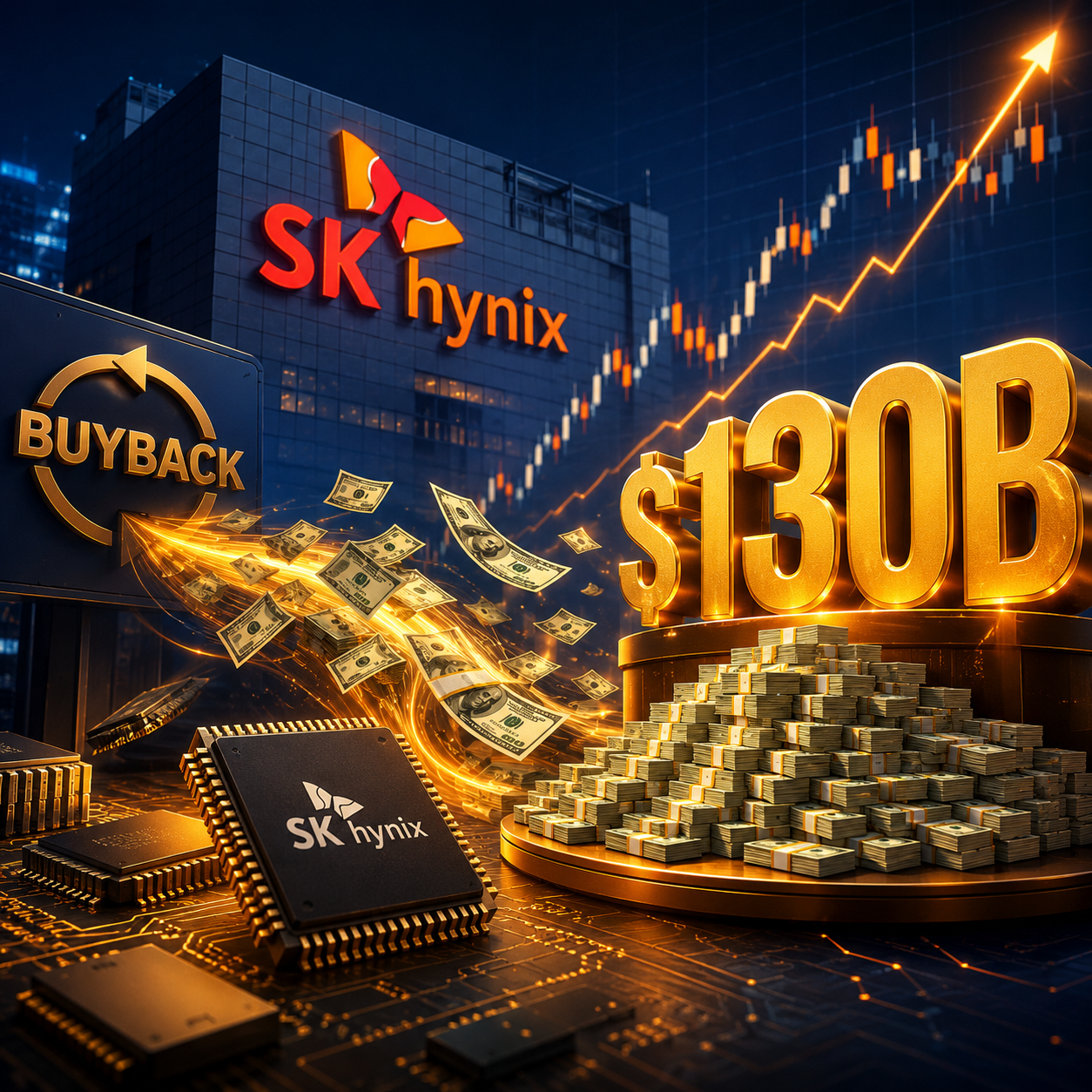
Is 40 trillion just an “appetizer”? The Hynix buyback landed ahead of schedule. Is 130 billion US dollars still ahead?

Is 40 trillion just an “appetizer”? The Hynix buyback landed ahead of schedule. Is 130 billion US dollars still ahead?

Source: Wall Street News Editor: Dong Jing Original title: Wall Street interprets Hynix's repurchase plan: Shareholder return of up to 8% next year, or return at least $130 billion to shareholders by 2027 Summary: J.P. Morgan believes that the shareholder return policy was upgraded from “no more than 50% free cash flow” to “no less than 50%”, changing from the upper limit to the lower limit, sending a clear signal to the market: future shareholder returns will only be greater, not less. Goldman Sachs predicts an 8% shareholder return in 2027, and expects an additional repurchase of approximately 7 trillion won in the future. J.P. Morgan expects additional return of over 16% of its market value by the end of 2027. Follow-up focus will be on the results meeting at the end of October. While the market was still debating the continuation of the AI storage cycle, and SK Hynix's stock price plummeted from a June high, the storage giant suddenly threw a huge bomb on the market. A historic repurchase, which was implemented early, reshaped the market's valuation logic for Hynix! SK Hynix officially announced the market's long-awaited shareholder return policy after closing on August 19, 2026 — it plans to repurchase and cancel 40 trillion won worth of shares, involving 24.07 million shares (3.3% of the shares issued as of the end of the second quarter of 2026), equivalent to about US$28.9 billion. This scale is not only the largest share repurchase in the history of a Korean listed company, but also exceeds the approximately 26.5 billion US dollars that Hynix raised through ADR financing in the US in early July this year. According to Chase Trading Desk, the two top Wall Street agencies, J.P. Morgan Chase and Goldman Sachs, both gave highly positive comments on the announcement in their latest research report on August 20. J.P. Morgan believes that the shareholder return policy has been substantially upgraded from “no more than 50%” to “no less than 50%”, and the policy ceiling has become the policy floor. Following the announcement of a 40 trillion won ($29 billion) share repurchase plan, SK Hynix may return at least $130 billion to shareholders by 2027, according to J.P. Morgan Chase. Goldman Sachs predicts a shareholder return of up to 8% in 2027, and expects an additional repurchase of approximately 7 trillion won in the future. Both J.P. Morgan Chase and Goldman Sachs maintain buying ratings: J.P. Morgan's target price is 2.75 million won (about 84% upside compared to the current price), and Goldman Sachs's target price is 3.5 million won (implying an upward margin of about 133%). The next key catalyst is the third quarter results conference call at the end of October 2026, when the company will reveal a more complete roadmap for shareholder returns. Analysts believe that this aggressive capital action directly proved to Wall Street that the company is “printing money” faster than market expectations. For the stock price, which has plummeted 49% since its high on June 22, this not only completely offset the dilution effect of the recent ADR issuance, but also established a valuation bottom (current annualized price-earnings ratio of only 3.8 times). The scale of the repurchase: The largest in history and earlier than expected. J.P. Morgan analyst Jay Kwon clearly stated that the 40 trillion won repurchase announcement “landed earlier than expected” — previously, the market generally expected the announcement to be released around the end of September, but the company chose to directly disclose it after closing on August 19, showing management's high level of confidence in the company's cash flow situation. In terms of scale, this repurchase has multiple historical significance: 40 trillion won is the largest share repurchase announced by a Korean listed company so far; equivalent to US$28.9 billion, higher than the approximately US$26.5 billion raised by Hynix's US ADR offering in early July, which means that the company actually used the repurchase to “hedge” the previous equity dilution; this amount is equivalent to 63% of the rolling FCF (operating cash flow minus capital expenses) over the past 12 months, & nbsp; It is higher than the previous “no more than 50%” FCF allocation limit policy. At the same time, J.P. Morgan Chase pointed out that if viewed from a valuation perspective, the price-earnings ratio corresponding to Hynix's current stock price is 6.4 times (based on adjusted earnings per share for the past 12 months) or 3.8 times (based on annualized adjusted earnings per share for the first half of 2026). This valuation level can be regarded as a reference benchmark for management to initiate repurchases. Policy upgrade: From “ceiling” to “floor”, the core policy change in this announcement is that the shareholder return ratio statement was upgraded from “up to 50% (no more than 50%)” to “50%”...

1d ago22#SK Hynix #J.P. Morgan Street

Source: Citi may become one of the core underwriters for Anthropic's IPO

Comparing the news, people familiar with the matter revealed that the artificial intelligence company Anthropic plans to bring Citigroup to join its primary underwriting team for its initial public offering. If successful, Citi will co-assume core underwriting roles with Morgan Stanley, Goldman Sachs, and J.P. Morgan Chase. Anthropic is likely to file a listing application with regulators as early as the end of this month.

1d ago
Whoever sings down Anthropic may be disappointed

Whoever sings down Anthropic may be disappointed

Author: Alan Walker, Silicon Valley Original title: Is Anthropic's Growth Slowing Down? Source of controversy. Claude Code ARR tracking chart produced by TickerTrends. The latest data is $15.12 billion for the week of August 10, 2026, accounting for 21.9% of Anthropic's total ARR. Please note: This is an estimate from a third party agency and is not an official disclosure of Anthropic. The first section below explains how important this difference is. Alan Walker from Silicon Valley made an appointment for dinner in Hong Kong. After some hard work, he discovered that this picture had been retweeted more than 30 times, and the matching statement was similar — “Anthropic's growth has leveled off; 2 trillion dollars is a bubble.” Alan saved the image, zoomed it in, and looked at it again. The problem isn't in this picture. This picture is very well done, and the data is probably done seriously. The problem is that almost everyone who retweeted it was using it to answer a question it couldn't answer at all. 01 Let's first figure out who made this picture, there is a Claude icon in the upper left corner. The color scheme is Claude's familiar orange. At first glance, it looks like an official product. It's not. The author of this picture is TickerTrends and has his name written in the upper right corner. It is a third-party data tracking agency that uses various external signals (application data, payment panels, recruitment, channel caliber, etc.) to estimate the revenue of an unlisted company. The line in the picture is written very honestly: “tracked allocation” -- the percentage of allocations that have been tracked. Let's be clear: Anthropic has never publicly disclosed Claude Code's individual ARR numbers, not once. Every point on this curve has been estimated by an outsider. For example, this is like someone using “long queues at the entrance of a restaurant every day” to estimate its turnover and then draw a beautiful weekly curve. The length of the team does correlate with turnover, but in the middle there is turnover rate, customer unit price, takeout ratio, private room business — you see that the team is three short weeks, and the kitchen is probably being renovated in those three weeks. What is more important is the caliber itself. ARR's algorithm is “revenue for the most recent period times 12.” Enterprise software contracts are not executed evenly every day; they are signed batch by batch. Big orders signed at the end of a quarter will jump a week's curve by a large margin; if the next quarter's big orders aren't signed, the curve will go sideways. Weekly ARR tracking is extremely insensitive to this kind of blocky landing—it will paint the “pace of signing” as a “change in demand.” In a nutshell, what you have in your hand is an unofficial weekly map estimated by an outsider, with a very blunt caliber. Judging by the weight of the “bubble” under it is tantamount to using body temperature to measure blood pressure. 02 I hit myself in the face on this picture. I haven't seen anyone mention it, but it's the most interesting part of the whole thing. The picture shows two numbers: Claude Code is $15.12 billion, or 21.9% of Anthropic's total ARR. By dividing: calculate 15.12 billion ÷ 21.9% = about $69 billion. This is Anthropic's total ARR for the week ending August 10, implied by this image. The official caliber figures reported by Bloomberg, Reuters, and CNBC on August 17 were — $65 billion at the end of July. Clear: This chart, which is being used to prove “slowing growth,” its own implied total number of companies is 4 billion US dollars higher than the official figure ten days ago. Further 10 days until today, if the trend continues, more than 70 billion is a reasonable estimate (this sentence is an inference, not data). In one sentence, people who retweeted only read the number 151.2 and the height of the column, skipping the 21.9% next to it. And that 21.9% said: This company went a step further when everyone shouted “it's slowing down.” I only believe in the two numbers on the same picture that is beneficial to my opinion; this is not called analysis. 03 You are looking at the picture below. The money in the picture above has the upper and lower two pieces. Above is the absolute amount (how many billion dollars), and below is the percentage change (how much more than a percent increase from four weeks ago). The vast majority of people's reasoning is: below...

1d agoWendy#Anthropic #ARR #IPOs #MiniMax

SK Hynix rose more than 3%, Moderna fell more than 13%

Comparing news, according to MSX.COM data, SK Hynix rose more than 3%, and J.P. Morgan expects SK Hynix to return at least $130 billion to shareholders by 2027 or more. Silicon carbide leader Wolfspeed fell more than 10% after the company previously announced fourth-quarter revenue that fell short of expectations. Moderna fell more than 13%, and the stock surged more than 176% yesterday.

1d ago

The Hong Kong Stock Exchange's net profit for the first half of the year was HK$10.568 billion, up 24% year on year

In comparison, on August 19, the Hong Kong Stock Exchange announced its 2026 interim results. In the first half of 2026, revenue and other income reached HK$16.702 billion, up 19% year on year; profit attributable to shareholders was HK$10.568 billion, up 24% year on year. Both figures set new records. Boosted by performance, the stock price of the Hong Kong Stock Exchange closed at HK$414.6, up 2.37%. The results were driven by strong demand for corporate financing and a rise in spot, derivatives and Shanghai-Shenzhen-Hong Kong Stock Connect transactions. A total of 87 IPOs were listed in the first half of the year, raising a total of HK$212.4 billion, a year-on-year increase of 94%. The average daily turnover of the spot market rose 18% year on year to HK$283 billion, a record high for the same period; the average daily turnover of derivatives contracts increased 6% to 1.8 million; and the average daily turnover of Shanghai Stock Connect and Shenzhen Stock Connect reached RMB 345.3 billion, more than double the same period last year. Goldman Sachs and J.P. Morgan Chase maintained “buy” and “gain” ratings respectively. Prior to the announcement of the results, the Hong Kong Stock Exchange announced that the contract was renewed with Chief Executive Chan Yi-ting for three years. The new term will begin on March 1, 2027 to February 28, 2030, and has been approved by the Hong Kong Securities Regulatory Commission. During the period, the Hong Kong Stock Exchange promoted consultation on shortening the stock settlement cycle, simplifying each trading unit, and introduced the first ETF to track the “HKEx Technology 100 Index”, and announced the launch of Chinese treasury bond futures. In response to the extension of the trading period, Chen Yiting said that the derivatives market is already in operation until 3 a.m. the next day, priority will be given to connecting with the North American market, and that the spot market requires more thorough communication.

2d ago

J.P. Morgan: SK Hynix may increase shareholder returns by an additional $130 billion

Comparing news, according to Bloomberg, J.P. Morgan said SK Hynix may add at least $130 billion in shareholder returns by 2027. Earlier, the company announced a 40 trillion won (approximately $29 billion) share repurchase program and plans to increase the share of the cumulative free cash flow from 2025 to 2027 for shareholder returns from no more than 50% to at least 50%. Jay Kwon, an analyst at J.P. Morgan Chase, said in the report that the key to this 40 trillion won repurchase plan is that SK Hynix has raised the shareholder return commitment limit. According to the new return policy, the company is expected to bring in additional shareholder returns of at least 180 trillion won by 2027, equivalent to 16% of the company's current total market value, which is expected to support the stock price after the recent decline. Kwon said, “We believe the worst period is over, and we expect that in the medium term, stock price sentiment will gradually improve, and investors are advised to increase their holdings in the stock. He added that the buyback plan was announced earlier than market expectations. SK Hynix shares rose 13% on the Korea Exchange on Thursday. Earlier, the company announced that it would buy back and cancel up to 24 million shares, which will become the largest share cancellation plan in the history of a Korean listed company. The rise in SK Hynix also led to the strengthening of the Korea Composite Index (KOSPI). At one point, the stock price of rival Samsung Electronics rose 10%. The market believes that further increases in shareholder return expectations may push South Korea's memory chip stocks to rise again. Previously, the storage sector recently recovered due to market concerns about the sustainability of AI investment and competitive pressure from China. Currently, SK Hynix's stock price is still more than 40% lower than the all-time high set in June.

2d ago

It is reported that the bank drastically lowered the cost of leveraged investment in SK Hynix Korean stocks

Comparative news, according to Kim Ju's report, after SK Hynix went public in the US and AI-related stocks experienced a sharp decline, the financing costs for global investors to make leveraged investments in SK Hynix Korean stocks have been cut in half in recent weeks. According to people familiar with the matter, a number of banks, including Bank of America, Citigroup, Goldman Sachs Group, and J.P. Morgan Chase, are offering customers an increase of about 150 to 300 basis points on the Guaranteed Overnight Financing Rate (SOFR) to obtain exposure to SK Hynix Korean shares through swap transactions. In mid-June of this year, for customers who wanted to establish a new SK Hynix swap contract or renew their offer, some banks once increased by more than 1000 basis points in SOFR. Since May 1, the SOFR has been fluctuating between 3.50% and 3.69%. Previously, in order to allocate a limited amount among customers to meet the demand for additional SK Hynix swap transactions, banks offered extremely high financing interest rates, and even directly rejected customer requests under certain circumstances. At the time, the AI boom boosted SK Hynix Korea stock's cumulative 11-fold increase in the 12 months up to June 22. As market sentiment becomes extremely bullish, banks are worried that their portfolios will be overly focused on such stocks, which in turn will drive up their financing costs in the repurchase market. According to people familiar with the matter, some banks that previously rejected customer requests are now actively seeking new business.

2d ago

J.P. Morgan Chase: Repurchase of bonds by the US Treasury poses a credit risk

Comparative news, according to a Jinshi report, J.P. Morgan strategists warned that the market may think that the US Treasury's unexpectedly attempt to reduce long-term financing costs lacks credibility. Over time, this may push up term premiums and bond yields. The US Treasury Department said on Wednesday that it will at least double the scale of bond repurchases to provide “greater liquidity support,” a move that will depress long-term US bond yields. However, J.P. Morgan said the move was only treating the symptoms rather than the root causes: the US economy is close to full employment, yet there is still a 6% fiscal deficit. Strategists such as Jay Barry wrote, “Without real fiscal consolidation, we are worried that the market will see this move as lacking in credibility. If the Treasury becomes more speculative in managing debt and deviates further from its 'routine and predictable' principles, this could lead to long-term premiums and higher yields.” The size of US Treasury bonds has surpassed $40 trillion, making it more difficult for policymakers to control financing costs, while the US government continues to issue more treasury bonds. According to a market survey, about 60% of respondents believe that the US debt situation will continue to deteriorate until it triggers a major crisis.

2d ago

Citi downplays the hawkish nature of the meeting minutes, and J.P. Morgan is concerned about the differences in inflation within the Federal Reserve

Comparative news. According to Kim Ju's report, at the July meeting, three Federal Reserve officials voted against the decision to keep interest rates unchanged. They believe that the Federal Reserve should raise interest rates because the core inflation rate was still as high as 2.6% at the time, which is significantly higher than the Fed's 2% target. But the data released in August is weakening their reasons for supporting interest rate hikes. The July CPI report showed that after excluding volatile food and energy prices, core prices rose 2.5% year over year, the lowest level since March 2021. Meanwhile, the July employment report showed that the US lost 23,000 jobs in the month. Andrew Hollenhorst, the US chief economist at Citigroup Research, said that these data will make it difficult for the minutes of the meeting to drastically change the market's currently reduced probability expectations of interest rate hikes. However, the minutes of the meeting will show more clearly the extent of the differences between eagles and pigeons within the Federal Reserve during the July meeting. The minutes of the meeting may reveal how officials will define and assess inflationary pressures in the future. Michael Ferrori, chief US economist at J.P. Morgan Chase, wrote that the minutes of the meeting may give us an idea of how much the other FOMC members actually tolerate higher than target inflation.

2d ago