政务 · 505

The institutionalization of the Korean crypto market accelerates: the top 5 exchanges have 6590 corporate accounts, Bithumb accounts for nearly half

Comparative news, according to Yonhap News Agency, Korea's Financial Supervisory Service submitted data to the South Korean National Assembly Government Affairs Committee, revealing that as of the end of July, there were 6590 registered corporate accounts on Korea's top five virtual asset exchanges (Upbit, Bithumb, Coinone, Digital Asset Exchange, Gopax). In terms of exchange distribution, Bithumb has the highest number of registered corporate accounts, reaching 3,280; Upbit operator Dunamu has 2,086 accounts. The two major exchanges had a total of 5,366 corporate accounts, accounting for 81.4% of the total. Additionally, Korbit has 620, Coinone has 539, and Gopax has 65. Judging from the compliance situation, there are a total of 711 corporate accounts that have completed customer identity verification (KYC), accounting for 10.8% of all corporate accounts. Among them, Upbit has the most, 290; Bithumb has 199, Korbit has 184, and Coinone and Gopax have 33 and 5, respectively. In terms of virtual asset holdings, Korean corporate accounts are about 43.377 billion won (about 31.2 million US dollars), of which the Upbit platform accounts for the highest share, with a holding scale of about 27.08 billion won, accounting for 62.4% of the total; Bithumb is about 6.29 billion won, and Coinone is about 5.15 billion won. The corporate account deposit amount is approximately KRW 9.13 billion.
1m ago

Civil service adding AI colleagues? Tencent WorkBuddy connects to Guangdong government system

Comparing news, Tencent officially released Wanqing WorkBuddy. The first batch of provincial units, such as the Guangdong Health Insurance Administration and the SME Service Center, are already piloting dozens of government scenarios, which will be opened to the first batch of civil servants in late August. It not only checks policies and writes materials, but also works directly with the business system. For example, in the Health Insurance Administration, WorkBuddy can identify maternity allowance materials, pre-review them in batches, and write the results back to the system after manual confirmation. Additionally, it can automatically organize government knowledge bases, clean enterprise data, and support local deployment. Files and data remain in the government environment, and AI can only use the permissions originally possessed by civil servants.

4d ago
China-US Token Economics: Profit Sources, Premium Flow, and Cash Out Order

China-US Token Economics: Profit Sources, Premium Flow, and Cash Out Order

Source: Wall Street has seen that the rapid computing power of the big model and the misalignment of slow monetization are reshaping the profit distribution pattern of the global AI industry chain. In the past two years, the average number of daily token calls in the Chinese market has skyrocketed by more than a thousand times, but in 2025, the annual revenue of public cloud MaaS (model as a service) remained at the level of 3 billion yuan. Massive consumption has yet to be converted into equivalent book revenue, and China and the US have gone in very different directions in terms of computing power bottlenecks and commercialization paths. Song Xinzhu, an analyst at Northeast Securities, proposed in his analysis of the Token economy industry chain that AI profit accumulation consists of four mechanisms: scarcity premium, intergenerational premium, integrated internal settlement revenue, and migration cost premium. Currently, profits are entering the report in the order of top, middle, and bottom: the upstream computing power base takes the lead in cashing out scarce dividends; the midstream model layer is deeply mired in deflation caused by commercialization of contemporaneous capabilities; and the downstream application layer undertakes the dividends of reducing computing power prices and building long-term moats with “migration costs” accumulated over time. At the end of the premium flow, due to differences in payment endowments between the two countries' markets, the incremental value of AI in the US is being settled in the high-price software subscription system, while the low-price token dividends in the Chinese market are directly spilled over to the application layer, awaiting revaluation after the pricing method is fully migrated. Computing power investment is approaching the cash flow boundary, and a thousand times the usage volume is only cashing out the 3 billion market token economy, which is still under heavy asset construction. On the demand side, the average number of calls per day in China soared from about 100 billion calls at the beginning of 2024 to 100 trillion by the end of 2025. However, most token consumption occurs within the manufacturer's own scenario, and no external transactions have been formed; through external transactions, transaction prices have been extremely compressed; in addition, application-layer fees have yet to be fully migrated to token pricing, resulting in a thousand-fold usage increase of only 3.07 billion yuan in public cloud MaaS market size. Corresponding to the meager API revenue, it is extremely heavy on the computing power investment side. The intensity of capital expenditure is approaching the coverage boundary of operating cash flow. As of the second quarter of 2026, the ratio of TTM (rolling 12-month) capital expenses to operating cash flow of the four major US cloud vendors rose to 0.63 to 1.05. Alphabet experienced negative free cash flow for the first time in a single quarter, and Meta's free cash flow plummeted 91% year over year. Funding sources during the construction period have spilled over from operating cash outflows to the capital market. The pace of investment in the Chinese market is clearly divided. Alibaba is ranked first in terms of capital expenditure intensity, while Baidu is the only company among the eight leading buyers of computing power where declining revenue and increasing capital expenditure coexist. Upstream has exhausted scarce dividends, and the bottleneck in computing power between China and the US is moving upstream in the field. Currently, it is the only link where profits are steadily included in the report. The “scarcity premium” based on the supply gap directly contributed to Nvidia's FY2026 data center revenue of $193.7 billion. Faced with the same thirst for computing power, China and the US have formed very different clearance methods and industrial bottlenecks under the same regulations. The bottleneck in America's industrial chain is access to electricity. Of the ERCOT (Texas Reliability Commission) queue awaiting approval for access, about 90% of the more than 1,800 projects are data centers, corresponding to a cumulative total of about 474 GW of electricity demand. The lengthening of approval and power access cycles has led to a historically low vacancy rate of data centers in North America. America's scarcity was eventually paid off according to the price, and the proceeds from the price increase went to leading manufacturers such as Nvidia. The bottlenecks in China's industrial chain directly point to computing power chips. Under export controls, the Chinese market is cleared in accordance with controlled allocations, and the institutional drive is directed towards domestic substitution. In 2025, local manufacturers already accounted for more than 40% of the AI accelerator card market. The additional computing power is gathered at the “East Digital and Western Computing” hub nodes, and the construction entities are combined with public departments, operators, and private capital to form a computing power system dominated by the public sector. Open weights have broken through intergenerational barriers, and the midstream model has become extremely fungible to tokens with standardized production capacity in the same capacity level, and open weighting (open source) has become the absolute main force in bridging the price gap. The cost for buyers to replace suppliers is extremely low, and competition falls directly on the listing price. According to estimates, the calling price that has reached the same capability as GPT-4 drops to about one-tenth of a year. The price of comparable capabilities is rapidly being leveled around the world. At about 51 points in the AA Intelligence Index, the mixed prices of the four main models of China and the US (GPT-5.6 Luna, GLM-5.2, MuseSpark 1.1, and Gemini 3.6 Flash) all fall into an extremely narrow range of 14 to 22 yuan/million tokens. The lowest price in this tier does not come from a Chinese manufacturer, but rather Meta, which entered the market in the form of an API. Once the capability level is leveled by open source, the token is commercialized, and the price only depends on usage and performance...

12d agoWendy#AI #token #Arithmetic power

South Korea's financial regulations are being questioned for “insufficient risk assessment”: single-stock leveraged ETFs were not stress-tested before listing

Comparatively, the Korea Financial Services Commission (FSC) completed a product structural risk review before approving the launch of a single-stock leveraged ETF, but it did not conduct stress tests on specific ETF products, nor simulated the market impact that could be caused by a sharp decline in core weighted stocks such as Samsung Electronics and SK Hynix. According to South Korea's National Power Party member Park Seong-hoon's office on the 3rd, the relevant risk analysis data submitted by the Financial Services Committee mainly includes internal product risk review documents, individual stock market transactions, and leveraged and reverse ETF research reports previously issued by the Capital Market Research Institute. The relevant person in charge of the Financial Services Commission said that the submitted materials covered all the existing analysis and confirmed: “The Financial Services Commission did not conduct independent stress tests on a single leveraged ETF, nor did it entrust external agencies to carry out stress tests on product launches.” Earlier, Park Sung-hoon asked the Financial Services Commission at the National Assembly Committee meeting to explain whether risk assessments such as extreme market tests were carried out before introducing single-stock leveraged ETFs. Lee Yi-won, chairman of the Korea Finance Committee, responded at the time that the relevant products had “undergone a thorough review” and promised to provide analytical data. However, the final submission did not include quantitative risk tests for individual stock collapse scenarios. (Supple)

19d ago

The Korean financial authorities intend to introduce emergency measures. The multiplier for a single stock leveraged ETF can be reduced to 1.5 times, simultaneously promoting investment limits and simulated trading obligations

According to comparative news, the Korea Financial Services Commission and the Financial Supervisory Service are jointly advancing the amendments to the Capital Markets Act. The core measure is to introduce the right to emergency measures, that is, in the event of drastic fluctuations in the financial market, the financial authorities can temporarily reduce the tracking multiplier for single-stock leveraged ETFs from 2 times to 1.5 times or 1 times without a vote at the beneficiaries' conference. The change in the leverage ratio under the current law is regarded as a core provision directly linked to investors' returns. It requires the consent of at least half of the voting rights attending the beneficiaries meeting and at least one-quarter of the total number of beneficiary securities, making it difficult to respond quickly in a rapidly changing market. The amendments will draw on the guidelines issued by the Hong Kong Securities and Futures Commission on the 24th of last month — the guidelines allow asset management companies to adjust leverage and inverse product multiples based on operating capacity after pre-setting and publicizing them, and set an upper limit on the duration of the measures. The multiples can only be adjusted downward. Meanwhile, the South Korean authorities are simultaneously considering setting leveraged investment limits (only about 20% of the total investment amount can be used for leveraged products) and introducing mandatory simulated trading obligations. The latter is aimed at pre-risk control for investors with large transaction amounts. Since July 31, the basic security deposit has been raised from 10 million won to 30 million won, and the authorities said there is still room for further increase depending on market conditions. The chairman of the Korea Finance Committee said at the plenary session of the National Assembly Government Committee on the 29th of last month that reducing the multiplier is expected to have an effect in mitigating volatility, but how to balance the interests of beneficiaries and investors will be carefully considered in the process of amending the law. This means that South Korea's regulatory framework for leveraged ETFs is undergoing a post-fix transition to a two-tier structure of proactive prevention+emergency intervention. This article is sponsored by GENG, Build Your Fortune on GENG (https://geng.one)

20d agoburnking

South Korea's ruling party plans to push for national compensation for losses in Samsung Electronics and SK Hynix leveraged ETFs, and demands that the government be held to account

According to similar news, Kim Eun-hye, a member of the Korean National Power Party (Kookmin Power), is studying whether investors who lost money after investing in single-share leveraged ETFs from Samsung Electronics and SK Hynix can file national compensation lawsuits with the government. Congressman Kim Eun-hye's office has recently begun collecting opinions from relevant investors, investigating the scale of losses, and considering promoting accountability and investor relief plans through the National Assembly Administration Committee. The focus of the dispute is whether the Korea Financial Services Commission previously fully assessed risk and established sufficient investor protection mechanisms when launching a single-share leveraged ETF. The Korea Financial Services Commission amended the relevant provisions of the Capital Markets Law in April of this year to allow the launch of leveraged ETF products that track the rise and fall of Samsung Electronics and SK Hynix in a single day starting May 27. Capital poured in rapidly after the product was launched, and the mechanized position adjustment mechanism is thought to be likely to amplify market fluctuations and trigger short gamma (Short Gamma) risk discussions. As of June 25, the net asset value of the 14 leveraged ETFs involved reached 16.28 trillion won, and the single-day turnover once rose to 14.48 trillion won. Subsequently, the Korea Financial Services Commission announced strengthened regulatory measures on July 16 to raise the basic deposit requirement for investors to purchase related products from 10 million won to 30 million won, and implemented it ahead of schedule until July 31. The National Power Party believes that the regulatory authorities drastically adjusted the rules only a month and a half after the product was launched, reflecting the lack of previous risk management and investor protection measures, and therefore plans to investigate the approval and risk assessment process between the Financial Services Commission, the Financial Supervisory Service, and the Korea Exchange. However, the Korea Financial Services Commission responded that the relevant system has gone through formal procedures such as 40-day legislative notice, impact assessment, and legal review, and that the product launch schedule has also been publicly announced in advance. If it eventually enters into a national compensation lawsuit, the core dispute will focus on whether financial regulators have committed illegal acts and whether there is a direct causal relationship between policy decisions and investors' losses.

25d ago

South Korea's ruling party called for strengthened supervision of single-share leveraged ETFs and introduced further measures if necessary

Comparative news, according to Kim Su-joo, according to South Korea's “Seoul Economic Daily”, on the 20th, South Korea's Common Democratic Party urged the Financial Services Commission (FSC) to focus on monitoring single-share leveraged ETFs and develop additional measures if necessary. On the same day, members of the Common Democratic Party belonging to the Political Affairs Committee of the National Assembly of the Republic of Korea held a party and government symposium at the Yeouido National Assembly and Finance Committee in Seoul to listen to reports on the work of Finance Committee Chairman Lee Eok-won (Lee Eok-won) and other officials. Park Sang-hyuk (Park Sang-hyuk), a member of the ruling party of the National Assembly's Political Affairs Committee and member of the Common Democratic Party, told reporters after the meeting that the Finance Committee reported on the relevant measures announced last Thursday. Lawmakers generally demand that the regulatory authorities further strengthen market monitoring and situation assessment, and study and introduce more supplementary measures if necessary.

32d ago
“GWDC 2026 KOREA”, the new Asian paradigm of Web3 and AI, landed in Seoul on September 29-30, inviting you to the pinnacle of global developers

“GWDC 2026 KOREA”, the new Asian paradigm of Web3 and AI, landed in Seoul on September 29-30, inviting you to the pinnacle of global developers

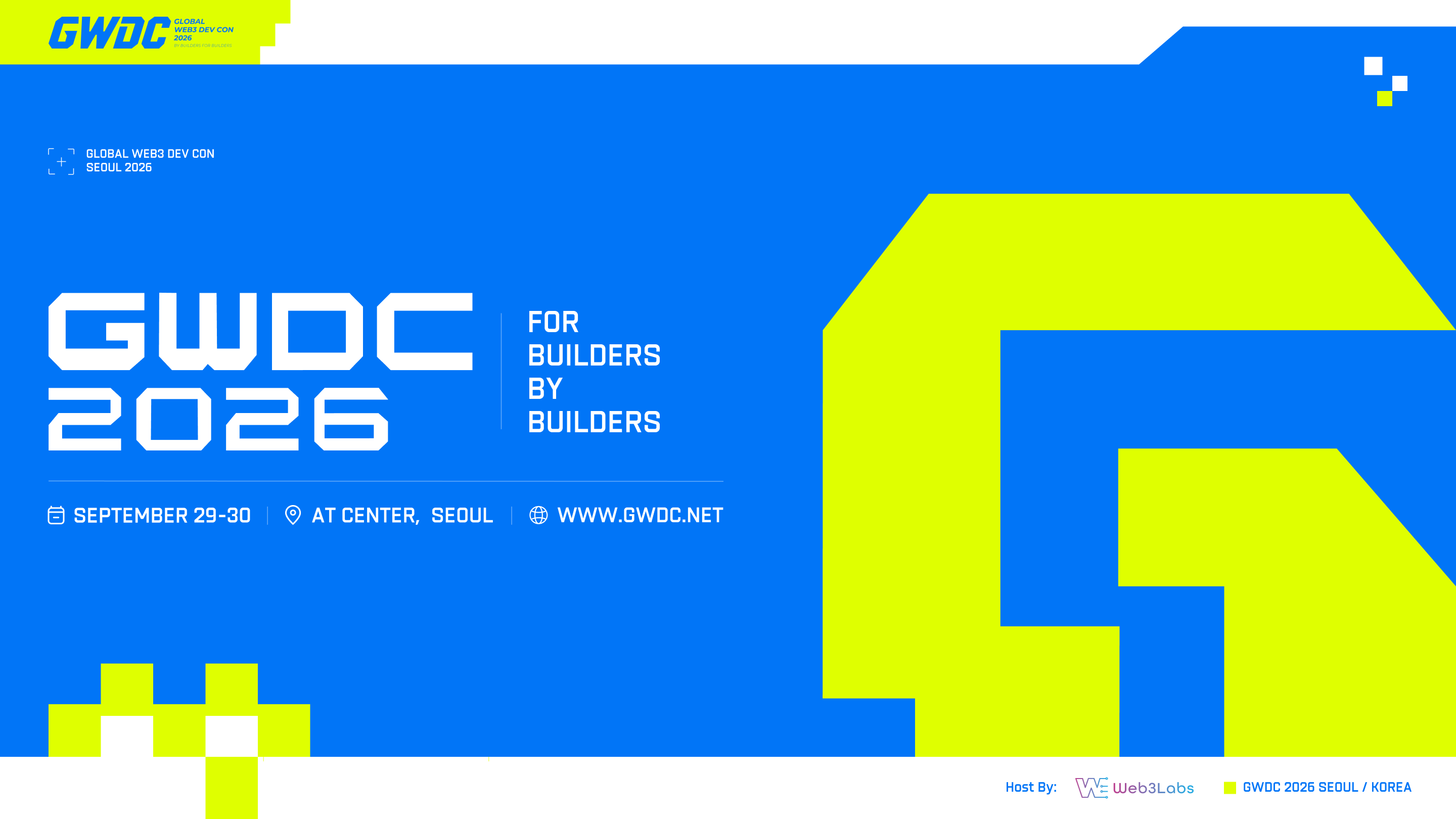
Following the successful hosting of the first Global Web3 Developers Conference (GWDC HK) in Hong Kong in February this year, sparking the Asia-Pacific technology wave and bringing together more than 2,000 industry elites, Web3 Labs, the conference organizer, officially announced a major upgrade today: the 2nd Global Web3 Developers Conference (GWDC 2026 Korea) will land at aT Center in Seoul, South Korea from September 29th to 30th. The conference will continue to adhere to the hard-core geek spirit of “For Builders, By Builders”, focus on Asia's top tech highlands, and strive to create a new paradigm for the integration of the global Web3 developer ecosystem with next-generation industries. According to the latest predictions of the organizing committee, Seoul Station will usher in a full-scale fission and leap up in scale. At that time, more than 8,000 participants, 500 of the world's top developers, 100 major industry speakers, and 100 exhibitors will gather in Seoul to witness the historic moment of the deep integration of Web3 and artificial intelligence (AI), and open a new chapter in the development of Web3 in Asia. Space Reshaping: Deconstructing the Web3 Future GWDC 2026 Korea Station broke the single dimension of the traditional exhibition and reshaped the spatial layout at the Seoul AT Center. Through the four core themed exhibition areas, it covered a full range of macroeconomic strategies, technical practices, geek contests and business matchmaking: Main Stage (Main Stage) | Strategic Leadership and Global Dialogue The main stage is the core of the conference's top-level design and macroeconomic strategy. The conference will invite government officials from Hong Kong, China and South Korea, decision makers from global tech giants, and visionaries in the Web3 field to play an in-depth game. The topics will focus strongly on “policy coordination” and cross-border cooperation, hard-core dismantling of AI applications and next-generation decentralized infrastructure, and defining new trends in Asian technology. Innovation Stage (Innovation Stage) | Deep Collision of Vertical Technology Sub-Forum rejects empty talk theory and aims to deliver practical practical insights. The conference accurately launched three core sessions: “Developer Ecosystem” focused on the evolution of open source culture and development tool chains; “Web3 and Financial Infrastructure” deciphering new paths of RWA, DeFi, and cross-border financial innovation; and “AI and Cloud Native” directly hit the underlying code behind model training and architecture upgrades. In addition, the grand finale of the conference, the GWDC Hackathon Finals and Awards Ceremony, will also be the pinnacle of the road show here. Innovation Booth Zone (Innovation Booth Zone) | An immersive marketplace for cutting-edge technology plans over 99 themed booths, spanning multiple tracks such as AI, blockchain, SaaS, and developer tools (DevTools). The exhibition area abandoned the boring traditional stall model and fully implemented an “interactive demo” to show the hard power of the project. Not only did 30 top KOLs follow up and link with global social media at high frequency, but they also cleverly integrated the highly popular “Good-looking Girl Group Flash Dance” in Korea with the hard-core technology exhibition area to boost traffic in the exhibition area. Hackathon Zone (Hackathon Zone) | 48 Hour Extreme Programming Challenge As the soul section of the conference, the hackathon is bringing together more than 500 geeks from China, Korea, Japan, India and Southeast Asia. The competition broke the shackles of a single ecosystem and invited 5 leading public chains to release development challenges simultaneously. To this end, the organizing committee provided a cash prize pool of more than 100,000 US dollars, and received huge computing power and resources from the world's top cloud service providers to create the ultimate testing ground linking top capital, public chain ecosystem, and talented developers. GWDC 2026 Korea's first wave of political and business leaders and ecological partnership matrices shockingly revealed that the core influence of GWDC 2026 Korea's cross-border integration continues to ferment, successfully bringing together a top international lineup covering “government, production, integration, and research.” We are pleased to announce that the following heavyweight speakers have confirmed their attendance at the conference: Johnny Ng, member of the National Committee of the Chinese People's Political Consultative Conference and Hong Kong Legislative Council member, Suk-hun Yoon, member of the National Assembly, sponsor of the Basic Law on Digital Assets, and member of the Government Council Suk-hun Yoon; Chairman of the Asian Economic Development Committee Caspar Wong; Jack Kong, CEO of Web3Labs; Lee Jae-won, CEO of Bithumb Evan Auyang, President of Animoca Brands E...

37d agoWendy#GWDC 2026 KOREA
Institutions are making a hundred times more profit, and the ban is about to be lifted: who will take over the intelligent trillion dollar valuation?

Institutions are making a hundred times more profit, and the ban is about to be lifted: who will take over the intelligent trillion dollar valuation?

Author: Plus 6, Zengsheng BeatZ Original title: Institutions have made a hundred times profit, has Zhipu's stock price reached its peak? The recent market popularity is Zhi Spectrum (02513.HK), the first AI stock in China. If you buy 1 million Smart Spectrum in January of this year, the high on June 22 was close to 25 million, and the closing time was more than 20 million. It is also one of the fastest companies in recent years where the market capitalization of Hong Kong stocks rose from a 10 billion IPOs to a market capitalization of HK$1 trillion. Regarding this stock, there are three questions repeatedly asked in the market: Who made this amount of money? Why did it rise like this? Who will take over next? This article is meant to answer these questions. Hong Kong stocks have made the most rapid rise in recent years, from angel turns to IPOs, and the valuation of Smart Spectrum has increased by about 130 times. From its IPO to its intraday high on June 22, Zhi Spectrum's stock price increased 24.6 times. The 57 external investors invested a total of RMB 8.36 billion, and the total book balance corresponding to the intraday high on June 22 was approximately HK$770.8 billion. The overall return is approximately 85x. In the history of China's primary market, cases where an average return of 85 times for all investors can be achieved on a single project can be obtained with one hand. According to the prospectus, Zhipu's financing is classified as “three rounds of fourteen times.” The return on the first batch of money was particularly impressive. China Science and Technology Innovation Star is the most extreme return multiplier. According to the prospectus, it invested about 20.37 million yuan in the angel round, and the corresponding post-investment valuation was about 407 million yuan. At that time, Smart Spectrum was still a knowledge map team split from the KEG lab in Tsinghua, and the concept of a big model didn't even exist. More than 20 million dollars became tens of billions of Hong Kong dollars. This is one of the most extreme cases of a single return multiplier in the history of China's AI Tier 1 market. The same is true for Round A and Series B investors. Based on the high intraday level and market capitalization on June 22, the amount of capital entered in round A was already several hundred times greater, and round B was also close to 100 times greater. The figures from the latter few agencies are also outrageous. Xu Xin's capital today invested 255.3 million yuan in November 2023 and received 11.35 million shares. Based on the high intraday price on June 22, the book balance was about HK$30 billion, and the return was more than 100 times higher. Today's capital management scale is around $3 billion, which means that the book value of Zhi Spectrum's amount has already exceeded the size of all of her funds. Xu Xin has been directly hired by NetEase, JD, and BOSS in the past, but judging from the absolute amount of money, Zhipu is probably the most profitable part of her career. Meituan's example is also very intuitive. According to current data, Meituan invested about 300 million yuan that year, and now the book return is more than 150 times higher. In other words, the surplus of industrial investment has already exceeded 5% of Meituan's own market value. Lei Jun's Shunwei Capital invested 150 million yuan through Beijing Shunying. Based on the high intraday price on June 22, the book balance was about HK$14.8 billion, and the return was about 90 times higher. Shunwei's management scale is nearly 50 billion yuan, and Smart Spectrum accounts for about a quarter of the total scale. The absolute largest amount of money has been earned by Junlian Capital. It followed up 6 times, and invested a total of 454.7 billion yuan. Based on the high intraday price on June 22, the book balance was approximately HK$53.3 billion, and the return was about 107 times. The total management scale of Junlian exceeds 90 billion yuan, and the book value of Zhipu's transaction is close to half of its total management scale. An established PE that participated in iFLYTEK, the Ningde Era, and Yao Ming Kangde finally received a history-level single-project return on the smart spectrum. In addition to market-based institutions, the density of intelligent state-owned shareholders is also very high. State-owned assets are in Beijing, Tianjin, Shanghai, Hangzhou, Zhuhai, Chengdu, and Daxing. Zhongguancun Science City, Zhuhai Huafa, Haihe Fuxin Youda Fund, Artificial Intelligence Fund, Hangzhou Urban Investment, and Daxing Industrial Fund are all well-known local government investment platforms. The social security fund Zhongguancun Independent Innovation Investment Fund also participated. This money comes in and is not just a financial investment. Once they come in, they will drive procurement in the government system of the city and province where they are located. A local state-owned company invested in Smart Spectrum. When the local government selected big model suppliers, Zhi Spectrum had an additional layer of natural advantage. This is a very obvious characteristic of China's technology industry: the richest buyer is the government. If a technology project receives investment and support from the government, it is half successful. Zhongji Xuchuang and Changxin Storage are all examples of this model. The founders brought back technology from overseas, the government invested money to build a factory for orders, and the company started up quickly. Employees are also big winners in this round of wealth creation. The intellectual genealogist...

60d agoburnking#AI topics #Intellectual spectrum #Hong Kong stocks #stock market

Alipay officially launched the AI version of Abao's public beta, releasing 100 invitation codes in the first batch

Comparative news, according to monitoring, Alipay officially issued an announcement to launch a public beta of the AI version of Alipay, which confirmed the previously revealed internal transformation of Alipay's plan. The new version introduces an AI assistant called Abao. Users can switch to the interactive work interface by right-swiping on the classic interface. The new interface focuses on dialogs and asset pages, and reserves entrances for high-frequency functions such as code scanning and transfers, and supports switching between old and new versions. The new version marks Alipay's upgrade from a display style to a conversational experience. The core function dialogue-as-a-service can automatically match applets and directly present the business operation interface. Currently, there are tens of thousands of customized services, covering scenarios such as government affairs, travel, and life. In order to promote the open beta, the official announcement provided 100 invitation codes, and indicated that users had the opportunity to drop more invitation codes to share by interacting with the Assistant. In terms of safety and ecology, Alipay emphasizes that assistants only run errands and don't use money. The final confirmation rights involving payments and capital flows still belong to the user, and maintain a compensation mechanism where you dare to pay, I dare to pay. At the same time, the platform announced the full opening of the service portal to welcome third-party merchants and developers.

67d ago