


China-US Token Economics: Profit Sources, Premium Flow, and Cash Out Order

Source: Wall Street News
The rapid computational power of large models and the misalignment of slow monetization are reshaping the profit distribution pattern of the global AI industry chain. In the past two years, the average number of daily token calls in the Chinese market has skyrocketed by more than a thousand times, but in 2025, the annual revenue of public cloud MaaS (model as a service) remained at the level of 3 billion yuan. Massive consumption has yet to be converted into equivalent book revenue, and China and the US have gone in very different directions in terms of computing power bottlenecks and commercialization paths.
Song Xinzhu, an analyst at Northeast Securities, proposed in his analysis of the Token economy industry chain that AI profit accumulation consists of four mechanisms: scarcity premium, intergenerational premium, integrated internal settlement revenue, and migration cost premium.
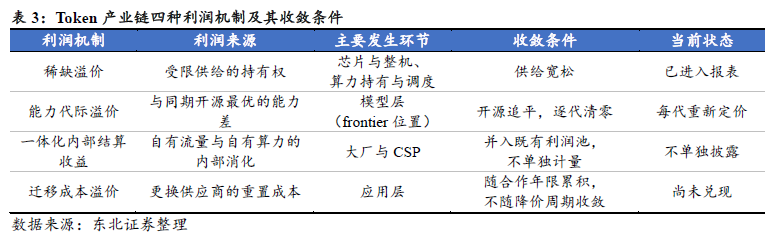
Currently, profits are entering the report in the order of top, middle, and bottom: the upstream computing power base takes the lead in cashing out scarce dividends; the midstream model layer is deeply mired in deflation caused by commercialization of contemporaneous capabilities; and the downstream application layer undertakes the dividends of reducing computing power prices and building long-term moats with “migration costs” accumulated over time.
At the end of the premium flow, due to differences in payment endowments between the two countries' markets, the incremental value of AI in the US is being settled in the high-price software subscription system, while the low-price token dividends in the Chinese market are directly spilled over to the application layer, awaiting revaluation after the pricing method is fully migrated.
Computing power investment is approaching the cash flow boundary, and a thousand times the call volume has only cashed in on the 3 billion market
The token economy is still in a period of asset-heavy construction. On the demand side, the average number of calls per day in China soared from about 100 billion calls at the beginning of 2024 to 100 trillion by the end of 2025. However, most token consumption occurs within the manufacturer's own scenario, and no external transactions have been formed; through external transactions, transaction prices have been extremely compressed; in addition, application-layer fees have yet to be fully migrated to token pricing, resulting in a thousand-fold usage increase of only 3.07 billion yuan in public cloud MaaS market size.
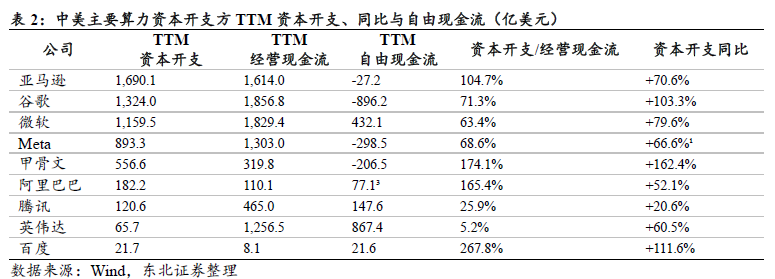
Corresponding to the meager API revenue, it is extremely heavy on the computing power investment side. The intensity of capital expenditure is approaching the coverage boundary of operating cash flow. As of the second quarter of 2026, the ratio of TTM (rolling 12-month) capital expenses to operating cash flow of the four major US cloud vendors rose to 0.63 to 1.05. Alphabet experienced negative free cash flow for the first time in a single quarter, and Meta's free cash flow plummeted 91% year over year. Funding sources during the construction period have spilled over from operating cash outflows to the capital market.
The pace of investment in the Chinese market is clearly divided. Alibaba is ranked first in terms of capital expenditure intensity, while Baidu is the only company among the eight leading buyers of computing power where declining revenue and increasing capital expenditure coexist.
Upstream has exhausted scarce dividends, and the Chinese and US computing power bottlenecks are moving into the field
Upstream is currently the only link where profits are steadily included in the report. The “scarcity premium” based on the supply gap directly contributed to Nvidia's FY2026 data center revenue of $193.7 billion. Faced with the same thirst for computing power, China and the US have formed very different clearance methods and industrial bottlenecks under the same regulations.
The bottleneck in America's industrial chain is access to electricity. Of the ERCOT (Texas Reliability Commission) queue awaiting approval for access, about 90% of the more than 1,800 projects are data centers, corresponding to a cumulative total of about 474 GW of electricity demand. The lengthening of approval and power access cycles has led to a historically low vacancy rate of data centers in North America. America's scarcity was eventually paid off according to the price, and the proceeds from the price increase went to leading manufacturers such as Nvidia.
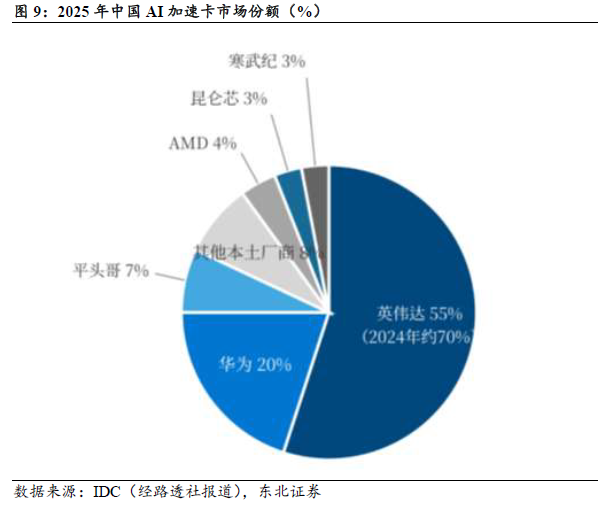
The bottlenecks in China's industrial chain directly point to computing power chips. Under export controls, the Chinese market is cleared in accordance with controlled allocations, and the institutional drive is directed towards domestic substitution. In 2025, local manufacturers already accounted for more than 40% of the AI accelerator card market. The additional computing power is gathered at the “East Digital and Western Computing” hub nodes, and the construction entities are combined with public departments, operators, and private capital to form a computing power system dominated by the public sector.
Open weights break through intergenerational barriers, and the midstream model is reduced to standardized production capacity
Tokens with the same level of competency are extremely fungible, and open weighting (open source) has become the absolute main force in bridging the price gap. The cost for buyers to replace suppliers is extremely low, and competition falls directly on the listing price. According to estimates, the calling price that has reached the same capability as GPT-4 drops to about one-tenth of a year.
The price of comparable capabilities is rapidly being leveled around the world. At about 51 points in the AA Intelligence Index, the mixed prices of the four main models of China and the US (GPT-5.6 Luna, GLM-5.2, MuseSpark 1.1, and Gemini 3.6 Flash) all fall into an extremely narrow range of 14 to 22 yuan/million tokens. The lowest price in this tier does not come from a Chinese manufacturer, but rather Meta, which entered the market in the form of an API. Once the capability level is leveled by open source, the token is commercialized, and the price only changes according to usage and cost.
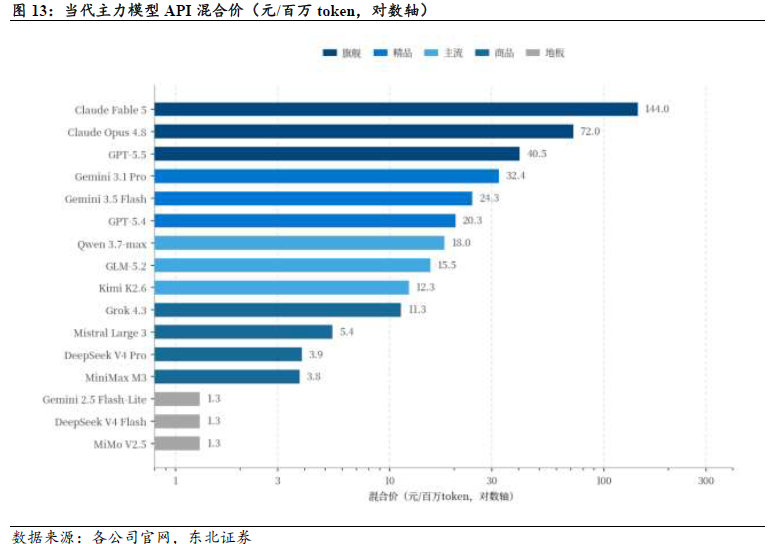
As a result, the midstream was squeezed at both ends. On the price side, the actual transaction price is often about an order of magnitude lower than the listing price; on the cost side, more than 70% of the estimated cost per unit is depreciated and amortized, accounting for less than 10% of the electricity bill. The core space for cost pressure reduction is not electricity prices, but depreciation periods and computing power utilization rates.
In China, the commercialization of tokens is being promoted to the infrastructure level. By directly supplementing the purchasing end of computing power vouchers and establishing a unified measurement and price comparison platform, the middle price increase space was squeezed out. The distribution chain is destined to increase in volume and profit, and there are only two things left that can continue to make money: the production side earns the cost difference by extreme utilization rate, and the scenario side relies on customer replacement costs to retain profits.
Divided profit destination: US settles on subscriptions, China spills over to the application layer
Deflationary token prices release the dividends of model upgrades downstream, and the way China and the US accept dividends is divided due to their willingness to pay endowments.
The incremental value of AI in the US is being absorbed by the existing subscription system. American users are used to paying high prices for software subscriptions, and cutting-edge model makers compete for the same position as existing software giants. Microsoft packages AI features into high-priced subscriptions, turning one-time capability advantages into ongoing customer payments.
The Chinese market is hampered by a lower willingness to pay for software subscriptions. The price of the same basic office software in the Chinese market is usually only one-fifth or less than that of the US. As a result, Chinese midstream manufacturers generally set prices based on computing power costs, and the value of low-priced tokens spills directly to the application layer.
For Chinese application layer companies, the shift in pricing methods determines the direction of profits. If subscription pricing is maintained, the token price reduction dividend remains on the cost side, reflected in improvements in gross margin and operating leverage; if pricing is changed to token consumption or business results, the dividend directly enters the revenue side.
However, changes in pricing methods do not mean falling into pockets of profit. Whether downstream can retain profits depends on the “migration costs” established in the scenario, which is the only weapon to resist buyers' pressure to recover dividends.
The attributability of output value, exclusivity of scene assets, customer structure, and task consumption intensity determine the texture of the scene. The moat in the scenario is maintained by three types of carriers: first, entry qualifications and procurement systems granted by external rules (such as government affairs and regulated industries); second, data docking and caliber accumulation formed over time (such as financial data governance, intelligent operation and maintenance); and third, replacement costs due to system-level integration.
With the collapse of the old seat billing system, the token and performance pricing model will greatly shorten the customer stickiness verification cycle. In the past, customers had to wait to renew their contracts once a year to be retained, but now it can be clearly observed through quarterly token usage. Ultimately, it is downstream players who bind customers to their own business flow with extremely high replacement costs.
Twitter:https://twitter.com/BitpushNewsCN
Compare the TG exchange group:https://t.me/BitPushCommunity
Compare TG subscriptions:https://t.me/bitpush
