
治理 · 8467

Sun Yuchen Says Lawsuit Against WLFI Is About Blockchain Ownership Principles

Comparing news, Bochang founder Sun Yuchen wrote that his lawsuit against World Liberty Financial (@worldlibertyfi) was ostensibly a commercial dispute involving 45 million US dollars and 4 billion tokens, but it was essentially about blockchain's founding principles. He pointed out that the industry is built on “your keys, your coins,” meaning that everyone can actually own their own assets without permission. Sun Yuchen said that the case revealed that the other party secretly embedded the power to freeze users' assets in the contract. There was no disclosure, no governance, no procedure, and that their tokens were unlocked for use within a few days. He believes that this is contrary to the name of “freedom”. If the issuer were to seize holders' assets at any time, blockchain would be no different from the old world. He will carry out the lawsuit to the end, not only to recover assets, but also to establish a precedent in court that “your assets must really belong to you”. This article is sponsored by GENG, Build Your Fortune on GENG (https://geng.one)

6h agoburnking

SOL Treasury HSDT: Supports the Solana Constitution but opposes adjusting inflation and fees now

Comparatively, SOL treasury company Solana Company (HSDT) announced its vote on the first three Solana Governance Proposals (SGP). It supports the passage of the SGP-0001Solana Constitution; opposes SGP-0002 doubling the rate of inflation reduction; and opposes SGP-0003 changing transaction fees from fixed to floating. On-chain voting is expected to open on August 22nd. The company said it supports the Solana Constitution because the new governance system allows every pledger to vote directly, and holders can always reverse the votes of operators they have delegated, which helps the agency participate in online decisions. However, with regard to the other two proposals, the company emphasized that it was not against the direction itself, but rather against the timing. This is a critical stage for institutions to consider entering Solana. The most important thing for institutions is that the rules are stable and predictable. Changing the two core economic parameters of the inflation rate and handling fees at this time may make institutions that are still on the sidelines even more hesitant. The company said that it will support rediscussions to reduce inflation after seeing that SOL continues to have a net inflow of capital; it is also willing to reconsider the plan to change the handling fee to a floating rate after ecological adaptation.

1d ago

SEC Proposes Reg Crypto: Establishing a Legal Path for the Public Offering of Some Tokens and the Withdrawal of Investment Contracts

Comparing news, Galaxy's research director posted an article on the X platform stating that the US Securities and Exchange Commission proposed the “Crypto Asset Regulation” to regulate Crypto Assets, referred to as Reg Crypto for short. The proposal aims to establish a legal path for some tokens to be issued to the US public and establish a mechanism to terminate investment contracts. The scope of application is limited to cryptographic assets that are not securities themselves but have been issued or sold as part of an investment contract. Tokenized stocks, bonds, and arrangements for bundling tokens with shares or other securities are not within the framework. The proposal establishes four stages: financing, disclosure, construction, and exit. The one-time startup exemption allows issuers to raise $5 million over a maximum period of 4 years; higher exemptions set by reference to Regulation A allow $20 million or $75 million in 12 months. Relevant financing is subject to SEC qualification review and ongoing disclosure. The maximum investment amount for uncertified investors is 10% of those with high annual income or net assets. Issuers are also required to disclose token supply and release plans, minting and destruction mechanisms, governance and smart contract authority, source code, and project construction commitments and progress. When the issuer completes or permanently suspends the relevant construction obligations, does not make new construction commitments, and submits a transition report, the relevant investment contract will be deemed terminated, and cryptographic assets will no longer be subject to the securities law under the investment contract. Issuers that have not used the above financing exemptions can also use this safe harbor. The US Securities and Exchange Commission estimates that approximately 475 issuers will use the safe haven of investment contracts each year, and about 130 issuers will use the two new exemptions. Eligible issuances may not be restricted securities and may be immediately resold without contractual restrictions. The proposal also excludes covered initial offerings and some secondary transactions from state registration and qualification requirements, but it does not involve exchanges, brokers, dealers, escrow, or independent innovation exemptions for tokenized securities and on-chain transactions. The comment period is 60 days after publication in the Federal Register. SEC Chairman Paul Atkins and members Hester Peirce and Mark Uyeda all issued statements of support.

1d ago

Central Cyber Security and Information Technology Commission: Accelerating legislation in emerging fields such as artificial intelligence, anti-cyber violence, digital economy, online platforms, and blockchain

Comparing news, the Central Cyber Security and Information Technology Commission issued the “Action Plan to Promote the High-Quality Development of Internet Communications Enterprises (2026-2030)”. Among them, it is mentioned to strengthen the establishment of the rule of law on the Internet. Actively carry out forward-looking research on legislation in the field of Internet communications. Accelerate legislation in emerging fields such as artificial intelligence, anti-cyber violence, digital economy, online platforms, and blockchain. Promote the revision of the “Administrative Measures on Internet Information Services” and improve legal systems such as Internet information service management, “self-media” management, and algorithm governance. Promote the enactment of the Telecommunication Law, the Cybercrime Prevention and Control Law, and cybersecurity level protection regulations, and improve the supporting provisions of the “Regulations on the Protection of Minors on the Internet” and “Regulations on the Administration of Network Data Security”. Standardize administrative inspections involving Internet communication enterprises to minimize interference with the normal production and operation activities of Internet communication enterprises. Improve supervision, management and enforcement measures adapted to the new characteristics of Internet development and governance, and strictly crack down on internet violations and regulations. This article is sponsored by GENG, Build Your Fortune on GENG (https://geng.one)

1d agoburnking
They are all stealing earlier data. Where exactly is VC Alpha hidden?

They are all stealing earlier data. Where exactly is VC Alpha hidden?

Author: insights4vc Compilation: Shenchao TechFlow Original title: Private Equity Market Intelligence Warfare Heats Up: In the AI Era, Where Did VC Alpha Come From? Guide to Deep Wave: Venture capital returns are extremely concentrated, and finding a good company in the early stages is almost the life and death line of a fund. This article breaks down the latest evolution of private equity market data tools and whether they can actually bring in excess profits. This is a sobering map for investors who are using AI and research tools to find projects. Venture capital has always been an information business. The advantage often lies in timing: founders tell former colleagues instead of updating data first; new companies start recruiting people before they appear in the database; investors start watching a team before the funding is announced. This advantage is important because VC returns are highly concentrated. According to data from the 2026 Oxford Academic Study, 4.5% of the investment amount contributed to a return of about 60% in a long-term LP data set. [1] Therefore, missing a few excellent companies can affect the entire fund. But finding them early is only part of the problem. Investors also need to develop beliefs, get credits, obtain meaningful holdings, and keep things right for a few years. The private equity market data industry is now getting closer to the moment the company was born. PitchBook, Crunchbase, Dealroom, Tracxn, and CB Insights remain core recording systems for transactions, funds, valuations, and company history. PitchBook generated revenue of $174.7 million in the second quarter of 2026, equivalent to nearly $700 million in annualized revenue. [2] The new platform is not replacing this layer. They're extending this layer with faster updates, behavioral data, and signals that predate traditional company records. Three changes stand out the most. First, companies such as Harmonic and Specter are building a continuously updated map of companies and people, rather than relying mainly on regularly updated data. Second, specialty products are looking for earlier behavioral signals. Evertrace tracks metrics formed by founders, including company registrations, technical activity, research, and domain names. Frontrun monitors changes in selected venture capitals' interest maps on X. Third, the API and Model Context Protocol (MCP) are moving this data into the fund's own software and AI workflows. Crustdata represents the infrastructure side of this market, while Affinity complements first-party relationship data from emails, calendars, and CRM events. Adoption is visible, but evidence of excess return on investment is not clear. Harmonic says hundreds of venture capital teams use its platform, and Specter reports more than 300 investment institutions, Evertrace more than 200 funds, and Affinity more than 3,300 private equity firms. Listed company Tracxn disclosed that it had 2,289 customer accounts in fiscal year 2026. [3] [4] [5] [6] Most of these figures are self-reported by companies. Vendors rarely disclose the complete set of companies unearthed by their models, making it difficult to assess accuracy, recall rates, false positives, and the economic value of individual leads. No single signal alone is enough. Employee departures may be early but vague. Company registration is objective but common. GitHub activities are valuable in developer-led markets, but have limited relevance in other areas. Hiring speed and employee migration provide broader signals, while revenue, customer, and usage data are often more valuable for decision-making, but come later. When several credible industry experts focus on the same company, investors' attention can provide early signs, even though this signal is platform-dependent and may reinforce itself. The strongest defensive sources are likely to be hidden deeper in the data stack: historical time series that cannot be reconstructed later, accurate physical analysis across people and companies, authorized first-party fund data, and distribution through CRM systems, APIs, and agents. Public data is not necessarily proprietary. However, five years of correctly time-stamped change history can become a proprietary asset. AI is more likely to make these infrastructures more easily queried rather than eliminate the need for them. As research, classification, and workflow costs drop, clean data, sources, and institutional context become more valuable. Investment decisions, quotas, and relationships are still not something a simple layer of automation can solve. The likely outcome is that a broader market for private market intelligence will emerge, rather than an independent search for project software categories. A mature database will increase discoveries and...

1d agoburnking
If it's just tokenized assets and doesn't connect to DeFi, what's left of RWA?

If it's just tokenized assets and doesn't connect to DeFi, what's left of RWA?

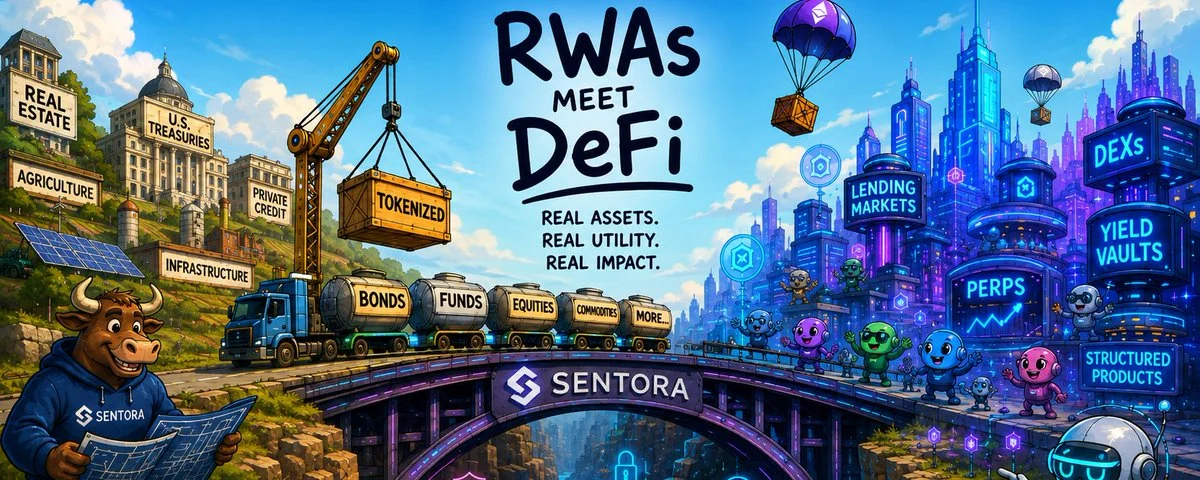
Author: Jesus Rodriguez, co-founder of Sentora Compiled by: Luffy, Foresight News Original title: Does RWA still make sense without DeFi? Discussions in the RWA industry often begin with a simple vision: take a treasury bill, fund share, stock, invoice, megawatt hour, or GPU for one hour, then mint a token representing it. Is it useful? It's really useful. But can it be called transformative? It's far from there. This is like putting a bar code on a container and claiming that a global trade problem has been solved. Barcodes make containers recognizable and machine-readable, but they don't create ports, cranes, customs, insurance, financing, shipping routes out of thin air, or bring in buyers from afar. A token is simply an addressable token of interest, and DeFi is a marketplace operating system. The question really worth discussing is not how many types of assets can go on the chain, but how many assets can complete valuation, financing, hedging, transaction monetization, and loss disposal in a stressful environment, and there is no need for offline meetings and coordination every time a transaction occurs. Tokenization completes the representation of equity; what DeFi brings is actual utility. Tokenization is just a bar code, and a similar scene has happened in the history of the supply chain finance market. The reason why mortgages can be scaled up is not as simple as turning a paper document into an electronic record. To actually achieve large-scale expansion, a complete set of operating mechanisms was created around this type of asset: credit review, post-loan services, securitization, credit rating, warehousing and financing, repurchases, hedging, clearing and settlement, and loss allocation rules. RWA also needed to go through the exact same evolutionary process. An asset that can be adapted to DeFi requires six levels: legally enforceable rights, reliable data sources, clear transfer and redemption rules, enforceable secondary market liquidity, collateral parameters that match actual behavior, and a credible settlement and loss disposal path. Most tokenization projects, on the other hand, tend to stop at the top five levels. There is a simple test that can be used to test the maturity of an asset. It only requires answering three questions: How much is this asset currently worth? Can the agreement complete withdrawal and monetization at this point? If the first two judgments are all wrong, who bears the loss? When smart contracts can definitively answer the above three questions, RWA can truly become a basic component of finance. Before that, it was mostly just a digital packaging shell. The deepest technical contradiction of RWA's quadruple time clock is that RWA runs under multiple sets of different time clocks at the same time. The blockchain can complete settlement in seconds and operate uninterrupted for 7 x 24 hours; oracles may update prices every hour or every day; underlying traditional exchanges are closed at night and on weekends; custodians follow bank working days; and the asset redemption process may take 1 day, 5 days, or even 30 days. If you use such a slow-paced RWA asset to support fast-maturing DeFi liabilities, such as stablecoin loans. This is the term shift, and it is also the core model that banks have relied on for hundreds of years: using short-term debt to fund long-term slow assets. This model has practical value, but the risk must be reasonably priced. Imagine a scenario: At 2 a.m. on Sunday, assets hit the liquidation threshold. Smart contracts can seize tokens immediately, but the underlying real-world market won't open until Monday, and the issuer's redemption business will not be processed until Tuesday. On-chain liquidation has been completed, and real-world asset disposal has only just begun. This creates a clearing gap. DeFi requires immediate withdrawal for monetization, but the real world does not allow it. The time difference between the two. This gap has counterintuitive consequences. Even treasury bonds with very low volatility are riskier than native crypto assets that are more volatile when used as collateral. The price of ETH fluctuates drastically, but it can be traded around the clock; the price of RWA assets appears to be stable, and it may only be up to a dozen hours without a new price tag. A flat price sometimes represents safety, and sometimes it's just a disguise of stale data. Liquidity is an exit channel, not TVL. The digital public also has common misunderstandings about liquidity. Liquidity is not equal to TVL, does not equal the existence of a trading pair, nor does it mean that the issuer promises to eventually redeem it according to net worth. Liquidity refers to the ability to convert a position into the settlement asset you need at an acceptable discount within the time window allowed by your debt. Take a crowded theater for example: the size of the hall cannot determine whether it is safe in the event of a fire; what really matters is the width of the exit channel. One copy of RWA to...

1d agoForesight News#DeFi #RWA

US Treasury bans ESG funds from appearing in “Trump accounts”

Comparing news, the US Treasury banned ESG funds from appearing in “Trump accounts.” According to reports, regulations that restrict ESG funds from being included in Trump accounts go hand in hand with other regulations that ensure that account investment options are inexpensive to ensure that investors retain more funds. An ESG fund refers to a fund that not only considers the financial performance of an enterprise, but also incorporates the three types of environmental (environmental), social (social), and corporate governance (governance) factors into the screening criteria in investment decisions. ESG funds look not only at “whether the company can make money”, but also “whether the way the company makes money is sustainable and in line with social responsibility.” (Fox News)

2d ago

KuCoin obtains ISO/IEC42001 artificial intelligence management system certification

Comparatively, KuCoin announced today that its artificial intelligence management system (AIMS) has officially obtained ISO/IEC 42001:2023 international certification, further strengthening the company's systematization capabilities in responsible deployment, governance and continuous improvement of artificial intelligence. This certification is the world's first international standard for artificial intelligence management systems, providing an internationally recognized management framework for enterprises to establish, implement, maintain and continuously improve artificial intelligence management systems. This certification covers KuCoin's artificial intelligence management system and related support functions, further promoting the transparent, safe and responsible application of AI in platform operations. As AI becomes more and more deeply involved in digital finance scenarios such as risk control, anti-money laundering, fraud detection, market monitoring, intelligent customer service, and platform operation, KuCoin continues to advance AI innovation simultaneously with trusted governance. This certification further refines KuCoin's trust framework and works with ISO/IEC 27001, SOC 2 Type II, and ISO 22301 to build a trusted infrastructure covering information security, operational reliability, business continuity, and artificial intelligence governance. This article is sponsored by GENG, Build Your Fortune on GENG (https://geng.one)

2d agoburnking
Will compliant ICOs be revived? New SEC regulations open up a financing channel for the cryptocurrency industry

Will compliant ICOs be revived? New SEC regulations open up a financing channel for the cryptocurrency industry

Source: ChainCatcher Author: 0xFACAI Original title: The biggest benefit for the coin industry, is compliant token financing coming back? Public coin sales and financing have once again gained a legal path in the US. On August 18, the US Securities and Exchange Commission released a draft “Regulation Crypto Assets”. According to this draft, startups can raise $5 million in up to four years, and larger projects can raise $20 million or $75 million in 12 months. Without completing a complete set of securities registration, the project can also sell tokens to investors to raise money for network development. The biggest benefit for the coin industry, is compliant token financing coming back? Sounds like ICOs are back. But the SEC gave far more than three funding lines. It wants to establish a set of rules for tokens from birth to “graduation”: projects can be sold to finance first, but it is necessary to clearly explain what to do with this money; if the key work promised by the team is not completed, the token continues to carry the regulatory responsibility for investment terms; only after fulfilling the promise, the token has a chance to exit this level of relationship. “Promises” are the core of the entire draft, and devs must “work” until the token “graduates” before they can “sell”. The draft rules gave the project parties two options. The first type is suitable for startup teams. Assuming a project required $3 million to develop, common choices in the past were to seek venture capital, limit buyers and issue coins outside of the US, or incur the high cost of registering securities. The new draft allows it to use the “startup exemption,” raise no more than $5 million over a maximum period of four years, and file with the SEC when the funding starts and ends. The second type is suitable for projects with greater funding requirements. The first tier raised up to $20 million every 12 months, and the second tier raised up to $75 million. Compared to the $5 million startup exemption, this path can be used over and over again, but the rules are more stringent. Projects can't just hand in a white paper and start selling coins. Both exemptions require the team to disclose how the network is being managed, how the product is being prepared and developed, what security risks the code has, what the company's financial situation is, and who is managing the project. The two larger funding levels also require financial statements to be provided and continuously updated, and the $75 million tranche requires an audit. The SEC didn't remove the original fence either. Issuers and insiders with a record of serious violations cannot use these exemptions, and anti-fraud and anti-manipulation responsibilities remain in effect. If the project uses other securities exemptions at the same time, it must also comply with existing consolidated financial calculation rules. The most important aspect of how to define “graduation” in the entire draft is to treat tokens separately from the investment relationships formed around tokens. A project sells coins to raise money to build a network. Buyers often buy more than just a digital asset that can already be used. They are also expecting the team to create products, attract users, increase token demand, and profit from these efforts. This relationship, which depends on the team's future work, is what the SEC calls an “investment clause.” The token itself can be just a digital asset, but how the project sells it and what it promises to the buyer makes it covered by a layer of investment terms. What the SEC really regulates is this level of relationship between issuers and buyers. The draft designs an exit path for the token. The token can only enter a “safe harbor” after the issuer has completed or permanently ceased all key management tasks of its promises, no new related commitments, and then submitted public certification and analytical instructions to the SEC. As a result, tokens have the concept of “graduation.” When the project is sold and financed, construction is promised to the market. After the project is completed and key tasks are completed, the buyer can no longer rely on the team to fulfill the old promises before the token can “graduate” and the project party can withdraw. The new regulations don't focus on whether tokens are considered securities. In the past, the market judged when a token was no longer subject to securities laws, and often questioned whether the network was “decentralized enough.” As long as the foundation, development company, or founding team continues to work, many people will understand this as the token still relies on a central entity. The SEC draft changed the question: what promises did the project rely on to sell the tokens, and are those promises fulfilled now? Take an example. When Project A sells coins, it tells investors that the team will develop the main network, launch transfer and pledge functions, and then leave the network to a decentralized validator to operate. The main network was later launched, and the features were also available, but the validators were still controlled by the team. Since “decentralizing the network” was also a promise at the time of financing, the token is still unable to “graduate” at this point. When Project B sells coins, it only promises to create a network that can function properly, without “the team must disappear” or “the network...

2d ago22#ICO #SEC

Binance blocks DAO governance attack less than 48 hours before execution, involving around $1.2 million in vault tokens

Comparing the news, Binance said that its monitoring team discovered a malicious governance proposal against an unnamed decentralized autonomous organization (DAO) involving a risk of approximately $1.2 million in treasury tokens, less than 48 hours before execution. Binance contacted the project and coordinated with centralized exchanges that listed the relevant tokens to close the deposit; the project then voted against the proposal and blocked its implementation. Binance did not disclose the name of the project and token. The proposal takes advantage of the low proposal threshold of the project chain governance mechanism. BonkDAO confirmed in July of this year that a malicious proposal had transferred approximately $20 million in BONK tokens from its treasury, and the attackers authorized the transfer by accumulating sufficient voting rights.

2d ago