白皮书 · 2759
Will compliant ICOs be revived? New SEC regulations open up a financing channel for the cryptocurrency industry

Will compliant ICOs be revived? New SEC regulations open up a financing channel for the cryptocurrency industry

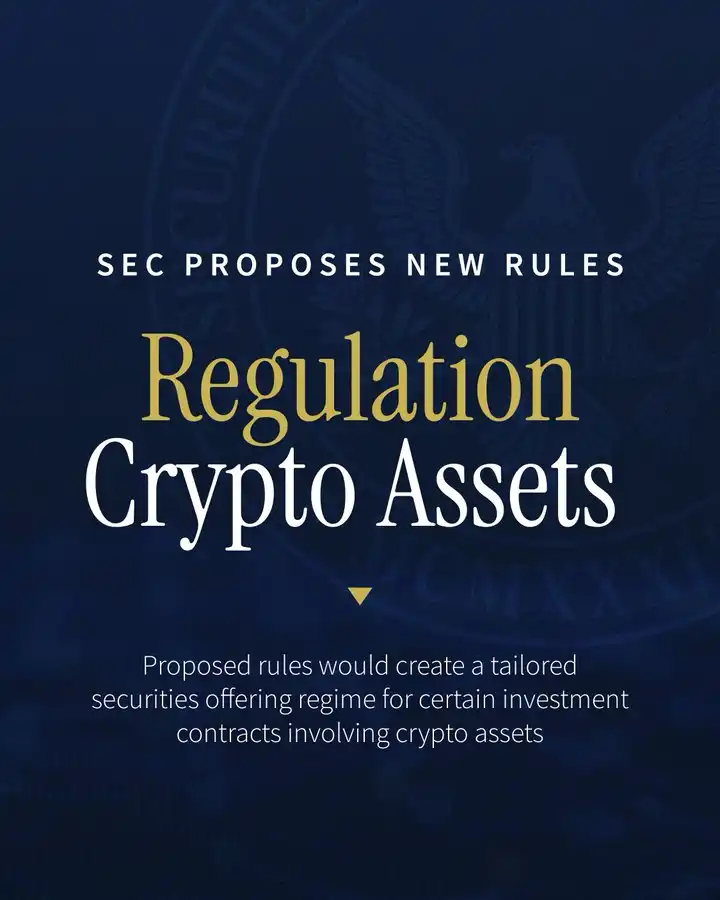
Source: ChainCatcher Author: 0xFACAI Original title: The biggest benefit for the coin industry, is compliant token financing coming back? Public coin sales and financing have once again gained a legal path in the US. On August 18, the US Securities and Exchange Commission released a draft “Regulation Crypto Assets”. According to this draft, startups can raise $5 million in up to four years, and larger projects can raise $20 million or $75 million in 12 months. Without completing a complete set of securities registration, the project can also sell tokens to investors to raise money for network development. The biggest benefit for the coin industry, is compliant token financing coming back? Sounds like ICOs are back. But the SEC gave far more than three funding lines. It wants to establish a set of rules for tokens from birth to “graduation”: projects can be sold to finance first, but it is necessary to clearly explain what to do with this money; if the key work promised by the team is not completed, the token continues to carry the regulatory responsibility for investment terms; only after fulfilling the promise, the token has a chance to exit this level of relationship. “Promises” are the core of the entire draft, and devs must “work” until the token “graduates” before they can “sell”. The draft rules gave the project parties two options. The first type is suitable for startup teams. Assuming a project required $3 million to develop, common choices in the past were to seek venture capital, limit buyers and issue coins outside of the US, or incur the high cost of registering securities. The new draft allows it to use the “startup exemption,” raise no more than $5 million over a maximum period of four years, and file with the SEC when the funding starts and ends. The second type is suitable for projects with greater funding requirements. The first tier raised up to $20 million every 12 months, and the second tier raised up to $75 million. Compared to the $5 million startup exemption, this path can be used over and over again, but the rules are more stringent. Projects can't just hand in a white paper and start selling coins. Both exemptions require the team to disclose how the network is being managed, how the product is being prepared and developed, what security risks the code has, what the company's financial situation is, and who is managing the project. The two larger funding levels also require financial statements to be provided and continuously updated, and the $75 million tranche requires an audit. The SEC didn't remove the original fence either. Issuers and insiders with a record of serious violations cannot use these exemptions, and anti-fraud and anti-manipulation responsibilities remain in effect. If the project uses other securities exemptions at the same time, it must also comply with existing consolidated financial calculation rules. The most important aspect of how to define “graduation” in the entire draft is to treat tokens separately from the investment relationships formed around tokens. A project sells coins to raise money to build a network. Buyers often buy more than just a digital asset that can already be used. They are also expecting the team to create products, attract users, increase token demand, and profit from these efforts. This relationship, which depends on the team's future work, is what the SEC calls an “investment clause.” The token itself can be just a digital asset, but how the project sells it and what it promises to the buyer makes it covered by a layer of investment terms. What the SEC really regulates is this level of relationship between issuers and buyers. The draft designs an exit path for the token. The token can only enter a “safe harbor” after the issuer has completed or permanently ceased all key management tasks of its promises, no new related commitments, and then submitted public certification and analytical instructions to the SEC. As a result, tokens have the concept of “graduation.” When the project is sold and financed, construction is promised to the market. After the project is completed and key tasks are completed, the buyer can no longer rely on the team to fulfill the old promises before the token can “graduate” and the project party can withdraw. The new regulations don't focus on whether tokens are considered securities. In the past, the market judged when a token was no longer subject to securities laws, and often questioned whether the network was “decentralized enough.” As long as the foundation, development company, or founding team continues to work, many people will understand this as the token still relies on a central entity. The SEC draft changed the question: what promises did the project rely on to sell the tokens, and are those promises fulfilled now? Take an example. When Project A sells coins, it tells investors that the team will develop the main network, launch transfer and pledge functions, and then leave the network to a decentralized validator to operate. The main network was later launched, and the features were also available, but the validators were still controlled by the team. Since “decentralizing the network” was also a promise at the time of financing, the token is still unable to “graduate” at this point. When Project B sells coins, it only promises to create a network that can function properly, without “the team must disappear” or “the network...
2d ago22#ICO #SEC
“Graduation rules” under SEC's new rules: token financing is legal, but too many promises make it impossible to get away

“Graduation rules” under SEC's new rules: token financing is legal, but too many promises make it impossible to get away

Author: 0xFACAI Original title: The SEC threw a bombshell, is the spring of compliant token financing finally here? Public coin sales and financing have once again gained a legal path in the US. On August 18, the US Securities and Exchange Commission released a draft “Regulation Crypto Assets”. According to this draft, startups can raise $5 million in up to four years, and larger projects can raise $20 million or $75 million in 12 months. Without completing a complete set of securities registration, the project can also sell tokens to investors to raise money for network development. Sounds like IC0 is back. But the SEC gave far more than three funding lines. It wants to establish a set of rules for tokens from birth to “graduation”: projects can be sold to finance first, but it is necessary to clearly explain what to do with this money; if the key work promised by the team is not completed, the token continues to carry the regulatory responsibility for investment terms; only after fulfilling the promise, the token has a chance to exit this level of relationship. “Promises” are the core of the entire draft, and devs must “work” until the token “graduates” before they can “sell”. The draft rules gave the project parties two options. The first type is suitable for startup teams. Assuming a project required $3 million to develop, common choices in the past were to seek venture capital, limit buyers and issue coins outside of the US, or incur the high cost of registering securities. The new draft allows it to use the “startup exemption,” raise no more than $5 million over a maximum period of four years, and file with the SEC when the funding starts and ends. The second type is suitable for projects with greater funding requirements. The first tier raised up to $20 million every 12 months, and the second tier raised up to $75 million. Compared to the $5 million startup exemption, this path can be used over and over again, but the rules are more stringent. Projects can't just hand in a white paper and start selling coins. Both exemptions require the team to disclose how the network is being managed, how the product is being prepared and developed, what security risks the code has, what the company's financial situation is, and who is managing the project. The two larger funding levels also require financial statements to be provided and continuously updated, and the $75 million tranche requires an audit. The SEC didn't remove the original fence either. Issuers and insiders with a record of serious violations cannot use these exemptions, and anti-fraud and anti-manipulation responsibilities remain in effect. If the project uses other securities exemptions at the same time, it must also comply with existing consolidated financial calculation rules. The most important aspect of how to define “graduation” in the entire draft is to treat tokens separately from the investment relationships formed around tokens. A project sells coins to raise money to build a network. Buyers often buy more than just a digital asset that can already be used. They are also expecting the team to create products, attract users, increase token demand, and profit from these efforts. This relationship, which depends on the team's future work, is what the SEC calls an “investment clause.” The token itself can be just a digital asset, but how the project sells it and what it promises to the buyer makes it covered by a layer of investment terms. What the SEC really regulates is this level of relationship between issuers and buyers. The draft designs an exit path for the token. The token can only enter a “safe harbor” after the issuer has completed or permanently ceased all key management tasks of its promises, no new related commitments, and then submitted public certification and analytical instructions to the SEC. As a result, tokens have the concept of “graduation.” When the project is sold and financed, construction is promised to the market. After the project is completed and key tasks are completed, the buyer can no longer rely on the team to fulfill the old promises before the token can “graduate” and the project party can withdraw. The new regulations don't focus on whether tokens are considered securities. In the past, the market judged when a token was no longer subject to securities laws, and often questioned whether the network was “decentralized enough.” As long as the foundation, development company, or founding team continues to work, many people will understand this as the token still relies on a central entity. The SEC draft changed the question: what promises did the project rely on to sell the tokens, and are those promises fulfilled now? Take an example. When Project A sells coins, it tells investors that the team will develop the main network, launch transfer and pledge functions, and then leave the network to a decentralized validator to operate. The main network was later launched, and the features were also available, but the validators were still controlled by the team. Since “decentralizing the network” was also a promise at the time of financing, the token is still unable to “graduate” at this point. When Project B sells coins, it only promises to make a network that works properly; it does not include “the team must disappear” or “the network must reach a certain degree of decentralization” in the financing promise. Wait until the Internet is online and produced...

3d ago律动BlockBeats#SEC #financing

18 years ago today, Satoshi Nakamoto registered the bitcoin.org domain

Comparatively, 18 years ago today, Bitcoin founder Satoshi Nakamoto registered the bitcoin.org domain name. The domain then became an important platform for Bitcoin's early information release and community collaboration. Satoshi completed bitcoin.org registration in 2008; in October of the same year, he published a Bitcoin white paper through a channel related to this channel, and unearthed the Genesis block in January 2009 to launch the Bitcoin network. Bitcoin.org has long carried Bitcoin protocol instructions, client download guidelines, and basic education content, and is one of Bitcoin's iconic online assets in the process from concept to global adoption.

4d ago
After eight years of investment, why did Ethereum abandon Poseidon?

After eight years of investment, why did Ethereum abandon Poseidon?

Author: ChandlerZ, Foresight News Original title: After eight years of sharp turns, why did Ethereum suddenly abandon Poseidon? On August 13, Ethereum researcher Justin Drake wrote on X that the Ethereum Fund decided to abandon the SNARK-friendly hash algorithm Poseidon at the L1 layer and instead use traditional hash functions such as SHA2 or BLAKE2. Behind this decision is eight years of research, the accumulation of tens of millions of dollars, and a major revision to the post-quantum cryptography roadmap. Since its launch in 2019, Poseidon has been regarded as an ideal hashing scheme for applications such as zkRollup and zKVM. Its structure makes it cheaper and more efficient than traditional binary-based hash functions in SNARK circuits. But when post-quantum security became a hard requirement for Ethereum, Poseidon's limitations began to be exposed. Justin Drake said that this shift is due to groundbreaking SNARK design progress, that is, the performance of traditional hash functions in SNARK circuits is comparable to that of Poseidon, which was previously designed specifically for SNARK optimization. A single laptop can verify about 1 million traditional hash calls per second. According to the article, Poseidon has been the mainstream SNARK-friendly hashing scheme since its launch in 2019, providing security guarantees for applications such as zkRollup and zKVM. Justin Drake said that the plan shows that production-grade LeanVM is expected to be launched in 2027, the relevant deployment of the consensus layer, data layer and execution layer is expected to be completed in 2028, and the quantum team is also accelerating research related to the binary domain after the Ethereum Foundation. Why now? Traditional hashes have been difficult to enter SNARK for a long time, and the main obstacle comes from differences in computational languages. SHA2, BLAKE2s, and Keccak make extensive use of Boolean operations such as XOR and shift. Traditional SNARK usually processes arithmetic on large prime numbers, and simulating every bit operation can incur high constraint costs. Poseidon is designed directly around prime field arithmetic, with fewer constraints in exchange for higher proof speed. The cost is that the algorithm has a short history and requires continuous cryptographic analysis. The binary domain switches the underlying math to the smallest element domain containing only 0 and 1, and uses the binary domain extension to carry larger data. As a result, bit computation can directly enter the proof system. SNARK began to adapt to traditional hashes, and the technical focus changed from designing SNARK-friendly hashes to designing hash-friendly SNARKs. Binius, proposed by Jim Posen and Benjamin Diamond in 2023, shows the binary tower domain SNARK path. The Flock paper by Benedikt Bünz, Ron Rothblum, and William Wang was uploaded to arXiv on July 29, 2026. Its M4 Max benchmark is that a single core proves 82,000 times of BLAKE3 compression and 42,000 SHA- cycles per second With 256 compression and 30,000 Keccak replacements, the 10-core BLAKE3 has a throughput of over 660,000 times. According to Drake, the laptop can prove about 1 million traditional hash calls per second, which is about 100 times the cost of native CPU Boolean calculations; SNARK.fast reached 1.8 million BLAKE3 per second on M3 Max a few days ago. LeanVM in 2027, the 2028 three-tier deployment Another key reason for the abandonment of Poseidon is that the post-quantum security timeline is accelerating. “The Quantum Threat to Blockchains - 2026 Report” published by Project Eleven points out that the rapid development of quantum computers poses a serious threat to blockchain security. Once a “cryptographics-related quantum computer” (CRQC) appears, the Shor algorithm can quickly crack asymmetric cryptography such as ECDSA (used by Bitcoin and most public chains) and RSA. It is expected that Q-Day (quantum decryption day) may be between 2030 and 203...

5d agoForesight News#L1 #Ethereum

Stable update white paper: 82% of STABLE tokens locked up until the end of 2029

Comparatively, Stable released an updated white paper. Its core design concept is to rebuild blockchain infrastructure around stablecoins. Unlike traditional public chains that use stablecoins as application-layer assets, Stable uses USDT as a native gas asset and the main settlement asset, and users can complete transactions without holding additional volatile tokens. At the same time, the network supports PYUSD issued by PayPal as a Tier 1 settlement asset. In terms of token economy, STABLE has a total supply of 100 billion coins. Of these, approximately 18 billion (18%) were in circulation at the time of token generation, including 10% of Genesis Distribution and 8% of foundations unlocked on the first day; the remaining 82 billion (82%) entered the Universal Lock (Universal Lock). According to the white paper, 82 billion locked tokens will be gradually unlocked in 7 stages: Phase 1: Release 5% (4.1 billion coins) on December 8, 2027 Phase 2: Release 5% (4.1 billion) on March 8, 2028 Phase 3: Release 10% (8.2 billion coins) on June 8, 2028 Phase 4: Release 15% (12.3 billion) on September 8, 2028 Phase 5: Release on December 8, 2028 15% (12.3 billion) Phase 6: Release 20% (16.4 billion) on March 8, 2029 Phase 7: Release 30% (24.6 billion) on June 8, 2029) All locked tokens will be unlocked through daily linear releases, and all are expected to be in circulation by December 8, 2029 at the latest. Additionally, the white paper establishes a price protection mechanism. If the token's volume-weighted average price falls below $0.025 30 days before the designated release date, the relevant unlock phase can be extended for up to 9 months.

6d ago

The ECX hard fork was changed to a three-phase launch, and the permanent version is scheduled to be released on October 31

Comparatively speaking, ECX developer Paul Sztorc announced that the ECX hard fork will be launched in three stages instead of being released all at once on August 23. ECX is a new blockchain that replicates Bitcoin's complete transaction history at a specified block level. With the exception of Satoshi Nakamoto's bitcoins, almost all Bitcoin holders will receive the same amount of ECX, and the Bitcoin network itself will not change. The first alpha version will be activated on August 23 at block height 963648, the beta version will go live on September 20 at block height 967680, and the permanent full version is scheduled to be released on October 31 at block height 973728. Tokens collected during the alpha and beta stages can be destroyed and exchanged for official ECX once the permanent chain is online. ECX's replay protection is still an optional mechanism, and the official wallet will enable this protection and alert users before transactions are executed. Paul Sztorc said that if users ignore the reminder, ECX will replay their Bitcoin transactions so that the relevant bitcoins are transferred out and transferred to new holders along with the user; October 31 is also the 18th anniversary of Satoshi Nakamoto's publication of the Bitcoin White Paper.

14d ago#On-chain dynamics
How did AI16z, the leader of AI Agent tokens in the past, come to an end?

How did AI16z, the leader of AI Agent tokens in the past, come to an end?

Author: David, Shenchao TechFlow Original title: Drowning Tide, the End of “Cryptographic XAI” pioneer ai16z, ai16z, do you remember the name? If you remember, it means you experienced the AI coin boom in the cryptocurrency industry at the end of 2024. If you don't remember, it's normal. The AI Agent token category has been quiet for a long time. Cryptography x AI seems too much like a fake concept and an old-fashioned toy in the current version of AI tools that are gradually being implemented and rapidly progressing. Today, Shaw Walters, the founder of the Eliza OS project, wrote a long, long article to the effect that the ai16z token is completely dead, the foundation is closed, there will be no repurchases, and the holders will handle it themselves. He suggests you either sell it or “get a bunch of people to fry it up,” but don't expect him to do anything more. The tone of this letter isn't like a founder politely announcing the termination of the project, but more like a person falling down the door in disappointment after scolding everyone. He called the crypto community “a bunch of used to crying bags,” saying that a law firm sued him from the standpoint of the token holder. However, the Eliza OS Foundation had no money to file a lawsuit and lost all the rest of the money. Shaw also said that he used to have 25 million dollars of AI16z tokens in his wallet, but not a single one was sold and went all the way back to zero; now he lives on his savings, lives in a small, dilapidated bedroom in San Francisco, and writes code every day. From his point of view, he probably thought he was standing in a smoky market and using idealistic colors to develop, ultimately leaving behind a heart full of ruin, disappointment, and anger. I have no intention of judging these personal feelings. However, standing at the crossroads of changing hot spots, shifting industry focus, and the rise of AI, the shutdown of Eliza OS inevitably made people feel emotional about encryption X AI. It really started early in the morning and caught up in the evening episode. One step ahead. In October 2024, ai16z launched crowdfunding on DAOS.fun. The goal is to raise 420.69 SOL, equivalent to about 75,000 US dollars, to become an investment fund managed independently by AI. 420.69. Anyone familiar with crypto culture knows this is a rough number. Starting with the selection of the amount of capital raised, the undertones of this matter have already been decided. But it actually flew. In less than three months, ai16z's market capitalization reached $2.6 billion. It also brought in an entire category. Before GOAT, after VIRTUAL, various Agent concept coins were constantly emerging, and the entire AI Agent circuit grew from zero to close to 10 billion US dollars. Cryptography is conceptually one step ahead of others. What will the AI market look like at the end of 2024? ChatGPT has just turned two, and is often criticized for answering various illusions; Claude doesn't have the tools to directly operate a computer, and most people's understanding of an “AI Agent” is still at the conceptual level. The crypto market has already set a price for this concept. But there is one detail that not many people cared about at the time. Less than a week after ai16z went live, some cryptographic media published reports questioning it, saying that the AI agent at the core of the ai16z project, the “Marc IndReessen,” which claims to be able to make independent investment decisions, is actually a person operating, not the real agent himself. This question later also occurred on AIIxBT, a well-known crypto market analysis agent. At the time, it was difficult for such questioning to cause any uproar and FUD. The market capitalization continues to rise, the community continues to shout, and new AI Agent tokens continue to be issued... Looking back, this is probably the most accurate microcosm of the entire cryptographic AI narrative. True or false, it doesn't matter. In an environment of excessive fluidity, a leading version of the narrative is enough to cause a wave of speculation. The concept is realistic, the direction is right, but the token exists before the product, and the price comes before the technology. This is the essence of cryptography being one step faster. The future has arrived, but Rain Girl won't help but in 2026, AI Agent will actually arrive. There are CodeX and Claude in the west, and Workbuddy in the east, which are more suitable for domestic physiques. Looking back at the white paper's narratives living in the hype boom of cryptographic AI, such as helping people automatically analyze market conditions, process workflows, monitor public opinion, etc., have actually completely become reality. This is probably one of the few real-world stories in the crypto industry other than stablecoins. But the people who redeemed them...

17d agoburnking#agent #AI #AI agent #token
A new face on the DTCC list: How can Ondo eat 70% of tokenized US stocks?

A new face on the DTCC list: How can Ondo eat 70% of tokenized US stocks?

Author: Curry, Shenchao TechFlow Original title: On-chain US stocks became the main line of the version. ONDO rose 30% in three weeks. What kind of catalyst is capital hyping up? When the market is bad, seeing who is still rising may be a sign of investigating which projects will still work. Bitcoin has been grinding at $63,000 for almost a month, and most of the altcoins are lying on the floor and no one is watching. The crypto market was basically in the same state in the first half of this year. After memes subsided, money and attention were finding their next destination. The meme on Robinhood is part of it, but currently there is also a trend of falling back; RWA is another high-confidence battleground. For example, the ONDO token was still at $0.31 at the beginning of July, but now it's around 0.40, and has risen nearly 30% in three weeks. This could of course be a bookmaker's pick or market value management. But what's even more interesting is that ONDO's rise occurred in a larger context. On Hyperliquid, the trading volume of tokenized stocks and commodities reached $25.1 billion in the third week of July. According to Startup Fortune, it surpassed the trading volume of crypto assets on the platform for the first time. Trade [XYZ] has launched SpaceX and the latest Changxin Storage on-chain contract, and tokenized stocks already account for 23 of Hyperliquid's top 30 assets. Binance also followed suit, taking 56% of RWA perpetual contracts in the CEX market. Even the SEC is discussing opening an “innovation exemption” for tokenized stock trading. In other words, trading US stocks on a chain is clearly the main line of this version of encryption. Ondo, on the other hand, happens to be the most action-intensive one on the main line recently. Of the US stock contracts on Hyperliquid, most of them are Ondo's shipments, ONDO, which rose 30% in this round. If you only see “another RWA concept coin rising,” you will lose money. Ondo's position on this table is different from Hyperliquid and Binance. Hyperliquid and Binance are stealing trading volume. Trade [XYZ] achieved 79% of the RWA Perpetual Circuit's open positions, and Binance's cumulative RWA perpetual transaction volume in the first quarter was $450 billion. To use an inappropriate analogy, they opened a restaurant, and Ondo was for food. Most of the underlying assets of the tokenized stock contracts listed on trade [XYZ] come from Ondo Global Markets. According to aInvest, Hyperliquid's on-chain tokenized shares accessed through Felix Protocol in May of this year are also tokens issued by Ondo. According to RWA.xyz data, Ondo Global Markets has a share of over 70% on the tokenized stock issuer side, a TVL of over $5 billion, and a cumulative trading volume of over $18 billion. There are more than 260 tokenized US stocks and ETFs on the platform, spread on Ethereum, Solana, and BNB Chain, distributed through channels such as Binance, Bitget, MetaMask, and Blockchain.com. When the DTCC news came out on July 15, ONDO rose 18% on the same day. For an old token, the market reacted so violently. This is the reason. DTCC is the settlement and clearing center for US stock trading, and almost all US stock transactions eventually have to go through it. On-chain US stock certificates issued by Ondo through DTCC tokenization services, and BlackRock and J.P. Morgan, Goldman Sachs, and Nasdaq appeared on the same list of participants. This is not a “partnership announcement” level message; this is a distribution channel level message. When Ondo went from being a supplier to starting its own store, and Perps data analysis accounted for 70% of the upstream share, Ondo began to eat downstream. Ondo Perps, which went live on July 7, is equivalent to Ondo opening its own trading platform. US stocks, ETFs, and commodities perpetual contracts with up to 20x leverage. This platform...

25d agoburnking#MEME #RWA #token #Bitcoin #US stocks

Argentine banking groups such as BIND, which manage more than $2 billion in assets, develop peso stablecoins

Comparatively, BIND Group, a bank holding group with assets under management of over $2 billion, is developing stablecoins linked to the Argentine peso through its virtual asset service provider BEN to provide programmable monetary services to institutions. BIND Group also announced a partnership with Circle to provide institutional payments and money management services that meet local regulatory requirements for BEN customers. Petersen Group is also advancing its second peso stablecoin program through a subsidiary and is supported by crypto-as-a-service company Lirium. The product, called DIPE, has formed a white paper; Lirium provides related solutions for Banco Galicia and Brubank. The above projects are all promoted by companies supported by bank groups, not directly provided by bank groups. The Central Bank of Argentina has banned private banks from providing crypto-related services to customers since May 2022. These products are mainly aimed at institutional scenarios, and use cases include fund management, payments triggered by on-chain events, and secured credit management. In March, the Argentine securities regulator determined that the stablecoin ARGT linked to the peso was a security and was not issued in accordance with regulations.

25d ago

Interlace partners with BlockSec to host next decade of payments summit to release AI Agent payments white paper

On July 17, Interlace and BlockSec jointly hosted the “Next Decade of Payments: Digital Currency, AI Agents, and the New Global Financial Order” summit. The event brought together industry guests in the fields of AI, Web3, security and payment to discuss the development trends of stablecoin payments, security compliance, AI agents, and global payment infrastructure. BlockSec co-founder Zhou Yajin and Interlace founder and CEO Michael Wu respectively delivered keynote speeches on “Security and Compliance of Crypto Payments” and “Agentic Payment and New Global Financial Infrastructure”, sharing their latest observations on the development trend of digital asset payments. As the stablecoin payment scene continues to expand, the security compliance system and the construction of next-generation payment infrastructure are becoming the key support for the development of the industry. In the future, payment infrastructure will not only assume capital transfer functions, but will also further evolve into a programmable, trustworthy, and verifiable value circulation system to provide underlying support for connecting digital assets with real business. At the event, Interlace also officially released the white paper “The Value Transfer Layer of the AI Economy: From Concept to Implementation”. The white paper was jointly launched with ecosystem partners such as Bitget, BlockSec, Cobo, Conflux, Stable, Xagent, and Hetu to systematically define the architecture, standards, and implementation path of Agentic Payment infrastructure, providing a reference for value flow in the AI economy era.

36d ago