金色财经 · 1499
Breaking the Web 4.0: The Hong Kong University Special Session of the Crypto Finance Forum will be grandly opened on April 19

Breaking the Web 4.0: The Hong Kong University Special Session of the Crypto Finance Forum will be grandly opened on April 19

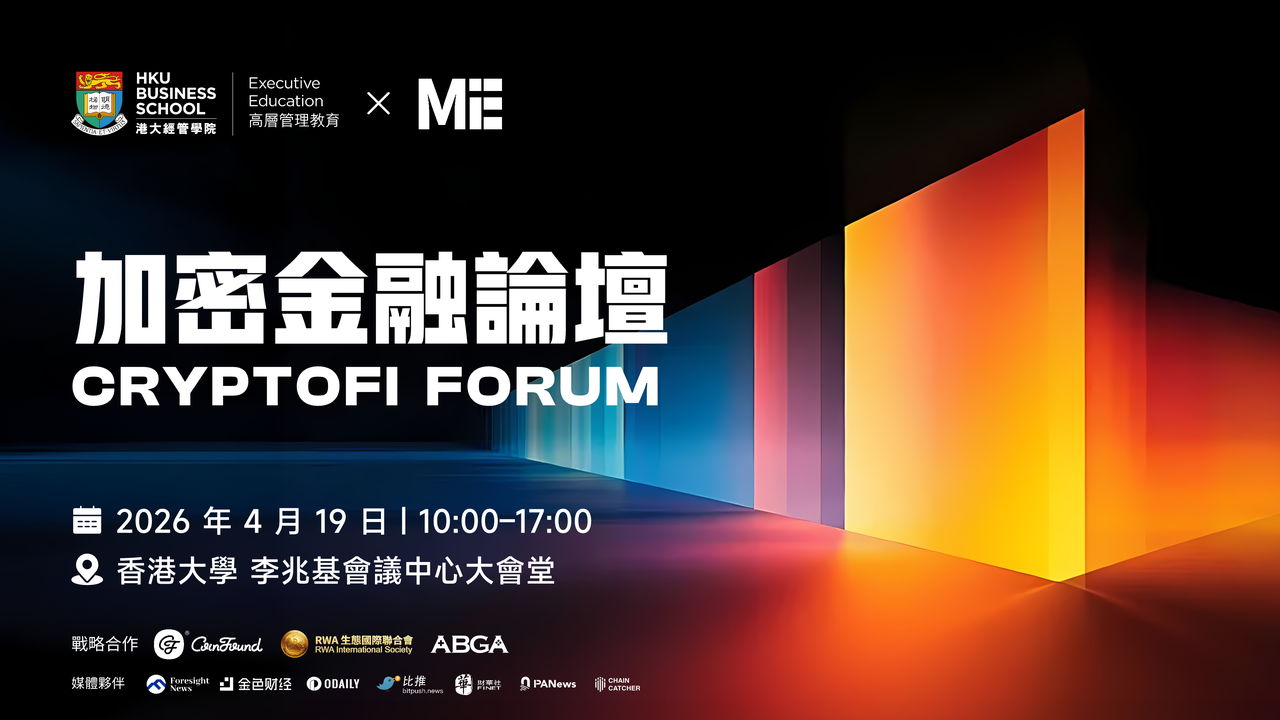
Article author and source: ME News As the global digital economy moves towards the eve of “Web 4.0,” where AI and Web3 are deeply integrated, Hong Kong is leading the global fintech transformation with a robust regulatory and innovation ecosystem. Co-hosted by ME Group and the Hong Kong University School of Economics and Management Executive Education, the “Hong Kong University Special Session” will be held on April 19, 2026 in the conference hall of the Lee Shau Kee Conference Centre of the University of Hong Kong. Decoding the new paradigm of Web4.0 top-level strategy and asset integration This forum aims to break down the barriers between academic research and industrial practice. The morning session of the forum brought together heavyweight guests from Hong Kong's political, academic, and business circles to comprehensively analyze the evolutionary logic of integrating digital assets and the real economy in the Web4.0 era through ceremonial speeches, keynote speeches, and in-depth round tables. Event details: April 19, 2026, 10:00 - 17:00 Venue: Hong Kong University Lee Shau Kee Conference Center Conference Hall Organizer: ME Group, Hong Kong University School of Economics and Management Executive Education Strategic Cooperation: CoinFound, RWA Ecological International Federation, ABGA Registration Links: https://www.me.news/events/538媒体伙伴:Foresight News, Golden Finance, Odaly, Bitpush, Caihua, PanNews , ChainCatcher, the political science representative discussed the opening of the Web4.0 Strategic Height Forum. The three guests of honor will point the direction for the development of digital finance in Hong Kong from a policy and regulatory perspective. Mr. Shen Haojie, deputy to the National People's Congress and managing partner of Shen Huang Law Firm, Mr. Lee Chun-keung, member of the National Committee of the Chinese People's Political Consultative Conference, member of the Hong Kong Legislative Council, and Vice Chairman of the Liberal Party, and Mr. Wang Junshun, Senior Vice President (Fintech) of the Hong Kong Investment Promotion Department, will personally visit the site. They will deliver important speeches on digital asset regulatory developments and Hong Kong's Web3 industry policy, and explain how Hong Kong is building a dual highland of “security and innovation” in the global AI and digital asset competition. In the keynote session, from the underlying architecture to the evolution of the smart economy, many top scholars and industry leaders will bring forward-looking hardcore sharing. The underlying logic of fintech: Professor Lin Chen, Vice President (Business Strategy) of the University of Hong Kong, will analyze the deep logic of Tokenized Gold from a global perspective. As a leading figure in finance, he will explain how gold tokenization is reshaping the way value is stored and distributed, and explain how technology can restructure production relationships and drive qualitative changes in the digital economy under the RWA (Real World Asset Tokenization) wave. The rise of the smart economy: Amber Group co-founder and CEO Michael Wu will present a presentation entitled “Financial Services in the Smart Economy: From Platforms to Autonomous Operating Systems” to discuss in depth the shift in service paradigms after AI agents are deeply involved in financial decisions. Practical implementation of security and compliance: Beosin's Chief Operating Officer Alex Cheng will focus on “From Regulatory Requirements to Technology Implementation”, analyze how Regtech (Regulatory Technology) can improve the on-chain risk control of payment institutions, and provide a technical roadmap for compliant operations in the Web4.0 era. The explosion of the social finance ecosystem: John, head of the Asia Pacific region of the TON Foundation, will reveal how the Telegram ecosystem can build an AI agent bot with millions of users, showing the huge potential of combining decentralized social networking with smart devices. Talent Development and Ecological Co-Construction: Dorothy Ying, Executive Director of Senior Management Education at the HKU School of Economics and Management, will introduce the HKU School of Economics and Management Web3 Global Elite Course and share how to send leading Web3 talents with a global perspective and practical ability to the industry through a systematic education system. Summit Discussion: Stablecoin Payments and RWA Institutional Applications The morning agenda also set up two high-quality round-table discussions to directly address the industry's most concerned implementation scenarios: stablecoins and payments-driven on-chain economy: hosted by CoinFound founder and CEO Horace Peng, FOMO Group co-founder Zack Yang, Victoria Chen, Executive Vice President of Yuancoin Technology, and Candice Zhang, CEO of DTCPay Hong Kong, WLFI Market Leader Shawn Chong and Plume CSO Shu...
126d agoWendy#ME Group #ME News #activity #hongkong
Connecting the world and integrating traditional finance with the crypto market - 2026 Crypto Finance Forum is about to open

Connecting the world and integrating traditional finance with the crypto market - 2026 Crypto Finance Forum is about to open

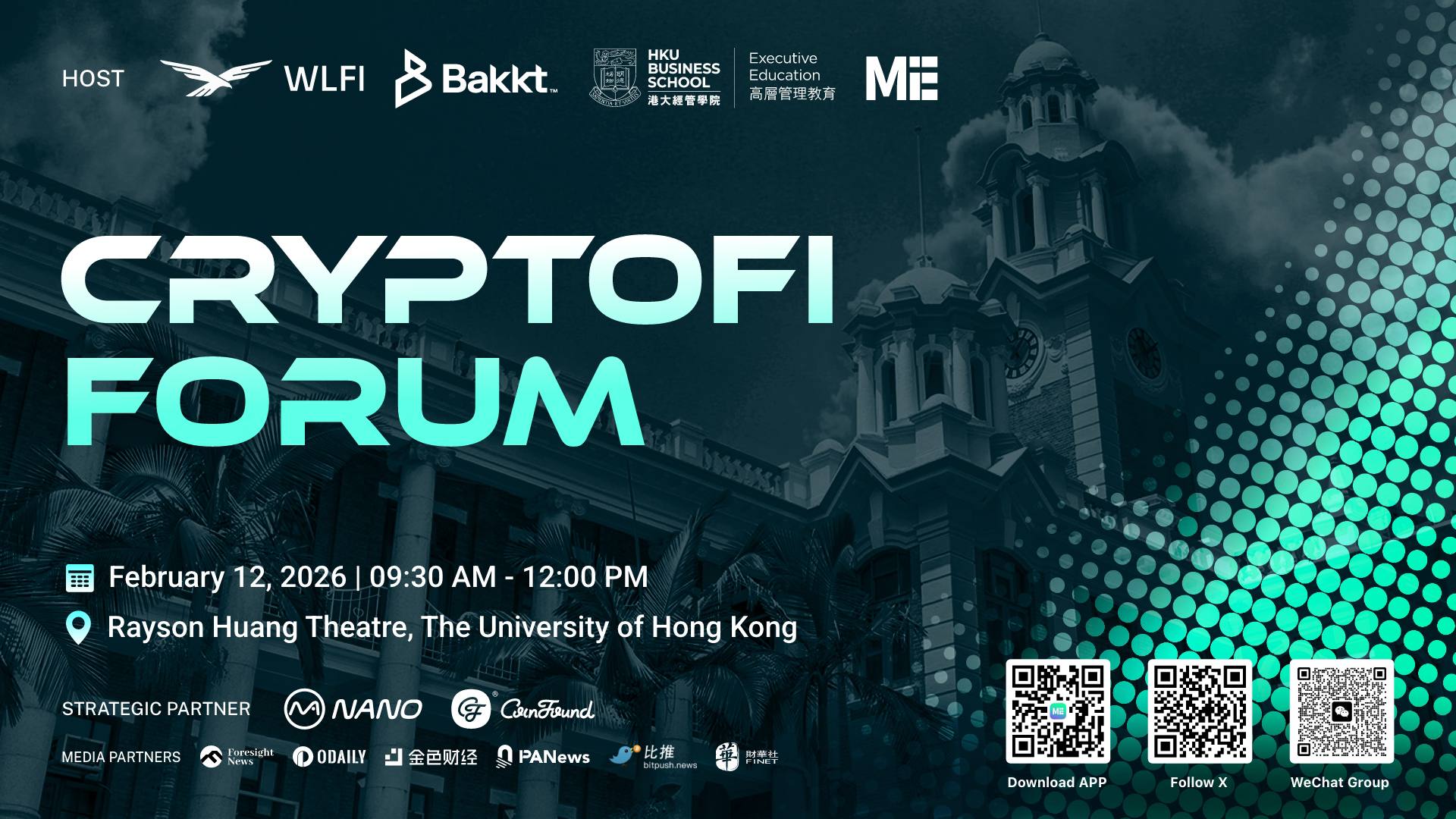
Article author and source: ME News At a time when cryptocurrencies and traditional finance are deeply integrated, the Crypto Finance Forum will be grandly opened at the University of Hong Kong on February 12, 2026. The CryptoFi Forum (Crypto Finance Forum), co-hosted by WLFI, Bakkt, HKU School of Economics and Management, and ME Group, aims to create a high-end dialogue platform connecting East and West, academic research and business practices, traditional finance and the crypto industry. Guided by the vision of “decoding cryptocurrencies and reshaping the future of finance”, the forum will systematically sort out the evolutionary path of crypto finance and explore in depth institutional opportunities and emerging technology paradigms within a compliance framework to provide forward-looking insight into the future of the global financial system. The forum will be held through multiple strategic dialogues. Guests include Zak Folkman, Chase Herro and Ryan Fang from the WLFI team, Nicholas Baes, Bakkt's Chief Operating Officer, Dr. Xiao Feng of HashKey Group, Professor Wang Yang, Vice President (University Development) and Chair Professor of the University of Hong Kong, Jack Kong, Director of Hong Kong Cyberport and CEO of Nano Labs, and Jessica Kong, CEO of ME Group Ms. Yang. The forum agenda will focus on three core topics: the current industrial landscape of the crypto world, the latest institutional-level practices in traditional finance, and cutting-edge applications in the on-chain world. Additionally, thanks to strategic partners: Nano Labs Ltd (Nasdaq: NA) and CoinFound; and media partners: Foresight News, Odaily, Golden Finance, PanNews, Bitpush, and Caihua for their strong support. Event Information Event Topic: Crypto Finance Forum Event Time: February 12, 2026 09:30 - 12:00 (HKT) Event Venue: The University of Hong Kong Organizers: WLFI, Bakkt, HKU School of Economics and Management Senior Management Education, ME Group Strategic Partners: Nano Labs Ltd (Nasdaq:NA), Coinfound on CryptoFi Forum's “CryptoFi Forum, CFF” (CryptoFi Forum, CFF) is committed to Build a platform for dialogue and cooperation to promote the development of the global crypto finance industry. Website: https://www.me.news/CryptoFi关于 WLFIWLFI is building the future of finance. USD1 is just the starting point, dedicated to serving individual users, institutions, and a wider range of financial participants. Official website: https://worldlibertyfinancial.com/关于 BakkTBakkt focuses on building a new generation of institutional-level digital asset infrastructure to reshape currency forms, circulation methods and market operation mechanisms. Official website: https://bakkt.com/关于 HKU School of Economics and Management Senior Management Education The HKU School of Economics and Management Senior Management Education is dedicated to helping managers cope with the complex global market environment. Relying on the University of Hong Kong's unique advantages in terms of international vision, comprehensive thinking ability and academic excellence, it enhances managers' strategic vision. Official website: https://execed.hkubs.hku.hk/关于 ME GroupMe Group is the world's leading financial information and technology platform. It is headquartered in Hong Kong and has a North American office in New York. The core business covers media services (ME News), brand events (ME Events), video services (BTV), and AI-driven media, marketing and data services. We are committed to providing accurate information content, professional marketing services and AI intelligent solutions for global users. Website: https://www.me.news/更多详情活动官方网站:https://www.me.news/events/488X Platform: https://x.com/CryptoFi_Forum...

205d agoLuxurytracy
Manus Xiao Hong, with that group of interns in the coin industry who “came to the table”

Manus Xiao Hong, with that group of interns in the coin industry who “came to the table”

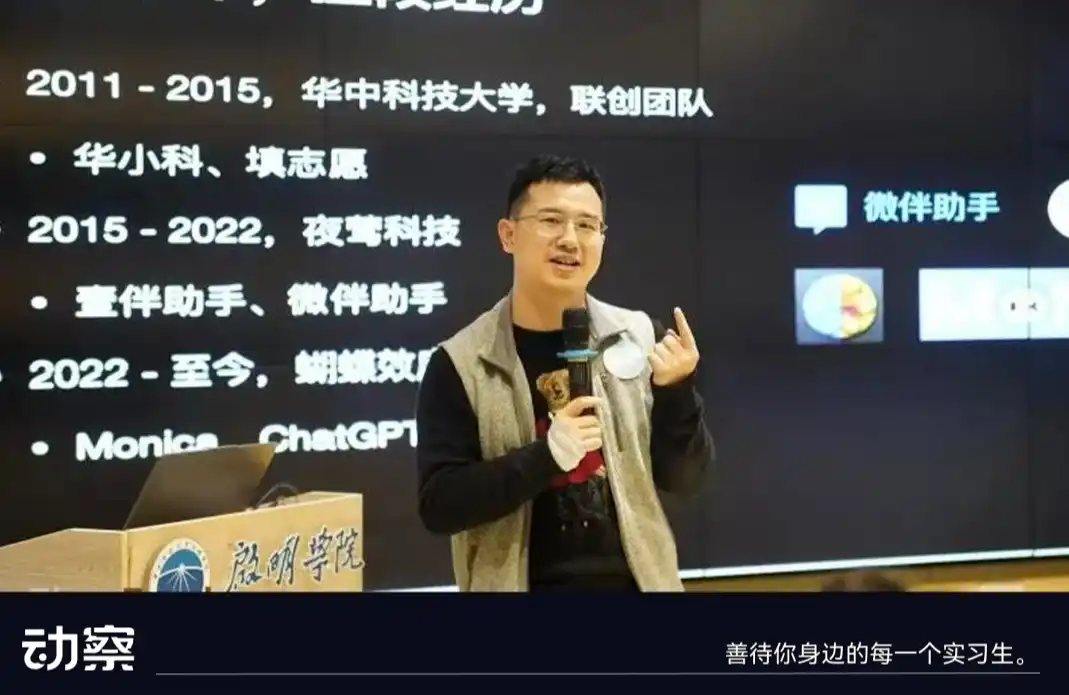
Author: Lin Wanwan, Motion Detective BeatingOriginal title: Starting with Manus Xiao Hong, the biggest news in the tech industry came from Meta: Zuckerberg spent billions of dollars to acquire Manus, an AI company that was founded less than a year ago. This is Meta's third-largest acquisition in history, after WhatsApp and Scale AI. A few days after the news was announced, everyone found that his profile stated: BTC Holder (Bitcoin holder). A tweet appeared on Twitter. The person who tweeted is called “Kamiyu”. His real name is Mao World Bank, one of the earliest Bitcoin miners in China, with a net worth of over 10 billion dollars: “It's no surprise that Manus founder Xiao Hong is a BTC holder — in 2013, he was one of our interns at Huake, and we worked together for 1bit at the time.” 2013. One bit. Huake intern. Xiao Hong, born in '93, is from the small town of Ji'an, Jiangxi. Prior to becoming Meta's vice president, he was best known as the founder of AI products Monica and Manus. But few people know that his first serious internship was at a Bitcoin media company called OneBit. He was in his sophomore year that year and worked on various student programs at Qiming College of Huazhong University of Science and Technology, WeChat drift bottles, WeChat on the wall, and a second-hand trading platform on campus. The vice-captain of the Lianchuang team is already considered a well-known tech geek among his peers. But Bitcoin is still a whole new world for him. One Bit is one of the earliest vertical Bitcoin media in China. Its office is located in Beijing Galaxy SOHO. The founding team included Kamiyu and several similarly young idealists. What they did was simple: translate foreign Bitcoin information, write popular science articles, and try to make more Chinese people understand this new thing called the “Ponzi scheme” by mainstream media at the time. What exactly did Xiao Hong do in Yibit is already difficult to verify. But looking back 12 years later, the significance of this experience has long surpassed the internship itself. The Bitcoin Circle in 2013 was a club of early participants in a major social experiment. There is no regulation, no pricing anchor, no mature business model — just a group of young people who believe “code is the law” to warm up amidst the ridicule of mainstream society. The people who were able to enter at that time were either gamblers or really understood something. Xiao Hong clearly falls into the latter category. Decentralized, permissionless, code autonomy. These ideas seemed like geek pride at the time, but they formed an underlying framework for understanding the world. Twelve years from now, when AI begins to reshape the boundaries of human-computer interaction, this framework may become traceable. From Bitcoin to AI Agents, the forms of technology vary widely, but the underlying logic is the same: it's all about how to make machines run autonomously, how to establish collaboration in an untrustworthy environment, and how to replace intermediaries with code. People who understood Bitcoin in 2013 understood AI Agents hardly needed additional cognitive purchasing in 2025. In that tweet, Kamiyu used a word: “identify vectors.” “In ten years, from Bitcoin to AI Agents, times have changed, and the company's boundaries have blurred. It's not so much about recruiting employees as it is about identifying vectors...” What is a vector? Direction multiplied by speed. Xiao Hong in 2013 is a sophomore who is willing to bet his time on “unreliable” fields. The choice itself is a screening — sifting out those who only look at immediate certainty, leaving behind those willing to pay for long-term possibilities. Twelve years later, this vector points to the position of Meta's vice president. In the cryptocurrency industry, where the myth of making wealth coexists overnight, there is a hidden path to success: follow one person in your early 20s. Around 2013, a group of the smartest and most adventurous young people poured into this barbaric world. Some of them have just dropped out of school, and some haven't graduated yet. Following the craziest entrepreneurs of that era, they work at the grassroots level in trading platforms, mining pools, and media companies. They're betting on some kind of perception. This perception allowed them to recognize opportunities faster than their peers in every wave of technology ten years from now. Buffett once said, “Life is like a snowball; the important thing is to find wet snow and long slopes.” The cryptocurrency industry in 2013 was that wet and long slope. And those who set foot on this slope in their early 20s have been rolling their snowballs for 12 years. Xiao Hong is one of them. But he's not the only one. One sheet...

226d agoburnking#Manus #Meta #trainee #viewpoints
From Chain Smell to Now: Liu Feng on Changes in Encrypted Media and Information Screening

From Chain Smell to Now: Liu Feng on Changes in Encrypted Media and Information Screening

Editor | Wu talks about blockchain Original title: Talking with Liu Feng, former editor-in-chief of Chainwen, about the current state of cryptographic media, how to find real and effective information? (Encrypted information source included) This podcast is from Web3 101. Liu Feng, editor-in-chief of Chainwen, and Wu said that Editor-in-Chief Colin and Jack, Deputy Editor-in-Chief of Blockchain Dynamics, discussed the current challenges and dilemmas faced by traditional media and cryptocurrency media. The two also discussed how ordinary readers can get more true, more accurate, and more effective information in the confusing cryptocurrency information field. This conversation was posted in June 2025, and some information may be out of date. Wu said the beginning and development process Liu Feng: Welcome to Web3 101. Today we are inviting Colin Wu, founder of Wu. We would like to discuss a topic, that is, in today's coin industry, how can information be screened and confirmed in today's complex and chaotic information? Of course, the topic will probably go far beyond that. Mr. Wu, can you briefly introduce yourself? Colin: Hi, I'm Colin, the founder of WubLockChain. Wu said it is now a cryptocurrency media and content platform covering English, Chinese, and a few other languages. At the end of 2019, I started a simple public account myself and started writing some content, then slowly recruited some colleagues to work with me, and it grew to where it is now. Liu Feng: The reason I invited Lao Wu to do this program is because I am often asked the question: In the world of cryptocurrency and Web3, how can I learn quickly and get really valuable information? All three of us are from the media, so we can only start from the media's perspective and hope to inspire our listeners. Another particularly important reason is that I think Wu said it is one of the media that has grown very fast and has been very successful in the past few years. The “success” here isn't about how much money has been earned, but rather that it has gained widespread trust in the cryptocurrency space. So when was Lao Wu, the Twitter account of WubLockChain (Wu said official account in English), officially launched? Colin: I don't remember this very clearly; it's probably between 2021 and 2022. Liu Feng: Assuming it's 2022, it's been over three years now. I took a look this morning. The account currently has over 530,000 followers. This number is critical, because Wu said it is a media with a Chinese team as the main, but this account mainly publishes in English, and its number of fans is close to the level of the world's leading crypto media. Of course, established media such as CoinDesk, which has been in operation for 12 years, currently has millions of followers on Twitter. In addition to this, Wu's English account is already one of the most influential blockchain media currently. Not only is the content published entirely in English, but in my opinion, it has become a frequently cited source of information by a large number of international media, important investors, and industry participants. So when I say “success,” I mean influence in this sense. Lao Wu, can you share how you think Wu's account has grown rapidly over the past few years and won the trust of the industry? What factors do you think contributed to everyone's attention and trust in you? Colin: The growth of our English account is actually quite “fantastic.” As a Chinese team, many people actually want to be an English platform, whether it's a media, content platform, exchange, or project party. But not much is actually being done; in particular, there are even fewer content-driven platforms. Exchanges and project parties can drive development through significant capital investment or other means, but our content-only team mainly relies on the content itself. There were a few key elements to our start at the time. The first is that there was a lot of major news in China at the time, probably related to evictions, policy support, important meetings, etc. We rushed to write this related news at the time. Our characteristic is that we post very fast. This is related to my background as a reporter for a news agency. Our style is to pursue speed and simplicity while ensuring accuracy as much as possible. This style formed a wonderful cycle in Western markets at the time — many people thought that as soon as our news came out, currency prices would fluctuate. In the cryptocurrency industry, the influence of a media or KOL often depends not on whether it actually affects the market, but on everyone's “belief” that it will affect the market. This psychological expectation itself may trigger a market reaction. So we became such a character at the time, and many people felt that our content might drive price fluctuations. The second factor is compared to...

228d agoLuxurytracy
Bitcoin falls below the $90,000 mark: December trend enters a critical inflection point

Bitcoin falls below the $90,000 mark: December trend enters a critical inflection point

Author: Shaw, Golden Finance On the morning of December 1, cryptocurrencies once again experienced a “flash crash”. Bitcoin rapidly fell by more than 4,000 US dollars within 2 hours, once hitting 86,161 US dollars, falling nearly 5% in 24 hours; Ethereum rapidly fell by more than 200 US dollars within 2 hours, once hitting 2813.20 US dollars, and falling by more than 5.5% in 24 hours. According to the data, the entire network closed out 481 million US dollars in the past 4 hours, including 462 million US dollars in more orders and 19.1404 million US dollars in empty orders, which mainly exploded many orders. BTC bursts out of $159 million and ETH bursts out of $134 million. At the beginning of December, the cryptocurrency market took the lead for investors, and fears that had abated slightly before spread again. What happened to the market? With only one month left in this year, what is the trend in the crypto market, will it continue to be sluggish, and is the bear market getting deeper and deeper? 1. The crypto market dived for a short time. Bulls were laundered by blood this morning. The crypto market showed another “flash crash”. Bitcoin and Ethereum all took a big dive. Bitcoin rapidly fell by more than 4,000 US dollars within 2 hours, falling below 87,000 US dollars in a short period of time. At one point, it hit 86,161 US dollars, a drop of nearly 5% in 24 hours; Ethereum quickly fell more than 200 US dollars within 2 hours, falling below 2,900 US dollars in a short time, and once hit 2813.20 US dollars, and fell by more than 5.5% in 24 hours. Solana, BNB, etc. also experienced rapid short-term declines. According to Coinglass data, the entire network sold out 481 million US dollars in the past 4 hours, including 462 million US dollars in more orders and 19.1404 million US dollars in short orders, which mainly exploded many orders. Among them, BTC bursted out of $159 million and ETH bursted out of $134 million. In the last 24 hours, more than 198,000 people across the network have been liquidated. The biggest single liquidation order occurred on Binance - ETH/USDC, worth $144.817 million. The recent rise in expectations of the Federal Reserve's interest rate cut is not enough to support the continued rebound and recovery of the crypto market. Factors such as weak ETF funds, sell-off by “giant whale” investors, the re-liquidation of long leverage, and the continued tightening of domestic policies have once again deepened the panic in the market. 2. Domestic regulatory policies continue to be tightened, amplifying market fears. The People's Bank of China recently held a coordination mechanism meeting to combat virtual currency trading hype. Relevant officials from 13 departments including the Ministry of Public Security and the Central Internet Information Office attended the meeting. The meeting called for continuing to adhere to the policy prohibiting virtual currencies and continuing to crack down on illegal financial activities related to virtual currencies. The conference emphasized that virtual currency does not have the same legal status as legal tender, is not legally compensable, should and cannot be used as currency in the market, and that virtual currency-related business activities are illegal financial activities. Stablecoins are a form of virtual currency. Currently, they cannot effectively meet customer identification and anti-money laundering requirements, and there is a risk that they will be used for illegal activities such as money laundering, fund-raising fraud, and illegal cross-border fund transfers. The meeting demanded that all units take risk prevention and control as an eternal theme in financial work, continue to adhere to policies prohibiting virtual currencies, and continue to crack down on illegal financial activities related to virtual currencies. Although no new regulatory policy was introduced at this conference, it once again emphasized the strict domestic ban on virtual currency transactions and strict regulatory requirements for stablecoins. 3. The unstable macroeconomic environment affects the risk asset market Bank of Japan Governor Kazuo Ueda said that its policy committee may raise the benchmark interest rate this month. He stressed that any rate hike is only an adjustment to the degree of easing policy, and the authorities will make appropriate decisions on whether to advance policy changes. Speaking to local business leaders in Nagoya in central Japan on Monday, Kazuo Ueda said that the Japanese economy has recovered moderately, and the inflation rate is expected to briefly fall below 2% in the first half of the 2026 fiscal year, then accelerate again, and is roughly in line with the 2% target in the second half of the outlook period. He said that wages and prices are rising at the same time, and the impact of the exchange rate on prices is increasing. In order to achieve the goal of price stability, the easing policy will be adjusted in due course. If the economy and prices continue to improve, further interest rate increases will be considered. According to overnight index swap data, traders expect the probability that the Bank of Japan will raise interest rates by the end of the next policy meeting on December 19 is about 64%. The probability of taking action by January next year is even higher to 90%. After Ueda's speech, the yen strengthened slightly against the US dollar. Prior to his speech, two-year Japanese Treasury yields had risen to their highest level since 2008 as expectations of the Bank of Japan's interest rate hike heated up. Expectations of the Bank of Japan's interest rate hike are heating up, and the uncertainty of the macroeconomic environment has affected risky assets such as cryptocurrencies...

263d agoLuxurytracy#Bitcoin
The Federal Reserve Cuts Interest Rates in December: A Full Analysis of Proponents and Opponents

The Federal Reserve Cuts Interest Rates in December: A Full Analysis of Proponents and Opponents

Author: Deng Tong, Golden Finance Original title: The Federal Reserve's Decision to Cut Interest Rates in December: Who Approves? Who is against it? On November 21, according to CME's “Federal Reserve Watch”, the probability that the Fed will cut interest rates by 25 basis points in December is 39.6%, and the probability of keeping interest rates unchanged is 60.4%. On the same day, Federal Reserve Vice Chairman and New York Federal Reserve Governor Williams said that the Federal Reserve can cut interest rates “in the near future” without jeopardizing its inflation target. Affected by this statement, Polymarket “predicts that the probability that the Fed will cut interest rates by 25 basis points in December will rise to 61%.” Today, according to CME “Federal Reserve Watch” data, the probability that the Fed will cut interest rates by 25 basis points in December has risen to 69.4%, and the probability of keeping interest rates unchanged is 30.6%. Furthermore, prior to Williams's statement, the BTC price had been falling continuously, even hitting 82,000 US dollars. Since the interest rate cut statement was announced, the BTC price began to slowly recover, up to $8,7067.46 as of the press release. White House economic adviser Hassett pointed out that the new leadership of the Federal Reserve may be expected to cut interest rates. Trump may interview candidates for the Federal Reserve in the next few months, and we will probably determine the candidate for the chairman of the Federal Reserve around the new year. The market is currently generally concerned about the Federal Reserve FOMC meeting. 1. Federal Reserve FOMC meeting voting mechanism The Federal Open Market Committee (FOMC) of the Federal Reserve uses a majority vote system, and every voting member has an equal vote. The committee has a total of 12 voting members. They are composed of two parts: a permanent voting committee and a rotating voting committee. All Board members (maximum 7 members); President of the Federal Reserve Bank of New York; 4 of the remaining 11 Reserve Bank governors rotate for a term of one year. The seven Reserve Bank governors who do not have the right to vote will attend the FOMC meeting and participate in the committee's discussions. The voting mechanism determines by majority vote: At the end of each two-day meeting, participants will vote on the monetary policy proposal (for example, whether to adjust the target range of the federal funds rate), and the proposal that receives the majority vote will be adopted. Consensus: Despite voting mechanisms, FOMC members usually engage in extensive discussions and negotiations to seek consensus to ensure broad support for policy decisions, thereby conveying a consistent message to the market. Record of objections: If a voting member disagrees with the final decision, their objections will be officially recorded in the minutes of the meeting, which shows the outside world the diversity of opinions within the committee. Jeffrey Roach, chief economist at LPL Financial, said, “Actually, committee members communicate closely between meetings and try to reach a consensus, but this does not guarantee that a consensus can be reached.” Allowing all members of the Federal Reserve to reach a consensus will help convey to the market that Fed officials agree on their actions. However, differences in voting results may raise questions about whether the Federal Reserve believes its actions are correct and the motives of the Federal Reserve officials. 2. 2025 FOMC voting member and permanent voting member (Federal Reserve Board Member and New York Federal Reserve Governor) Jerome H. Powell, Chairman (Federal Reserve Board): Uncertain. On October 29, at a press conference after the Federal Reserve decided to cut interest rates by 25 basis points, Powell said that interest rate cuts will not necessarily continue until December as previously generally predicted. “Further interest rate cuts at the December meeting were not a foregone conclusion; far from it. The opinions of all parties are very divided today. As can be seen from this, we have yet to make a decision on interest rate trends in December.” Powell acknowledged that the Federal Reserve is in a difficult situation and that economic trends are driving monetary policy in the opposite direction. “We are facing a situation where inflation is at an upward risk and employment is at a downside risk. We only have one tool... you can't deal with these two problems at the same time.” John C. Williams, Vice Chairman (New York Federal Reserve Governor): Williams, who is inclined to cut interest rates, said at a meeting of the Central Bank of Chile that US interest rates may fall without jeopardizing the Federal Reserve's inflation target, and at the same time help prevent the job market from falling. “I think monetary policy has been tightened slightly... Therefore, I think there is still room for further adjustments in the federal funds rate target range in the short term to bring the policy stance closer to the neutral range.” Williams said the Federal Reserve needs to achieve its inflation target “without putting excessive risk to the goal of full employment.” Michelle W. Bowman, Federal Reserve Governor: Proposed to cut interest rates Bowman said in a speech in September after the Federal Open Market Committee (FOMC) decided to cut interest rates for the first time since 2025...

270d agoLuxurytracy#Federal Reserve #Interest rate cut
Bitwise: Institutions have controlled 12.5% of Bitcoin, and this wealth migration is just beginning

Bitwise: Institutions have controlled 12.5% of Bitcoin, and this wealth migration is just beginning

Author: André Dragosch, Head of European Research at Bitwise; Translation: Golden Finance Xiaozou Original title: Institutions already control 12.5% of Bitcoin? Bitwise Report: This major shift in wealth is only the beginning “If you have any doubts, please take a longer time to observe” This is the essence of the key chart in our latest Bitwise quarterly Market Report. The data clearly reveals current general trends, and can even explain the special nature of the current Bitcoin cycle (data provided by River). 1. The core key point in interpreting the essence of “big wealth transfer” is that Bitcoin is flowing from early retail investors to institutional investors (funds/exchange-traded products), enterprises, and even government entities. Unlike other traditional asset classes in history, Bitcoin's popularity path began with retail investors such as cryptopunks and early participants, and then ushered in the initial deployment of institutional investors such as family offices, fund managers, and ETFs. Even now, retail investors still account for around 66%, which means that the vast majority of Bitcoins are still controlled by non-institutional investors (see matrix distribution in the chart above)! In comparison, the latest data from the US 13F file shows that the allocation ratio of institutional investors in traditional asset classes is significantly higher. Observe the share of institutional holdings in mainstream traditional financial ETFs: iShares 20-year treasury bond ETF (TLT) institutional holdings 79%; SPDR S&P 500 ETF (SPY) institutional holdings 58%; SPDR gold ETF (GLD) institutional holdings 36%. Compared to Bank of America's latest survey of global fund managers: Currently, the average allocation ratio of crypto assets (including Bitcoin and other tokens) is only 0.4%. (Note: IBIT currently accounts for only 26% of institutional holdings...) It can be seen from this that, as the industry often says, “We are still in the early stages”, institutional adoption is still in its infancy. But it is undeniable that a large-scale transfer of wealth from retail investors to institutions is taking place. Wealth migration from early retail coin holders to institutional investors will have multiple impacts, and its depth may be beyond imagination: 2. Bitcoin Popularity: Trends and Cyclical Rules (1) The trend is first clear: this transfer will not happen overnight, but rather a long-term trend. The reality is that most bitcoins are in an illiquid state and are being held for a long time. Only about 14.5% of the Bitcoin supply is relatively liquid stored on exchanges such as Coinbase or Binance, while the rest of the assets are stored in off-chain wallets and remain illiquid. Without financial incentives, Bitcoin wealth will not automatically transfer. Many early holders set a psychological price level (such as $1,000,000 per BTC) or economic goals (such as “home purchase capital”) as a trigger for selling Bitcoin, which is far higher than the current market price of around $115,000. To attract these illiquid tokens to the market (that is, exchanges), the price of Bitcoin would need to rise sharply. In the process, Bitcoin's popularity will expand as ETFs hold assets for millions of individual investors in the form of trusts. The financial reports of listed companies also show that they are being held by hundreds of thousands of different investors. At the time of writing, institutional investors (ETPs and publicly traded companies) controlled around 12.5% of the Bitcoin supply — and it's still rising fast. (2) Cycle rules Most analysts may agree that the early Bitcoin bull and bear cycle was mainly dominated by halving events that occurred every 210,000 blocks (about 4 years). This mechanism halved Bitcoin output (therefore called “halving”). But the impact of the halving event is diminishing with each event — whether in absolute terms or in proportion to circulating supply. With the increase in institutional adoption rates and changes in the demand structure, the halving effect has clearly weakened. According to 2025 data, the scale of institutional demand has reached about 7 times the supply gap caused by the halving! In the process, the influence of traditional macro cycles has increased relatively — Bitcoin has become a real “macro asset.” Our quantitative analysis also shows that more than 80% of Bitcoin price fluctuations over the past 6 months were driven by macroeconomic factors such as global growth expectations and monetary policy, and token-specific factors influenced less than 5%. However, the dominance of macro factors also means that the future Bitcoin bull-bear cycle will fluctuate in sync with the macro/business cycle, and the four-year cycle driven by “halving” is likely to “fail.” This ultimately shows that the accumulation and distribution of Bitcoin will depend on the dominant macroeconomic environment (expansion/boom vs. contraction/decline), so...

296d agoLuxurytracy#Bitwise #Bitcoin
Is “VC Dead” real or just a sentiment? What do industry insiders think of this wave of recession

Is “VC Dead” real or just a sentiment? What do industry insiders think of this wave of recession

Author: Golden Finance Original title: Are crypto VCs about to die out? What do industry insiders think? Recently, the coin community has sparked a discussion about “whether crypto VC has died out”. Galaxy Research's latest venture capital report shows that in the second quarter of 2025, cryptocurrency and blockchain startups raised a total of $1.97 billion in 378 deals. Compared with the previous quarter, the amount of funding fell 59% and the number of transactions fell 15%. This is the second-lowest quarterly total since the fourth quarter of 2020. Independent researcher Haotian pointed out, “In four years, VCs haven't even found a sustainable investment model; leading VCs can get the best terms, the lowest price, and an early exit opportunity, while most small and medium-sized VCs follow suit and are treated as successors by large institutions; most VCs are “big leeks,” and basically rely on the diversity of portfolios to gamble on probability; the market is looking for a possibility that VC is not needed.” What do industry insiders think about the demise of crypto VCs? Is VC really dying out in the coin industry? 1. Crypto VC crashed Waterloo's joint research with Chainplay and Strorible shows that of the 1,181 crypto projects that were venture-funded between January 1, 2023 and December 31, 2024, nearly 45% have been suspended, and 77% have a monthly income of less than $1,000. In terms of venture capital institutions, Polychain Capital had the highest investment failure rate, 44% of participating projects were terminated, and 76% of the projects did not generate effective revenue; Yzi Labs (formerly Binance Labs) supported projects with a failure rate of 72%; top venture capital firms such as Circle, Delphi Ventures, Consensys, and Andreessen Horowitz also suspended a large number of support projects, and many failed over two-thirds of the projects. Among angel investors, former Coinbase CTO Balaji Srinivasan “zombie project” topped the list with 57%; Arthur Hayes at 34%, Santiago Santos at 15%, and projects supported by Sandeep Nailwal and Stani Kulechov each ceased operations at 10%. The data showed a significant correlation between the size of funding and the success rate. Projects with financing over $50 million have a significantly lower failure rate, while 33% of projects with less than $5 million in financing have failed and 20% have ceased operations. 2. VC is more rational: Waterdrip Capital's founding partner and CEO Jademont pointed out, “Why is VC disappearing soon? You can take a look at the top CEX listing announcements in the past two years. It only tells you the letters XXX will be listed. Let's take a quick gamble without wasting a single word to explain why this project was launched and what this project does. Many retail investors have been playing games with dog stores for a few months, and they don't even know what the target of their trade is, let alone use the product. CEX has been heavily gamified, and even casinos occasionally come out of nowhere. It is said that the top criteria currently assessed by CEX are community popularity, whether market funding is sufficient, and whether they are willing to donate enough free chips. If the above conditions are true, then the existence of VC really doesn't make much sense. Because most VCs are unable to help the project party become a community, they are unwilling to help the project side to trade and gamble with retail investors. So instead of saying VC is about to die out, VC has made a different choice. But first, I don't want to publicize it. Because advertising has no practical meaning other than doing PR. Even when the project side messes up, they will be scolded by the community. You need to know that even if the team takes responsibility for early projects, the probability of being ruined is already very high. Why don't we wait until the project gets bigger and then tell the market that I invested in this project. Second, many projects have no plans to issue coins at all, or do not do retail business, so there is no need for publicity. Just wait for the launch to ring the bell and celebrate. Looking at the schedule below, at least 3-5 early-invested projects will go to Nasdaq next year. Starting a business now isn't just about issuing coins as an exit path.” Bullish Capital Management Director...

305d agoLuxurytracy#Cryptographic VC
Nivex SeaSpark Yacht Feast: Meet the Future Social and Financial Waves

Nivex SeaSpark Yacht Feast: Meet the Future Social and Financial Waves

On October 3, the ocean breeze at Sentosa, Singapore saw a unique future event — SeasPark VIP Yacht Gala & 3 Cruises hosted by Nivex, hosted by EventPro, and sponsored by PopChain, Luma Protocol, and beFlow. The three themed cruises set sail simultaneously, bringing together business executives, investors, community leaders, and Web3 opinion leaders from around the world to experience a four-hour immersive journey intertwined with technology, networking, and entertainment at sea. Highlights of the event focus: SeaSpark explores new boundaries of social networking at sea and opens a new chapter of future experiences. In the light of starlight and ocean breeze, Nivex SeaPark VIP Yacht Gala & 3 Cruises uses the sea as the stage, technology as the medium, and the event focuses on social, experience, and inspiration. It explores new ways to connect people and the future in the Web3 era, and build a new balanced paradigm of high-end social and immersive experiences. 1. Themed Cruise Launch — Building a multi-dimensional social space for the future SeaPark, with three themed cruise ships Aurora (Aurora), Pulse (Pulse), and Nova (Rising Star) as the core, has built a rich level of experience: Aurora's exclusive investors and business elites, Pulse brings together community and media energy, and Nova, in the name of creativity and trends, allows each guest to find their own way of expression in different scenes. Each of the three ships is independent and echoes each other, forming a “maritime city” with both social depth and entertainment, redefining the imaginary boundaries of high-end activities. 2. Immersive sensory experience — The multi-resonance event site of technology, art, and emotion combines music, light, and space design to create a very ceremonial marine immersion experience. Drone filming, giant slides, and magic carpets, and other exclusive water interactions on cruise ships perfectly blend technology and entertainment; the DJ stage, light show, and short video creation area allow guests to release energy in a free atmosphere. SeaSpark is more than just a “party at sea”; it is an artistic expression of technology and the senses, making every experience a flashpoint of memory. 3. Global guests gathered — the event to create a bridge for high-end networking and ideological exchange invited business executives, investment institutions, community leaders from Asia, Europe, the Middle East, etc. and Web3 KOLs to jointly build an international exchange network across fields. In a light and open atmosphere at sea, guests discussed industry trends, shared investment views, and discussed the future direction of AI and crypto finance. SeaSpark takes the form of a “maritime consensus”, which extends the connection beyond shaking hands to a deep fusion of ideas and trust. Special thanks. Finally, we would like to extend our sincere thanks to our media support partners for this event: Web3 Vision, Gold Finance, Defam, BY DAO, BitKoala Finance, ME, blockeats, TechFlow, Cointime, Tintin, non-small, Ctalks, Bitpush, WikiBit, MarsBit, ChainCatcher, Dashu Finance, Web3Space, etc. Extensive coverage and strong support. Conclusion SeaSpark is more than just a sea event, but a preview of the future of finance and social networking. Through this diverse and fluid scenario, it shows how technology can make connections warmer and finance more imaginative. From waves to algorithms, from champagne to intelligent strategies, this feast at sea not only brought people closer together, but also made the outline of future finance more clear under the Singaporean sun [About Nivex] Nivex, the world's leading artificially intelligence-driven spot and derivatives trading platform, has launched a major upgrade — introducing a next-generation institutional order trading system and an advanced artificial intelligence strategy engine. Designed for professional traders and institutions, it provides a smarter, faster, and safer way to grow your wealth. [X: https://x.com/nx_lab【关于 POPChain] POPChain is a new generation EVM compatible public chain, focusing on social and creative ecology, reshaping the way values are connected, and promoting “connecting the economy...

311d agoWendy
The biggest liquidation day in the history of market maker Wintermute's reopening

The biggest liquidation day in the history of market maker Wintermute's reopening

Author: Wintermute Translation: Golden Finance xiaozou Original title: Market Maker Wintermute Revises the Biggest Liquidation Day in Crypto History Last Friday, the US announced the imposition of 100% tariffs on all imported goods from China starting November 1, triggering a wave of risk aversion in major markets. The S&P 500 index fell 2.9%, the VIX surged from 16 to 22, and the 10-year yield fell from 4.14% to 4.05%. Investors are de-risking and shifting to defensive allocations, and the price of gold is rising. Digital currencies were also hit hard. The total number of unclosed contracts before the incident reached 220 billion US dollars, and leveraged positions of 19 billion US dollars were liquidated within just a few hours, setting the record for the largest single-day liquidation in history. Here's our look at the spot perpetual contract and options market. 1. The spot market is based on centralized exchange data aggregation. We see that sell-offs are rapid and synchronized. Most centralized exchange trading pairs bottomed out within 55 minutes (20:40 to 9:35 UTC time), and severe price fluctuations quickly depleted overall market liquidity. Liquidity quickly returned as prices recovered from their lows. Based on the aggregated exchange data of the top 50 currencies, we observed: 1. The median withdrawal was -54%, and over 90% of the tokens declined by more than 10%. BTC (-11%) and ETH (-13%) showed the strongest resistance to falling, while small to medium capitalization assets fell by 60-80% during peak periods. 2. Nearly all tokens in the global liquidation wave bottomed out at around 21:20 UTC time, then rebounded sharply as forced sell-off positions were closed, with an average rebound of +84% within 30 minutes. 3. Losses are negatively correlated with market capitalization size: based on the GMCI30 index, large-cap coins fell by an average of about -27%, and small-cap coins fell by an average of -52%. Within an hour, the order book situation returned to normal, and funds reflowed back to BTC, ETH, and major tier 1 network tokens, and the rebound of small market capitalization coins lagged behind. 4. The overall trading depth of centralized exchanges fell by about 65% during the trough period, but as the frequency of quotes and spreads returned to normal, it returned to over 90% of the pre-incident level within 35 minutes. Liquidity was provided during this period, but the spread between the quotation and the median price widened markedly. 2. After the impact of the US tariff policy triggered market panic in the options market on Friday, BTC futures positions quickly turned to a defensive stance. Traders scrambled to seek downward protection, driving total options trading volume to a record high. The data covered tariff headlines and 24-hour activity during the market sell-off. Panic hedging dominated capital flows, and short-term put options were actively bid on. Market sentiment changed until Saturday. As BTC stabilized around $115,000, the trading strategy switched to volatility harvesting and range trading to profit by selling bullish options and shorting calendar spreads. Volatility surged due to a surge in safe-haven demand, and implied volatility jumped 20-25 points on 7-14. Put options with execution prices of $10.5-115,000 had a premium of 10-15 volatility points compared to bullish options, making it one of the largest single-day front-end increases on record. Options trading volume reached a record high, mainly on contracts expiring in October. About 70% of the premium went into put options below $115,000, highlighting strong demand for downside protection. The 24-hour trading volume on the Deribit platform doubled from the previous record. The flow of capital was reversed to volatile sales on Saturday. Traders sold bullish options and cross-modal combinations in the $118,000-130,000 range, driving the implied volatility reduction from 63% to 51% in the first cycle, indicating that the market quickly judged the tariff shock as a short-term disturbance. 3. Perpetual contract market In the midst of the sharp decline in the market on Friday, both the centralized and decentralized perpetual contract markets experienced extreme tests, and hundreds of millions of dollars of leveraged positions were liquidated within minutes. Centralized exchanges experienced record liquidation volumes and brief liquidity gaps, while on-chain DEX perpetual contracts faced heavy pressure from clearing systems and funds banks, yet mainstream DEX platforms maintained normal operation and solvency throughout the process. This incident became a real stress test for the resilience of on-chain transactions and margin systems. As some users adopted a long and short spread strategy, their short positions were automatically reduced by ADL, causing their positions to temporarily deviate from a neutral state, and then their long positions faced liquidation as prices continued to fall. A total of more than 1,000 wallets on the Hyperliquid platform were automatically deleveraged, which may be one of the triggers for this serial liquidation incident. Take HYPE, which has experienced the worst liquidation on the entire network, as an example. Its settlement amount reached 10.3 billion US dollars: This liquidation triggered the first ADL incident of automatic cross-margin reduction of positions on mainstream DEX perpetual contract platforms. The effect of this mechanism is to close the profit side by closing the position when the reserve fund pool is exhausted...

312d agoburnking#market maker