


The Federal Reserve Cuts Interest Rates in December: A Full Analysis of Proponents and Opponents
Author: Deng Tong, Golden Finance
Original title: The Federal Reserve's Decision to Cut Interest Rates in December: Who is in favor? Who is against it?
On November 21, according to CME's “Federal Reserve Watch”, the probability that the Fed will cut interest rates by 25 basis points in December is 39.6%, and the probability of keeping interest rates unchanged is 60.4%. On the same day, Federal Reserve Vice Chairman and New York Federal Reserve Governor Williams said that the Federal Reserve can cut interest rates “in the near future” without jeopardizing its inflation target. Affected by this statement, Polymarket “predicts that the probability that the Fed will cut interest rates by 25 basis points in December will rise to 61%.” Today, according to CME “Federal Reserve Watch” data, the probability that the Fed will cut interest rates by 25 basis points in December has risen to 69.4%, and the probability of keeping interest rates unchanged is 30.6%.
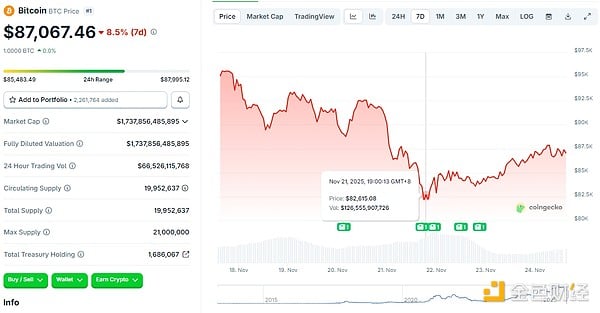
Furthermore, prior to Williams's statement, the BTC price had been falling continuously, even hitting 82,000 US dollars. Since the interest rate cut statement was announced, the BTC price began to slowly recover, up to $8,7067.46 as of the press release.
White House economic adviser Hassett pointed out that the new leadership of the Federal Reserve may be expected to cut interest rates. Trump may interview candidates for the Federal Reserve in the next few months, and we will probably determine the candidate for the chairman of the Federal Reserve around the new year. The market is currently generally concerned about the Federal Reserve FOMC meeting.
I. Federal Reserve FOMC Meeting Voting Mechanism
The Federal Open Market Committee (FOMC) of the Federal Reserve uses a majority vote system, and every voting member has an equal vote. The committee has a total of 12 voting members. They are composed of two parts: a permanent voting committee and a rotating voting committee.
All members of the Board of Directors (maximum 7 members);
President of the Federal Reserve Bank of New York;
Of the remaining 11 Reserve Bank governors, 4 take turns and serve one-year terms.
The seven Reserve Bank governors who do not have the right to vote will attend the FOMC meeting and participate in the committee's discussions.
Voting mechanism
Majority vote decision: At the end of each two-day meeting, participants will vote on the monetary policy proposal (for example, whether to adjust the target range of the federal funds rate), and the proposal receiving the majority vote will be adopted.
Consensus: Despite voting mechanisms, FOMC members usually engage in extensive discussions and negotiations to seek consensus to ensure broad support for policy decisions, thereby conveying a consistent message to the market.
Record of objections: If a voting member disagrees with the final decision, their objections will be officially recorded in the minutes of the meeting, which shows the outside world the diversity of opinions within the committee.
Jeffrey Roach, chief economist at LPL Financial, said, “Actually, committee members communicate closely between meetings and try to reach a consensus, but this does not guarantee that a consensus can be reached.”
Allowing all members of the Federal Reserve to reach a consensus will help convey to the market that Fed officials agree on their actions. However, differences in voting results may raise questions about whether the Federal Reserve believes its actions are correct and the motives of the Federal Reserve officials.
II. 2025 FOMC voting members and tendencies
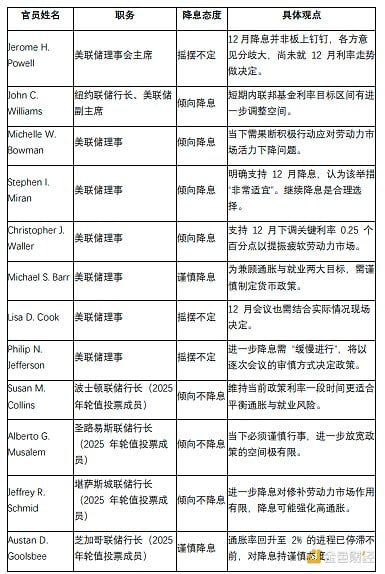
Permanent voting members (members of the Federal Reserve Board of Governors and the President of the New York Federal Reserve)
Jerome H. Powell, Chairman (Federal Reserve Board): Uncertain
On October 29, at a press conference after the Federal Reserve decided to cut interest rates by 25 basis points, Powell said that interest rate cuts will not necessarily continue until December as previously commonly predicted. “Further interest rate cuts at the December meeting were not a foregone conclusion; far from it. The opinions of all parties are very divided today. As can be seen from this, we have yet to make a decision on interest rate trends in December.” Powell acknowledged that the Federal Reserve is in a difficult situation and that economic trends are driving monetary policy in the opposite direction. “We are facing a situation where inflation is at an upward risk and employment is at a downside risk. We only have one tool... you can't deal with these two problems at the same time.”
John C. Williams, Vice Chairman (New York Federal Reserve President): Proposed interest rate cuts
Williams said at a meeting of the Central Bank of Chile that US interest rates may fall without jeopardizing the Federal Reserve's inflation target, while also helping to prevent the job market from falling. “I think monetary policy has been tightened slightly... Therefore, I think there is still room for further adjustments in the federal funds rate target range in the short term to bring the policy stance closer to the neutral range.” Williams said the Federal Reserve needs to achieve its inflation target “without putting excessive risk to the goal of full employment.”
Michelle W. Bowman, Federal Reserve Governor: Prefer to cut interest rates
Speaking in September after the Federal Open Market Committee (FOMC) decided to cut interest rates for the first time since 2025, Bauman said: “Now is the time for the Commission to take decisive and positive action to deal with signs of declining vitality and weakness in the labor market. We are probably lagging behind in dealing with worsening labor market conditions.”
Stephen I. Miran, Federal Reserve Governor: Preferring to cut interest rates
Milan clearly supports cutting interest rates in December and believes it is “very appropriate.” On November 15, he stressed that the overall data since September is dovish and supports the Federal Reserve in strengthening its dovish stance. Earlier, he also proposed that interest rates should be cut by 50 basis points, or at least 25 basis points. He believes that if there are no major changes in economic data, continuing to cut interest rates is a “consistent and reasonable choice.” Milan is a former White House chief economic adviser appointed by Trump, and outsiders have questioned its independence — his aggressive stance has fueled divisions within the Federal Reserve.
Christopher J. Waller, Federal Reserve Governor: Prefer to cut interest rates
On November 17, Waller said he supports another 0.25 percentage point cut in the US key interest rate in December to help boost the weak US labor market — and he doubts he will change his mind. Waller said that based on surveys of consumers and businesses and his own contacts with large employers, he is convinced that the labor market situation has deteriorated. He pointed out that key employment data, which was delayed due to a record 43-day government shutdown, once released, will likely be the opposite. “The labor market is still weak and close to stagnation”. Meanwhile, inflation has not risen significantly in recent months. He said that the economic slowdown and high interest rates have curbed consumer spending, thereby helping to control inflation. “Given the signs that economic growth is slowing, and a weak labor market may lead to moderate wage growth, I don't think there are any factors that will cause inflation to accelerate.”
Michael S. Barr, Federal Reserve Governor: Be careful about cutting interest rates
On November 20, Michael Barr said, “I'm worried that the inflation rate is still around 3%, and our target is 2%. So now we need to be careful about monetary policy, because we want to ensure that we achieve both aspects of our mission.
Lisa D. Cook, Federal Reserve Governor: Uncertain
In an interview with the Brookings Institution in Washington, Cook said, “Every meeting determines my monetary policy position based on the latest data from various sources, changes in my expectations, and risk balance. Every meeting, including the December meeting, was a live meeting.”
Philip N. Jefferson, Federal Reserve Governor: Uncertain
On November 17, Jefferson pointed out that as the Federal Reserve relaxes its policy to a position that may stop the progress of slowing inflation, it needs to “proceed slowly” on the issue of further interest rate cuts. “In recent months, I think the balance of risk in the economy has changed. Compared with the upward risk of inflation, the downside risk faced by employment has increased, and the upward risk of inflation may have declined recently.” Jefferson will be guided by data and adopt a “meeting by meeting” approach to determine policies. “At this point, this is a particularly prudent approach.” Ahead of the Federal Reserve policy meeting in December, “it is still unclear how much official data we can see.”
2025 Rotating Voting Member (Regional Federal Bank President)
Susan M. Collins, President of the Boston Federal Reserve: Preferably not to cut interest rates
On November 12, Collins said: Due to concerns about high inflation, she believes the threshold for further easing monetary policy in the near future is “relatively high.” “In the absence of clear evidence of a deterioration in the labor market, I will not relax policies easily, especially when there is limited information on inflation due to the government shutdown. In the current highly uncertain environment, in order to balance inflation and employment risks, it may be appropriate to maintain policy interest rates at current levels for a period of time.”
Alberto G. Musalem, St. Louis Federal Reserve President: Prefer not to cut interest rates
On November 10, Mussalem was clearly skeptical about the prospects for further monetary easing. In an interview with the media, he said, “We must act with caution at this moment, which is critical. I think there is very limited room for further policy relaxation without making the policy excessively loose.” Mussalem believes that the current inflation rate is closer to 3% than the Fed's 2% target. He added that the financial environment, including stock valuations and housing prices, is already at a high level; monetary policy is closer to a neutral level rather than a mildly restrictive state; and the labor market has cooled down in an orderly manner. “I think we need to continue taking steps to curb inflation.”
Jeffrey R. Schmid, Kansas City Federal Reserve President: Prefer not to cut interest rates
On November 14, Schmid said that further interest rate cuts may play a greater role in strengthening high inflation and will outweigh the effects of supporting the labor market: “I don't think further interest rate cuts will play much role in repairing the cracks in the labor market — these pressures are more likely to come from structural changes in technology and immigration policies. However, interest rate cuts may have a more lasting impact on inflation, as it will make outsiders increasingly question our determination to stick to the 2% inflation target.” This reason is guiding his thoughts on the upcoming December Federal Reserve policy meeting. He added that he will remain open to new information in the coming weeks.
Austin D. Goolsbee, Chicago Federal Reserve Governor: Be cautious about cutting interest rates
Goulsby once stated at the Indianapolis Association of Chartered Financial Analysts event that the process of the inflation rate returning to 2% “seems to have stalled.” “It makes me a little uneasy.”
In summary, four of the 12 voters clearly prefer to cut interest rates, while the other eight are in a wavering position of not cutting interest rates.
3. Expectations from the outside world that the Federal Reserve will cut interest rates in December
Barclays research points out that there is still uncertainty about the Fed's interest rate decision next month, but Chairman Powell is likely to push the FOMC to make a decision to cut interest rates. According to recent statements, Barclays believes that directors Milan, Bauman, and Waller may support interest rate cuts, while Regional Federal Reserve Chairman Mussalem and Schmid prefer to keep interest rates unchanged. Recent statements by directors Barr and Jefferson, as well as Goulsby and Collins, show that their attitude is not clear yet, but they prefer to maintain the status quo. Directors Cook and Williams, on the other hand, rely on data, but seem to be more in favor of cutting interest rates. Barclays said, “This means that before considering Powell's position, six voters may prefer to keep interest rates unchanged and five prefer to cut interest rates.” The bank added that Powell will eventually dominate this decision because the threshold for councilors to publicly oppose his position is very high.
According to the CITIC Securities Research Report, New York Federal Reserve Chairman Williams hinted at further interest rate cuts in December, reversing market expectations of interest rate cuts. Currently, the market believes there is a 70% chance that the Federal Reserve will cut interest rates in December. The Federal Reserve will begin a period of silence on November 29. Powell did not have a schedule for public statements or media interviews before the quiet period. The statement of his “close ally” Williams may be the last time a US Federal Reserve official spoke to influence market expectations. Continuing the previous view, it is expected that December may be a “close call” to cut interest rates by 25 bps. As far as the market is concerned, expectations of interest rate cuts are reversing the “28 point” plan and the news that the Trump administration is considering exporting H200 chips to China. Macro factors will no longer be a source of market pressure in the short term, and the market may focus more on issues such as AI companies' debt issuance and cryptocurrency trends.
Polymarket predicts that the probability that the Fed will cut interest rates by 25 basis points in December will rise to 67%.
Twitter:https://twitter.com/BitpushNewsCN
Compare the TG exchange group:https://t.me/BitPushCommunity
Compare TG subscriptions:https://t.me/bitpush
