
链上金融 · 423

Yi Lihua: The greatest value of encryption is financial freedom on the chain, adhering to “half encryption, half AI”

Comparing news, Liquid Capital founder Yi Lihua wrote that every round of the crypto bear market raises questions about the value of the industry, but he has always believed that the core value of crypto lies in “on-chain finance,” that is, mapping real financial assets and services such as gold, dollars, US stocks, and exchanges onto the chain, and providing a more convenient, transparent, and free financial experience. E-Lihua said that BTC, stablecoins, and on-chain transactions all reflect this logic. At the same time, AI represents a new technological development direction and investment opportunity, which is why it has always emphasized the “half encryption, half AI” configuration logic. This article is sponsored by GENG, Build Your Fortune on GENG (https://geng.one)

2d agoburnking

Blueprint Finance completes strategic financing led by Polychain Capital

In comparison, institutional on-chain financial infrastructure developer Blueprint Finance announced the completion of strategic financing, led by Polychain Capital, Bullish, Keyrock, BitGo, FalconX, G-20, Flowdesk, JPEG Trading, Sentient Capital, Andes, and 2Square. Blueprint Finance is the core developer of Concrete. Concrete is a full-stack treasury infrastructure for institutions, agreements, and asset managers to launch, manage, and allocate capital through complex on-chain strategies, integrating execution, accounting, risk control, rebalancing, and protocols into a unified treasury system. This round of funding will support it to continue expanding Concrete and promote collaboration with protocols, asset issuers, networks, and institutional allocators to build a vault that supports on-chain yield products and acts as a core liquidity infrastructure. In addition to treasury infrastructure, Blueprint Finance is also expanding the Concrete ecosystem and launching on-chain finance primitives such as AssetCx and ConcusD. Nic Roberts-Huntley, CEO and co-founder of Blueprint Finance, said that DeFi is going beyond simply chasing the highest advertising returns. The next stage involves infrastructure, which provides control, transparency, automation and risk management for professional allocators while retaining the advantages of the on-chain market.

2d ago#financing

Centrifuge connects to Symbiotic Liquidity Network to provide instant USDC liquidity to $1.6 billion tokenized fund

Comparatively, according to Cointelegraph, asset tokenization platform Centrifuge announced that it will connect to the Liquid Lane liquidity network launched by Symbiotic to provide on-chain liquidity support for its three tokenized funds, covering fund products with an asset management scale of about 1.6 billion US dollars. The consolidation involves Janus Henderson's JAAA (AAA Mortgage Bond Strategy Fund), JTRSY (Short-Term US Treasury Bond Strategy Fund), and HYB (US High Yield Corporate Bond Fund) under New York Life Investment Management (NYLIM). Through Symbiotic Liquid Lane, eligible fund holders can exchange fund tokens for USDC through the on-chain request for quotation (RFQ) marketplace to achieve instant liquidity. The mechanism allows market makers to obtain funds from liquid vaults to meet investors' redemption needs, and then redeem fund tokens through issuers or sell them in other RFQ transactions. Centrifuge said the solution separates investors' instant access to USDC liquidity from traditional fund redemption processes, making tokenized funds more adaptable to the transaction needs of the on-chain financial market. This article is sponsored by GENG, Build Your Fortune on GENG (https://geng.one)

3d agoburnking

Tether Gold (xAUt) officially launched on Unitas Labs

According to Twitter, Tether Gold announced through official channels at 18:00 Beijing time on August 19, that xAUt has now officially launched Unitas Labs, and the two parties have completed the integration. This launch marks the first time that on-chain gold has acquired native habitability. Users deposit XAuT and get XGLD 1:1. After XAuT enters the agreement, it lends stablecoins through leading centralized exchanges or compliant lenders, and then invests in a Delta-neutral strategy to capture capital rate benefits. The gold configuration remains the same, only increasing the interest-bearing attribute; when exiting, destroy XGLD through a Redemption Contract to retrieve XAuT, and there is no mandatory lock. Tether Gold is the most liquid tokenized gold asset. Each XAuT is backed 1:1 with physical gold from the Swiss Treasury. Unitas Labs is an on-chain asset management protocol deployed on the BNB Smart Chain, which focuses on providing income-layer infrastructure for real assets. This integration is a key step in tokenizing gold from “on-chain holding” to “on-chain financial application.” This article is sponsored by GENG, Build Your Fortune on GENG (https://geng.one)

3d agoburnking
Don't bet 100 times more, just look for “cash bulls”: What other projects are worth investing in in a bear market?

Don't bet 100 times more, just look for “cash bulls”: What other projects are worth investing in in a bear market?

Source: Odailey Planet Daily Author: Asher Original title: Don't guess 100 times the coin, only bet on “cash cow”: What other projects in the bear market are worth investing in? The bear market only buys the most profitable items on each track, and the bull market then goes after short-term hot spots. Core point of view: In the context of the downturn in the crypto market, this article has selected four issued projects, Pump.fun, Hyperliquid, Uniswap, and Chainlink. They have shown profitability through a bear market with stable agreement revenue, providing a more realistic reference target for long-term investment. Key elements: 1.pump.fun's revenue in the past 30 days was 41.53 million US dollars, with a cumulative total of about 256 million US dollars in the first 7 months. The revenue depends on the popularity of Meme transactions on the Solana chain, but the average monthly cash flow capacity of tens of millions of dollars is outstanding. 2. Hyperliquid's cumulative revenue for the first 7 months was about US$352 million, surpassing Pump.fun. In June, it reached a new high of 60 million US dollars during the year. The revenue mainly comes from perpetual contracts and spot transaction fees. 3. Hyperliquid uses approximately 99% of the agreement fee to repurchase and destroy HYPE tokens, forming a simple investment logic of “profitable and continuous repurchase”. 4. Uniswap has earned 5.6 million US dollars in the past 30 days. It is the most profitable DEX. It accumulated about US$28.4 million in the first 7 months, benefiting from the official opening of the agreement fee after the implementation of the Unification proposal and its use for UNi's destruction. 5. Chainlink's revenue in the past 30 days was 4.57 million US dollars. The monthly revenue was stable in the range of 4.4 million to 5.8 million US dollars. The revenue came from service fees such as oracles and cross-chain services, and the cumulative transaction value facilitated reached 32.18 trillion US dollars. Since this year, the crypto market has continued to be sluggish. There aren't no hot spots on the chain; every once in a while, there are a few burgeoning memes, but these quotes often focus on new coins that have just been issued and hardly give the market time to fully study. Once the story ebbed down, prices quickly dropped back down. Most players who got on the bus halfway ended up losing money and making little money. Since blindly guessing the next 100 times the coin makes little sense. A more realistic investment logic is: if you are preparing to invest slowly in a bear market and wait for the next round of the bull market to return, what other projects are worth buying now? Compared to simply reading the story, a more direct screening criterion is whether the project itself still makes money or not. If a platform can still earn millions or even tens of millions of dollars in revenue every month in the crypto bear market, it at least indicates that users and demand are still there, and the project also has a stronger ability to cross the cycle. This type of platform token won't necessarily be the altcoin with the most exaggerated rise in the next round of the bull market. So, since this year, what other coin issuing projects have continued to make money? (The revenue data for the project in this article comes from Tokenomist and DeFilLama. The revenue caliber is uniformly adopted, that is, the actual revenue of the agreement after deducting distribution to supply-side participants such as LPs.) Pump.fun: The “shovel seller” on the meme circuit earns money from round after round of coin issuance boom. Apart from the two major stablecoin issuers Tether and Circle, Pump.fun is one of the most profitable crypto native projects in the past 30 days, with a revenue of 41.53 million US dollars. Looking at monthly data, Pump.fun's revenue from January to July was 51 million US dollars, 40 million US dollars, 38.1 million US dollars, 32.4 million US dollars, 32.4 million US dollars, 34.4 million US dollars, 26.6 million US dollars, and 33.7 million US dollars, respectively, with cumulative revenue of about 256 million US dollars for the first 7 months. Pump.fun's revenue peak was high at the beginning of the year, then the overall decline was evident in April and June, and there was some recovery in May and July. The core of Pump.fun's revenue comes from continuous trading of SGD on the platform. Currently, users are free to create tokens themselves, but trading during the Bonding Curve phase requires transaction fees. According to Pump.fun's latest rate, Bonding Curve's total fee rate is 1.25% per transaction, of which 0.95% goes to the agreement and 0.30% is distributed to token creators. Additionally, when tokens graduate from Pump.fun and enter PumpSwap, a graduation fee of 0.015 SOL will be charged. Pump.fun's revenue still depends on Solana's on-chain meme activity. When the on-chain market is lukewarm, revenue drops significantly, and recovers quickly when popularity picks up. But from the perspective of a bear market, it can be at 7...

4d agoOdaily星球日报#DeFi #MEME #invests

Circle: The euro stablecoin EURC has surpassed 400 million euros in circulation and has become an important component of Europe's on-chain payment infrastructure

Comparing news, Circle officially announced that its euro stablecoin EURC circulation has surpassed 400 million euros and has become an important growth point for the Eurozone on-chain financial ecosystem. Circle said that EURC supply has increased by more than 100% over the past year, and EURC is moving from the experimental phase to the actual application phase as demand for compliant stablecoins increases in trading platforms, payment networks, and institutional businesses. EURC first launched on Ethereum in June 2022, then expanded to multiple blockchains such as Avalanche, Stellar, Solana, and Base. By the end of 2024, EURC had covered 5 chains, with a circulation volume of around 80 million euros, and continued to grow since then. Currently, EURC has been launched on many mainstream trading platforms such as Bitpanda, Bitstamp, Bybit, Coinbase, and Kraken, supporting EURC/EUR and EURC/USD trading pairs to further enhance the liquidity on the Euro chain. Circle said EURC's application scenarios are expanding from transactions to the fields of payments, settlement and institutional money management. Currently, fiat deposit and withdrawal service providers such as Mercuryo, MoonPay, Ramp, and Transak have enabled users to directly use the Euro to access digital assets, and institutional hosting and settlement platforms such as Cobo, Copper, and Fireblocks have also integrated EURC. Additionally, Visa and Mastercard have both previously expanded support for EURC settlement capabilities, making them usable for cross-border payments, card payment settlements, and enterprise-level fund transfer scenarios. With the full implementation of the European Union's Crypto Asset Market Regulation Act (MiCA), EURC operates according to the electronic currency token (EMT) standard, issued by Circle France's electronic money agency, and is regulated by the French Prudential Regulation and Disposal Authority (ACPR). EURC reserve assets are completely segregated from Circle's funds and confirmed by regular audits by an independent third party. As of January 2026, the total global supply of stablecoins is around $300 billion. Although dollar stablecoins still dominate, euro stablecoins have become the second largest category. The euro stablecoin market has grown from around €400 million in June 2025 to around €650 million in June 2026, with EURC maintaining its leading position. Circle said that despite EURC's growth, the euro stablecoin is still in its early stages compared to the Eurozone's M2 money supply of more than 16 trillion euros, and there is still plenty of room for future development in real-time settlement, cross-border payments, and corporate financial infrastructure.

4d ago#On-chain dynamics

Hyperliquid Policy Center Announces Support for US SEC to Abolish “Penetrative Trading Rules”

According to Twitter, the Hyperliquid Policy Center announced that it has recently submitted a joint opinion letter with Douro Labs to the US Securities and Exchange Commission (SEC) to support the SEC's proposal to repeal Regulation NMS Rule 611 (“Trade-Through Rule”) and to call on regulators to establish a more clear Best Execution (Best Execution) regulatory framework for the on-chain market. The Hyperliquid Policy Center believes that the current transactional rules are based on the traditional securities market structure and are clearly incompatible with the blockchain's native transaction model. HPC and Douro Labs made three recommendations in a joint opinion: First, support the SEC's revocation of the Trade-Through Rule. The two companies believe that the rules rely on the traditional quotation system, and that the system does not accurately reflect the on-chain transaction environment, and continued application may hinder the development of the on-chain financial market. Second, the SEC should establish clear best execution guidelines for on-chain transactions. The on-chain market has new factors that don't exist in traditional markets, such as unquoted trading, 24/7 operation, blockchain network fees, and MEV (maximum extractable value). Brokers need more clear regulatory standards to ensure they can execute transactions on behalf of clients. Third, the regulatory framework should be guided by principles and recognize an independent price reference mechanism. HPC and Douro Labs suggest that when traditional NBBO is unable to cover the on-chain market, the SEC should recognize independent price reference data based on transparent, manipulation-resistant mechanisms. For example, Pyth Network, which Douro Labs participated in the construction of, provides price prediction services for the on-chain market by collecting data provided by exchanges and market participants in real time. This article is sponsored by GENG, Build Your Fortune on GENG (https://geng.one)

5d agoburnking

Mizuho cuts BitGo price target to $11: says the Clarity Act will be postponed to expand regulatory advantage

Comparing news, Mizuho Securities's latest research report lowered the target share price of crypto escrow company BitGo from $14 to $11, but maintained an outperform (Outperform) rating. Analysts believe that the continued extension of the US crypto market structure bill “Clarity Act” may instead help BitGo consolidate its competitive advantage. Mizuho said that the market generally sees delays in the regulatory framework as a negative factor for BitGo, but the agency believes the opposite is true. Since BitGo already owns the first federally chartered digital asset trust bank in the US controlled by a listed company, its business does not depend on the implementation of new regulations, and competitors still have to wait for the regulatory rules to be clarified. Analysts pointed out that with every quarter of delay, BitGo's existing license, compliance system, and regulatory first-mover advantage will further accumulate, raising the competitive threshold for new entrants. In terms of performance, BitGo's second-quarter revenue reached US$4.33 billion, up 79.6% year over year, with a net loss of US$19 million, which is significantly narrower than the previous quarter's loss of US$60.7 million. Mizuho believes that the market currently values BitGo's struggling companies, but they are actually closer to high-growth, recurring revenue businesses. According to the report, the number of BitGo customers increased 27% year over year, and subscription and service revenue increased 7% month over month. Furthermore, the company cooperates with institutions such as DTCC, Canton, and Figure, and is expected to become an important infrastructure provider for tokenized securities and on-chain financial products.

7d ago

Andre Cronje: DeFi no longer exists, only on-chain finance is left

Comparing news, Andre Cronje, founder of the DeFi platform Flying Tulip and founder of Fantom Network, said that most DeFi protocols are no longer truly decentralized, and only a few niche sectors can still be called DeFi. In his opinion, DeFi has evolved into “on-chain finance” or “open finance.” He pointed out that true DeFi should have characteristics such as decentralization, immutability, and no intermediaries. Currently, intermediaries for most agreements have become companies and assume traditional financial institution functions such as decision makers and risk committees. Cronje said that doesn't mean real DeFi doesn't exist anymore, and some protocols are still innovating. According to DeFilLama data, the total hedging value of DeFi has dropped by more than half in the past 10 months from $167 billion in early October 2025 to $75 billion when the original article was published. The European Central Bank (ECB) analyzed Aave, MakerDAO, Ampleforth, and Uniswap in a working paper published in March and found that based on November 2022 and May 2023 position snapshots, the 100 addresses with the highest governance token holdings in the above agreement all control more than 80% of the token supply. The ECB therefore questioned the extent of decentralization of the DAO in question and whether it should continue to be considered a “fully decentralized” service not subject to the Crypto Asset Market Regulation Act (MiCA). This article is sponsored by GENG, Build Your Fortune on GENG (https://geng.one)

9d agoburnking
The amount of USDT issued on the Bochang TRON chain surpassed Ethereum and then entered the world's largest USDT distribution network

The amount of USDT issued on the Bochang TRON chain surpassed Ethereum and then entered the world's largest USDT distribution network

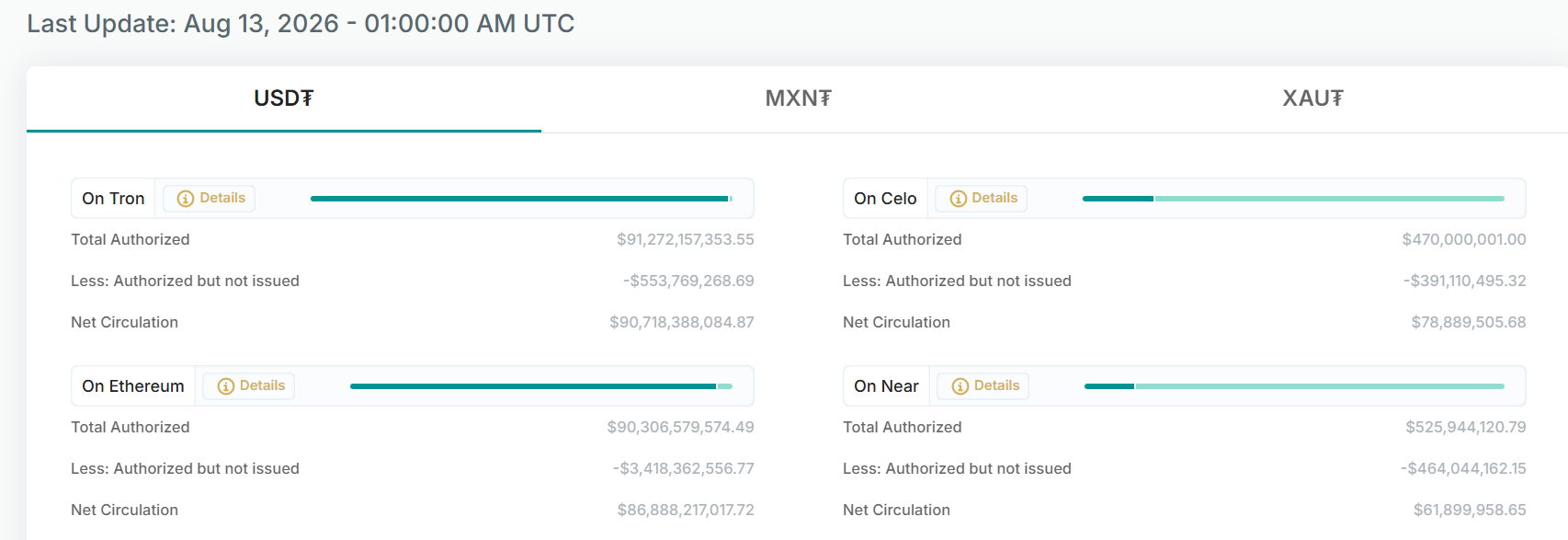
According to official Tether data, as of August 13, 2026, USDT on the Bochang TRON network chain once again increased by 1 billion US dollars, reaching 91.2 billion US dollars. The circulation volume once again surpassed the amount of USDT issued by the Ethereum network (90.3 billion US dollars), ranking first among blockchain networks. This historic milestone marks the further consolidation of Wavefield TRON's dominant position in the stablecoin field, and once again confirms the continued appeal of low-fee, high-efficiency settlement networks to global stablecoin funds. From trading assets to settlement tools, TRC20-USDT usage scenarios continue to expand the growth of USDT on the TRON chain, starting with sustainable real usage requirements. As of August 2026, the distribution volume of TRC20-USDT on the Bochang TRON network officially exceeded 91.2 billion US dollars, setting a new historical record. During the year, a total of about 10 billion copies were added, and the number of accounts held reached about 75.47 million. This size has enabled Wavefield TRON to carry half of the world's USDT issuance for a long time, accounting for about 50%. Judging from the usage structure, the actual payment attributes of Wavefield TRON are becoming more and more clear. According to CoinDesk Research data, in the first quarter of 2026, the average quarterly daily active account value of Bochang TRON rose to about 3.2 million, a new quarterly high. Meanwhile, in retail USDT transfers under $1,000, Bochang TRON's share is about 50%. It still maintains a dominant position in the $1,000 to $100,000 range, and continues to strengthen its “friendly” public chain position for retail and small to medium value settlement. This means that one of the main uses of USDT on Wave Field TRON is always the actual transfer of value between wallets. Looking at a longer period of time, the scale of on-chain transfers and settlements confirms this judgment. According to a research report released by Messari, in the first quarter of 2026, the amount of USDT transfers processed by the Bochang TRON network reached about 2.04 trillion US dollars, and the total number of transactions across the network was about 950 million. The average daily transactions rose from about 10.2 million in the previous quarter to about 10.9 million, which also set a new quarterly record; since 2026, Bochang TRON has led all public chains with annual USDT transfers of about 4.2 trillion US dollars. It depicts not a ledger within a single trading platform, but rather a scenario where multiple wallets directly transfer value on a public blockchain. Specifically, an overseas worker can send USDT to a family's wallet, and the payee can exchange it for local currency; cross-border e-commerce merchants can use USDT to settle with suppliers to reduce the impact of bank business hours and intermediary processes; freelancers can receive rewards from overseas customers and confirm on-chain payments within minutes; and digital asset service providers can transfer liquidity between exchanges, custodian wallets, and market-making accounts. The amount and purpose of the different cases are not the same, but the common requirements are fast payment, transparent fees, and 24/7 operation. Furthermore, cost stability is particularly important in a market environment where network fees fluctuate drastically. Since August 2025, Bochang TRON passed Governance Proposal No. 104 and lowered the unit price of energy by about 60%, on-chain transfer costs have been further reduced. Ecological access and secure collaboration go hand in hand. Whether the stablecoin infrastructure continues to improve and the stablecoin network can develop over the long term depends not only on circulation volume, but also on entry coverage, depth of liquidity, developer support, and risk management capabilities. Wavefield TRON is simultaneously constructing infrastructure in these directions. In terms of application entry, wallets, trading platforms, payment service providers, and DeFi protocols have extensive support for TRC20-USDT, enabling users to deposit, withdraw, transfer, exchange, and interact on the chain relatively easily. As new stablecoins such as USDD are integrated into the TRON ecosystem, stablecoin asset types have been further enriched; agreements such as JustLend DAO have extended the use of stablecoins to collateral and loan scenarios. Stablecoins are gradually shifting from a single transfer tool to the underlying asset for on-chain financial activities. In terms of user experience, mechanisms such as GasFree try to solve a common pain point: although new users hold USDT in their wallets, they may not be able to initiate transactions because there are no native tokens. By supporting stablecoins to pay associated network fees, these solutions help simplify the first-time usage process. For merchants, wallets, and payment applications, reducing the cost of user understanding bandwidth, energy, and native Gas tokens will also help stablecoin services enter a wider range of consumer scenarios. More importantly, scaling up needs to be synchronized with security governance capabilities. In September 2024, Wavefield TRON, Tether and TRM Labs joined forces...

9d agoburnking