


Don't bet 100 times more, just look for “cash bulls”: What other projects are worth investing in in a bear market?

Source: Odaily Planet Daily
Author: Asher
Original title: Don't guess 100 times the coin, just bet on “cash cow”: What other projects in the bear market are worth investing in?
The bear market only buys the most profitable items on each track, and the bull market then goes after short-term hot spots.
Core ideas:
In the context of the downturn in the crypto market, this article filters out Pump.fun, Hyperliquid,
Uniswap and Chainlink are the four issued projects, which have demonstrated their profitability through a bear market with stable agreement revenue.
It provides a more realistic reference target for long-term investment.
Key elements:
1. Pump.fun has earned 41.53 million US dollars in the past 30 days, with a cumulative total of about 256 million US dollars in the first 7 months.
Revenue depends on the popularity of Meme transactions on the Solana chain, but the monthly cash flow capacity of tens of millions of dollars is outstanding.
2. Hyperliquid's cumulative revenue for the first 7 months was about US$352 million, surpassing Pump.fun,
June reached a record high of 60 million US dollars during the year. Revenue mainly comes from perpetual contracts and spot transaction fees.
3. Hyperliquid uses approximately 99% of the agreement fee to repurchase and destroy HYPE tokens,
Form a simple investment logic of “being able to earn money and keep buying back”.
4. Uniswap has earned 5.6 million US dollars in the past 30 days, making it the most profitable DEX.
The first 7 months accumulated about US$28.4 million, benefiting from the formal commencement of the agreement fee after the implementation of the UNification proposal and its use for UNi destruction.
5. Chainlink's revenue in the past 30 days was 4.57 million US dollars, and the monthly revenue was stable in the range of 4.4 million to 5.8 million US dollars.
Revenue comes from service fees such as oracles and cross-chain services, and the cumulative value of transactions facilitated reached 32.18 trillion US dollars.
Since this year, the crypto market has continued to be sluggish. The chain is not without hot spots,
There are a few burgeoning memes that come out every once in a while, but these markets tend to focus on new coins that have just been issued and have hardly given time to fully study the market.
Once the story ebbed down, prices quickly dropped back down. Most players who got on the bus halfway ended up losing money and making little money.
Since blindly guessing the next 100 times the coin makes little sense.
A more realistic investment logic would be:If you are preparing to invest slowly in a bear market and wait for the next round of the bull market to return, what other projects are worth buying now?
Compared to simply reading the story, a more direct screening criterion is:The project itself still makes no money.
If a platform can still earn millions or even tens of millions of dollars every month in the crypto bear market,
At least it shows that users and needs are still there, and the project also has a stronger ability to go through the cycle.
This type of platform token won't necessarily be the altcoin with the most exaggerated rise in the next round of the bull market.
So, since this year, what other coin issuing projects have continued to make money?
(This article's project revenue data comes from Tokenomist and DeFiLlama, and uses a unified revenue caliber.
(That is, the actual revenue of the agreement after deducting allocations to supply-side participants such as LPs.)
Pump.fun: The “shovel seller” on the meme circuit earns money from round after round of coin issuance
In addition to the two major stablecoin issuers Tether and Circle,
Pump.fun is one of the most profitable crypto-native projects in nearly 30 days, with revenues of $41.53 million.
Judging from monthly data, Pump.fun's revenue from January to July this year was$51 million, $40 million,
$38.1 million, $32.4 million, $34.4 million, $26.6 million, and $33.7 million
The cumulative revenue for the first 7 months was approximately $256 million.
Pump.fun's revenue high appeared at the beginning of the year, then the overall decline fluctuated.
The decline was more pronounced in April and June, and there was some recovery in May and July.
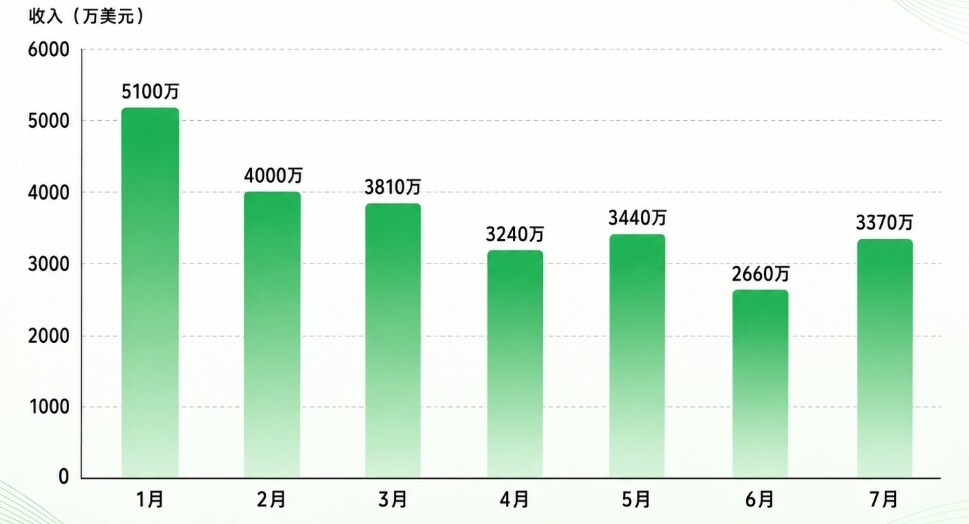
The core of Pump.fun's revenue comes from continuous trading of SGD on the platform.
Currently, users are free to create tokens themselves, but trading during the Bonding Curve phase requires transaction fees.
According to Pump.fun's latest rates,Bonding Curve has a total rate of 1.25% per transaction,
Of this, 0.95% went to the protocol and 0.30% was distributed to the token creators.
Additionally, when tokens graduate from Pump.fun and enter PumpSwap, a graduation fee of 0.015 SOL will be charged.
Pump.fun's revenue still depends on Meme activity on the Solana chain,
When the on-chain market is lukewarm, revenue will drop significantly, and when popularity picks up, it will recover quickly.
However, from the perspective of a bear market, monthly income of tens of millions of dollars can be maintained continuously for 7 months.
Revenue has returned to 40 million US dollars in the past 30 days.
It has proven itself to be one of the most powerful “cash flow machines” in Web3 today.
If you believe the meme circuit lasts forever, PUMP is probably worth watching for a long time than betting on the next meme.
Hyperliquid: the “light of a bear market” on the Perp DEX circuit, can continue hematopoietic even when trading is sluggish
In terms of this year's cumulative revenue, which is more profitable than Pump.fun, is Hyperliquid, the “light of the bear market” on the Perp DEX circuit.
Looking at monthly data, Hyperliquid's revenue from January to July this year, respectively$59.8 million, $54 million,
$51.5 million, $42.4 million, $46.3 million, $60 million, and $38.4 million,
The cumulative revenue for the first 7 months was approximately $352 million, surpassing Pump.fun.
Unlike Pump.fun's overall downward trend since the beginning of the year, Hyperliquid's revenue did not continue to decline unilaterally.
June even hit a year-long high of $60 million.
Revenue fell back to $38.4 million in July and fell further to $29.02 million in the last 30 days.
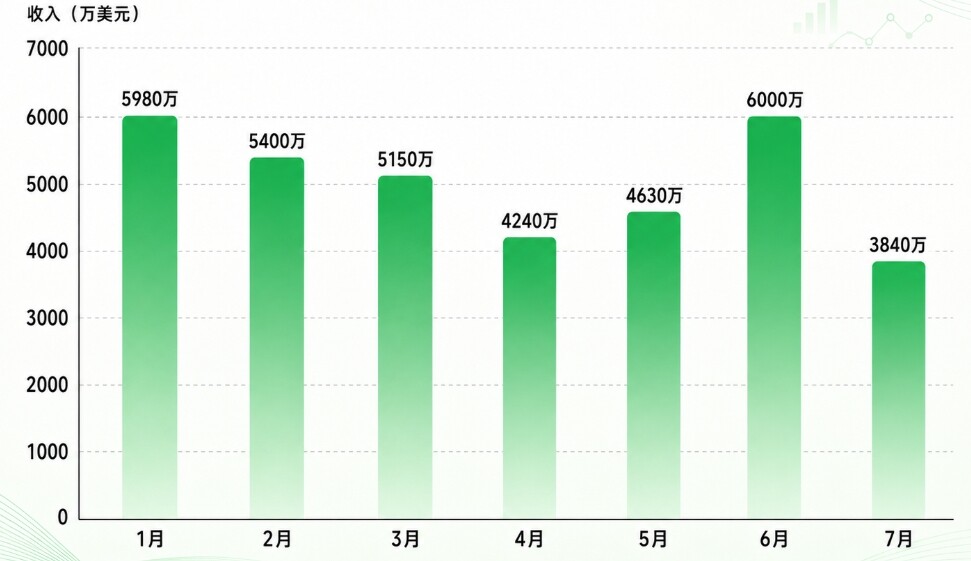 Hyperliquid's revenue mainly comes from perpetual contracts and spot trading fees.
Currently, the platform uses tiered rates. The basic taker/maker rates for perpetual contracts for ordinary users are
0.045% and 0.015%, while spot is 0.07% and 0.04%,The higher the transaction volume and HYPE staking volume, the lower the rate.
Funding rates are paid directly by the long and short parties, and are not Hyperliquid's agreed revenue.
Almost all of the money Hyperliquid made was used to buy back and destroy HYPE.
Currently, about 99% of the processing fees generated by the agreement will go to the Assistance Fund
(According to SEC documents, Hyperliquid raised the agreement fee ratio for entering the Assistance Fund from 97% to 99% in August 2025),
Used to continue to buy HYPE from the secondary market and permanently destroy the purchased HYPE.
“Earn money and keep buying back” is probably HYPE's most simple and powerful investment logic in a bear market.
Uniswap: DEX leader turns on fee switch, UNI finally starts to “eat” protocol revenue
In the past 30 days,Uniswap became the most profitable DEX with $5.6 million in revenue.
Although there is still a gap compared to platforms such as Pump.fun and Hyperliquid with monthly income of tens of millions of dollars,
But on the DEX circuit, Uniswap's ability to make money has returned to the first tier.
Judging from monthly data, Uniswap's revenue from January to July this year was$2.8 million, $3.2 million,
$4.6 million, $4.5 million, $3.8 million, $5.1 million, and $4.4 million,
The first 7 months had accumulated approximately $28.4 million.The overall fluctuation is not significant,
Basically, it remained in the range of 3 million to 5 million dollars per month, with a record high of 5.1 million dollars in June for the year.
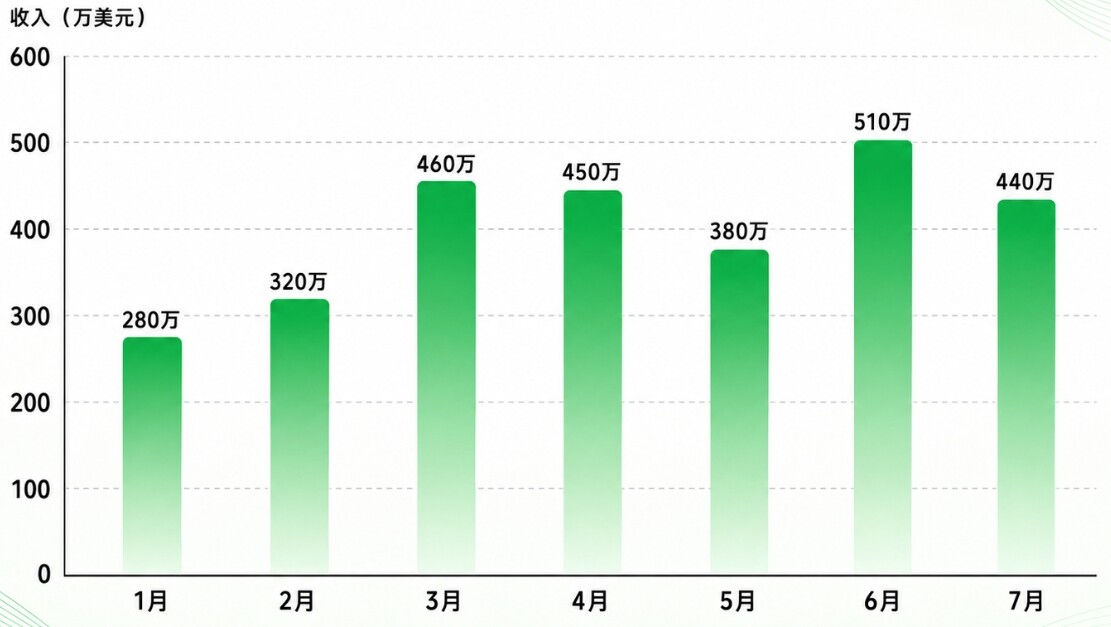 Uniswap's revenue comes from protocol fees collected during the transaction process.
Currently, agreement fees have been opened in all Uniswap v2 pools and some v3 pools.
It also gradually expanded from Ethereum to multiple chains such as Arbitrum, Base, OP Mainnet, BNB Chain, and Polygon.
Taking v2 as an example, users still pay a 0.30% processing fee for each transaction.Of these, 0.25% is reserved for LP and 0.05% is entered into the agreement;
v3 charges an appropriate percentage of the agreement fee based on the different rate pools.
Since the implementation of the UniFICation proposal at the end of 2025, Uniswap officially launched Protocol Fee.
The revenue was also used to destroy UNI (see more related content: After the Uniswap Fee Switch Is Implemented: Is the “Report Card” of this DeFi Transformation Enough to Read?).
The agreement fee will go into TokenJar. If external participants want to take away the assets accumulated in it, they need to destroy the corresponding amount of UNI at the same time.
UNI tokens have changed from “pure governance assets” to “assets clearly linked to agreement fees and usage.”
If DEX continues to be the most basic entry point for on-chain transactions, fixed investment UNI is now at least no longer just investing in Uniswap's brand and position.
Chainlink: Don't chase hot spots, be a “toll booth” for on-chain finance
Regardless of meme popularity or contract trading volume, Chainlink still earned $4.57 million in the past 30 days.
Compared to platforms such as Pump.fun and Hyperliquid, where revenue fluctuates with the popularity of market transactions,
Chainlink is doing a more infrastructure-based business — as long as on-chain applications such as DeFi, stablecoins, and RWA are still running,
The demand for oracles, cross-chain communication, and data services will not go away.
Judging from monthly data, Chainlink's revenue from January to July this year was$5.7 million,
$4.5 million, $4.4 million, $5.8 million, $4.6 million, and $5.8 million,
The cumulative revenue for the first 7 months was approximately $35.4 million。Chainlink's monthly income is relatively stable.
It has remained between $4.4 million and $5.8 million over the past 7 months, and reached $5.8 million twice in April and July.
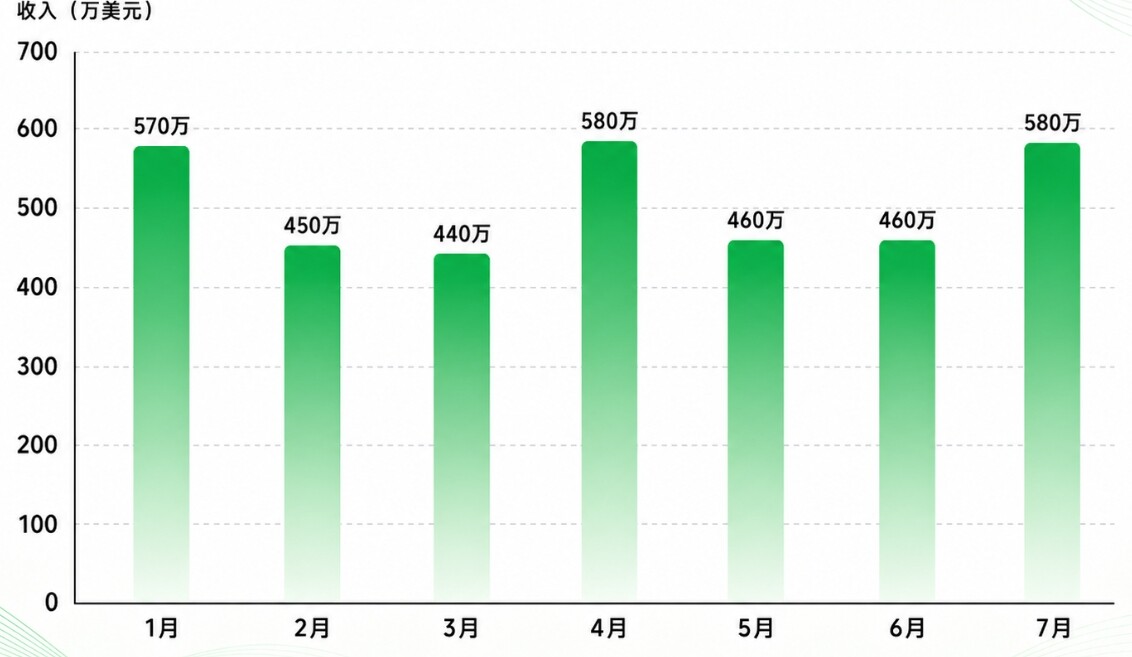
Chainlink revenue comes from developers, protocols, and institutions using Data Feeds, CCIP, Automation,
The fees paid for Chainlink services such as VRF cover basic on-chain requirements such as price data, cross-chain communication, and automated execution.
Today, Chainlink services not only serve DeFi, but are also increasingly entering stablecoin, RWA, and institutional asset on-chain scenarios.
According to official data, as of July 2026, its cumulative Transaction Value Enabled (transaction value facilitated by Chainlink)
It has reached $32.18 trillion.
Currently, Chainlink has launched Payment Abstraction and Chainlink Reserve.
Gradually turn Chainlink's business growth into continued demand for LINK.
On-chain and off-chain service revenue from user and enterprise payments can be automatically converted into LINK through Payment Abstraction.
It also entered Chainlink Reserve to continue to accumulate.
If more financial assets actually go to the chain in the future, Chainlink won't necessarily need to bet on which public chain,
Which DeFi project wins in the end — as long as on-chain finance continues to expand, this “toll booth” will earn more and more.
(This article is not used as a basis for trading)
Twitter:https://twitter.com/BitpushNewsCN
Compare the TG exchange group:https://t.me/BitPushCommunity
Compare TG subscriptions:https://t.me/bitpush
