香港Web3嘉年华 · 109
I've been a headhunter for four years on Web3: I've seen the craziest robbers, and I've also seen it quietly transition to AI

I've been a headhunter for four years on Web3: I've seen the craziest robbers, and I've also seen it quietly transition to AI

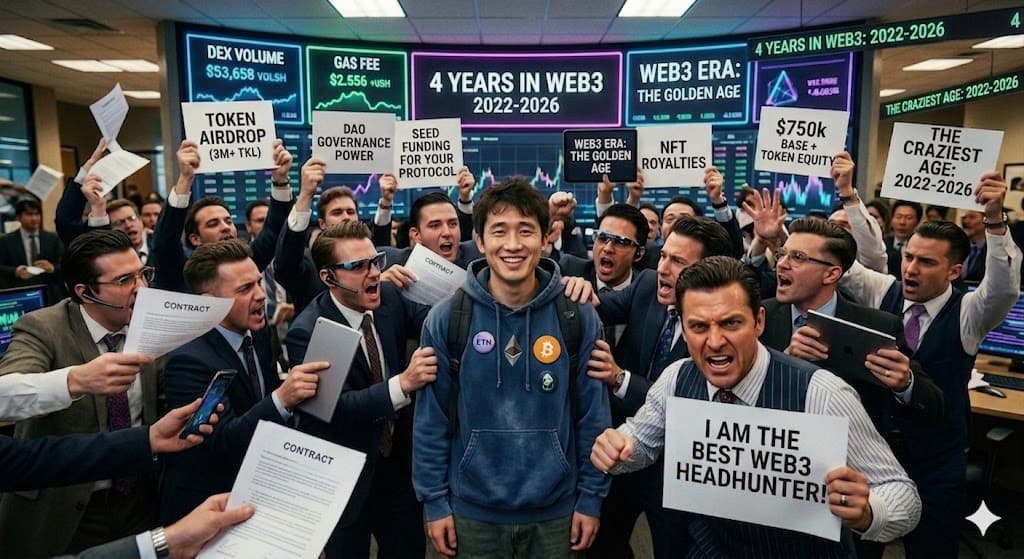
Author: Joe Zhou, Foresight News Original title: I've been a headhunter in Web3 for 4 years: I've seen the craziest human robbery era, and I've been a headhunter for 4 years on Web3. At the craziest time, a Web3 company burned our recruitment budget of over 20 million in one quarter. Fresh graduates can earn one million a year after entering the business for half a year. The project party just finished financing in the morning and began recruiting 30 people in one go in the afternoon. At that stage, the entire industry was like an uncontrolled money printer. Doubling wages, no work, global remote, token incentives... everyone thinks Web3 money will continue to flow in this way. Even I myself began to think that this industry might actually go crazy forever. However, starting in the second half of 2025, it suddenly cooled down. There is less and less funding news, and the recruitment of HCs on the project side has shrunk in a round, and many bosses who had aggressively (aggressively) expanded before are slowly losing their jobs. Some people are starting to travel. Some companies even just disappeared. Headhunters are the industry's thermometer. The craziness and desolation of all racetracks will be reflected first and most realistically in recruitment needs. This is me, as a Web3 headhunter, that I have seen with my own eyes the madness, bubbles, cooling down, and reorganization over the past four years. “At its craziest, one company burned 20 million.” Four years ago, I first started working as a Web3 headhunter. At the time, I didn't understand anything, and I couldn't even explain what blockchain was. I only know that the company suddenly connected with a “technology-based project partner”. It's so mysterious that I'm not even too embarrassed to say the name. As a result, we helped them recruit almost 20 people and collected 3 million in headhunting fees. You read that right. One company, in one quarter, recruits 20 or 30 people and pays more than 3 million for headhunting alone. If calculated at a rate of 25% of headhunting fees, the combined annual salary of these people is at least 12 million or more. Coupled with benefits, bonuses, etc., this company spent at least 20 million dollars a year on only the money it burned on the “person” found by a headhunter, and there were many similar stories in that year. At that time, Web3, almost every project was expanding like crazy. Many companies have just completed their financing. The first thing they do is not to make a product, but to set up a team first. It doesn't matter if the product comes out first. People must grab it first. One time I was particularly impressed by helping a leading crypto company promote a fresh graduate. To be honest, I was hesitant at first — customers wanted younger ones, but they couldn't be new. However, that kid has a really good background. He graduated from the top 3 universities, and also worked on blockchain-related scientific research projects during his college years. After learning about this company, he showed great enthusiasm, thought the project was valuable, and also had his own unique opinion on the industry, which is rare. We generally don't promote fresh graduates; after all, most of them don't have any practical experience. But I still had the mentality of trying it out and recommended him to a leading crypto company. As a result, the other party directly paid an annual salary of nearly one million. He also had other offers, but this one was clearly higher. The overall market was good that year. By the end of the year, his performance, along with salary increases and year-end bonuses, in less than a year — half a year to be exact — he actually earned more than one million dollars. Are you saying this is an ability? Is it luck? Or is it a gift of the times? I think they have it all. People have been sensing the temperature of the industry for a long time. The first thing I do every day is brush up on financing news. From 2022 to the first half of 2023, Web3 received more than a dozen financing messages every day, worth tens of millions of dollars at a loss. It's impossible for us to get in touch with every company. So then our logic was simple: focus only on the projects with the highest amount of financing. Because they are the richest and the most willing to expand. In those few years, the entire industry was in a state of extreme excitement. As soon as the project was funded, jobs were already being released. Some teams don't even have a full product. There is only one PPT. But even that doesn't prevent them from opening dozens of HC (recruitment places) in one go. That stage is also the best time for headhunters to make money. Many projects, from 0 to 1, are frantically robbing people at home. There are also many people who realized for the first time that they can earn far more money than they used to do in major internet companies without attending classes. To this day, leading exchanges are still recruiting people steadily. But the logic is completely different from what it used to be. It used to be an expansion. Now it's more of a normal business iteration. New businesses will only add a little HC. Moreover, recruitment requirements are significantly higher. They want the new recruits to be better than the original employees. Overall, the top deal...


89d agoburnking#AI topics #OpenClaw topics #WEB3
From coin trading to engineering: Hong Kong Web3 Carnival announces that the industry has reached an inflection point

From coin trading to engineering: Hong Kong Web3 Carnival announces that the industry has reached an inflection point

Author: Curry, Shenzhen TechFlow Original title: Looking back at this Hong Kong Web3 Carnival, everyone is saying goodbye to the amateur era. All the big speeches are telling us that the early bonus period has passed, and amateur rules are being rewritten. It's been almost a week since the Hong Kong Web3 carnival ended. The hustle and bustle quickly dissipated. A few days after the conference, there was still a funny video on X showing the Bitget CEO's bag being laughed at by a hotel lady, a team of male and female models lining up in front of the exchange booth, grandparents and aunts who came in ten big baras scavenging the surroundings... Until this week, none of this was mentioned. The communication curve of the industry conferences was basically the same. The three-day session covered highlights. After the conference, several soft copies were published a week, and then this incident was over. Source: Various gossip scenes summarized by X netizens, but is this really what we want? But looking back at the serious content of this edition, it's actually a bit different. Wanxiang's Hong Kong Web3 Carnival is an annual trend window for the Chinese-language crypto community. Every year at this time, from the Hong Kong SAR government to the world's largest exchange, from the founder of Ethereum to a veteran of traditional finance, they are willing to fly over to the same venue, which in itself shows that everyone still needs this opportunity to take stock of the current position of the industry. This meeting was never an isolated event. When it was held, compliance, policy, and traditional finance were all in place at the same time. Looking back at some of the key guests who walked on the main stage this year, they spoke from different positions, but put together, they were actually the same picture: the amateur era of the crypto industry is over. The industry has been in a kind of amateur era for over ten years. Living by faith, storytelling, and the next wave of hot spots earns money in the early stages. There's no problem with this kind of lifestyle when the market is good; when it's bad, everyone only has gossip to talk about. At this conference, what a few people on stage said didn't go well with this kind of work, but it's totally worth looking back at. Hong Kong, selling a table First, Hong Kong Financial Secretary Chan Mao-po said quite a bit in his opening speech on April 20, but there is a saying that the crypto industry has been waiting for more than ten years. “Same activity, same supervision.” This means that on-chain assets and off-chain assets are managed according to the same standards as long as they bear the same risk. On the afternoon of April 10, 10 days ago, the Hong Kong Monetary Authority announced the first batch of stablecoin issuer licenses. Thirty-six applications were approved, and the license was granted by HSBC Bank and Anchorage Fintech, which is a joint venture between Standard Chartered, Hong Kong Telecom, and Anzen Group. Both are banknote issuing banks. Ten days later, Chen Maobo walked on the carnival stage. Stand in a position where the cards have already been dealt and signed, and tell the industry how to play next. The four words “equal regulation” are the most important words the crypto industry heard at this carnival, but people don't seem to pay much attention to the gossip. Over the past ten years, the crypto industry has basically heard two types of regulatory voices. One is wait-and-see, and the other is prohibition. This time, Hong Kong gave you the third type. It follows the same set of rules as you. Following the same set of rules means that the crypto industry will be allowed to move indoors starting today. There are banks, insurance, and brokerage firms in the room. Everyone is at the same table. This table has been set up in the traditional financial industry for hundreds of years. In the past, crypto players watched from the outside, but now they are sitting in. The cost, however, is to eat according to the rules on the table. Chen Maobo said an unobtrusive but critical phrase in his speech, “Decentralization and digital intelligence do not mean that accountability will weaken.” The code makes up its own mind; it doesn't matter what's on the chain; this kind of work doesn't work on this table. But sitting at an indoor table is much harder than staying outside. HSBC has been participating in HKMA's tokenization pilot and the CyberHKD+ project since 2022, and it took almost 4 years to obtain a license in April of this year. Thirty-six have applied and 34 have been left out. The other side of “equal regulation” is “equal opportunity.” These two things have always been the same thing in mature financial markets. This is the real signal sent by the Fiesta boss. Over the past ten years, the crypto industry has relied on doing things first and then growing bigger, stepping on the regulatory gap and eating away at poor information and compliance. The early bonus period is characterized by the fact that the rules are not yet in place; who moves first eats meat. This path may not work since stablecoin licensing this time around. The rules come first, and practitioners have to prove in the rules that they can make something. Near the end of the speech, the director of the department did something unexpected. He said to the international guests offstage, “Please stay in Hong Kong for a few more days,” and then listed rugby sevens, Michelin restaurants, untaxed red wine, country parks... I think this can be understood as friendly sales. Incense...

115d agoburnking#WEB3 #Exchanges
Five days after joining Xinhuo, he overturned the car. How did Fu Peng anger the entire crypto community?

Five days after joining Xinhuo, he overturned the car. How did Fu Peng anger the entire crypto community?

Author: web3_golem Original title: Five days after joining Xinhuo, he overturned his car. Why was Fu Peng spilled as a sieve by the crypto community? It only took Fu Peng 5 days from officially announcing his entry into the crypto industry to being ridiculed by the crowd. On April 20, Fu Peng, the former chief economist of Northeast Securities, announced that he joined the Hong Kong stock listed company Xinhuo Group as the chief economist. As soon as the news came out, Xinhuo Group's stock price rose by more than 12% during the intraday period. Three days after joining Xinhuo, Fu Peng appeared at the 2026 Hong Kong Web3 Carnival and delivered a speech. In his speech, he proposed that the future financial market will move into the “FICC+C” era, where large asset allocations will add crypto assets. Finally, Fu Peng also responded to why he joined the crypto industry across borders: “Because your (crypto) industry has matured to an age where it can be included in investment portfolios.” Fu Peng's high attitude in this speech may have laid the groundwork for this conflict with crypto KOLs. On April 25, Fu Peng published an article arguing that the funding rate for Bitcoin perpetual contract transactions is similar to the deferred fee for traditional financial gold spot transactions. However, Fu Peng later added that many people had no idea what he was saying; only early large-scale BTC holders and people of a certain level understood what he meant. This kind of self-deprecation and “everyone who knows it” aroused disgust in the crypto community. The most representative one was to play with Fu Peng's “taking over the North,” implying that Fu Peng's past remarks had no real power (Odailey note: As a fund manager, Zhaobei is a KOL in the coin industry and has experienced significant losses as a fund manager, losing more than 20 million yuan worth of ETH at once). Surprisingly, under the “exchange of courtesy,” Fu Peng broke through defense and blackmailed all KOLs and crypto practitioners who mocked and made fun of him in one go. This act of breaking down and blackmailing at the wrong level has also completely infuriated the crypto community, and the real image hidden behind Fu Peng's ostentatious personality has also been completely stripped out by the community. Who is Fu Peng and Fu Peng, who has a “bright” background. Native crypto players may not be familiar with him, but if you are a user who often follows financial topics such as macros and major assets, you will definitely be impressed by this name. According to public information, Fu Peng's early career was mainly in the UK. He graduated from the University of Reading in the UK and worked for Lehman Brothers in 2004 (then the fourth largest investment bank in the world); from 2005 to the end of 2008, he worked for an event-driven strategy fund under Solomon International Investment Group, where he was the head of global macro-hedging strategy design for international financial markets; after returning home in 2008, he worked as chief macroeconomic advisor/chief macro-related position at China Mid-Term Group, Galaxy Futures, etc. Fu Peng was truly recognized by the wider public after joining Northeast Securities in 2020 as chief economist. At the beginning, he mainly served private clients, providing wealth allocation advice to high-net-worth individuals from a macro perspective. In 2024, he successfully broke the circle and became an “influencer economist” due to several speeches that differed from mainstream macroeconomic views. The content of his speech was cut into short videos that were widely distributed and sparked discussion on social media. According to public reports, Fu Peng had over 4 million followers on the Weibo platform alone at the time. However, the good times did not last long. At the end of 2024, Fu Peng's multi-platform accounts were frozen due to his long-term negative remarks about the Chinese economy and controversial statements. At the end of April 2025, Fu Peng said he needed surgery and recuperation due to physical reasons, so he left his job at Tohoku Securities. Some of Fu Peng's past remarks summed up by the community are just Fu Peng's career history. After hacking crypto KOLs in batches, his past experiences related to encryption were also sifted out. In 2024, Fu Peng expressed his opinion that he was bearish on Bitcoin and gold in a paid economy course analyzing gold, but was later criticized by many people for refunds due to differences between predictions and actual price performance. In 2025, Fu Peng also covered the crypto field in the sixth season of his video series “Fu Peng Talks,” focusing on paid courses such as “BTC: Financial Assets in the AI Era” and “Stablecoins Restructure the Global Monetary Order”. The price was 1,798 yuan. At the time, Bitcoin reached a new high of 120,000 US dollars, and now the price of Bitcoin fluctuates between 7.5 and 80,000 US dollars. As can be seen from Fu Peng's paid course experience, Fu Peng is not a traditional academic economist. His status is more like an economic commentator or macro analyst, with the aim of guiding transactions and providing solutions...

117d agoburnking#Exchanges #big company #Bitcoin #stablecoins #finance
Hong Kong Web3 Carnival Debate: Sun Yuchen Predicts AI May Crack Bitcoin by 2029, Wave Field TRON Seizes Quantum Blockchain

Hong Kong Web3 Carnival Debate: Sun Yuchen Predicts AI May Crack Bitcoin by 2029, Wave Field TRON Seizes Quantum Blockchain

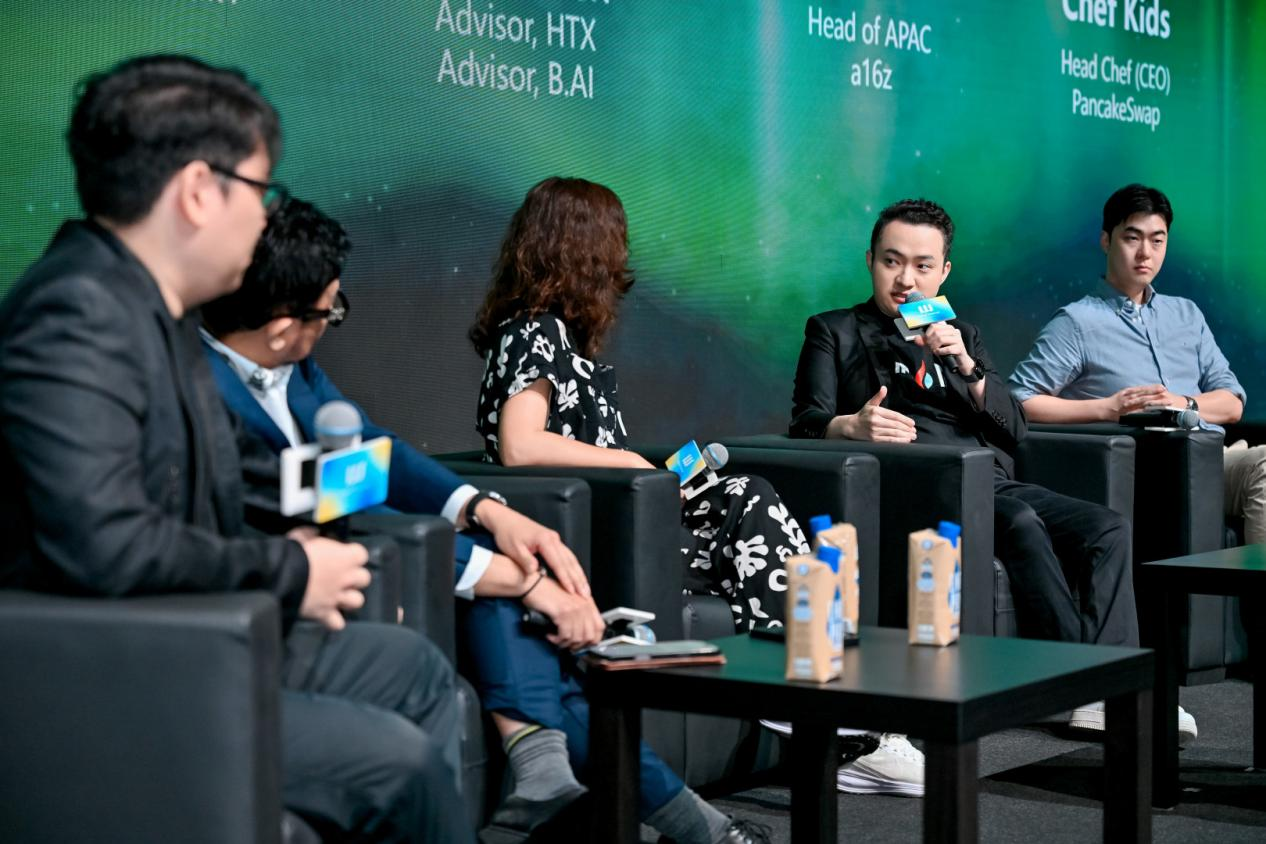
On April 21, at the main venue of the Hong Kong Web3 Carnival, “Talking about Star Apps of the Year: Open Claw, Predictive Markets, Dex, and More”, Sun Yuchen, founder of Wavefield TRON, presented a series of opinions and made extremely forward-looking judgments on topics such as AI agents, blockchain infrastructure, stablecoin security, and post-quantum cryptography. The round table was presided over by AltLayer founder YQ Jia, Oceanus Group Executive Director and Group CEO Peter H.K. Koh, BNB Chain Growth Executive Director Nina Rong, PancakeSwap CEO Kids Chef, and A16z Asia Pacific Head Sungmo Park, and many other heavyweight guests participated in the discussion. During the conversation, Sun Yuchen used the core narrative of “Blockchain Is Born for AI” throughout the conversation, which not only outlined B.AI's complete product matrix from the cloud to the “brain”, but also brought topics such as post-quantum cryptography, AI governance, and agent economy to the forefront of the industry agenda. At the inflection point of an era where AGI is approaching and quantum shocks can be expected, the sense of strategic urgency and acceleration shown by Sun Yuchen and the TRON ecosystem is becoming a pole that cannot be ignored in the global Web3 industry. “Blockchain is infrastructure created for AI”: Sun Yuchen presented the B.AI strategic blueprint to the first question from the host. Sun Yuchen clearly stated that the combination of AI and blockchain is still the greatest opportunity now and in the future. He cut in from an insightful perspective: AI can't open human bank accounts, so blockchain is the only viable path for payment, settlement, and collaboration between AI agents. “In this sense, blockchain is essentially a startup engine prepared for AI. Everything we build today, ostensibly for humans, is actually for AI. “Sun Yuchen emphasized. Based on this judgment, B.AI founded by Sun Yuchen is building a two-way bridge between AI and blockchain: connecting mainstream global models such as Claude, Gemini, ChatGPT, Kimi, and MiniMax on the AI side; connecting all mainstream EVM networks such as BNB Chain, Tron, Ethereum, and Arbitrum on the blockchain side. He said bluntly that the Chatbot era has come to an end, and the Agent era is beginning. The key proposition is how to make AI “complete 100% or even 1000% of output with 1% investment”. Redefining the “country”: 10 billion agents will rewrite the national power pattern Sun Yuchen shared his recent visit to Kyrgyzstan at the round table. He expressed a bold idea to the Kyrgyz president: the future concept of a “nation” will be completely reshaped by AI. “Today, the standard for measuring a country is population and territory, but in the future, a small country with a population of only 1 million may become the largest country in the world if it continues to have hundreds of billion AI agents working for it. Conversely, even a country with a population of 300 million could become a small country if it lacks AI computing power layout. “Sun Yuchen called for every country to take AI trends seriously, because AI already has the ability to complete a large number of complex tasks, and may even hack Bitcoin in 2029. B.AI Brain is about to be released: Let everyone have a “clonable brain” When talking about the pace of implementation of B.AI, Sun Yuchen first revealed in public that B.AI Brain will soon be officially released. The product allows users to clone their own “brain” and superimpose arbitrary large language models (such as Kimi, Claude, etc.) to handle all kinds of tasks. Sun Yuchen himself will be the first to be the first tester, and then open to all users. In terms of security architecture,...

123d agoWendy

HashKey RWA CEO Anna Liu: RWA is not an experiment or a restructuring; the global market size is close to $30 billion

Comparing the news, HashKey RWA CEO Anna Liu delivered a keynote speech at the 2026 Hong Kong Web3 Carnival. She explained that Hashkey Chain has deployed 11 tokenized products, the total value of RWA assets on the chain has reached HK$2 billion, and the exchange has launched seven tokenized products, including Hong Kong's first tokenized gold ETF. She faced RWA's four major challenges: one is the authenticity of underlying assets; blockchain cannot guarantee the authenticity of pre-chain data; second, there is a lack of closed commercial loops, and many projects must create new value that cannot be achieved by traditional methods; third, the liquidity dilemma. Even US compliant STO exchanges often have a daily trading volume of only tens of thousands of dollars, requiring high-quality assets, licensed distribution channels, and secondary market infrastructure; fourth, the complexity of cross-border compliance, and recommended incorporating resource planning from day one. She suggested that the tokenization of assets should first be asked three questions: can it be done, is it appropriate, and why tokenize it. Citing data, she pointed out that the global tokenized RWA market reached nearly $30 billion in the first quarter of this year, growing by more than 260% over the past year, and the IMF characterized it as a “fundamental restructuring of the financial architecture” this month.

123d ago

Xiao Feng: Digital currency is the lifeblood of the smart economy, and existing bank payment systems cannot support AI micropayments

Comparing news, according to live reports, HashKey Group Chairman Xiao Feng shared the keynote speech “Smart Economy Model Innovation - AI Token, Blockchain Token, and Fully Homomorphic Encryption Revolution” at this year's 2026 Hong Kong Web3 Carnival. He pointed out that the two major commercial characteristics of blockchain technology are no trust and no permission, but openness and transparency cause data to go naked, making it difficult for banks and other compliance agencies to go directly to the chain. With fully homomorphic encryption chips expected to be launched in the second half of this year, and the performance can reach about 1,000 strokes per second, privacy computing technology is about to reach the commercial threshold. He proposed that the integration of AI tokens and blockchain tokens with zero-knowledge proof and fully homomorphic encryption technology is the ultimate form of the smart economy. He used hospitals as an example: medical data is fully encrypted and then converted into a token. Anyone can use the blockchain to call the data for calculation without permission, but cannot obtain personal private information. As a result, the hospital becomes a “token factory.” Individuals can also put the encrypted medical examination data on the chain and issue requests to global insurance companies. Their actuarial models calculate and provide personalized optimal insurance plans in an encrypted state. Since then, there is no need for insurance brokers and intermediaries. In particular, he corrected a common misunderstanding: AI tokens are not a monetary unit of the smart economy, but rather a means of production. From electricity and chip computing power to large models, algorithms, and applications, they depict the production process of intelligent devices. The currency of the smart economy must be a digital currency that can be programmed, segmented, and settled in real time, because AI agents may only need a few cents each time to call the API, and the cost of the bank's existing payment system cannot support such small payments. Digital currency is the “lifeblood” of the smart economy, and a new financial service system designed for machines rather than humans will appear in the future.

123d ago

Co-created by Mysten Labs: Sui will achieve zero transaction fees across the network and become a global commercial settlement layer for the AI smart economy

According to Twitter news, Adeniyi Abiodun, co-founder and chief product officer of Mysten Labs, delivered a keynote address at the 2026 Hong Kong Web3 Carnival. He said that the core members of the team are from Facebook and were responsible for launching Libra, a global payment network, with the goal of making transferring funds as easy as sending a message. He announced that Sui will be the first high-speed public chain to achieve zero transaction fees across the network. Regardless of the transfer amount from $0.0005 to $1 billion, there are no fees, covering all stablecoins such as USDC, USDT, and Sui Dollar. In terms of privacy, Sui will provide bank-level on-chain privacy, use advanced cryptography to ensure that transaction history and balances are not viewed by third parties, while being fully compliant with regulatory requirements. In terms of revenue, he described Sui Dollar, which was launched in partnership with Stripe, and about 3.5% of the revenue generated will directly return to the online ecosystem and users rather than go to intermediaries. He also released Hashi, a Bitcoin DeFi protocol for institutions, which allows holders of sovereign wealth funds, hedge funds, and ETFs to deploy Bitcoin to DeFi to obtain benefits without generating taxable events, and has been backed by legal advice from top US law firm Fenwick & West. Furthermore, Sui's deep on-chain order book DeepBook supports large-scale transactions to complete instant on-chain exchanges between assets such as BTC, gold, dollar, and euro with extremely low slippage. In terms of the AI smart economy, he pointed out that Stripe estimates that the future will require the processing capacity of 1 billion transactions per second, while Sui uses the same scalable architecture as Google Search and Facebook infrastructure, and can scale to 1 million or even tens of millions of TPS as needed. The full-stack atomic composability provided by Sui is its core differentiating advantage, allowing agents to simultaneously execute multiple cross-app transactions and make one-time payments, which cannot be achieved on AWS, Google, or any existing Web3 platform. He also announced a partnership with RedotPay, which allows users to spend with Sui dollars at over 130 million merchants around the world and positions Sui as an alternative to SWIFT.

123d ago
Cook stepped down as Apple CEO; Fu Peng went to Hong Kong to work for Li Lin; Chinese currency industry OGs gathered...

Cook stepped down as Apple CEO; Fu Peng went to Hong Kong to work for Li Lin; Chinese currency industry OGs gathered...

Dear readers, what have the KOLs in the crypto industry been talking about in the past 24 hours? Note: The following content is compiled from the X platform. They are all personal opinions. They do not represent the platform's position, let alone constitute investment advice. Apple CEO Tim Cook has stepped down and Tim Cook announced that he will step down as CEO in September and be replaced by John Ternus, a senior engineer who has worked at Apple for 25 years. At the same time, I would like to thank the user in my personal name, saying that this is not a farewell and that I am confident in the company's future development. Aave/kelpdao/RSETH loophole triggers liquidity crisis and bad debt discussion, influencer analyst Fu Peng joined the Hong Kong Web3 carnival scene, and the Chinese-language coin industry OGs gathered for a group photo of the coin community OG: How many do you recognize? This article is sponsored by GENG, Build Your Fortune on GENG (https://geng.one)Twitter:https://twitter.com/BitpushNewsCN比推 TG Community: https://t.me/BitPushCommunity比推 TG Subscription: https://t.me/bitpush

123d agoWendy#KOL #hotspots #starters

HK Web3 Feastival Roundtable: The Present and Future of Cross-border Payments and Asset Digitalization

In comparison, KGA Managing Partner Kevin M. Goldstein, Binance Co-CEO Richard Teng, Stable CEO Brian Mehler, Akhil Devmurari, J.P. Morgan Asia Pacific (Payments Business) Fintech Industry Leader Akhil Devmurari, and Bitstamp by Robinhood President Leonard Hoh attended the 2026 Hong Kong Web3 Carnival Roundtable Discussions were held on “The Present and Future of Cross-border Payments and Asset Digitization”. Richard Teng pointed out that the existing financial infrastructure is extremely old. Bank transfers take two to three days and are expensive. Cross-border remittance rates can be as high as 11%, while stablecoin transfers are instantaneous and extremely low in cost. He revealed that with the passage of the US Genius Act, stablecoin trading volume increased by more than 70% year on year, surpassed Visa's trading volume, and the market capitalization increased by more than 50% year on year. He also said that Binance began trading precious metals in January this year. The trading volume has surpassed many traditional commodity exchanges within three months, and has also launched products such as petrochemicals, stock tokens, and pre-IPOs. The goal is to create a multi-jurisdictional and multi-asset class trading platform that serves more than 310 million users. On the AI side, he believes that stablecoins will become the native currency of AI, and the smart payment ecosystem will be built around blockchain and AI. Akhil Devmurari pointed out from the perspective of J.P. Morgan Chase that the Asia-Pacific region has a population of 4.8 billion and a fintech adoption rate of over 90%. Cross-border payments are the biggest pain point, and there are huge opportunities for digital currencies as alternative payment tracks. He said that J.P. Morgan's payment platform processes $12 trillion a day, and the bank focuses on the two major directions of tokenized deposits and tokenized assets, and uses blockchain technology to reduce friction. He stressed that at present, the market value of digital currencies accounts for only about 1% of total payments, and 99% are still fiat currencies. There is huge room for growth, but compliance is a key part of ecological development. He defined the relationship between traditional finance and crypto as a “co-opetition” (co-opetition), where banks need to collaborate with the industry to drive ecological growth. Leonard Hoh said that as an exchange and infrastructure provider, Bitstamp has observed that transaction and payment counterparties are adopting a “stablecoin first” strategy. Whether it's prepayment, settlement, or credit collateral, traditional finance and cryptographic native institutions feel comfortable with this technology. He pointed out that the industry is currently facing excessive fragmentation — stablecoin issuers, layer 1, and regulatory frameworks are oversupplied compared to the market size, and exchanges need to address cross-chain and cross-border interoperability challenges. He believes that the key to unlocking the next stage lies in the development of non-US dollar stablecoins and on-chain foreign exchange markets. From the perspective of the Layer 1 public chain, Brian Mehler pointed out that the technology itself is already working properly. Traditional cross-border payments charge about 6.5% processing fees for a $200 transaction, while the on-chain only requires 1% or less. The real problem is the fragmentation of compliance, where each country's regulatory framework is separate, so compliance elements such as permitted lists, blacklists, and travel rules must be embedded in the infrastructure layer of the chain to achieve true global interoperability. He also mentioned that PayPal has introduced PYUSD into the Stable chain, and traditional financial institutions are actively seeking an on-chain layout. Layer 1 is not meant to replace banks, but rather becomes a settlement layer.

124d ago

OKX Global Business Officer Lennix: AI Agents Will Reshape Transaction Models, Onchain OS Builds Underlying Infrastructure

In comparison, OKX Global Business Officer Lennix was invited to attend the “2026 Hong Kong Web3 Carnival” summit and delivered a keynote speech entitled “Start Building on Onchain OS” at the main forum. He shared the design ideas and development direction of OKX Onchain OS around various dimensions such as AI Agent changes in transaction models, on-chain operating system construction, and Web3 infrastructure evolution. Lennix said that with the rapid development of large models and AI agents, users are beginning to complete market monitoring, signal generation and strategy execution through agents, and trading behavior is changing. However, the current industry still lacks an infrastructure that can balance execution efficiency and security. On the premise of ensuring user control, AI agents can truly participate in on-chain interaction and operation. He further pointed out that Onchain OS is an on-chain operating system built for this purpose. By integrating transaction, data, security and settlement capabilities, AI Agents can complete decisions and execution under a unified framework. At the same time, as collaboration between agents and agents and people increases, the future market will gradually evolve from “human-to-system” interaction to a “multi-agent collaboration” network structure. Lennix said that in this process, an open ecosystem and infrastructure will be the key, and every user will have the opportunity to obtain the ability to approach professional institutions with AI Agents to reshape the way they participate in the entire Web3 ecosystem.

124d ago