马斯克 · 3216

Anthropic's valuation targets $2 trillion, funding may exceed $100 billion

Comparing the news, according to the “New York Times”, two people familiar with the matter revealed that Anthropic recently stated during discussions with potential investors that the San Francisco-based company may seek to raise more than 100 billion US dollars in an initial public offering. According to people familiar with the matter, the offering could also raise the company's valuation to $2 trillion. If successful, Anthropic, which is only five years old, will set the record for the largest public offering in history, surpassing the record set by Musk's SpaceX in June this year — the latter was valued at $1.77 trillion when it went public and raised $85.7 billion. It would also be a major leap forward for Anthropic. The company reached a valuation of $900 billion in a private funding round this year and submitted a listing application in June.

17h ago
US Stock Value Investing Is Heading Into Another Trap

US Stock Value Investing Is Heading Into Another Trap

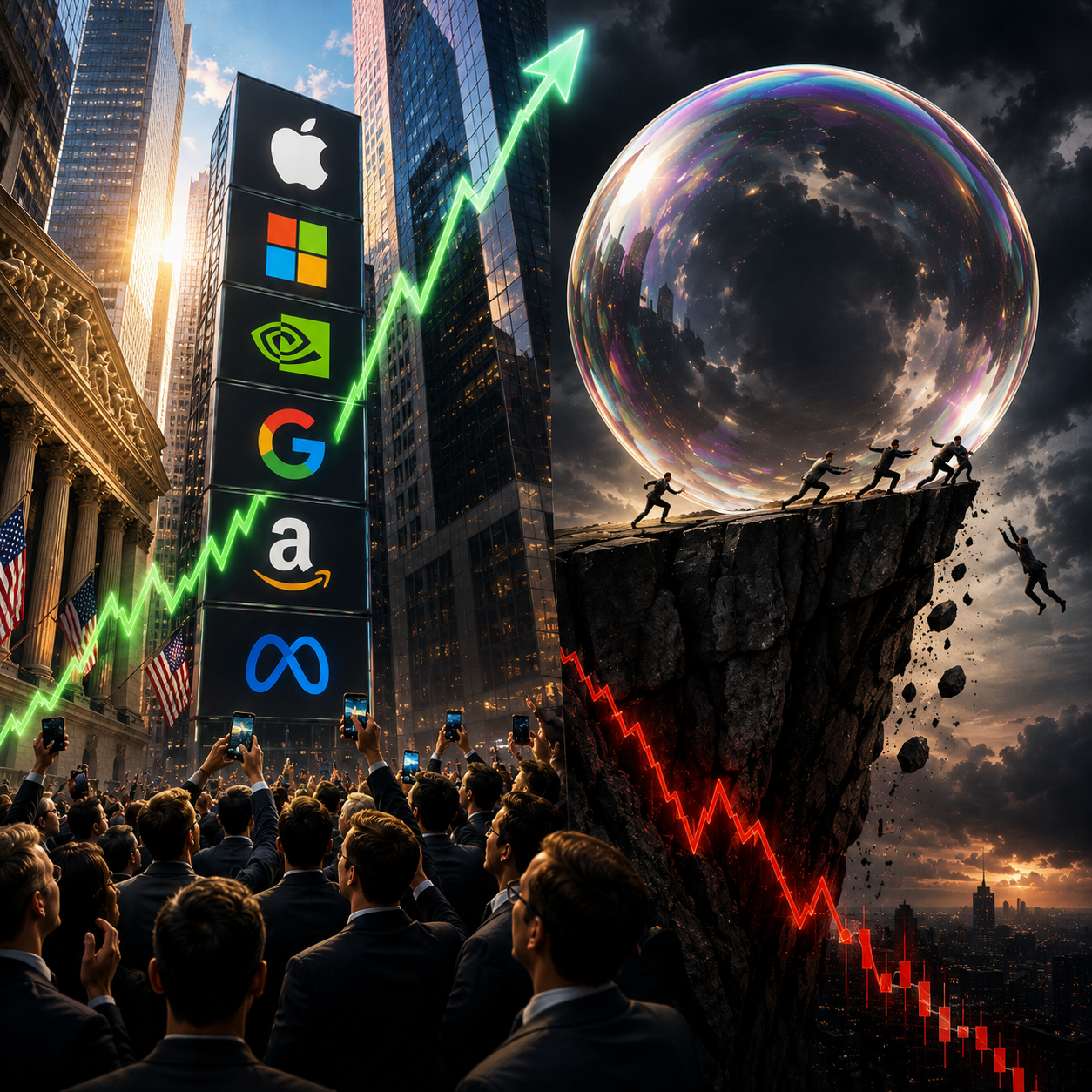
Source: Shenchao TechFlow Original title: (Opinion: Value investing in US stocks is not equal to fundamental investment) When “fundamentals are dead” becomes a consensus, investors who blindly organize giants will eventually experience astonishing capital destruction. Guide: When the market shouted “fundamentals are dead” and the capital frenzy formed a group of tech giants, the author used an astronomy discovery to unravel the logical loopholes behind this narrative. Starting from the composition of valuation multiples, this article reminds investors to distinguish between the true quality of an enterprise and the premium that the market is willing to pay. It is particularly cautionary about long-term allocation in the crypto and technology sector. I promise this introduction won't be as long as the last one on the weather. But please give me 90 seconds. More than 100 years ago, a woman named Henrietta Levitt was doing the tedious job of measuring the brightness of thousands of stars on photographic negatives (the way they were imaged before film appeared). She noticed one characteristic of a class of pulsating stars: the slower they pulsate, the brighter they themselves are. ¹ This might just seem a little interesting today, like “OK, that's pretty cool.” But at the time, astronomers couldn't tell the difference between a dark star very close to Earth and a very bright star far away. For them, the two left the same stain on the photographic film. Visual brightness is a messy mix of these two variables: how bright the thing itself is, and how far away it is from us. Henrietta's work decouples these two things: if you can observe the rate of pulsation, you can know its true luminosity; if you know its true luminosity, you can reverse the distance based on how dark it looks. Astronomers call it “standard candlelight.” A few years later, a man named Edwin Hubble discovered one of these pulsating stars, applied Levitt's math, and discovered what he had always thought was a cloud of gas within our galaxy; in fact, it was an entire independent galaxy, one million light years away. So in simple terms, the observable universe has grown about a trillion times larger, just because one person has figured out how to tell the difference between what things look like and what they actually look like. That in itself is obviously pretty cool. But another interesting thing is that around the same time period, two other astronomers each independently drew a scatterplot. One axis was actual luminosity, and the other axis was temperature. They discovered that stars are not randomly distributed in this space, but rather clustered into different families. The meaning behind this is: stars with the exact same visual brightness may and do belong to a completely different family, have a completely different past, and most importantly, have a completely different future... So what is written in the star? Over the past few years, there has been much discussion about markets, narratives, capital, company building, and financial nihilism. This feeling seems to have reached a feverish climax as the tech and financial world begins to face a very different future than a few decades ago. What is particularly clear is that separating progress from asset prices has become more noisy and in many ways more repulsive. But as an investor who makes a living by buying assets that (hopefully) outperform, a simple framework is: forward returns are roughly equal to growth in fundamentals multiplied by changes in valuation multiples (and multiplied by the dividends you've collected along the way). In this case, the valuation multiplier can very cleanly correspond to the smudges on the photographic film. It's an observable data point, but it entangles two things that the market can't directly see: how good the company actually is, and how far (or how long) its future cash flow is now. I think most of the money that can be made comes from investors who are most capable of unraveling these two variables earlier than others (or “perception of differences”), and we will continue to see astonishing capital ruin for investors who treat their stains as stars. Value investing is not equal to fundamental investing. I think there is a misunderstood view: fundamental investing has historically dominated the creation of excess returns. Most of these legends come from the Graham, Buffett, and Tiger Foundation lineage, as well as numerous narratives built around this group of people. It is believed that by some point in the 2000s, this approach was no longer effective, and anyone who invested in this way was overwhelmed by momentum, trends, and “direct buying tech giants.” The conclusion was (and still is?) It's “fundamentals are dead.” ² The modern version of “fundamentals don't matter” itself isn't stupid. It's rooted in a lot of ideas that many of us on the Compound team have written before. The biggest companies get the most mechanical purchases, and the software industry has a winner-take-all economic law. AI means that giants can transform scale into moats faster than challengers, and there are also reasons why the market's microstructure embeds momentum more deeply into our market infrastructure. These are all real...

1d ago深潮TechFlow#US stocks

Musk announced that the next test flight may be postponed until the end of the year

Comparing news, the SpaceX Starship's recycling test is at a critical stage. Although the recycling of first-level boosters has been successful many times, the recycling of second-stage spacecraft has not broken through. Musk recently announced that the Starship Class 2 spacecraft recycling program originally scheduled for late August may be postponed until the end of the year or the beginning of next year.

1d ago

British media: Ukraine seeks to use Starlink drones to attack Russian missile launchers

Comparatively, due to a shortage of anti-aircraft interceptors, Ukraine is seeking to use drones equipped with the Starlink system to hit missile launchers within 200 km of Russia. The move requires Elon Musk's approval, and his position is uncertain. Communications faced challenges after former Minister of Defense Mikhailo Fedorov was sacked. Military experts say it is difficult for Ukraine to obtain enough interceptor bombs to maintain an air defense strategy.

1d ago
MicroStrategy paid back; Hwang In-hoon's daughter went to Beijing; OpenAI secretly cut quotas...

MicroStrategy paid back; Hwang In-hoon's daughter went to Beijing; OpenAI secretly cut quotas...

Dear readers, what have the KOLs on X been talking about in the past 24 hours? Note: The following content is compiled from the X platform. They are all personal opinions. They do not represent the platform's position, let alone constitute investment advice. MicroStrategy returns, Huang Renxun's daughter went to Beijing to secretly cut quotas with OpenAI, Musk comments on Suzaku Rocket: Twitter: https://twitter.com/BitpushNewsCN比推 TG Exchange Group: https://t.me/BitPushCommunity比推 TG Subscriptions: https://t.me/bitpush

1d agoBitpushNews#KOL
The New York Times: Ominous Omen? US debt surged above 40 trillion US dollars, with a per capita debt of 116,000

The New York Times: Ominous Omen? US debt surged above 40 trillion US dollars, with a per capita debt of 116,000

Source: The New York Times Compiled and Edited by: BitPushNews Original title: U.S. Debt Hits $40 Accumulated as America's Borrowing Binge ContinuesBitPush Note: The size of US federal government debt has once again broken through a historic integer node. According to data released by the US Treasury Department on the 19th, the total US debt surpassed 40 trillion US dollars for the first time, which is nearly 10 trillion US dollars more than last year's US gross domestic product (GDP), which means that every American is burdened with about 116,000 US dollars in debt. Here is the text: On Wednesday, the total amount of US Treasury bonds broke the $40 trillion mark for the first time. This is an ominous milestone for the US economy: for decades, the US has relied on continuous borrowing to support growing military spending, social security spending, and President Trump's tax cuts, and the fiscal ground has loosened. This year alone, the US will need to borrow more than 2 trillion US dollars to cover various financial expenses, including military expenses for the Iran war and large-scale tax cuts passed by the Republicans in 2025. Meanwhile, interest payments to US debt holders have also risen sharply. Currently, they account for nearly half of the total deficit, further dragging the US into a fiscal quagmire. Is this growing debt a crisis that must be addressed, or is it an alternative manifestation of America's economic strength? It's still a contentious topic. Deficits are also a battleground in a bipartisan political game — when the Republicans are in opposition, they have always been most vocal about reducing the deficit. “The scariest part of this is that we are beginning to see signs of a spiral in debt,” Mark Godwin, senior policy director at the “Committee for Responsible Federal Budget,” which supports deficit reduction, said of interest on debt. The inability of legislators to deal with the debt problem poses long-term risks. Although the US remains the world's largest economy, rising debt burdens may cause investors to demand higher interest rates on US Treasury bonds or question America's credibility, which could shake people's confidence in the US dollar as the world's reserve currency. Both Republicans and Democrats are responsible for America's debt burden. America is having to sell more and more debt to cover the costs of health-care programs, stimulus benefits, disaster relief, and day-to-day government operations. President Trump promised to restore fiscal order, yet many of his policies have exacerbated America's financial woes. When he first ran for president in 2016, Trump said he would eliminate the national debt within eight years by reaching a new trade deal and spurring economic growth. Since then, the national debt has doubled. During his second term, Trump's major measures to cut spending and increase revenue were unsuccessful. The Government Efficiency Department, initially headed by Elon Musk, promised to cut federal spending by $1 trillion. So far, the department claims to have saved just over $200 billion. The US Government Accountability Office said this month that the Government Efficiency Department's estimates lack reliability and transparency. By imposing comprehensive tariffs on imported goods, the Trump administration has previously made progress in increasing additional government revenue. However, this year, the Supreme Court ruled that some of these tariffs were illegal, forcing the federal government to refund more than 160 billion US dollars to companies that have already paid import tariffs, causing these plans to be thwarted. Treasury Secretary Bezent has set a goal of reducing the deficit from more than 6% of GDP when Trump took office to 3% by 2028. He admitted last week that this year's deficit situation is moving in the wrong direction. In an interview with Newsmax, Bezent gave several reasons for the growing deficit. He said that expenses related to the Iran war forced the US to increase military spending, and that tariff refunds weakened the Trump administration's progress in reducing the deficit as a share of GDP in 2025. The war in Iran has led to a rise in US energy prices, which has also dragged down economic growth and weakened economic expansion that Trump administration officials had hoped would increase taxes. Bessent also said that last year's tax cuts are increasing deficits as businesses are using a provision that allows them to immediately deduct plant construction and equipment costs. According to estimates by the Congressional Joint Committee on Taxation, these measures could cost $100 billion in fiscal expenditure this year. However, the finance minister said that despite the initial costs, these tax cuts will pay off in the future through increased revenue. “While this will currently widen the deficit, we are creating productive assets for future growth, and these assets will generate taxes in the future,” Bezent said. “I'd rather compare this to pulling out a slingshot, creating a large amount of potential energy, and then converting it into kinetic energy.” Although he believes that the fiscal trend will stabilize, investment...

1d agoBitpushNews#Trump #US debt #Federal Reserve

Crypto, AI and betting firms drive 2026 midterm elections corporate political spending to record highs

Comparatively, according to Reuters, in the 15 months up to the end of the first quarter of 2026, US companies have invested a record $517 million in the 2026 House of Representatives and Senate elections, surpassing the previous high of 461 million US dollars in two years of the 2024 election cycle. Together, the crypto, tech, and online betting industries contributed at least $294 million, making them a major force in shaping the midterm elections. Fairshake Super PAC, which is mainly funded by Coinbase, Ripple, and a16z, had $193 million in capital at the beginning of the year; a16z donated more than $81 million to crypto and AI-related PACs. Elon Musk has invested over $90 million, and Meta has donated $65 million to four super PACs. AI-related organization Leading the Future raised $140 million, and Anthropic donated at least $40 million through dark money nonprofits. Online sports betting companies DraftKings, FanDuel and others donated over $72 million. AdImpact expects total political advertising spending to reach a record $11.6 billion in this midterm election. Related industries spend unlimited amounts of money through super PACs, associated PACs, and dark money non-profit organizations for advertising, voter mobilization, etc. Critics believe this amplifies the influence of niche issues such as crypto regulation, data center energy, and betting regulation. This article is sponsored by GENG, Build Your Fortune on GENG (https://geng.one)

2d agoburnking

Musk and Buffett's Great Settlement of the Century? Berkshire Hathaway indirectly holds 0.04% of SpaceX shares through Google parent Alphabet

Comparative news, according to foreign media BusinessInsider reports, based on public position data estimates, Berkshire Hathaway, a subsidiary of “shareholder” Warren Buffett, indirectly holds about 0.04% of the shares in the space exploration technology company SpaceX through a “penetrating shareholding” model with two layers of nested shares, corresponding to a market value of over 700 million US dollars. This also caused a rare capital intersection between “stock god” Buffett and “Iron Man” Musk, the two top business bosses. Musk has long regarded Buffett's investment approval as an important industry endorsement, and has publicly thrown olive branches at Buffett on social platforms many times, hoping that he will become a shareholder of his company. Musk posted an article in 2023 mocking “Unfortunately, he didn't invest when Tesla's market capitalization was only 0.1% of what it is now.” In 2024, he once again publicly stated, “He should open a position with Tesla; this is an obvious choice.” Today, although Buffett has not invested in Tesla, he has become an “invisible shareholder” of SpaceX in a different way. Judging from the shareholding structure, this equity is not Berkshire's direct investment in SpaceX, but rather a subsidiary asset of tech giant Google's parent company Alphabet. (interface news)

2d ago