ChainCatcher · 269
From 4 models to more than 500, OpenRouter was acquired after growing 30,000 times in three years

From 4 models to more than 500, OpenRouter was acquired after growing 30,000 times in three years

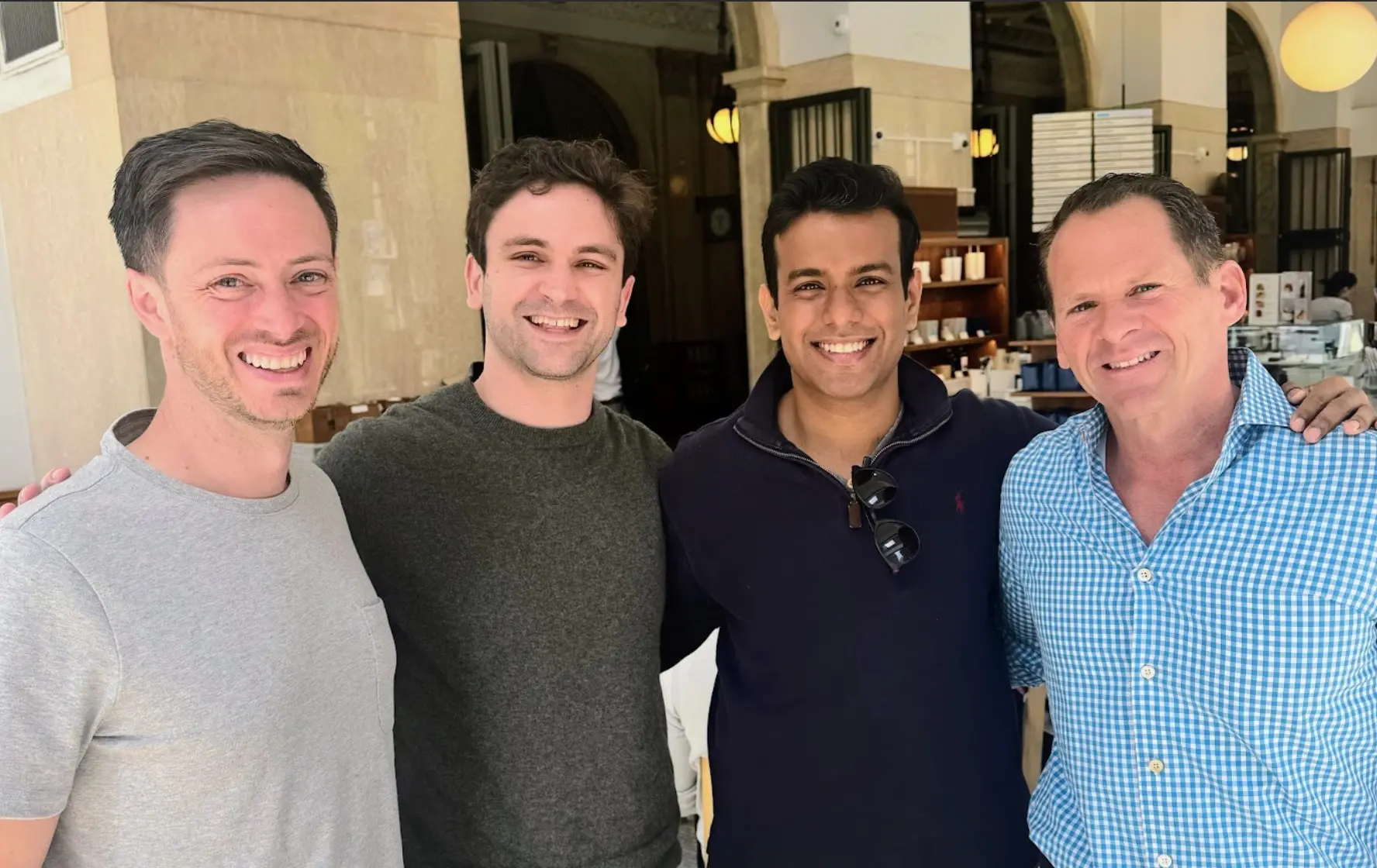
Author: Menlo Ventures Compiled by: Jia Huan, ChainCatcher Original title: Early Investors Behind OpenRouter Revisited Investments Today, OpenRouter announced that it has reached an acquisition agreement with Stripe. OpenRouter was launched in 2023, just over three years ago. OpenRouter was initially launched as a “unified interface for LLM” and only supported 4 models at the time: GPT-3.5, GPT-4, GPT NeoXt and Cohere xlarge by Together. When the company was founded, it was based on two core judgments: first, AI will eventually be used on a large scale and penetrate various fields; second, there will be many different models on the market, each with trade-offs, and users will choose different models according to different needs. As it turned out, both judgments far exceeded expectations at the time. Since its launch, the number of tokens processed by the OpenRouter platform has increased by about 30,000 times. Currently, it has exceeded 4,500 trillion tokens on an annualized basis, and the scale of expenditure on the platform has reached a very impressive level. Meanwhile, the number of models supported by OpenRouter has grown from the original 4 to over 500. Figure: OpenRouter Token usage growth from inception to acquisition Menlo Ventures is fortunate to be part of this journey. In March 2025, we participated in OpenRouter's seed funding round through the Anthology Fund set up in partnership with Anthropic. OpenRouter founder and CEO Alex Atallah previously founded OpenSea, which was once valued at $13.3 billion. His co-founders include tech guru Louis Vichy, whom he met on Discord, and highly executive COO Chris Clark. In May 2025, we led OpenRouter's Series A funding round, with Matt joining the company's board of directors, and Deedy as a board observer. Earlier this year, after seeing OpenRouter's rapid growth in customer numbers and revenue, and the company built a product route with stronger “model intelligence” capabilities around model selection and evaluation, we continued to step up Series B financing. In the tech industry, it often takes years for an idea to change from the judgment of a few people to industry consensus. And just a few weeks ago, this happened: from Ramp to Cursor, more than 10 companies launched their own model routing products almost simultaneously. In just a few years, OpenRouter has become one of the most important companies in the AI era. Picture: Group photo when deciding to lead OpenRouter Round A At first glance, Stripe doesn't seem like the most natural buyer of OpenRouter, but the two companies are actually strikingly similar. Both use an API that can be directly accessed to simplify the otherwise complicated transaction process and charge a certain percentage of the fee. It's just that OpenRouter deals with AI models. As Stripe has always said, the two companies combined and are still doing the same thing: increasing “internet GDP.” In fact, over a year ago, OpenRouter called itself the “Stripe of LLM.” OpenRouter's core value OpenRouter was one of the first companies Deedy came into contact with after joining Menlo in 2024. This company is almost right at the heart of our AI infrastructure investment logic. Menlo presented two judgments necessary to invest in OpenRouter in the 2024 Enterprise AI Report: AI spending will increase dramatically, and developers will not only use one model, but multiple models at the same time. Figure: Menlo's initial contact email to OpenRouter As someone who can also write code and actually use these models, we realized long ago that there is a very clear difference in cost, latency, and performance between the different models...


2d agoburnking#OpenRouter
Will compliant ICOs be revived? New SEC regulations open up a financing channel for the cryptocurrency industry

Will compliant ICOs be revived? New SEC regulations open up a financing channel for the cryptocurrency industry

Source: ChainCatcher Author: 0xFACAI Original title: The biggest benefit for the coin industry, is compliant token financing coming back? Public coin sales and financing have once again gained a legal path in the US. On August 18, the US Securities and Exchange Commission released a draft “Regulation Crypto Assets”. According to this draft, startups can raise $5 million in up to four years, and larger projects can raise $20 million or $75 million in 12 months. Without completing a complete set of securities registration, the project can also sell tokens to investors to raise money for network development. The biggest benefit for the coin industry, is compliant token financing coming back? Sounds like ICOs are back. But the SEC gave far more than three funding lines. It wants to establish a set of rules for tokens from birth to “graduation”: projects can be sold to finance first, but it is necessary to clearly explain what to do with this money; if the key work promised by the team is not completed, the token continues to carry the regulatory responsibility for investment terms; only after fulfilling the promise, the token has a chance to exit this level of relationship. “Promises” are the core of the entire draft, and devs must “work” until the token “graduates” before they can “sell”. The draft rules gave the project parties two options. The first type is suitable for startup teams. Assuming a project required $3 million to develop, common choices in the past were to seek venture capital, limit buyers and issue coins outside of the US, or incur the high cost of registering securities. The new draft allows it to use the “startup exemption,” raise no more than $5 million over a maximum period of four years, and file with the SEC when the funding starts and ends. The second type is suitable for projects with greater funding requirements. The first tier raised up to $20 million every 12 months, and the second tier raised up to $75 million. Compared to the $5 million startup exemption, this path can be used over and over again, but the rules are more stringent. Projects can't just hand in a white paper and start selling coins. Both exemptions require the team to disclose how the network is being managed, how the product is being prepared and developed, what security risks the code has, what the company's financial situation is, and who is managing the project. The two larger funding levels also require financial statements to be provided and continuously updated, and the $75 million tranche requires an audit. The SEC didn't remove the original fence either. Issuers and insiders with a record of serious violations cannot use these exemptions, and anti-fraud and anti-manipulation responsibilities remain in effect. If the project uses other securities exemptions at the same time, it must also comply with existing consolidated financial calculation rules. The most important aspect of how to define “graduation” in the entire draft is to treat tokens separately from the investment relationships formed around tokens. A project sells coins to raise money to build a network. Buyers often buy more than just a digital asset that can already be used. They are also expecting the team to create products, attract users, increase token demand, and profit from these efforts. This relationship, which depends on the team's future work, is what the SEC calls an “investment clause.” The token itself can be just a digital asset, but how the project sells it and what it promises to the buyer makes it covered by a layer of investment terms. What the SEC really regulates is this level of relationship between issuers and buyers. The draft designs an exit path for the token. The token can only enter a “safe harbor” after the issuer has completed or permanently ceased all key management tasks of its promises, no new related commitments, and then submitted public certification and analytical instructions to the SEC. As a result, tokens have the concept of “graduation.” When the project is sold and financed, construction is promised to the market. After the project is completed and key tasks are completed, the buyer can no longer rely on the team to fulfill the old promises before the token can “graduate” and the project party can withdraw. The new regulations don't focus on whether tokens are considered securities. In the past, the market judged when a token was no longer subject to securities laws, and often questioned whether the network was “decentralized enough.” As long as the foundation, development company, or founding team continues to work, many people will understand this as the token still relies on a central entity. The SEC draft changed the question: what promises did the project rely on to sell the tokens, and are those promises fulfilled now? Take an example. When Project A sells coins, it tells investors that the team will develop the main network, launch transfer and pledge functions, and then leave the network to a decentralized validator to operate. The main network was later launched, and the features were also available, but the validators were still controlled by the team. Since “decentralizing the network” was also a promise at the time of financing, the token is still unable to “graduate” at this point. When Project B sells coins, it only promises to create a network that can function properly, without “the team must disappear” or “the network...

2d ago22#ICO #SEC
Wall Street Q2 holdings revealed: as institutions fall and buy more, ETH outperforms BTC across the board

Wall Street Q2 holdings revealed: as institutions fall and buy more, ETH outperforms BTC across the board

Source: ChainCatcher Author: Zhou Original title: Q2 Wall Street Institutional Crypto Positions: Most institutions bucked the trend, and ETH exposure completely outperformed BTC in the second quarter. ETF capital flows and institutional behavior were decoupled, and the institutionalization of crypto assets deepened; at the same time, institutional differences over crypto-related stock targets are also getting bigger. August 14 is the legal deadline for the US SEC to require institutional investors to submit Q2 13F forms. After the centralized disclosure of documents, Wall Street's crypto holdings were once again spread out on the table. There was a clear contrast between institutional movements and currency price trends this season. The price of Bitcoin fell by about 14.2%, while crypto holdings declared by institutions increased. According to Bitcoin Strategy's calculation of 13F data, institutional Bitcoin holdings increased 7.5% from about 498,000 to about 536,000, up 7.5% month-on-month, while total ETF holdings fell from about 1.297,000 to about 1,211,000 during the same period. According to SosoValue data, the US spot Bitcoin ETF continued to make net redemptions in the second quarter, with net outflows of about 2.4 billion and 4.5 billion US dollars in a single month in May and June, respectively. Among them, June set the worst monthly record since listing. The Ethereum ETF also had a cumulative net outflow of around $700 million over the same period. At the same time, the chips are concentrated on the head. The number of institutions declaring Bitcoin holdings dropped from about 2,000 to about 1,900. According to Bloomberg data, as of August 13, the number of institutional holders of an IBIT product reached about 1,500, with a net worth of about US$47.35 billion. The growth rate of Ethereum on the bank side completely outperformed Bitcoin. Previously, ChainCatcher wrote in the first quarter position review: Institutional interest in Ethereum's allocation is increasing, and Jane Street, Wells Fargo, and J.P. Morgan Chase all added Ethereum ETFs during the outflow phase. In the second quarter, this sign was confirmed on the bank side. According to DWF Labs estimates, in terms of the number of corresponding crypto assets, Morgan Stanley's exposure to BTC increased 3.7% month-on-month and ETH exposure increased 18.6% in the second quarter. J.P. Morgan's BTC exposure increased 12.2%, and ETH exposure increased 67.3%. Both banks are growing at a significantly higher rate of ETH than BTC. The individual level is more intuitive. Morgan Stanley's ETHA increased by about 202% to 4.6 million shares, J.P. Morgan's ETHA increased by about 338% to nearly 1.17 million shares, and Bank of America ETHA increased from about 67,500 shares to about 1.98 million shares, about 29 times the previous one. But in fact, there was an overall net outflow of Ethereum spot ETFs in the second quarter. According to SosoValue data, there was still a net inflow of about 356 million US dollars in April, net outflows of about 541 million and 529 million US dollars in May and June respectively, and a total net outflow of about 714 million US dollars in the second quarter. Jane Street bought it back. Hedge funds moved their positions into options. Last season, Jane Street cut IBIT holdings by about 71%. The market once speculated that it was bearish on Bitcoin. This quarter, it reversed IBIT and added back about 24.9 million shares, a sharp increase of about 324% over the previous quarter, making it one of the biggest buyers of the quarter. Its current spot Bitcoin ETF exposure is approximately $9.9 billion, of which approximately $828 million is in IBIT. As an authorized participant and market maker, its end-of-quarter inventory is related to redemptions and hedging, and a large amount on spot is not equal to a directional bet. It is worth noting that 13F only reported a long spot volume at the end of the quarter. If options were added, the image of several institutions would also reverse. Global macro hedge fund Brevan Howard cut spot IBIT from 24.3 million shares to 7.21 million shares in the second quarter, reducing its holdings by about 70.4%. But it also holds a call option corresponding to approximately 7.23 million IBIT shares and a put option of 5.27 million shares. Graham Capital reduced its current IBIT from about 926,000 shares to 259,000 shares, reducing its holdings by about 72%, while holding down options corresponding to about 1.74 million IBIT shares, with a declared value of about $57.94 million. Multi-strategy giant Millennium reduced current IBIT from about 19.29 million shares to 9.69 million shares, reducing holdings by about...

3d ago22#Wall Street #Bitcoin
BTC fell 46%, why are mining companies' stocks not falling but rising?

BTC fell 46%, why are mining companies' stocks not falling but rising?

Author: Zhou, ChainCatcher Original title: Mining enterprise stocks are getting farther and farther away from crypto According to RootData market data, BTC has fallen by 46.12% in the past year, but Bitcoin mining stocks have not declined at the same time. Among them, HUT rose 363.26%, WULF rose 268.95%, IREN rose 121.14%, RIOT 59.90%, and CLSK rose 12.41%. This round of growth was not based on improvements in mining fundamentals. Operational data for June showed that despite the continuous reduction in mining difficulty, the production of CleanSpark, BitFuFU, and Canan fell 9% to 29% month-on-month. It's easy to see that the focus of market chase has changed. Since July, CleanSpark has signed an initial 20-year infrastructure lease of approximately $6.6 billion, TeraWulf plans to expand the data center campus with up to $3.5 billion, and MARA to acquire a Texas campus project company with a planned power capacity of up to 2 GW for up to $600 million. Mining companies' stock prices are no longer revolving around currency prices, production, and computing power; the market is beginning to value them according to a different set of logic. The source of fluctuation in mining stocks is no longer on the chain. At the beginning of this month, there was a round of typical misalignment in the market. At one point, mining stocks retraced by about 20% overall, while BTC remained stable around $64,000. On the production side, CleanSpark produced 614 BTC in June, down from 671 in May, down 9% from the previous month. The nominal computing power was 50 EH/s, and the average operating computing power was only 42.6 EH/s. The gap widened from 3.8 EH/s in May to 7.4 EH/s, pointing to downtime or degradation. BitFuFU produced 125 units, down 29.4% month-on-month, and the total computing power dropped from 19.5 EH/s to 15.3 EH/s. The main drag was the reduction in third-party hosting computing power from 16.3 EH/s to 11.8 EH/s. Jianan produced 64 units, down 29% from the previous month. The company attributed part of the reason to mine power grid maintenance. However, this round of production cuts occurred after the difficulty level was continuously lowered. On June 14, the difficulty of the Bitcoin network was reduced by 10.09%, the second largest negative adjustment in 2026. It dropped another 5% to 127.17 T on July 11, a cumulative decline of about 18% since the high of about 155 T in November 2025. The reduction in difficulty was supposed to allow miners remaining in the network to mine more coins per unit of computing power, but production is still declining. On the other hand, against the backdrop of a sluggish market and pressure on profitability, some miners are continuing to withdraw from the network or shut down their equipment. According to Galaxy Research, miners are entering a surrender period, which is the biggest pullback since China completely cracked down on Bitcoin mining in 2021. The reason for the clean-up is also straightforward. According to the CoinShares mining report for the first quarter of 2026, the average cash production cost of listed mining companies in the fourth quarter of 2025 has risen to about $79,995. J.P. Morgan estimates that the current production cost is about $78,000, while the current price of BTC is around $64,000. The spread has continued for five months, and about 20% of miners are in a state of loss. According to Hashrate Index data, around March 2026, the hashprice once fell to a new low of 28 to 30 dollars per PH/s after being halved. Currently, it is around $32, and is still in the lowest region in history. The new logic included in the AI infrastructure valuation system is not complicated. What AI data centers currently lack the most is grid-connected power capacity, contiguous land, heat dissipation, and plant framework, and mining companies just happen to have this amount of resources in their hands. They have large-scale electrical connection capabilities, sites that can be remodeled, have ready-made operation and maintenance systems, and are more familiar with the pace of construction of high-load facilities. According to PJM data, AI infrastructure projects put into operation in 2025 took an average of more than seven years. Of these, about three years were granted an interconnection service agreement, and another four years were waiting to be connected to the network. However, a mine connected to the grid is tantamount to skipping these seven years, and the value of mining companies comes from this. Take CleanSpark as an example. On July 14, the company announced the signing of a 20-year three-network lease with an unnamed high-investment-grade technology company,...

36d agoburnking
Social experiments failed, competition approached, and Base completely switched to the financial circuit

Social experiments failed, competition approached, and Base completely switched to the financial circuit

Author: Gu Yu, ChainCatcher Original title: Base founder Jesse rarely publicly admits strategic mistakes. On July 15, Jesse Pollak, founder of Base, published a long article announcing that he would return the leadership of the Base App to Coinbase, while devoting all his energy to the Base blockchain itself, with the goal of making Base a “global financial blockchain.” Jesse will continue to lead the Base Chain, but will no longer be responsible for the Base App; the Base App will be taken over by Jordan Fish, known as Cobie in the crypto community. The most notable adjustment was not Jesse's departure from the Base App, but rather his rare admission of Base's strategic misdecisions in the social direction of the past two years. In the past, Base tried to establish itself as a consumer-grade entrance into the crypto world. From Farcaster to Zora, from creator coins to miniapps, to Base App, Base hopes to use “on-chain social + creator economy” to bring more regular users to the chain. But now, Pollak personally admits: Base bet on the right builder and misplaced the social network. This statement can almost be viewed as a phased judgment in the Base social experiment. On-chain social networking has not become the center of the next round of adoption; what really comes out is predicting markets, perpetual contracts, stablecoins, and tokenized assets. It's not that users don't want to go online; they don't want to go online for the sake of social networking itself. They are more willing to go on the chain for transactions, payments, earnings, and speculation. 1. What did Jesse say? In the long post, Jesse reviewed in detail the reflections and adjustments of the past six months. “The first quarter of 2026 was a big punch,” he confessed. Over the past two years, Base has made a two-track bet: one is believing that builders will unlock the next wave of cryptographic adoption; the other is believing that adoption will be driven by “new on-chain native social experiences” (creators, content, messages). The result: “Our bet on builders was right, but our bet on social was clearly wrong.” Builder is indeed driving a wave of adoption — predicting markets, perpetual contracts, and stablecoins as the strongest growth engines — but social networking isn't at the center. Instead, “the entire social side marketplace we've been trying to build — Farcaster, Zora, miniapps, and yes, creator tokens — has completely crashed.” He said bluntly: “I was wrong. Whether the timing is wrong... or completely wrong, only time will tell, but in any case, I'm sure it was wrong.” Collateral damage is quite serious: Base lags behind in key areas — perpetual contracts (although Avantis, etc.) and the prediction market (although Limitless, etc.) all lag behind mature competitors; there is also plenty of room for improvement in enterprise-level tokenization and payment unlocking. People lost confidence, and CT reminded him of his mistakes every week. Jesse said that this year was a practice of “eating shit.” But the lesson he learned was: when things feel the worst, the best thing to do is to bow down and build. He has refocused his attention from the app to the chain, started writing code again, introduced features such as Azul, Beryl, B20, privacy, ledger, etc., and re-examined the hypothesis: Does crypto need social networking to grow? Does Base need an app? Can Base be bigger than Coinbase? The conclusion turned clear: “Better money is enough — we're seeing this in real time through stablecoins, forecasting, perpetuity, tokenization... I'm now focusing on getting one billion people on the chain by making global finance actually work.” The three main pillars of 2026 are: winning transactions (all assets, including tokenized stocks, memes, app coins, etc.), payments (global stablecoins, effective for individuals and businesses), and proxies (AI agents accelerate everything, because encryption is the native currency of computers, AI will create trillions of new economic participants). He has returned the Base App to Coinbase, led by Cobie, and allowed it to expand beyond the Base ecosystem (something he “wouldn't like” as the leader of Base). He stressed that builders are still the cornerstone, and Base will continue to support them through Base Layer, Batches, Ecosystem Fund, etc. 2. Why is Base's social dream shattered...

37d agoburnking#AI
Circle CEO 10,000 words long article: The agent economy is reconstructing everything, and the corporate era will come to an end

Circle CEO 10,000 words long article: The agent economy is reconstructing everything, and the corporate era will come to an end

Author: Jeremy Allaire, Co-founder and CEO of Circle Compiled by Jia Huan, ChainCatcher Original title: Circle CEO 10,000 characters long article: The Agent economy is disrupting value creation and circulation 1. Technology integration and the dissolution of companies Every platform-level transformation in the Internet era does not rely on a single invention, but several mature technologies collide at some point. The birth of the Web required a graphical interface, a commercial open Internet, a sufficiently fast modem, and an open software layer of web pages, links, and servers. Digital media, mobile internet, cloud computing, and social platforms all follow the same path. There is a recurring pattern behind this: when multiple capabilities are integrated, the marginal cost of an otherwise expensive activity will collapse to close to zero; once the cost collapses, the speed of this activity will explode. The Web has detonated the speed of information publication, mobile and social networking have detonated the speed of interpersonal communication, and cloud computing has detonated the speed of software production and delivery. Now, two new “operating systems” are being integrated, applying the same mechanisms to two things that the Internet has never natively digitized: intelligence and economic activity itself. The first is an intelligent operating system, that is, artificial intelligence in the form of a basic model and an agent system built on it. The second set is an economic operating system, or blockchain network, where values, contracts, and collaboration can be expressed and executed with software. The former reduces the cost of cognition and work to zero; the latter reduces the cost of transactions, settlements, and collaboration to zero. The two reinforce each other. Intelligence enables economic activity to run at machine speed, and the economic foundation allows machine intelligence to trade, exchange value, collaborate, and execute contracts. The core assertion is that the smart economy and the on-chain economy are not neighbors, but the same economy. The two are converging into a force to reshape the global economic system. Let's look at smart operating systems first. It is comprised of cutting-edge foundational model capabilities, as well as inference and agent infrastructure that enables models to execute at scale. Today, representatives include platforms such as Claude and Claude Code, OpenAI, and Codex. This is a new type of computer: instead of programming in traditional ways, it uses natural language to give instructions to produce results and complete work. The atomic unit of this type of work is an intelligent body, that is, a reasoning process that is sent to perform a certain task. Why is this important? First, let's look at what the company actually is. Without brands and buildings, a company is an information system organized around a set of familiar functions: product and engineering, marketing, sales, talent, finance, legal compliance, operations, and customer service. The vast majority of the cost of maintaining this system comes from manpower. Looking at the economy as a whole, manpower is the largest single operating expense. It usually accounts for one-quarter to one-third of revenue, and the service sector accounts for a higher proportion. Among intellectual and technology companies, this is almost absolute: almost all non-capital expenses are wages. In other words, such a company is essentially an “organized perception with a logo attached to it.” There is also a second huge market outside the company's walls: professional services such as consulting, lawyers, accounting, and agency agencies. In the end, it is also organized manpower rented from outside. These two huge cost pools are the target targets of intelligent operating systems. This is why the smart economy is disrupting classic business theories. Economists have long used transaction costs to explain why companies exist: the costs of coordinating, signing contracts, and trusting external labor are too high, so companies internalize “do it yourself cheaper.” Company boundaries are essentially delineated by coordination costs. When every non-physical work unit can be completed by an intelligent entity that can be discovered, contracted, and settled instantly, coordination costs begin to collapse, and the company's traditional boundaries become meaningless. The most intuitive result is a one-person company: one person directs a group of intelligence agents to do work that previously required multiple departments. Small, highly leveraged teams will also appear within large companies to execute the business on a scale far exceeding their own preparation. Economic accounts continue to be compounded because the three exponential curves are moving simultaneously: cognitive work continues to be transferred to smart devices, and the share of manpower in operating costs is declining; the cost of operating intelligent devices continues to drop, and the price of the same machine intelligence drops by about an order of magnitude every year; at the same time, the ability of intelligence continues to improve on almost all benchmarks. The combination of cheaper, more powerful, and more costly will unlock huge production potential. This disintegration will not happen evenly. It first appeared in software engineering because today's models are extremely good at understanding and writing code. Meanwhile, it...

39d agoWendy#Circle
On top of stablecoins, how can the “second-tier dollar” create new elasticity?

On top of stablecoins, how can the “second-tier dollar” create new elasticity?

Author: Neira, Tempo tokenized financial product architect Compiled by Jia Huan, ChainCatcher Original title: Collateral Dollar: How is the “second-tier dollar” above stablecoins formed? Most people believe that stablecoins are replicating the function of the European dollar and driving the further expansion of the offshore dollar system. But that's not the case. Stablecoins mainly replace only some of the functions in the existing system, especially the dollar balance required for daily operations and settlement; in some areas where the Federal Reserve is most concerned, it may even depress the multiplier effect of credit expansion. What is really worth asking is: What happens when a financial intermediary creates a new layer of dollar claims based on stablecoins? This article will explain how this new mortgage financing channel works, what conditions it needs to meet to achieve scale, and why its performance under pressure is fundamentally different from the traditional European dollar system. Abstract Stablecoins have introduced a tokenized private dollar claim. Even if issuers, reserve assets, and major settlement banks are within the legal boundaries of the United States, or rely on banking and securities settlement infrastructure connected to the US, such claims may still be economically essentially “offshore” in terms of circulation and collateral use. Enforceable collateral control opens a secured credit channel, but it does not create a monetary claim as a result. A real monetary event will only happen if another balance sheet funds, extends, or accepts this debt for a controlled token at a price close to face value. The discount is the distance pricing between “effective control over the token” and “reliable conversion into bank dollars”. The source of elasticity is different: it comes from the balance sheet that issues debt for tokens, and from third party balance sheets that are still willing to treat this debt as an asset close to face value under pressure. The decisive variables include who has effective control over the token, what legal and operational path it uses to convert it into bank dollars, how high the actual cost is, how long the term is, and whether the resulting claims can still be funded at close to face value when these paths are blocked. The collateral dollar is not a stablecoin itself. It is another balance sheet for a controlled token balance that is willing to open, fund, and maintain a second-tier liability close to face value. 1. The European dollar system is a European dollar in the strict sense of the hierarchical structure of claims. It is a dollar-denominated bank debt recorded outside the direct jurisdiction of the Federal Reserve: it is a private commitment to deliver dollars, issued by a banking institution, and the institution's legal registration place, regulatory treatment, and liquidity acquisition channels are all different from banks in the US. The broader offshore dollar system also includes dollar claims issued by traders and market intermediaries based on guarantees and derivatives. The unit of measure is always the dollar, and the balance sheet for issuing a claim is outside the direct jurisdiction of the central bank. This market forms a private dollar balance sheet system. An offshore institution can create a dollar claim by only recording a matching amount of liabilities and assets at the same time. The final settlement may still have to go through the US payment system, but “creation” and “settlement” are separate in institutional space. This separation allows non-US institutions to use dollars to finance positions, hedge their exposure, and complete settlements without having to rely on domestic central bank currencies all the time. But it also creates dependency: reliance on rollover ability, interbank credit, dealer intermediation, and a shift to higher-tier claims when settlement pressure intensifies. Claims are ranked according to the following points: the strength of face value commitments, the quality of the endorsed assets, term, market liquidity, and the degree of direct acquisition of higher-tier currencies. Under normal circumstances, market making and exhibition periods will compress this hierarchical structure. Under pressure, this compression will be reversed: counterparty quotas are tightened, deadlines are shortened, discounts are expanded, and the hierarchy is re-revealed through various operational restrictions. Flexibility comes from those willing to expand their balance sheets for dollar liabilities before imposing hard constraints on final settlement. In an unsecured channel, offshore banks issue deposits, large deposit certificates, or interbank liabilities, and then invest the funds raised in US dollar assets. In the guarantee channel, traders issue a dollar claim against collateral, and the discount determines how much financing this collateral can support. In the derivatives channel, foreign exchange swaps and forward contracts do not create dollar funds through an instantaneously visible deposit, but through promises that span time. This long-term leg allows banks and non-banks...

45d agoburnking#stablecoins #USD
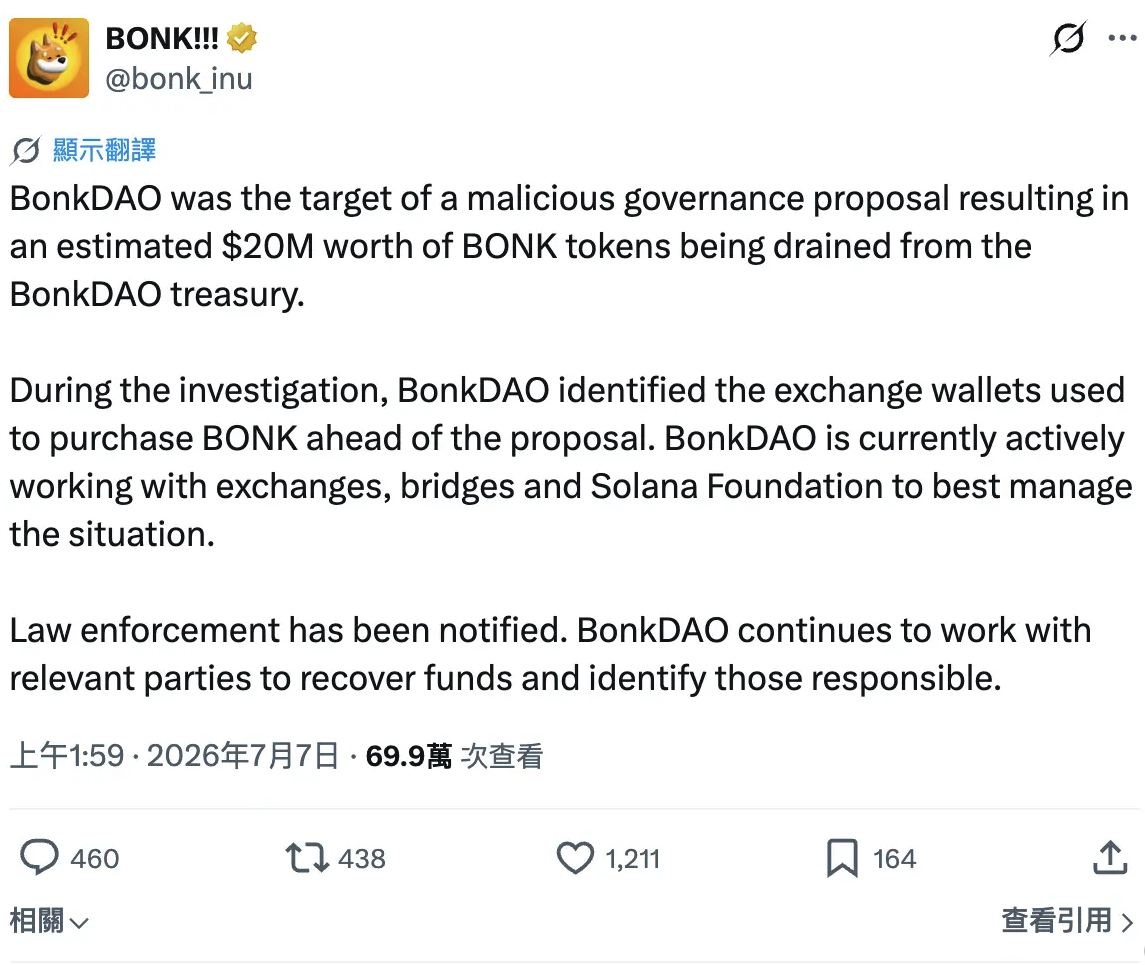
BonkDAO Governance Tragedy: When “Decentralized Voting” Becomes a Money-Manipulated ATM

BonkDAO Governance Tragedy: When “Decentralized Voting” Becomes a Money-Manipulated ATM

Source: Chain Catcher Author: Chloe, ChainCatcher Original title: A “Legitimate” Heist? Attackers emptied the BonkDAO treasury by buying tickets. BonkDAO, the community governance organization of Solana's ecological meme coin BONK, faced a governance attack in the early morning of July 6, 2026. The attackers emptied the treasury of approximately 4.4 trillion BONK tokens through a “lawfully” governance proposal. The most notable aspect of the whole incident was not any smart contract bug, but rather that the attackers only spent about $4.4 million to “buy tickets,” exchanging assets worth around $20 million, and from beginning to end, every step of buying, voting, and funding was technically a completely valid transaction. BonkDAO was attacked by governance, and the treasury of about $20 million was emptied. BonkDAO's official X account confirmed the attack on July 6, calling it a “malicious governance proposal (malicious governance proposal)”. It is estimated that about $20 million of BONK was transferred from the treasury. As the stolen tokens immediately flowed to exchanges, market selling pressure surfaced, and the BONK price fell about 7% to 10% within 24 hours, to around $0.0000043, which is about 93% lower than the all-time high of $0.000058. The tokens transferred were 4.4 trillion BONK. Due to slight differences in valuation over time and data sources, various descriptions of the amounts ranged from about 19.3 million to 21.2 million US dollars, generally summed up as “about 20 million US dollars.” BONK is a well-known doggy meme coin launched on Solana in December 2022. It is famous for large-scale community airdrops, has long been regarded as one of the representative meme coins in the market, and has even been included in some ETFs. Attack mechanism: Proposal #76 “Sowellian BonkDAO” is the core tool for malicious command attacks, and is a governance proposal called “BIP #76 - Sowellian BonkDAO”. On the face of it, it advocates the introduction of a series of reform themes such as “Sowellian governance,” changing members and directors, restructuring, monetization of positions, and stop-loss. In terms of text, it is more like a generous and passionate declaration than a governance motion. It even says that it wants to “rebuild from the ashes, monetize positions, and stop blood loss,” and promises that all participants who cast an “yes” vote are eligible to receive BONK token rewards. What is really problematic is the actual execution instructions hidden under the proposal to transfer 4.43 trillion BONK directly into the attackers' wallets. This is the only practical action of the entire proposal, and it is also the real purpose it has set since it was written; according to BonkDAO, this order to empty the treasury was sandwiched between the second execution step and not placed in the most prominent position, further reducing the chance of being seen through at first sight. In other words, this is a proposal for a misappropriation of funds order; it is simply cloaked in the guise of governance reform. Once the attackers use the purchased votes to pass the proposal, the order is automatically executed on the chain without anyone having to confirm it again. As a result, the funds went directly to the attackers' wallets ending in “jHVQ” at around 4 a.m. EST on July 6; of course, the token dividends previously promised to supporters will not be distributed. The attackers “bought tickets” ahead of time and bypassed community monitoring. According to Chainalysis, Lookonchain and other on-chain analysis, the entire attack was a planned operation that took about a week: as early as June 30, an anonymous wallet submitted this proposal on the governance platform. To pass, it was necessary to reach a minimum 1% token supply threshold, and about 889.95 billion BONK voted in favor. As a result, from July 4 to 5, another wallet bought about 882.38 billion BONK through Bybit and Binance exchanges, spending about $4.4 million, which was just enough to accumulate enough votes to pass the threshold; according to Lookonchain, the attackers may also be borrowing more tokens through DeFi lending platforms. This series of actions was distributed through exchange wallets, and several communities...

45d ago谢伟伦#BonkDAO #meme coins #wallets
Whose stablecoin will stand on the platform? What does OUSD's “fake collaboration” storm explain?

Whose stablecoin will stand on the platform? What does OUSD's “fake collaboration” storm explain?

Author: Chloe, ChainCatcher Original title: OUSD Fake Cooperation Storm? A credit game endorsed by stablecoins and giants Last week, Open Standard launched the US dollar stablecoin OpenUSD (OUSD) and revealed a strong lineup with more than 140 companies standing at the same time, from Visa, Mastercard, Stripe, and American Express, to BlackRock, BNY, Standard Chartered, to Google, Shopify, Samsung, Coinbase, Solana, and Ripple. As soon as the news came out, Circle's stock price fell on the same day, but in just a few days, this gorgeous list began to crack. A number of Korean companies came forward to cut OUSD, led by Bridge co-founder Zach Abrams (Bridge was acquired by Stripe in 2024), focusing on three things that are different from existing stablecoins: zero processing fees for minting and redemption, no maximum transaction volume, and returning most of the proceeds from reserve assets to partners driving adoption, rather than being taken by the issuer alone. In terms of governance, it does not have a single controller; instead, partners form a board of directors to make collective decisions. The structure is more like payment networks such as Visa and Mastercard, and plans to launch on the four chains of Solana, Polygon, Aptos, and Stellar first. However, according to a report by the Korean media “North Korea Biz” on July 3, many of the 13 Korean companies on the list came forward to cut. Samsung Electronics said that there have been no formal negotiations between the two sides, and the company doesn't even know what role it wants to play in the alliance. Shinhan Financial Group, Upbit's parent company Dunamu, and K Bank are almost the same: Open Standard only asked “if they are willing to participate,” and their responses were simply “I will evaluate and see,” but the names appeared directly on the official member list. What is even more embarrassing is that some companies said that they only discovered that they were listed through local news. Their initial response was only “I will consider it if everything goes well,” and they are amazed that it was written into the alliance. This question is not limited to South Korea either. Gabor Gurbacs, founder of US OpenAssets, said that several of his clients on the list told him that they had never signed or agreed to anything, and could only speculate that “either the media is seriously distorted, or that this list of participants is misleading.” Objectively speaking, this list is not entirely fictional. Companies such as Mastercard, Stripe, Visa, Coinbase, BlackRock, BNY, and Adyen do indeed have executive endorsements, and Stripe has even stated that it wants OUSD to become the default stablecoin for its platform merchants. The real controversy is that OUSD's model is to share reserve profits, and being listed as a partner is tantamount to enjoying financial benefits. This makes whether or not to participate officially no longer just a matter of PR copywriting, but a real business and reputation issue. Reputation is built up into marketing inertia. In the past, “All-Star League” also fell from heaven and used the fame of giants to stack their momentum. This is a marketing inertia that has been around for a long time in the crypto industry. Chainstory analyzed nearly 3,000 crypto press releases in the second half of 2025. Projects rated as high risk accounted for 35.6% of all published projects, and 26.9% of projects flagged as scams. Together, these questionable categories account for more than 62% of the total number of press releases. Meanwhile, low-risk projects only account for about 27% of the total number of press releases. If you want to talk about how the “All-Star League” fell from heaven, the most classic and apt counterpoint is Facebook's Libra. In the summer of 2019, Facebook made a high-profile announcement with a white paper to launch the stablecoin Libra. The lineup was unprecedented: payment terminals include Visa, Mastercard, PayPal, and Stripe; e-commerce companies include eBay, Shopify, Coinbase in the crypto sector, and even top venture capital such as a16z. Almost half of Silicon Valley is shouting for it. Later, a congressional hearing changed fate. Governments feared that the status of sovereign currencies and the US dollar would be impacted. France was the first to oppose it, while the US Congress fought hard against Facebook's past privacy and data scandals, questioning “why this government...

47d agoburnking#OUSD #stablecoins
Crypto projects' flee 'their old names in bulk: the liquidity reset game behind brand upgrades

Crypto projects' flee 'their old names in bulk: the liquidity reset game behind brand upgrades

Author: Gu Yu, ChainCatcher Original title: Why do crypto projects always like to change their names? In the traditional business world, brand assets are the lifeblood of an enterprise. Frequent name changes are almost tantamount to actively destroying a moat. Nvidia won't change its name every few years, Apple won't give up on Apple because of some kind of business transformation, and Nike won't bring back the brand because of a sluggish market cycle. But in the cryptocurrency world, the rules are often the opposite. According to RootData statistics, more than 16% of encryption projects have changed their names, and many well-known first-line projects have also changed their names in large numbers. Just yesterday, the on-chain IP ecosystem Story Protocol announced that it will change its name to DATA, and IP tokens will migrate 1:1 to new DATA tokens. Within a few months, Xion changed its name to Verona, Matrixport changed its name to BIT, and TON's token symbol to GRAM. Earlier, a number of well-known projects such as Klaytn, EOS, Fantom, MakerDAO, Elrond, and Matic Network changed their names. More extreme projects have even changed their names more than once. For example, MAITRIX used names such as CENTRAL, X Network, and XLD Finance; BitSafe used the names dlcBTC and DLC.Link; Talex used the names Read2N and Metale Protocol; and KGen used the names IndigG and Kratos Gaming Network. The names have changed more and more, but most projects have not gained new life due to the new name; instead, they have gradually fallen silent. This brings up a question that is rarely seriously discussed in the crypto industry: Why do crypto projects always like to change their names? The answer is probably not complicated: because in the crypto industry, brands aren't the most important assets; attention, narrative, token prices, and liquidity are. 1. Crypto brand loyalty is too low. The reason traditional brands are afraid to change their names is because user loyalty comes from long-term consumer experiences. A user has bought an iPhone for many years, drank Starbucks for many years, and worn Nike for many years. His perception of the brand was not formed in a day, nor did it change easily due to a certain marketing campaign. But cryptographic projects have a completely different user structure. Most early users aren't consumers in the traditional sense, but investors, airdrop hunters, liquidity providers, node participants, and narrative traders. They use products not necessarily because they are easy to use, but because they may have air investment, may be profitable, and may have room for growth. This means that crypto brands are naturally less loyal to users. In the traditional industry, users ask “Is this brand worth trusting”; in the crypto industry, users are more often asked “can this coin rise?” As long as prices are sluggish for a long time, the narrative fails, and the ecology is silent, the old name will instead become a negative asset. A name that has experienced a crash, duvet cover, hacking, team controversy, or route failure can hardly inspire the market's imagination. It doesn't carry brand assets, but K-line scars and community grievances. This is the root reason why crypto projects dare to change their names frequently: in many cases, old names have no moats, only historical baggage. 2. Renaming is a marketing strategy. Not every name change should simply be viewed as a “vest change.” The name change of some projects is indeed because the original name cannot carry the new strategic scope. As hot market concepts change, if the name includes old concepts such as “Social” and “DAO,” or if the meaning of the name does not match, changing the name is an inevitable choice. For example, the decentralized social networking protocol OpenSocial changed its name to Eden after transforming AI, the decentralized electronic signature platform EthSign chose to remove “Eth” from its name after expanding its business, and the Ethereum sidechain Matic Network changed its name to Polygon (meaning polygon) after building multiple scaling solutions. When the project's business boundaries fundamentally change, the original brand may limit external perception. The name change is a necessary strategic calibration at this point. Of course, there are also quite a few projects that actively “grab hot spots”, and you can get more attention by naming popular concepts. In the last metaverse boom, Elrond changed its name to MultiversX and directly added “Multiverse” elements to the name, apparently hoping to join Yuanyu...

57d agoburnking#encryption #Exchange coins