GPT · 1437

OpenAI cuts GPT-5.6 Sol API price, long context output price reduced by 50%

In comparison, OpenAI announced a limited-time reduction in GPT-5.6 Sol's API and credit prices, and the discount will last at least until November 21. Among them, the standard short context API reduced the token price per million inputs from $5 to $4, the output from $30 to $20; the long context input dropped from $10 to $8; and the output dropped from $60 to $30. The new API price is now in effect, and the credit prices for ChatGPT Work and Codex will be adjusted over time. Plus, Pro, and Business subscriptions keep their own usage limits. Previously, OpenAI had lowered the GPT-5.6 Terra and Luna prices respectively. After Sol's price reduction, all three models in the GPT-5.6 series have completed a round of price adjustments.

17h ago
The reduction in the Codex quota is still being investigated. OpenAI will first send a reset to all users

Comparative News, AI News, and Tibo Sottiaux, head of OpenAI Codex, has responded to the quota reduction controversy. He added that OpenAI has not found any abnormalities in the overall usage system so far, but the investigation continues. The previous response about sub2api was only explaining a specific situation discovered by the team. It cannot be used to explain the problem that all user quotas suddenly dropped faster. That's a little bit awkward. A few hours ago, Tibo just claimed that a number of affected users were converting subscriptions into APIs through sub2api and then distributing them to multiple people, thus triggering an anti-fraud system. Now he has also made it clear that the faster consumption of the quota itself has not been clarified. In other words, it is currently not possible to simply attribute this round of controversy to anti-generation or subscription sharing. Meanwhile, Codex has surpassed 20 million active users this week. To celebrate this number, OpenAI will issue a Banked Reset to all Codex and ChatGPT Work users, which can be saved first and then restored once at a time of their choosing. CNBC also previously reported that OpenAI's AI programming and work products have reached 20 million weekly active users. OpenAI still has no answer as to whether the quota has been uniformly adjusted. It was only this time that they clarified that sub2api was one of the problems found in their investigation, not the final conclusion of this round of quota reduction.

1d ago

The Xiaomi MiMO-v3-Pro score is suspected to have been leaked, and the SW-Bench Pro reached 72.8 or close to the top overseas closed source model

According to Twitter news, Max For AI published an article that revealed that a Benchmark screenshot suspected to be Xiaomi's next big model, MiMO-v3-Pro, was circulating in the community. The screenshot shows that the model focuses on coding agents and general agent scenarios, and some test results are close to top overseas models such as Claude Opus and GPT. According to the suspected screenshot, MIMO-v3-Pro scored 72.8 points on the SW-Bench Pro, which is higher than the 67.9 points of GLM 5.3 and the 65.8 points of Kimi K3, which is less than 3 points different from Claude Opus 5's 74.6 and GPT-5.6 Sol Max's 75.4 points; Terminal-Bench 2.0 scored 70.6 points, which is also close to Claude Opus 5's 72.0 points and 73.5 points for GPT-5.6 Sol Max. Furthermore, it scored 76.4 points on the bt3-bench compared to the GPT-5.6 Sol Max with 78.8 points. If the above results are finally officially confirmed and replicated in the official version, the MIMO-v3-Pro may enter the first tier of the world's top models. However, at present, the authenticity and testing conditions of this Benchmark screenshot have not been officially confirmed by Xiaomi, and the relevant data should still be regarded as unconfirmed breaking news. It is worth noting that the latest MiMO flagships officially unveiled by Xiaomi are MiMO-v2-Pro and MiMO-v2.5-Pro, so whether V3-Pro exists and when it will be released is yet to be further disclosed by the official authorities.

1d ago
Black eats black? Fake DeFi actually snatched out North Korea's Lazarus real hacker

Black eats black? Fake DeFi actually snatched out North Korea's Lazarus real hacker

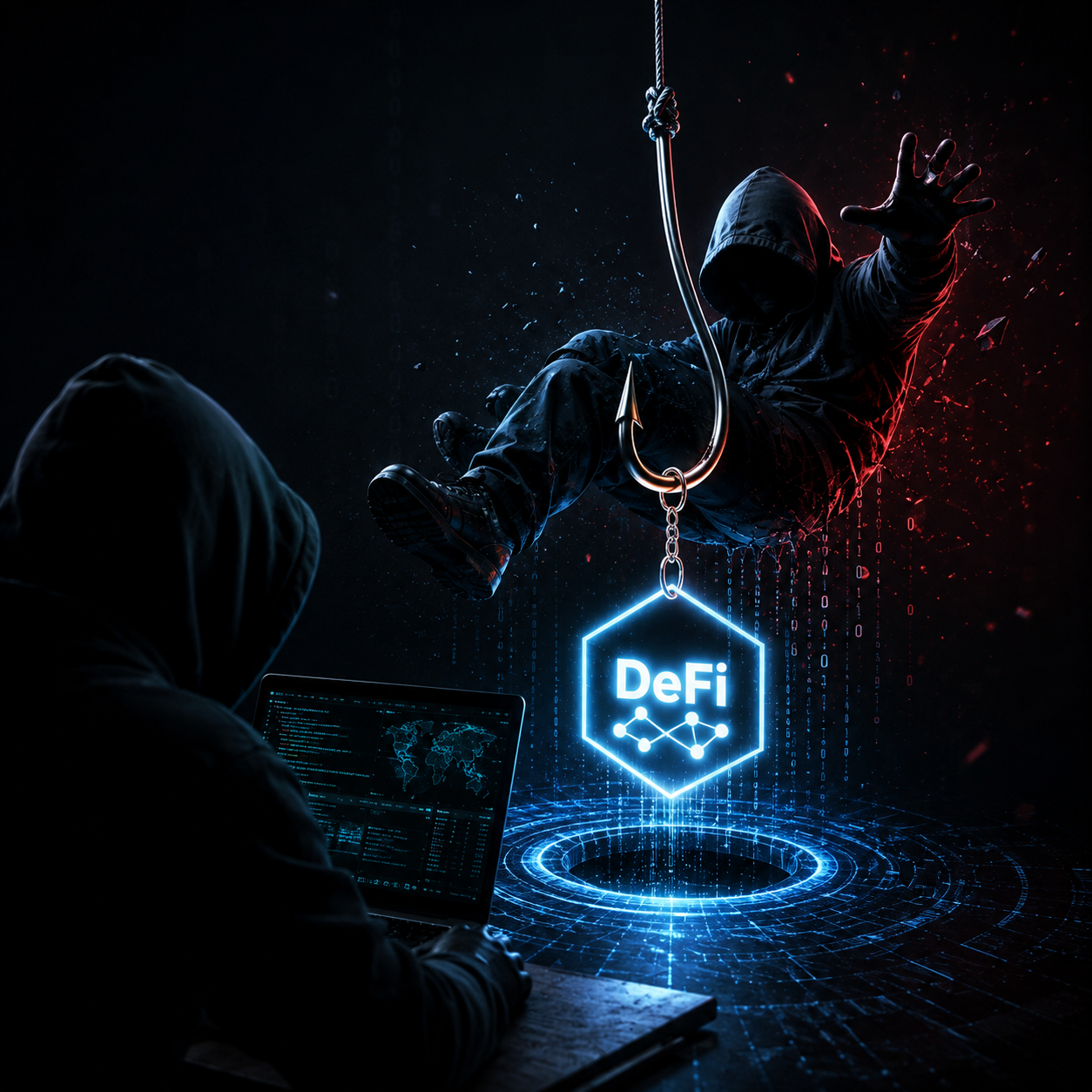
Source: Security Company ANY.RUN Compiled by: Daily Planet Daily Original title: Fishing Show of the Year, Fake DeFi Picks Out North Korea's Lazarus, Real Madrid Fans, Real Madrid Fans. With a mathematical background, they only use AI to write code. Core point of view: By setting up a fake DeFi company, the security agency successfully infiltrated the “Famous Chollima” hacker group under North Korea's Lazarus Group, revealed its complete process of using false identities, AI tools, and remote collaboration to infiltrate Western companies, and revealed its evolving toolset and infrastructure. Key element: The researchers disguised themselves as recruiters and recruited three North Korean agents within a few months to record their operation behavior, tool usage, and collaboration patterns in real time through the ANY.RUN sandbox environment. Agents used forged driver's licenses, stolen social security numbers, and mule accounts to complete the onboarding process. Some of these documents were processed by Google Gemini and had SynthID watermarks, revealing signs of forgery. Attackers rely on AI tools such as ChatGPT and Google Gemini to encode, translate, and modify files, and use AstrillVPN, remote desktop software, and dedicated servers to covertly access corporate environments. The three agents showed insufficient skills during development, frequently searched for basic issues, and exposed more proxy server and infrastructure information induced by selective network outages and captcha. The investigation found that Famous Chollima aims to lurk within the enterprise for a long time and legally obtain access to code, systems, and intellectual property rights, and is not limited to short-term attacks, and the threat persists significantly. Crypto friends who are often phished have probably heard of the North Korean hacker group Lazarus Group. Its well-known “campaigns” include, but are not limited to: Bybit ($1.5 billion) theft, Ronin Network/Axie Infinity Bridge attack ($6.2 billion), DMM Bitcoin/Ginco related attack ($308 million), Harmony Horizon Bridge attack ($100 million), and Atomic Wallet attacks ($100 million), etc. And the key to the success of these attacks is social engineering — hackers usually disguise themselves as normal job applicants, lurk at crypto companies for years, and wait for the right time. Recently, security agency ANY.RUN joined forces with BCA LTD (a company dedicated to threat intelligence and hunting) and NorthScan (a threat intelligence program to uncover the infiltration of North Korean IT workers) to effectively crack down on North Korean hacker agents. The researchers created a fake DeFi startup and successfully recruited “Famous Chollima” agents under North Korea's Lazarus Group who specialize in human infiltration, to gain an inside perspective on the actions of North Korea's IT workers. The ANY.RUN sandbox environment shows the agent's behavior patterns in real time, revealing their evolving toolsets, remote access workflows, AI tool usage, and supporting infrastructure. This survey went beyond the simple recruitment process and showed in depth how these agents collaborated, obtained, and used company resources after joining the company. The findings suggest that the North Korean IT worker program not only poses a recruitment risk; once agents sneak inside the organization, they can legally obtain access to code, systems, intellectual property, and critical business processes. The following is a report co-authored by the three parties, compiled by Daily Planet Daily. ——————Introduction In December of last year, we fully recorded the infiltration cycle of “Famous Chollima” for the first time. From recruiting collaborators to help them join Western companies, to falsifying documents, shipping laptops to intermediaries, and even using AI tools to assist and translate in real time during interviews, everything is under control. In that survey, we pretended to be a middleman willing to interview them and lend them a laptop in exchange for a percentage of their salary. The point is that those laptops are actually ANY.RUN sandbox environments that record every click and every step they take. This provided us with massive metrics, hours of computer operation videos, and face-to-face contact images, making an unprecedented survey and making headlines in many media. (“Famous Chollima...

1d agoOdaily星球日报#wallet security #hacks
From 4 models to more than 500, OpenRouter was acquired after growing 30,000 times in three years

From 4 models to more than 500, OpenRouter was acquired after growing 30,000 times in three years

Author: Menlo Ventures Compiled by: Jia Huan, ChainCatcher Original title: Early Investors Behind OpenRouter Revisited Investments Today, OpenRouter announced that it has reached an acquisition agreement with Stripe. OpenRouter was launched in 2023, just over three years ago. OpenRouter was initially launched as a “unified interface for LLM” and only supported 4 models at the time: GPT-3.5, GPT-4, GPT NeoXt and Cohere xlarge by Together. When the company was founded, it was based on two core judgments: first, AI will eventually be used on a large scale and penetrate various fields; second, there will be many different models on the market, each with trade-offs, and users will choose different models according to different needs. As it turned out, both judgments far exceeded expectations at the time. Since its launch, the number of tokens processed by the OpenRouter platform has increased by about 30,000 times. Currently, it has exceeded 4,500 trillion tokens on an annualized basis, and the scale of expenditure on the platform has reached a very impressive level. Meanwhile, the number of models supported by OpenRouter has grown from the original 4 to over 500. Figure: OpenRouter Token usage growth from inception to acquisition Menlo Ventures is fortunate to be part of this journey. In March 2025, we participated in OpenRouter's seed funding round through the Anthology Fund set up in partnership with Anthropic. OpenRouter founder and CEO Alex Atallah previously founded OpenSea, which was once valued at $13.3 billion. His co-founders include tech guru Louis Vichy, whom he met on Discord, and highly executive COO Chris Clark. In May 2025, we led OpenRouter's Series A funding round, with Matt joining the company's board of directors, and Deedy as a board observer. Earlier this year, after seeing OpenRouter's rapid growth in customer numbers and revenue, and the company built a product route with stronger “model intelligence” capabilities around model selection and evaluation, we continued to step up Series B financing. In the tech industry, it often takes years for an idea to change from the judgment of a few people to industry consensus. And just a few weeks ago, this happened: from Ramp to Cursor, more than 10 companies launched their own model routing products almost simultaneously. In just a few years, OpenRouter has become one of the most important companies in the AI era. Picture: Group photo when deciding to lead OpenRouter Round A At first glance, Stripe doesn't seem like the most natural buyer of OpenRouter, but the two companies are actually strikingly similar. Both use an API that can be directly accessed to simplify the otherwise complicated transaction process and charge a certain percentage of the fee. It's just that OpenRouter deals with AI models. As Stripe has always said, the two companies combined and are still doing the same thing: increasing “internet GDP.” In fact, over a year ago, OpenRouter called itself the “Stripe of LLM.” OpenRouter's core value OpenRouter was one of the first companies Deedy came into contact with after joining Menlo in 2024. This company is almost right at the heart of our AI infrastructure investment logic. Menlo presented two judgments necessary to invest in OpenRouter in the 2024 Enterprise AI Report: AI spending will increase dramatically, and developers will not only use one model, but multiple models at the same time. Figure: Menlo's initial contact email to OpenRouter As someone who can also write code and actually use these models, we realized long ago that there is a very clear difference in cost, latency, and performance between the different models...

2d agoburnking#OpenRouter

Yu Shu Wang Xing: It may take 2 to 10 years for ChatGPT to become intelligent

Comparatively, at the 2026 World Robotics Conference, Wang Xingxing, founder and chairman of Yushu Technology, delivered a keynote speech entitled “From Exhibits to Products: The Next Ten Years of the Humanoid Robot Industry”. He said that in recent years, the company has continued to promote robots into our lives, including implementing applications in automobile factories, deploying simple tests in our own factories, and AI teams promoting robots to work at home, but since overall efficiency and versatility are still not high enough, they have not been promoted on a large scale. Wang Xingxing believes that moving towards an intelligent ChatGPT moment would ideally take 2 to 3 years, or 5 to 10 years longer. Reaching this point means that in 80% of unfamiliar scenes, robots can successfully complete about 80% of tasks through voice or text commands. Currently, the core challenge is aligning the input and output of a large AI model with a real robot.

2d ago
Yao Shunyu reorganizes Tencent's multi-modal route: closer to Liang Wenfeng and away from Li Feifei

Yao Shunyu reorganizes Tencent's multi-modal route: closer to Liang Wenfeng and away from Li Feifei

Text | Miao Zheng Editor | Wang Jing Source | Letter AI Tencent's mixed element multi-modal team has undergone another personnel change. According to media reports, Lin Xudong, who was responsible for xAI's multi-modal understanding, has left xAI and joined Tencent's mixed element as the head of the multi-modal content generation algorithm. The reason this personnel news is worth paying attention to is that it takes place in the context of continuous adjustments of mixed and multi-modal teams. Over the past period of time, news of the departure of the person in charge, the transfer of researchers, and the addition of new members came out one after another within the mixed yuan. Hu Han, the former head of multimodal understanding, left his career to start a business, and Tian Yonglong and others joined Tencent. The reporting relationship between the original multi-modal team also changed with the integration of the big language model department and the multimodal model department. However, does this mean that Tencent's multi-modal team is “changing the dynasty” is currently unable to draw a direct conclusion. What can be confirmed by public information is that mixed forces have indeed experienced personnel movements and organizational restructuring. The rumor of Lin Xudong's addition is more like a new signal in this adjustment: Tencent is recombining the two routes of multimodal understanding and content generation. So the question is, what exactly did Lin Xudong come from, and what abilities can he add to Tencent? And is Tencent's multi-modal approach shifting from “generating content” to Yao Shunyu's more biased “understanding context and acting in the world”? What is Lin Xudong's origin and what can he do after joining Tencent? According to public information, Lin Xudong graduated from Tsinghua University in 2018 and then went to Columbia University to study for his doctorate. While studying at the blog, his research interests included embedded learning, video analysis, and generative models. He also participated in the Vx2Text project in collaboration with Columbia University and Facebook AI. V indicates video, x indicates unknown, can be sound, voice, or even ambient sound. 2 represents TO, and Text represents subtitles. Its logic is to first convert different modes such as video and sound into vectors similar to “language tokens”, then uniformly feed the language model for fusion, and finally generate open text by an autoregressive decoder. Transformer can only understand tokens, so AI essentially doesn't understand video and audio file formats, making it even less likely to convert them into text. For example, if a dog jumps into the water next to a swimming pool, Vx2Text's video recognizer (V) will output keywords: dog, jump, pool; sound reader (x) will output: sound of water, fluttering. Although the product function of Vx2Text is “generation,” the core difficulty of the product is “understanding.” Of course, Vx2Text doesn't simply “translate” a screen into a few sentences. Models need to recognize people, objects, movements, and events from videos, understand how these things change over time, and finally organize visual information into language. After graduating from his PhD, Lin Xudong joined DeepMind and participated in Gemini-related multi-modal pre-training and post-training work. In 2025, he also joined xAI. According to public information, it is responsible for the direction of multimodal understanding and participating in the training of multimodal content understanding and generation models. Now that he has joined Tencent Hybrid, he will be responsible for the hybrid multi-modal content generation algorithm. Lin Xudong was added not so much to improve the performance of mixed-element multi-modal generation, but rather to solve a problem that plagues all multimodals — understanding. The previous generation model was more like a picture maker. Give it a hint, and it can generate an image or a video. But as long as users make more complex requests, the model just can't keep up. For example, the characters change in the long video, the shape of the object is not consistent before and after, the camera movement does not match the spatial relationship, etc. It's not because the model doesn't generate, but because it doesn't remember and understand the world steadily. Therefore, putting Lin Xudong in the position of multi-modal content generation is probably because he “translated” multi-modality into something AI can understand. Lin Xudong's addition can only be clearly seen in a larger context. That is, now Tencent's mixed element is reorganizing its multi-modal route. In January 2025, Tencent Outstanding Scientist (Tencent Distinguished Scientist) Hu Han succeeded Liu Wei, who had previously left his job, and was fully responsible for the research and development of mixed-element multi-modal models, and also served as Tencent's mixed-element big model Tech Lead. Tencent's internal organization was adjusted in the second half of 2025. He transferred from the Multimodal Model Department to the “Frontier” Frontier Technology Research Group under the Big Language Model Department. The title was changed to Head of the Multimodal Understanding Direction, and the reporting line was also changed to report to Yao Shunyu. The actual position changed from “the head of an independent department” to a “big language model...

2d ago字母AI#AI #Li Feifei #Liang Wenfeng #Tencent

Tang Jie, founder of Zhi Spectrum: Big model scaling is not just heap parameters; the core of future competition will shift to post-training and reasoning capabilities

Comparing news, Tang Jie, founder of Smart Spectrum, published a thought article on the big model Scaling Law on the X platform, saying that currently, the artificial intelligence industry's understanding of improving model capabilities is shifting from “expanding the scale of parameters” to multi-dimensional expansion. The number of parameters is not the only indicator for measuring the model's ability; it also requires a comprehensive evaluation based on data scale, computational resource allocation methods, and actual model operation scenarios. Tang Jie pointed out that early research had driven the industry to rapidly expand the scale of model parameters. Kaplan et al.'s research in 2020 suggests that the growth rate of model parameters should be higher than the data growth rate, driving the development of large-scale models such as GPT-3, Gopher, and MT-NLG. However, by analyzing hundreds of models in 2022, Hoffmann and others discovered that the optimal calculation solution is closer to “about 20 training tokens for each parameter,” and that model parameters and data scale should continue to grow at the same time. In the past, the path of pursuing a trillion parameter model was actually a “yaw” experienced by the industry. As model application scenarios change, inference costs have gradually become an important part of life cycle costs, and optimization goals have also shifted from simply reducing training costs to improving long-term operation efficiency. Therefore, the “small model+fuller training” route has begun to receive attention. Tang Jie said that the sparse hybrid expert (MoE) architecture has further changed the scaling logic. In MoE models, the total number of parameters determines how much knowledge the model can store, and activation parameters and effective depth affect the model's ability to complete complex inference tasks. For tasks that require a long chain of reasoning, such as finding bugs, the ability does not come from simply memorizing more information, but rather requires models to maintain the continuity of the multi-step inference process. Recent research shows that there is no uniform answer for the optimal “token/parameter ratio”: memory-oriented tasks require more parameters, while biased reasoning tasks rely more on data and computational depth. At a fixed scale of training data, blindly increasing total parameters may even weaken reasoning ability, while increasing the number of active experts is more helpful in improving model performance. Regarding the latest development of the smart spectrum model, Tang Jie revealed that GLM-5.3 is an experiment in the direction of scaling. This model uses the same basic model, architecture, and total parameters and activation parameter scales as GLM-5.2, but post-training optimization is performed through a month of large-scale long-term environmental training and reinforcement learning (RL). The performance improvement does not come from an increase in parameters, but from an expansion in the post-training phase. He concluded that competition for large models has moved from simply competing for parameter sizes to the stage of exploring “multi-dimensional scaling”. Future model capability improvements will rely more on continuous optimization of training strategies, inference depth, and post-training capabilities.

3d ago

GPT-5.6 deletes user files by mistake, OpenAI adds 5 layers of protection to Codex

Comparative News, AI News, OpenAI Product Owner Tibo has reviewed the Codex file mistakenly deleted issue and announced the fixes that have already been launched. In rare cases, GPT-5.6 will mistake the path when cleaning temporary files. One of the most dangerous situations is to mistakenly treat $HOME as a temporary directory and directly delete all the files in the user's home directory. OpenAI now adds 5 layers of protection: 1. Read the target clearly before deleting. The codex has to check the path to be removed, and stops when the scope isn't clear. 2. Temporary files will only be placed in a new directory. System environment variables such as $HOME are no longer used as temporary directories. 3. Review high-risk delete orders first. The system will identify suspicious deletion commands and submit them for additional review. If the review does not pass, it will not be executed, and the model will be replaced with a safer approach. 4. Tighten Full Access. Full permissions are more difficult to misopen, risk alerts are more clear, and some particularly dangerous permission combinations have been further restricted. 5. Train codecs to make fewer such mistakes. OpenAI made the previous mistakenly deleted question into a playback test, while adding related reinforcement learning tasks and filtering destructive operations in the training data. Tibo said the new measures have significantly reduced such issues, while not significantly affecting Codex's ability to complete programming tasks properly. He still advises regular users to use sandbox mode first, and only enable Full Access in a trusted and recoverable environment.

3d ago

Florida sues OpenAI and Sam Altman, accusing ChatGPT of public nuisance

Comparatively, the US state of Florida has filed a lawsuit against OpenAI and its CEO Sam Altman, alleging that its generative AI products and big language models (LLM) constitute public nuisance (public nuisance) in the legal sense of the word. According to the report, some states in the US are trying to regulate AI companies through a legal framework called public nuisance, comparing generative AI to a digital pollution source that may cause social harm. Allegations suggest that AI chatbots may impact public mental health, provide uncertified advice, and pose public safety risks. The Florida side claims that the rapid development of OpenAI is based on misleading behavior and the use of users, causing Florida residents to be widely affected and disrupted social order. The state asked the court to take restrictive measures while seeking financial compensation. Currently, this case is viewed as an important case for US regulators exploring the boundaries of AI liability. If courts uphold Florida's public nuisance theory, it could push more states to take similar legal paths to litigate AI companies.

3d ago