
Polkadot · 2111

21Shares Polkadot ETF Q2 “Staked Proceeds” Are Costly: Realized a $4.52 Loss for Every $1 Reward Paid

Comparatively, according to Protos, the latest disclosure documents of 21Shares' Polkadot ETF (TDOT) show that when the fund paid staked proceeds through the sale of DOT tokens in the second quarter of 2026, every dollar of revenue generated was accompanied by a realized loss of approximately $4.52. According to regulatory documents, TDOT sold 98,505 DOTs in the second quarter and received approximately $10.75 million in cash to pay pledged proceeds to shareholders. However, due to the sharp drop in DOT's price, these sales confirmed a loss of approximately $48.56 million. According to the data, DOT fell by about 34% in the second quarter of 2026, with a cumulative decline of 76% over the past 12 months up to June 30. Since TDOT shareholders receive dollar-denominated distributions rather than directly receiving DOT pledge rewards, the fund needs to sell DOT to convert cash payments to lock in losses in a low price environment. TDOT paid shareholders a cumulative income of about $0.14,698 per share in the second quarter, but the fund's share price fell from $14.95 to $9.86 during the same period, a decrease of about 34%. The pledge income did not offset the losses caused by falling asset prices.

5d ago

Enterprise blockchain infrastructure Aventus launches Aventus Cloud node sale

On August 12, Aventus, an enterprise blockchain infrastructure provider, announced the official launch of Aventus Cloud node sales. The program aims to expand participation in Aventus network infrastructure by enabling individuals and institutions to run nodes with available computing resources. Established in 2017, Aventus has provided blockchain infrastructure for enterprise applications in the aviation, energy, telecommunications and other industries, and has become a Polkadot parachain. Aventus Cloud went live on the mainnet in April 2026. Nodes can handle verification network activities, and eligible operators can receive network rewards. Currently, Genesis Tranche node licenses cost $1,755, and the network is ultimately planned to have up to 40,000 nodes, and over 2,500 nodes are already active.

10d ago

Moonbeam announced it will shut down on July 31, 2026

Comparing news, cross-chain protocol Wormhole announced that the Moonbeam network will officially shut down on July 31, 2026. Moonbeam will keep the parachain running during the transition period, but the chain will cease operations after July 31. Wormhole notes that after this date, Portal and Wormhole contributors will not be able to assist in recovering any assets deposited on the chain. Wormhole advises users to transfer external assets across the chain through Moonbeam's official channel before the deadline. Earlier, Moonbeam announced a complete exit from the Polkadot ecosystem and the 1:1 migration of GLMR tokens to the Base network.

45d ago

The US SEC approves T. Rowe Price's application for an actively managed crypto ETF to include up to 15 crypto assets

According to US SEC documents, the US Securities and Exchange Commission recently officially approved a rule change application for T. Rowe Price Active Crypto ETF (T. Rowe Price Active Crypto ETF) listed and traded on NYSE Arca. NYSE Arca first submitted a rule change request in November 2025, and was finally approved after two revisions. The ETF invests in seeking long-term capital appreciation and will hold 5 to 15 crypto assets under normal circumstances. As of the date of submission of the application documents, eligible assets identified by the sponsor include Bitcoin (BTC), Ethereum (ETH), Solana (SOL), XRP, Cardano (ADA), Avalanche (AVAX), Litecoin (LTC), Polkadot (DOT), Dogecoin (DOGE), Hedera (HBAR), Bitcoin Cash (BCH), Chainlink (LINK), Stellar (XLM), Shiba Inu (SHIB), and Sui ( SUI). Additionally, the fund can also hold USDC as operating capital to pay expenses and buy assets, but not as an investment object.

69d ago

Kalshi applied to launch 12 altcoin perpetual contracts, covering ETH, SOL, XRP, etc.

According to Decrypt, after the US CFTC approved the Bitcoin perpetual contract on Friday, prediction market Kalshi quickly submitted self-certification applications for 12 mainstream altcoin perpetual contracts, including Ethereum, XRP, Solana, Dogecoin, Stellar, Chainlink, Bitcoin Cash, Litecoin, Sui, Shiba Inu, Polkadot, and Hedera. When approving the Bitcoin perpetual contract, the CFTC said that perpetual contracts for other assets will be reviewed on a case-by-case basis, so Kalshi's applications have yet to be approved.

81d ago

Polkadot OpenGov plans to require validators to self-pledge a minimum of 10,000 DOT

Comparing news, Polkadot posted on X that OpenGov is voting on major changes to the network staking architecture. The 1890 proposal requires validators on Polkadot to lock in at least 10,000 DOTs as self-pledges. The reform is a mandatory prerequisite for the next stage of pledge upgrades. The upgrade includes exemption of nominees from forfeiture and quick unbundling (about 24-48 hours instead of 28 days). The logic is for validators to directly absorb the risk of forfeiture through significant self-collateral exposure, while nominators can continue to earn staking rewards without disclosing the principal amount. If passed, the Polkadot staking will remove the two major barriers to participation, thereby reducing risk and shortening withdrawal time for nominees.

89d ago
From coin trading to engineering: Hong Kong Web3 Carnival announces that the industry has reached an inflection point

From coin trading to engineering: Hong Kong Web3 Carnival announces that the industry has reached an inflection point

Author: Curry, Shenzhen TechFlow Original title: Looking back at this Hong Kong Web3 Carnival, everyone is saying goodbye to the amateur era. All the big speeches are telling us that the early bonus period has passed, and amateur rules are being rewritten. It's been almost a week since the Hong Kong Web3 carnival ended. The hustle and bustle quickly dissipated. A few days after the conference, there was still a funny video on X showing the Bitget CEO's bag being laughed at by a hotel lady, a team of male and female models lining up in front of the exchange booth, grandparents and aunts who came in ten big baras scavenging the surroundings... Until this week, none of this was mentioned. The communication curve of the industry conferences was basically the same. The three-day session covered highlights. After the conference, several soft copies were published a week, and then this incident was over. Source: Various gossip scenes summarized by X netizens, but is this really what we want? But looking back at the serious content of this edition, it's actually a bit different. Wanxiang's Hong Kong Web3 Carnival is an annual trend window for the Chinese-language crypto community. Every year at this time, from the Hong Kong SAR government to the world's largest exchange, from the founder of Ethereum to a veteran of traditional finance, they are willing to fly over to the same venue, which in itself shows that everyone still needs this opportunity to take stock of the current position of the industry. This meeting was never an isolated event. When it was held, compliance, policy, and traditional finance were all in place at the same time. Looking back at some of the key guests who walked on the main stage this year, they spoke from different positions, but put together, they were actually the same picture: the amateur era of the crypto industry is over. The industry has been in a kind of amateur era for over ten years. Living by faith, storytelling, and the next wave of hot spots earns money in the early stages. There's no problem with this kind of lifestyle when the market is good; when it's bad, everyone only has gossip to talk about. At this conference, what a few people on stage said didn't go well with this kind of work, but it's totally worth looking back at. Hong Kong, selling a table First, Hong Kong Financial Secretary Chan Mao-po said quite a bit in his opening speech on April 20, but there is a saying that the crypto industry has been waiting for more than ten years. “Same activity, same supervision.” This means that on-chain assets and off-chain assets are managed according to the same standards as long as they bear the same risk. On the afternoon of April 10, 10 days ago, the Hong Kong Monetary Authority announced the first batch of stablecoin issuer licenses. Thirty-six applications were approved, and the license was granted by HSBC Bank and Anchorage Fintech, which is a joint venture between Standard Chartered, Hong Kong Telecom, and Anzen Group. Both are banknote issuing banks. Ten days later, Chen Maobo walked on the carnival stage. Stand in a position where the cards have already been dealt and signed, and tell the industry how to play next. The four words “equal regulation” are the most important words the crypto industry heard at this carnival, but people don't seem to pay much attention to the gossip. Over the past ten years, the crypto industry has basically heard two types of regulatory voices. One is wait-and-see, and the other is prohibition. This time, Hong Kong gave you the third type. It follows the same set of rules as you. Following the same set of rules means that the crypto industry will be allowed to move indoors starting today. There are banks, insurance, and brokerage firms in the room. Everyone is at the same table. This table has been set up in the traditional financial industry for hundreds of years. In the past, crypto players watched from the outside, but now they are sitting in. The cost, however, is to eat according to the rules on the table. Chen Maobo said an unobtrusive but critical phrase in his speech, “Decentralization and digital intelligence do not mean that accountability will weaken.” The code makes up its own mind; it doesn't matter what's on the chain; this kind of work doesn't work on this table. But sitting at an indoor table is much harder than staying outside. HSBC has been participating in HKMA's tokenization pilot and the CyberHKD+ project since 2022, and it took almost 4 years to obtain a license in April of this year. Thirty-six have applied and 34 have been left out. The other side of “equal regulation” is “equal opportunity.” These two things have always been the same thing in mature financial markets. This is the real signal sent by the Fiesta boss. Over the past ten years, the crypto industry has relied on doing things first and then growing bigger, stepping on the regulatory gap and eating away at poor information and compliance. The early bonus period is characterized by the fact that the rules are not yet in place; who moves first eats meat. This path may not work since stablecoin licensing this time around. The rules come first, and practitioners have to prove in the rules that they can make something. Near the end of the speech, the director of the department did something unexpected. He said to the international guests offstage, “Please stay in Hong Kong for a few more days,” and then listed rugby sevens, Michelin restaurants, untaxed red wine, country parks... I think this can be understood as friendly sales. Incense...

115d agoburnking#WEB3 #Exchanges
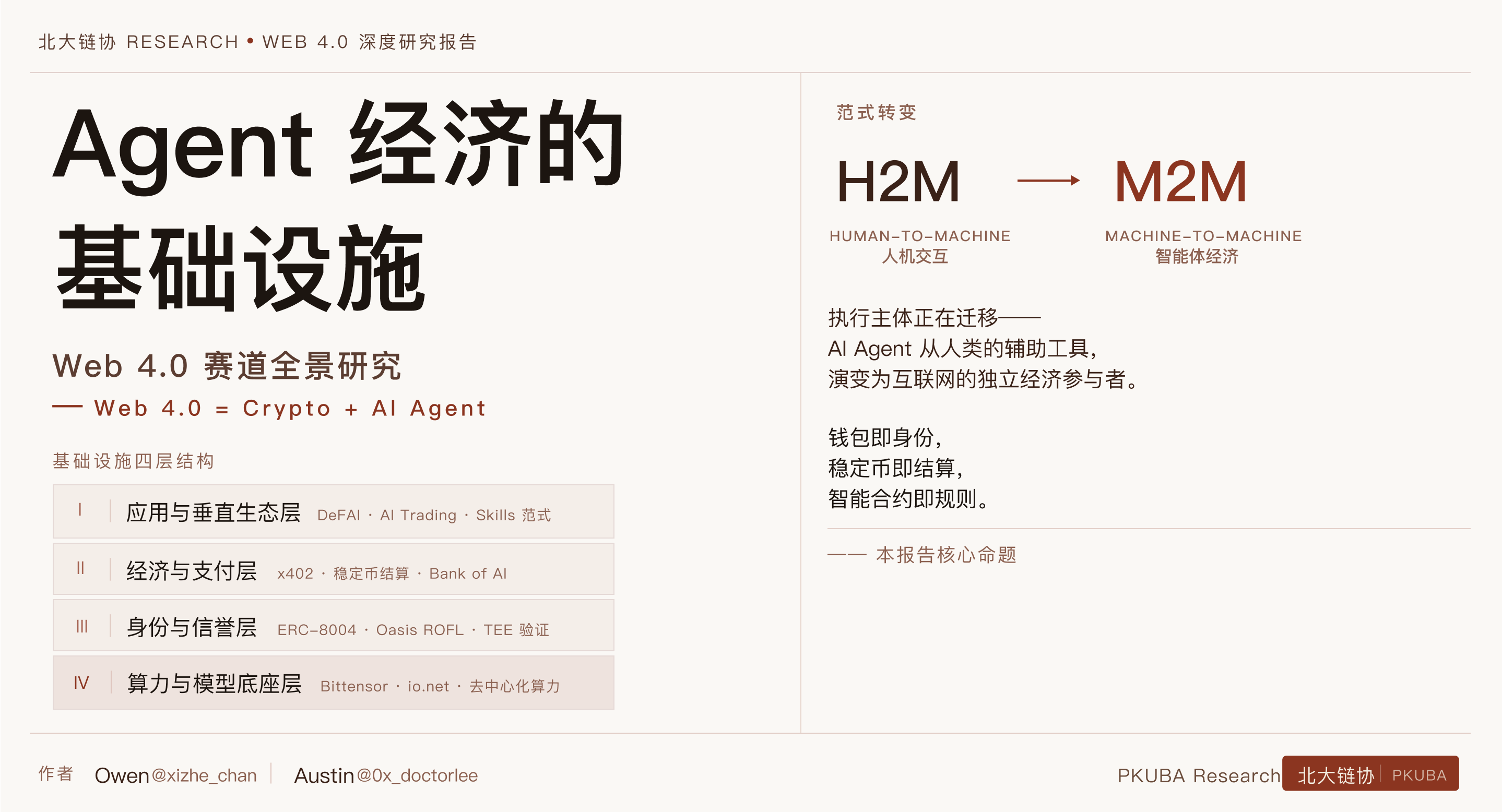
Agent Economic Platform: A Panoramic Teardown of the Web 4.0 Infrastructure Circuit

Agent Economic Platform: A Panoramic Teardown of the Web 4.0 Infrastructure Circuit

Abstract The core proposition of Web 4.0 is the migration of execution agents — AI agents are gradually evolving from human auxiliary tools to independent economic participants on the Internet. The underlying driving force behind this transformation is that the existing financial system is structurally excluded from AI agents. Whether it is account opening, contract signing, or micropayment settlement, traditional financial infrastructure is not compatible with machine-native behavioral logic. The permissionless blockchain network just provides agents with an alternative path to circumvent these restrictions — wallets are identities, stablecoins are settlements, and smart contracts are rules. This report systematically sorts out the context of the evolution of Web 4.0 from narrative to infrastructure. At the protocol layer, gaps in the three layers of the x402 payment standard, ERC-8004 identity standard, and MCP tool calling protocol are being filled centrally to form the minimum operational protocol stack required for an Agent as an independent economic entity. At the track level, the report scanned representative projects at four levels from the bottom up: ●Bittensor and IO.net provide decentralized computing power supply●Oasis ROFL pioneered TEE integration in the ERC-8004 verification layer ●Bank of AI (based on TRON ecosystem) packages x402, 8004 protocols, MCP, Skills, and OpenClaw extensions into a one-stop Agent financial operating system for developers ● Midaz At the application level, the “Built for Agents, Visualized for Humans” Skills product model was demonstrated. From an investment perspective, the Web4.0 circuit is currently in a window period of centralized infrastructure construction: the dispute over standards has yet to be settled, the actual commercial traffic on the chain is still in the early stages of verification, and the overall narrative is ahead of implementation. The first-mover card window for the underlying infrastructure is narrowing, and being able to transform protocol capabilities into a closed commercial vertical application layer will be the most noteworthy opportunity in the next phase. Keywords: Web 4.0, AI Agent, Smart Economy, Decentralized Infrastructure 1. Introduction: Why is Web 4.0 suddenly everywhere In the past year, the frequency of Web4.0 appearing in cryptographic research reports and AI industry gatherings has increased dramatically. Along with the “lobster fever” triggered by OpenClaw, the wave of AI agents has taken the world by storm, and more and more people are beginning to realize that the underlying logic of this wave of technology is very different from previous AI crazes. There is currently no strict definition of Web 4.0, but the core proposition has gradually become clear - Web 4.0 = Web 3.0 + Agent, that is, combining blockchain infrastructure with AI agents to gradually become new active actors on the Internet, fundamentally changing the network's participant structure. The capital side's response to this judgment has arrived. Dragonfly completed a $650 million new fund raising in February 2026, and partner Haseeb publicly stated: “Crypto was not designed for humans, but for AI agents. “At the same time, the critical puzzle of the infrastructure layer was also in place during the same period: in May 2025, Coinbase launched the x402 payment protocol, which first provided a standardized channel for machine-native settlement between agents; in August 2025, the Ethereum Foundation and others took the lead in proposing the ERC-8004 identity standard, which provided a verifiable foundation of trust for cross-organizational agent collaboration. Narrative, capital, and infrastructure, the three forces resonate within the same time window — this is a sign that Web 4.0 is moving from concept to racetrack. This report will systematically sort out the core logic, infrastructure gaps and racetrack pattern of Web 4.0, focus on analyzing representative projects at the four levels of computing power, identity, payment, and application, and use Bank of AI as an implementation case to discuss the complete closed-loop path of the Agent economy from agreement to product, and provide a reference framework for investigating investment opportunities on this racetrack. 2. What is Web 4.0: The core is the smart economy 2.1 From Web1.0 to Web3.0: The executor is always a human looking back at the three stages of development of the Internet, every transition...

123d agoLuxurytracy